
Peugeot 107 P0420: An Exhaust Leak Can Change What the Rear Sensor Sees

Quick answer: P0420 does not by itself authorize a catalyst. Check whether the oxygen measurement is being altered by an exhaust leak before the rear sensor.
Exhaust testing requires ventilation and safe access to cooled components. Do not block the tailpipe, run the engine in an enclosed space or use improvised mixture-changing methods.
A permitted low-pressure smoke test helps reveal an unintended path. The external-air AUTOOL SDT103 can serve where its pressure and medium meet the vehicle procedure; producing smoke does not itself establish catalyst efficiency.

In this guide
Start with what the code actually measures
An efficiency fault is the result of a monitoring assessment, not a photograph of a failed catalyst. The information used by that assessment must be trustworthy. Before approving an expensive component, the technician needs to consider whether the relevant sensor information and exhaust conditions represent the system as intended.
This does not mean the catalyst should never be replaced. It means the replacement should follow evidence that supports it. Ask what checks established the integrity of the measurement environment and what findings remain after those checks. The useful distinction is between investigating a monitoring result and treating its component name as an automatic purchase instruction.
The location of a leak changes its meaning
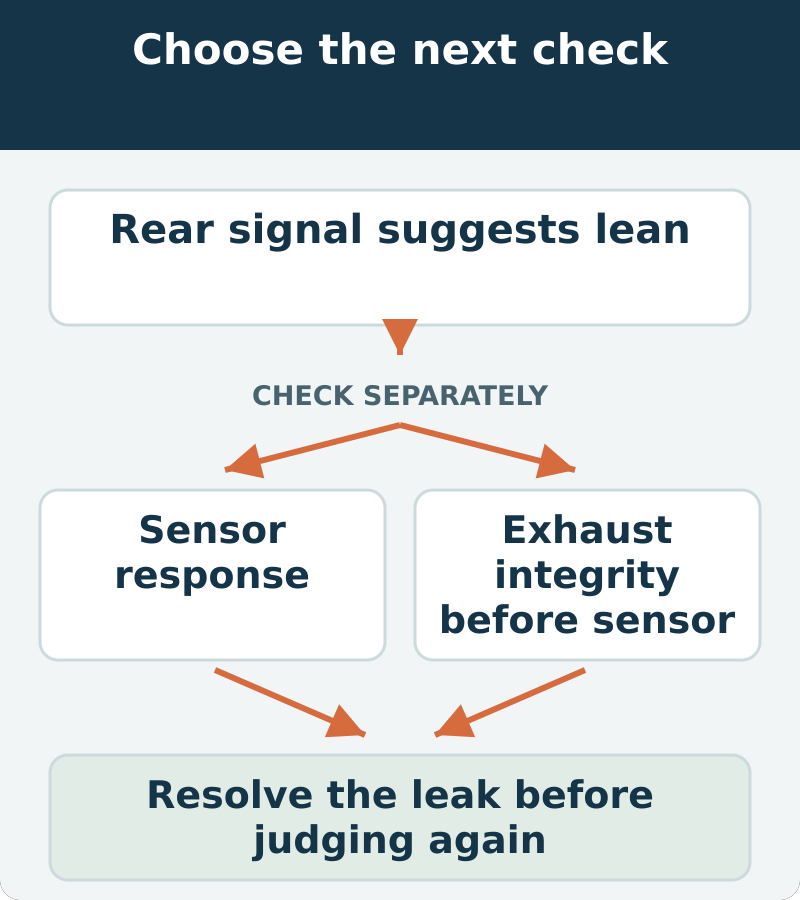
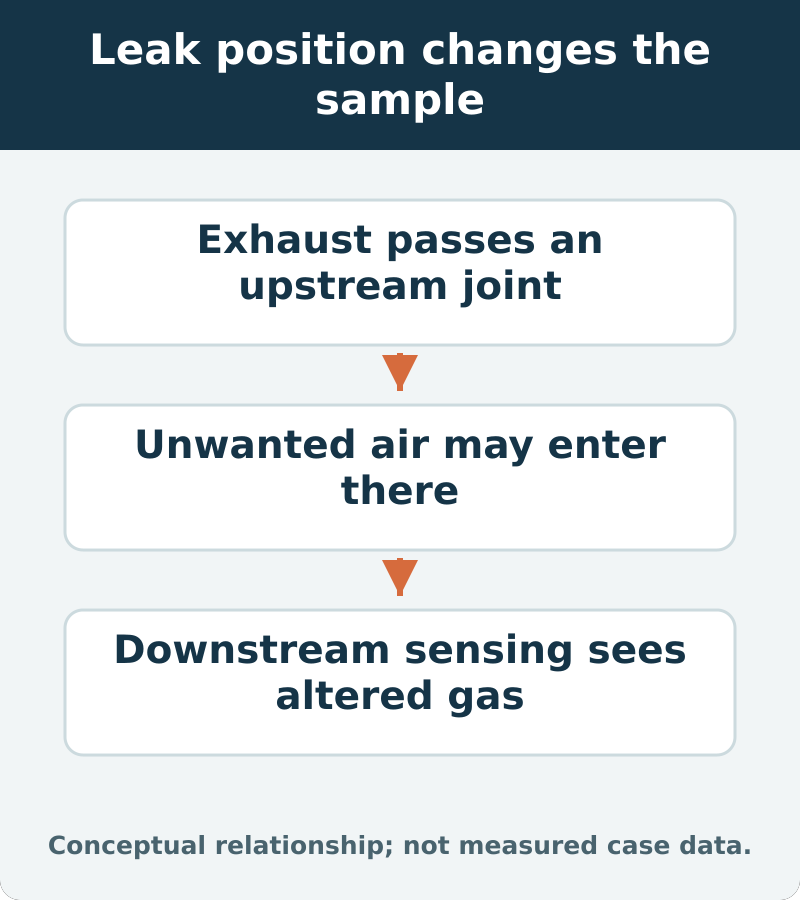
Delphi’s reported Peugeot 107 case involved a persistently lean rear-sensor indication while the front signal appeared plausible. The rear sensor responded to a mixture change. A smoke check found a flange leak upstream of it; correcting the joint restored sealing and reported sensor behavior. The account gives no model year, engine identification or detailed final monitor record.
Location matters because a leak can alter the environment observed by one sensor without affecting every observation in the same way. The technician should identify the defect relative to the sensing points, not simply report that the exhaust has a leak somewhere. A conceptual drawing can explain that relationship without claiming the exact layout of every 107 version.
A sensor response narrows the possibilities
Demonstrating that a sensor responds under an appropriate controlled assessment provides information about its ability to report a change. It does not independently establish perfect accuracy in every condition or certify the component being monitored. The result should narrow the investigation, not become a blanket declaration that the entire emissions system is healthy.
For the owner, ask what the response test established and what it left unresolved. There is no need to reproduce the stimulus yourself. The permitted method, expected behavior and safety controls depend on the vehicle. A trace or reading becomes persuasive only when the technician can connect it to the relevant question and operating conditions.
Use a permitted leak test, not a blocked tailpipe
An exhaust leak assessment must use a method compatible with the system and its condition. The permitted pressure, medium, connection and observation access all matter. A generic instruction to obstruct the tailpipe is not an appropriate substitute for a controlled procedure, especially around hot components and hazardous exhaust gases.
Ask the workshop which section was assessed and how the identified escape was distinguished from the test setup itself. A negative result covers only the region and conditions actually tested. If access is limited or the relevant joint cannot be observed, that limitation should remain visible in the diagnosis rather than being translated into a claim that every possible leak has been excluded.
Fix the joint before judging the catalyst again
Where a supported exhaust defect affects the measurement environment, restoring that environment creates a better basis for reassessment. The repair needs the correct joint condition, alignment and specified assembly method. A temporary seal that changes a reading is not necessarily a durable repair suitable for ordinary operation.
The estimate should explain what is damaged and why the proposed scope is required. Do not assume every flange can be corrected in exactly the way described in another car’s story. Once the supported defect is repaired, the remaining sensor and monitoring behavior can be assessed without that known disturbance. If a fault remains, continue diagnosis rather than claiming the first repair guaranteed a catalyst pass.
Check the monitor result rather than assuming readiness
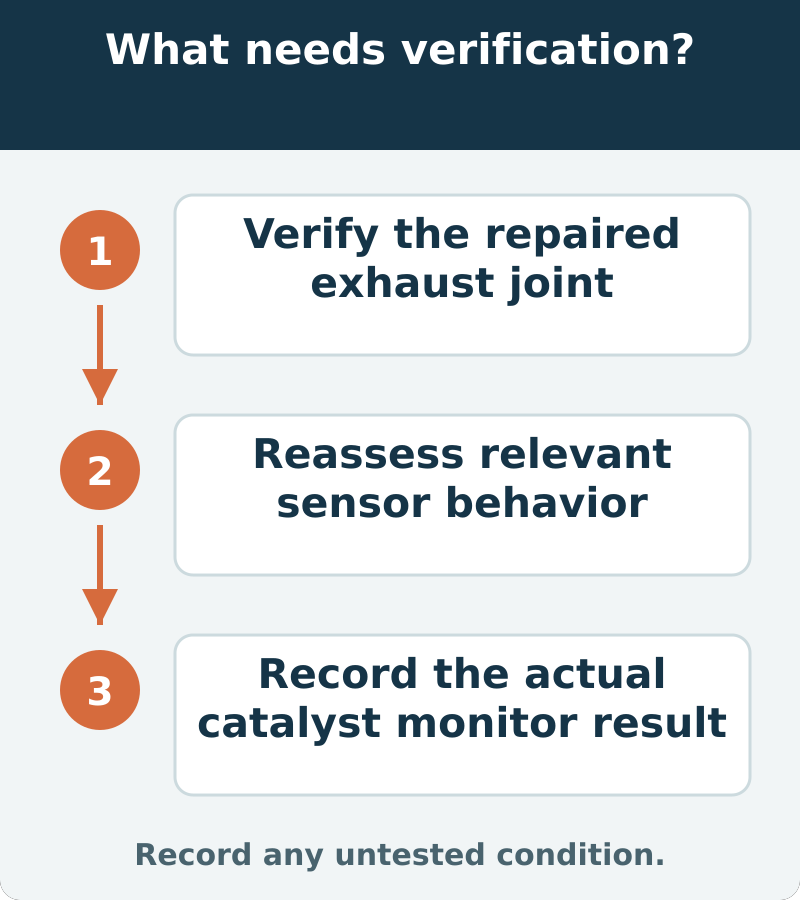
A warmed engine and an extinguished lamp do not, by themselves, prove that every relevant monitor has completed successfully. Ask for the actual fault and readiness information available after the repair and whether the applicable evaluation remains pending. Memory clearing and a completed reassessment must be recorded as different events.
If further evaluation is needed, follow the vehicle-specific safe plan rather than an improvised drive sequence. Keep the original findings and completed joint repair in the record. The practical answer is to restore a trustworthy exhaust measurement before judging an expensive component—and to finish with the monitor result actually obtained, not the one everyone hoped a successful leak repair would produce.










Comments 0
Questions, fixes, and real-world diagnostic notes from readers.
Be the first to share a diagnostic result or ask a follow-up question.