
2003 Ford F-250: Pressing the Brake Dimmed the Dash, but the Fault Was Behind the Cab

Quick answer: When one switch changes unrelated lights, record the whole combination. An added lamp assembly can join circuits that the factory diagram keeps separate.
An electrical fault that changes with two controls can be easier to investigate than one described only as “random.” Write down the combination. If brake lamps or added wiring are unsafe, keep the truck out of service rather than removing a fuse as a workaround.
Once the affected branch is identified, a circuit tester such as the MRCARTOOL B550 can support passive voltage checks at known points. Do not inject power into an unidentified circuit to see which light responds.
On a modified truck, the factory wiring diagram is a starting map. It may not show what someone connected behind the cab.

In this guide
- Write down the odd combination before changing it
- Why working brake lamps did not clear the circuit
- What one disconnected branch can tell the technician
- Factory wiring is only half the map on a modified truck
- Backfeed is an explanation to prove, not a diagnosis by name
- Test every light function before handing back the keys
Write down the odd combination before changing it
ALLDATA’s 2003 F-250 case involved dash lamps dimming when the brake was pressed with the doors closed; with a door open, braking triggered a chime. The brake lamps appeared to work. Isolation through a rear-lamp feed and then the added cab-guard lamps identified one faulty assembly. Replacing it resolved the symptoms.
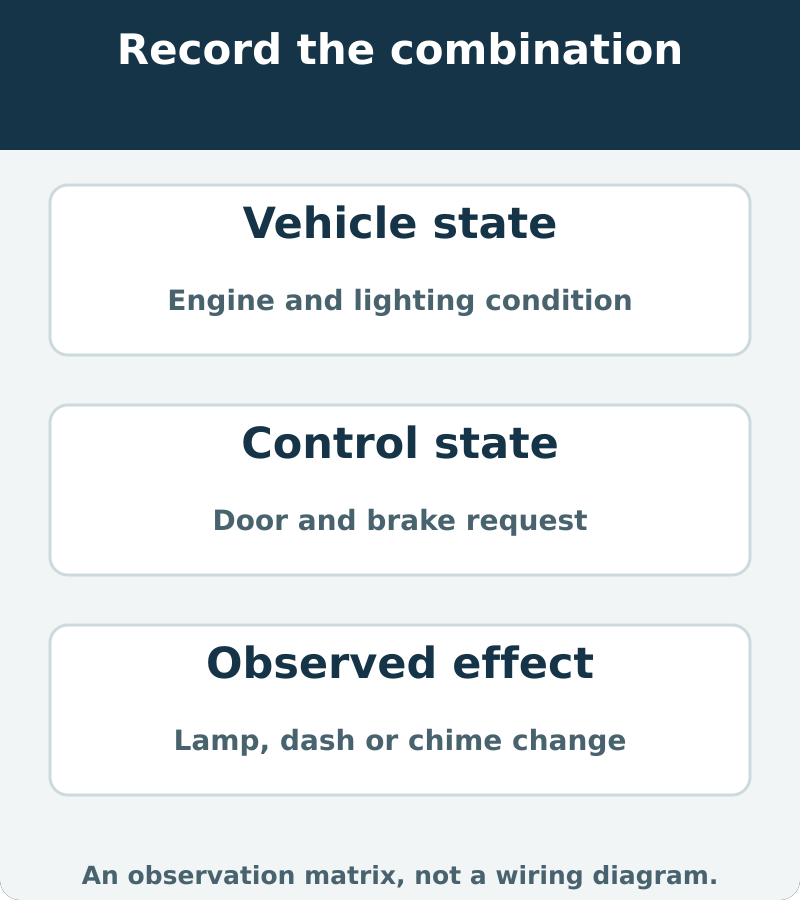
Here is a useful way to organize your own observation, without assuming your truck will show the same pattern:
| Record this state | Record what changed |
|---|---|
| Engine and lighting state | Which systems were operating before braking |
| Door position | Whether opening or closing a door changes the symptom |
| Brake request | Which lamps, warning or chime responds |
| Added equipment state | Whether an accessory was switched on or recently altered |
Leave unknown entries blank. Do not manufacture a complete-looking table from memory. The value is the comparison, not the number of boxes filled.
Why working brake lamps did not clear the circuit
One visible function can operate while another interaction remains wrong. Seeing a lamp illuminate does not verify every connection, ground and relationship within an altered installation.
That is why the workshop should evaluate the unexpected interaction rather than stop at the most obvious output. Which action causes the change? Which electrical path could connect the affected functions? What test would distinguish that path from a separate instrument-panel fault?
The owner’s description is especially useful here. A technician who only checks the lamps with a different combination of controls may not see what you reported.
What one disconnected branch can tell the technician
An isolation test changes a defined part of the system and observes the effect. If the symptom disappears, that can localize the investigation. It does not necessarily identify a single defective component on a branch containing several loads.
The next step should narrow the affected path while preserving the test conditions. Record what was disconnected and what behavior changed. The same symptom disappearing after a broad intervention is weaker localization than it disappearing after a carefully defined one.
Fuse numbers and wiring routes must come from the actual truck’s information. Do not copy a number from a historical case or drive with a brake-light supply removed. An isolation state is a test condition, not an acceptable operating configuration.
Factory wiring is only half the map on a modified truck
Bring information about cab guards, trailers, auxiliary lamps and previous electrical work. Even an accessory that has been present for years deserves inclusion if it is connected to the affected path.
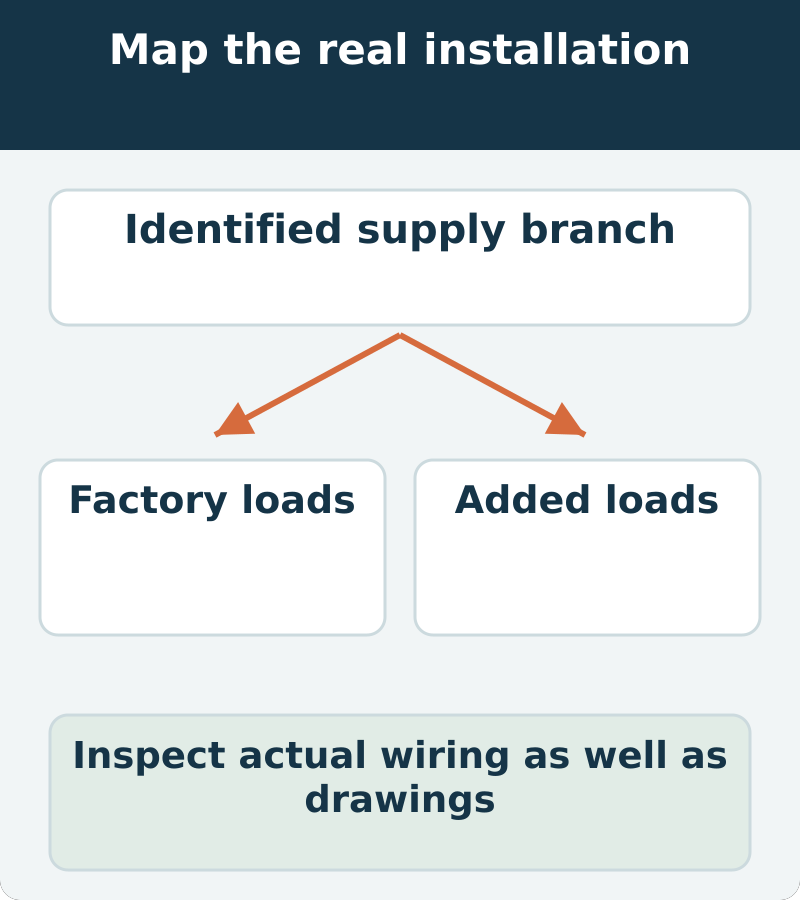
Ask the technician to inspect the actual installation rather than assume the factory drawing describes it completely. Splices, connections and accessory assemblies should be assessed according to what is found, not condemned merely for being aftermarket.
If damaged wiring is present, the repair needs to address its condition and the relevant installation requirements. Hiding a troublesome branch or disabling a safety-related function does not resolve the original problem.
Backfeed is an explanation to prove, not a diagnosis by name
Backfeed describes an unintended electrical route influencing another part of the circuit. It can make a plausible explanation for linked symptoms, but the label alone does not establish where that route exists.
The historical account proposes an internal lamp mechanism; it does not document a teardown proving every detail of it. Keep that distinction when discussing your own repair. The localized failed assembly and a hypothesis about its internal failure are different levels of evidence.
A sound workshop explanation can state what was observed, what isolation established and what remains inferred. It does not need a more dramatic story about the inside of a part than the inspection supports.
Test every light function before handing back the keys
Ask for a final functional check that includes the original control combinations and the required lighting functions. Confirm that all test disconnections have been restored and that the installation is safe for use.
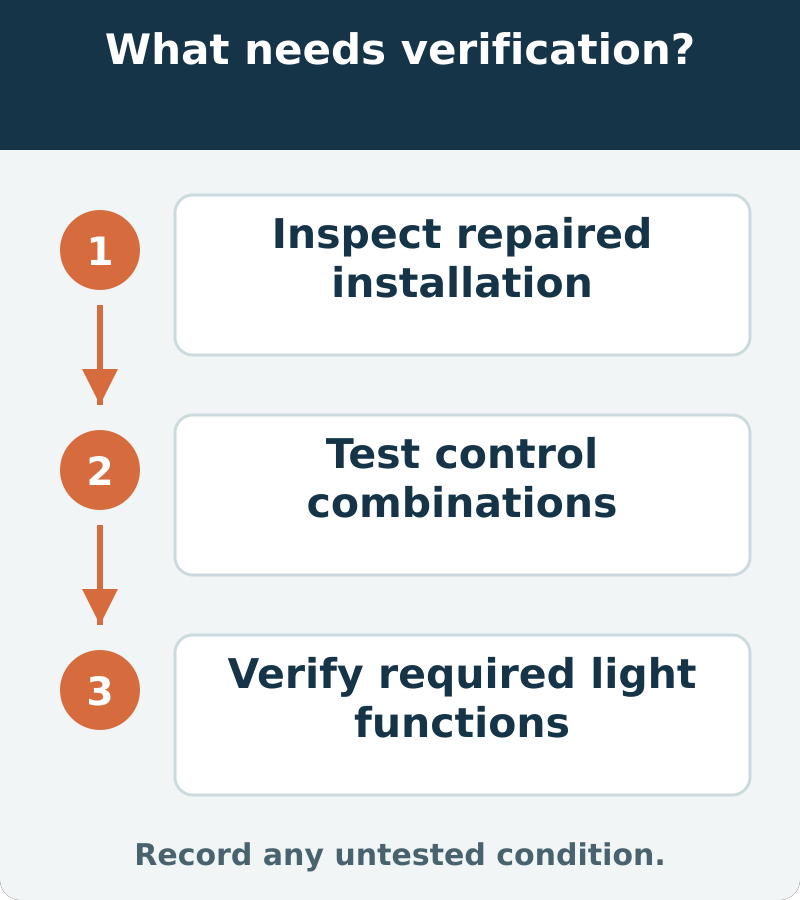
The result should be more complete than “the dash no longer dims.” The driver also needs correctly functioning brake lamps and any other affected equipment. If an accessory has been left disconnected by agreement, document that condition rather than letting it disappear from the handover conversation.









Comments 0
Questions, fixes, and real-world diagnostic notes from readers.
Be the first to share a diagnostic result or ask a follow-up question.