
2017 Hyundai Santa Fe: P0087 Is Still Permanent, but Is the Fuel Fault Still Active?

Quick answer: An unerasable permanent code is not the same as a returning active fault. This Santa Fe needed both a fuel-pressure repair and a completed self-check before P0087 disappeared.
The engine runs properly after a repair, but the scan tool still shows a code that will not erase. Before buying another fuel-system component, look at the code’s status. A permanent entry and an active failure are not interchangeable descriptions of the car’s present condition.
If fresh pressure evidence is needed, a compatible supply-side tester such as the AUTOOL PT635 can support a low-pressure check with the correct adapter and range. It must not be connected to the direct-injection high-pressure rail, and it cannot command the ECU to erase a permanent code.
This article discusses the 2017 2.4L AWD Santa Fe identified in the source case. If yours runs poorly, loses power or has a flashing malfunction indicator lamp, stop the proposed verification drive and have the fault assessed. “Permanent” does not mean it is safe to ignore a returning symptom.
In this guide
- There are two questions, not one
- What the Santa Fe case actually resolved
- Active, pending, permanent and readiness are different
- Use pressure evidence to decide whether diagnosis stays open
- Why another erase command is not the next repair
- Plan useful driving instead of counting trips
- Know when to stop and return to the shop
- Finish with a status report, not a promise
There are two questions, not one
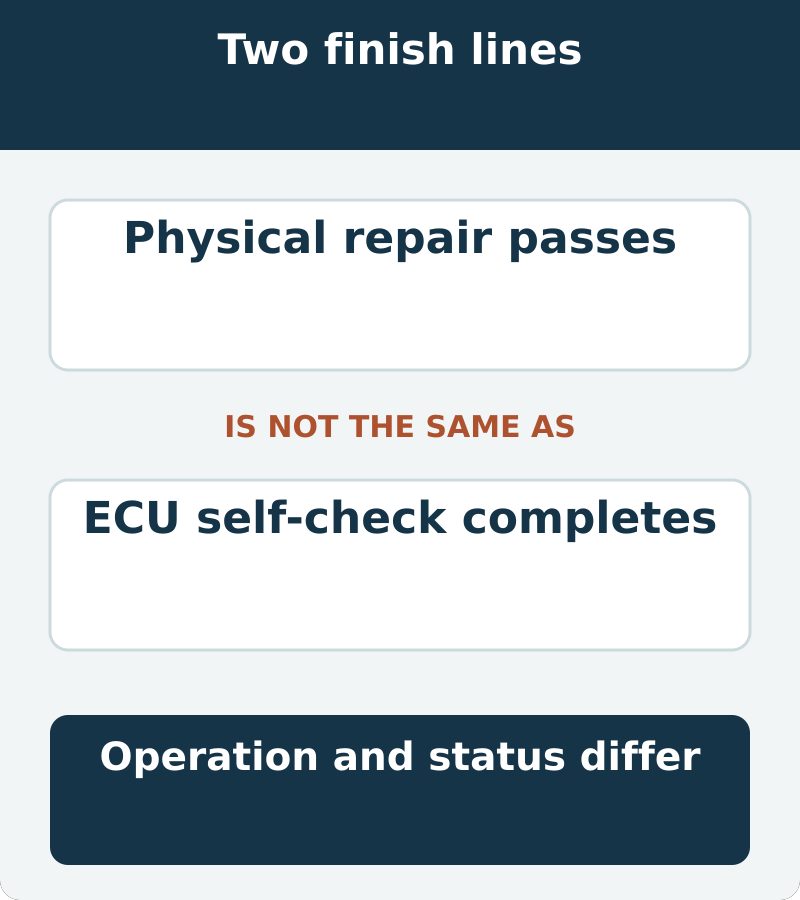
First: has the physical fault been corrected? Second: has the vehicle’s diagnostic system completed the self-check needed to recognize that correction? The answers can be different at the same moment.
A useful repair record therefore includes operating behavior, current fault status and monitoring status. It should not reduce all three to a green or red symbol on an inexpensive reader. Ask what the reader actually supports and what each displayed label means.
What the Santa Fe case actually resolved
In ALLDATA’s case, P0087 and P0191 accompanied high-side pressure loss as engine speed increased, while low-side supply passed testing. High-pressure pump replacement restored operation. A permanent P0087 remained until further fuel-system monitoring and a subsequent key cycle cleared it.
That sequence demonstrates two finish lines. It does not establish a universal number of trips, miles or warm-up cycles for every Hyundai with P0087.
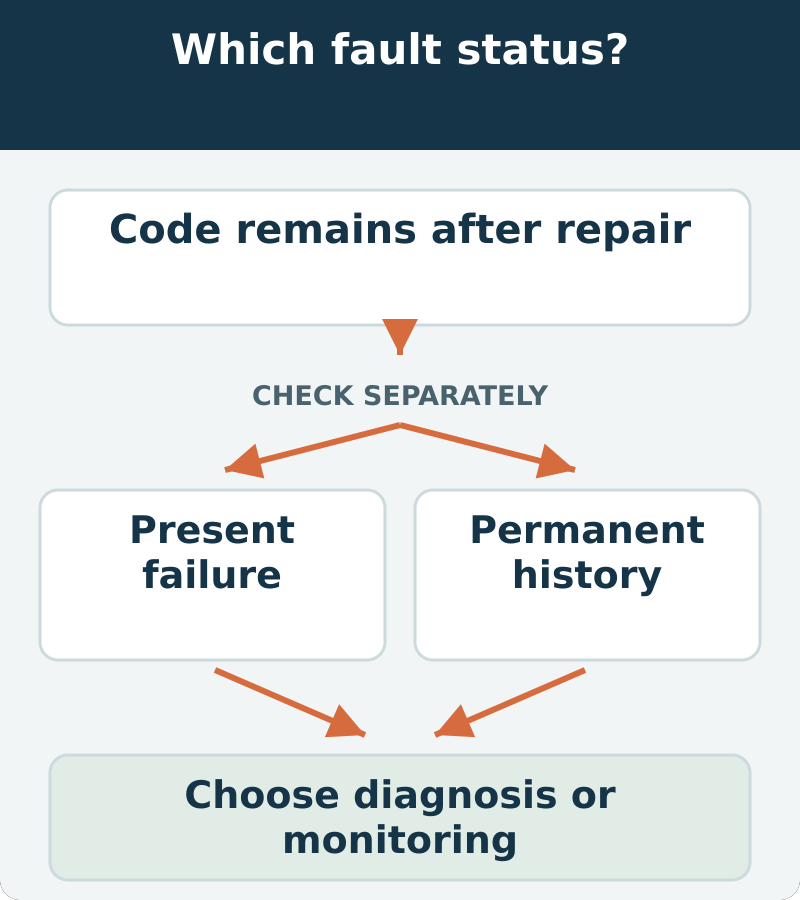
Active, pending, permanent and readiness are different
Scan-tool wording varies, so have the technician identify the actual status rather than infer it from the code number alone. A pending entry, an entry associated with a present fault and a permanent entry need different interpretation. Readiness describes self-test completion; it is not simply another name for an empty code list.
California BAR explains that a permanent DTC cannot be removed by an ordinary erase command or battery disconnection: the OBD system must verify that the earlier defect is absent. Inspection standards are a separate issue, with their own vehicle-specific exceptions. See the BAR OBD test reference for that jurisdiction’s rules; do not assume those rules apply everywhere.
Use pressure evidence to decide whether diagnosis stays open
If the complaint returns, capture the new event and assess it as current evidence. Do not dismiss a new pressure deviation because the same code also exists in permanent memory. Equally, do not reopen a successful mechanical repair solely because a historical permanent entry remains.
Ask which side of the fuel system was measured, under what condition and against which specification. Electrical commands, scan pressure values and an independent supply measurement each answer a different question. None should be described as a complete fuel-system test without explaining its scope.
Why another erase command is not the next repair
Repeatedly clearing information can remove useful context without completing the self-check you need. Before another clear, ask the shop what it expects that action to accomplish. “To see whether it goes away” is not the same as a defined diagnostic step.
Do not disconnect the battery as a permanent-code remedy. Preserve the repair date, current scan report and the vehicle’s operation since the repair. Those records help distinguish lack of verification opportunity from an actual returning failure.
Plan useful driving instead of counting trips
The applicable monitoring procedure may depend on operating conditions, not merely distance. Have the shop identify the relevant enable conditions and decide whether they can be met safely in normal driving or require a controlled test arrangement.
Do not imitate an online speed-and-time recipe in traffic. A driver should not watch live scan data while driving. A professional can arrange safe logging and later review, or choose another appropriate setting. Completion should be checked on the vehicle, not inferred because an arbitrary distance has passed.
Know when to stop and return to the shop
New hesitation, stalling, a fuel smell or a warning that changes behavior is reason to reassess the plan. Do not continue a “drive cycle” through a worsening mechanical complaint.
If operation remains normal but the expected self-check still does not complete, ask what condition is preventing it. The next step may be a service-information review or additional diagnosis; another pump should need fresh evidence.
Finish with a status report, not a promise
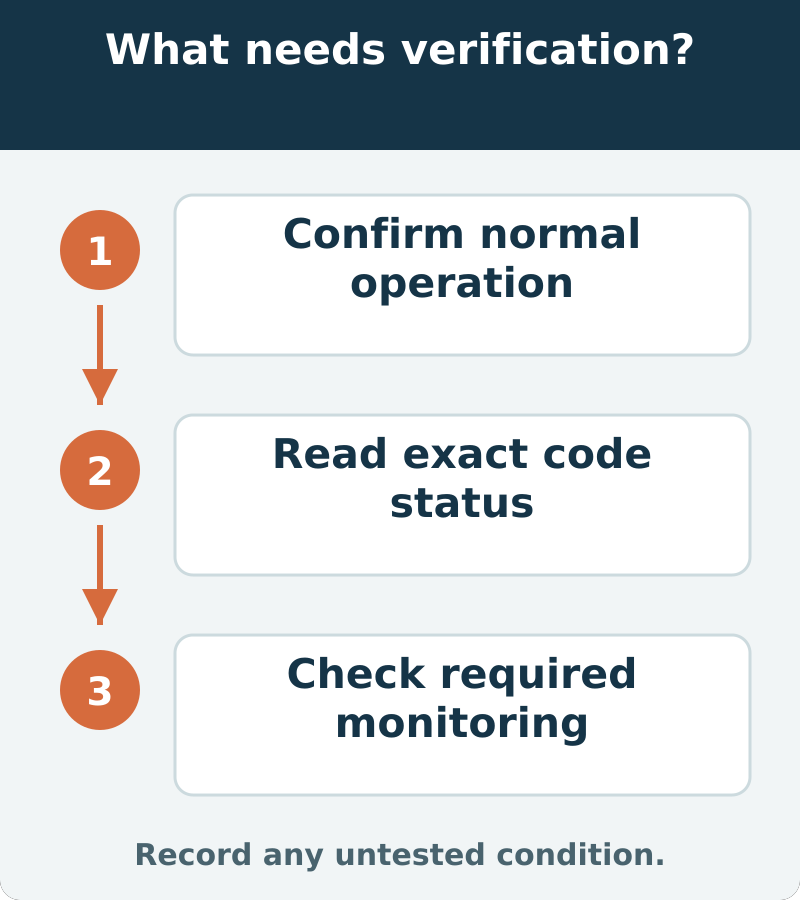
Request the final scan report and a plain-language explanation of anything still pending. Then confirm inspection eligibility with the relevant local program or station. “The repair passed its operating test” is a useful statement; “it will pass any inspection after three drives” is not.







Comments 0
Questions, fixes, and real-world diagnostic notes from readers.
Be the first to share a diagnostic result or ask a follow-up question.