
2014 Subaru Outback Died and Would Not Restart: Fuse 17 Pointed to the Main Relay

Fuse 17 Blows? Follow The Protected Circuit
The Outback died on the highway and then cranked without starting. Fuse 17 was open, and a replacement opened immediately. That second fuse was not bad luck; it was the circuit protecting itself. Because the TCM still communicated while the PCM did not, the protected power path and its main relay became more useful than the broad U0100 description.
One useful machine class at this stage is a bounded measurement tool, chosen only after the circuit or system question is defined. The AUTOOL DM301 is one route for that supporting task. DM301 can support voltage, resistance and bounded waveform checks on identified low-voltage circuits. It cannot safely inject power into a PCM path, replace a current-limited short finder or identify terminals without Subaru information.
This article follows one documented vehicle. Its cause is a useful diagnostic pattern, not a failure-rate claim and not permission to replace the same part on a similar symptom. The goal is to show which evidence changed the decision and how the repair was verified.
Quick answer: The fuse defined the protected path. Wire isolation and abnormal relay behavior narrowed the case; replacing the main relay and correct fuse restored PCM communication and starting.
In this guide
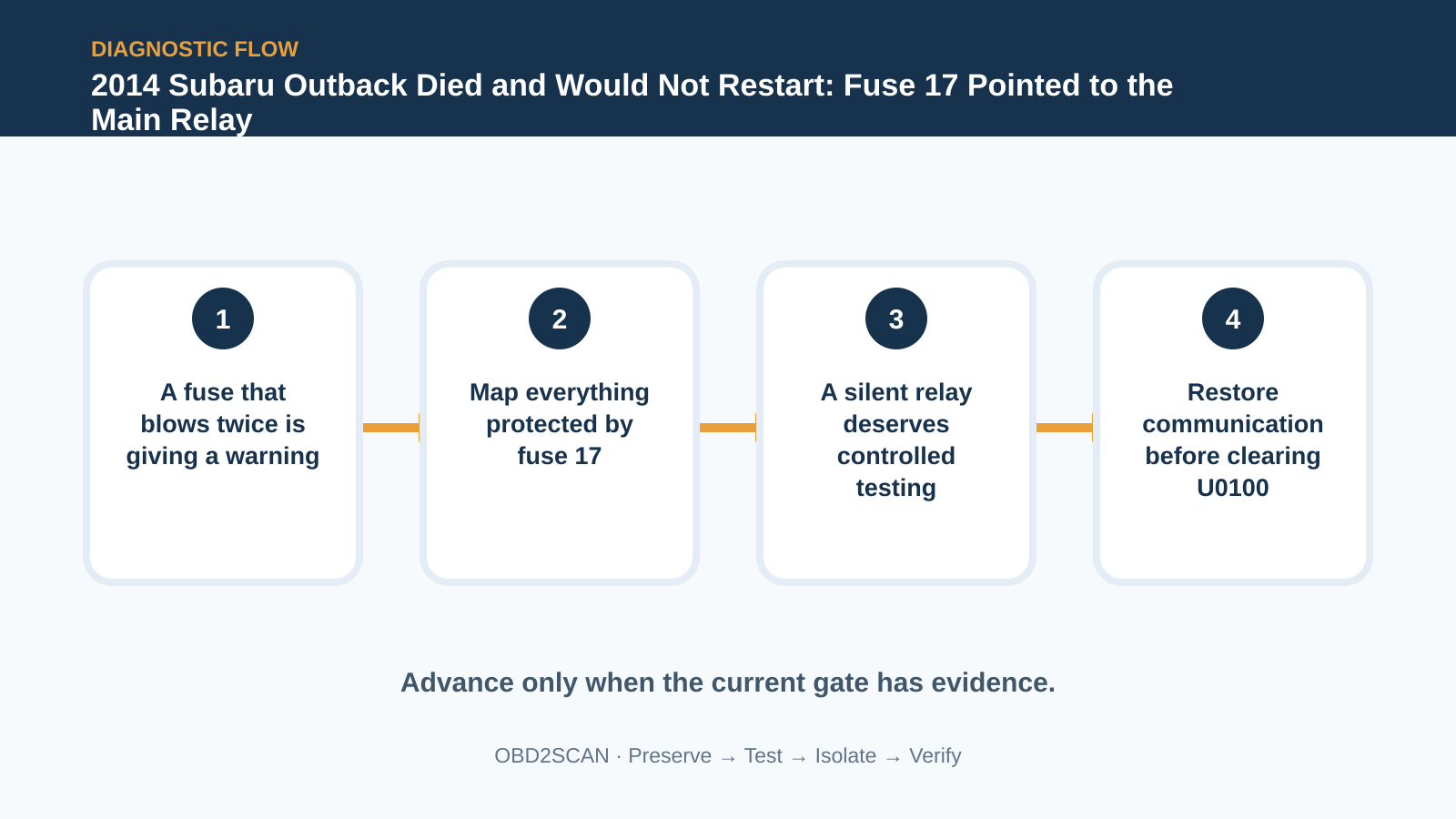
- A fuse that blows twice is giving a warning
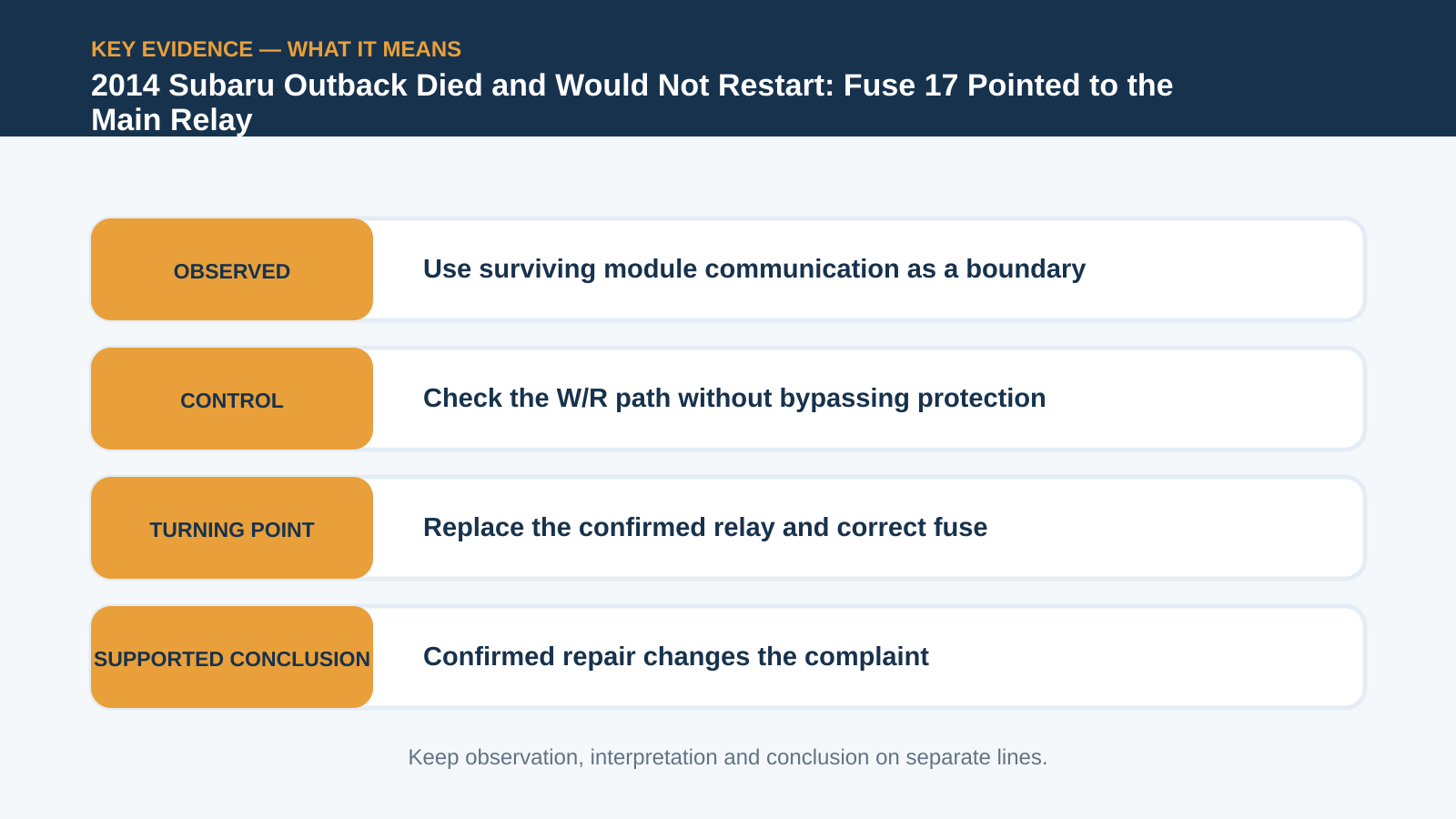
- Use surviving module communication as a boundary
- Map everything protected by fuse 17
- Check the W/R path without bypassing protection
- A silent relay deserves controlled testing
- Replace the confirmed relay and correct fuse
- Restore communication before clearing U0100
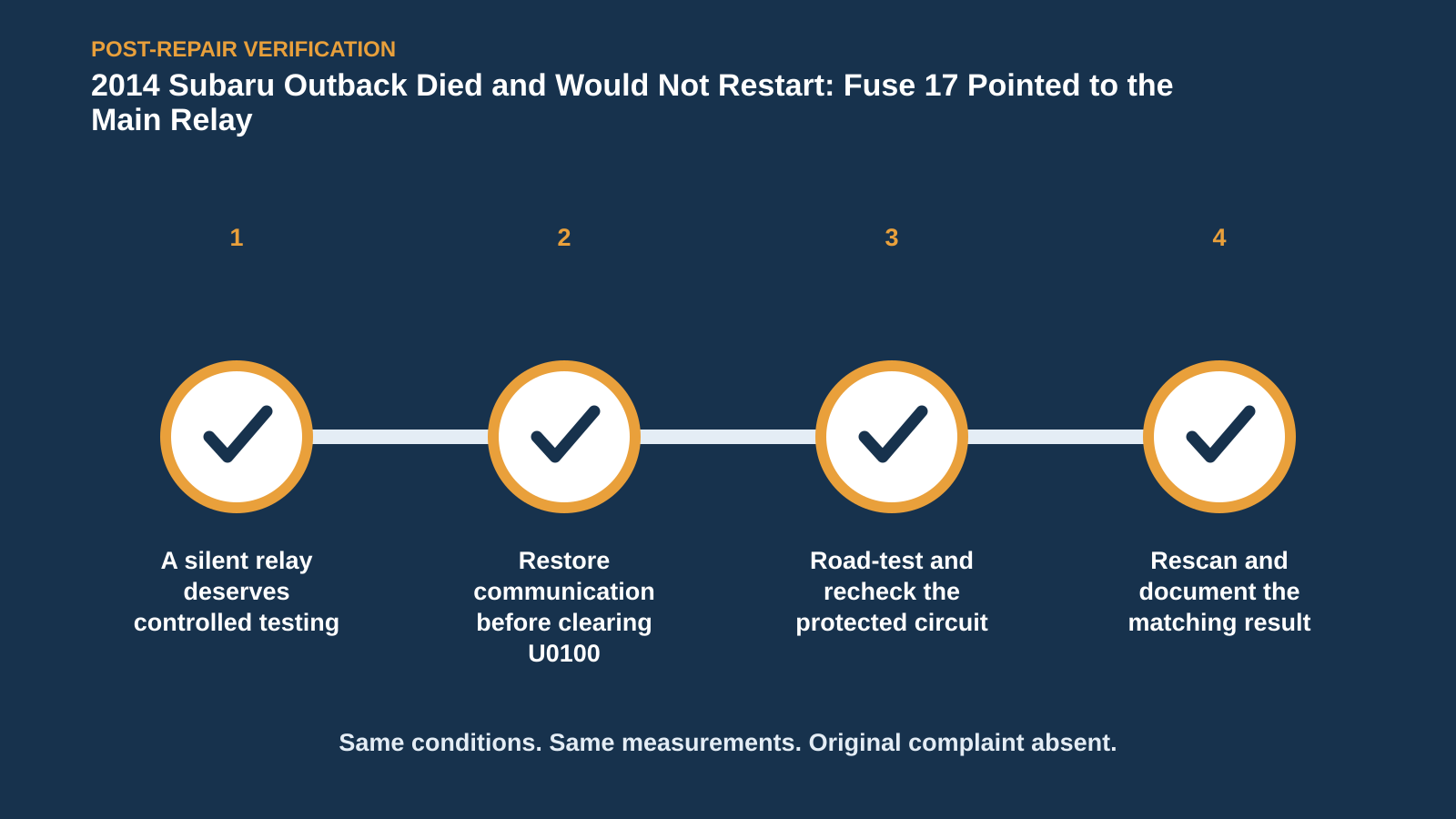
- Road-test and recheck the protected circuit
A fuse that blows twice is giving a warning
A fuse protects wiring from heat and fire. Replace it only with the specified rating for controlled diagnosis, and stop after it opens again; foil, jumpers and oversized fuses convert evidence into damage. Keep the vehicle in the failed state long enough to capture evidence, but never extend a test beyond the point where a stall, brake event, refrigerant release or moving component creates risk.
Use surviving module communication as a boundary
The TCM responded and stored U0100 while the PCM did not communicate. That asymmetric network result suggests the scan connector and at least part of the vehicle network still functioned. Write down the conditions before disconnecting anything. That record is what lets a later change mean something instead of becoming another uncontrolled attempt.
Map everything protected by fuse 17
Use the exact diagram to list every load and splice downstream of engine-compartment fuse 17. Separate branches with power off and keep a current-limited method in place before energizing again. Use service information for the exact engine, build and option set. A correct test on the wrong pin or configuration can produce a precise but useless answer.
Check the W/R path without bypassing protection
The W/R wire was checked for a short and passed in the documented case. A single wire result narrows one route; it does not certify every load fed through the fuse. This is the turning point in the documented case. It gains weight because earlier branches were tested and because the symptom changed with one controlled condition.
| Observation | What it supports | What it does not prove |
|---|---|---|
| Fuse 17 opens again | Protected path has a fault | Install larger fuse |
| TCM online, PCM offline | Network is partly alive | PCM itself failed |
| W/R wire passes | One branch is less likely | All wiring passes |
| Relay/fuse repair holds | Relay path caused outage | Heat verification is optional |
A silent relay deserves controlled testing
The main relay did not click until it was removed and reinstalled. Test coil control, contact feed and loaded output where safe, because sound alone cannot distinguish a stuck mechanism from missing command. Separate observation from inference: record what moved, opened, failed or remained stable, then state only the component or path that result actually narrows.
Replace the confirmed relay and correct fuse
Replace the confirmed relay and the correct fuse, inspect socket tension and heat marks, and avoid swapping an unknown relay into a critical circuit without matching its pinout and capacity. The repair must remove the demonstrated mechanism and restore mechanical support, sealing, torque or terminal fit—not merely make the symptom disappear once.
Restore communication before clearing U0100
With stable power restored, confirm PCM communication and engine start before clearing U0100. The code was a consequence of the PCM going offline, not automatically a failed communication wire. Reassemble to the original protection standard. Clear codes only after preserving the pre-repair record and confirming the relevant controller is online.
Road-test and recheck the protected circuit
Road-test long enough to heat the relay and repeat the original electrical load. Then rescan all modules and inspect fuse temperature; the source reported no stall and no returning DTCs. Use the customer’s original complaint as the final test specification. Matching conditions and a post-repair scan are stronger closure than a quiet bay or a cleared warning lamp.
For the owner or service adviser, the useful explanation has three parts: what was observed, why the decisive test narrowed the fault, and which original condition was repeated after repair. It should not promise that every similar vehicle needs the same component. This was one evidence chain on one vehicle, and the appropriate next step on another car may change with build data, prior work, safety condition and test results. That honest boundary makes the case easier to trust and more useful at the next diagnostic visit.
The fuse defined the protected path. Wire isolation and abnormal relay behavior narrowed the case; replacing the main relay and correct fuse restored PCM communication and starting. The reusable lesson is narrower and more valuable: Let the fuse define a protected circuit tree, then use surviving TCM communication and relay behavior to narrow it.







Comments 0
Questions, fixes, and real-world diagnostic notes from readers.
Be the first to share a diagnostic result or ask a follow-up question.