
Mercedes-AMG GLC43 Air-Suspension Lockout: Open Valve-Block Coil Confirmed

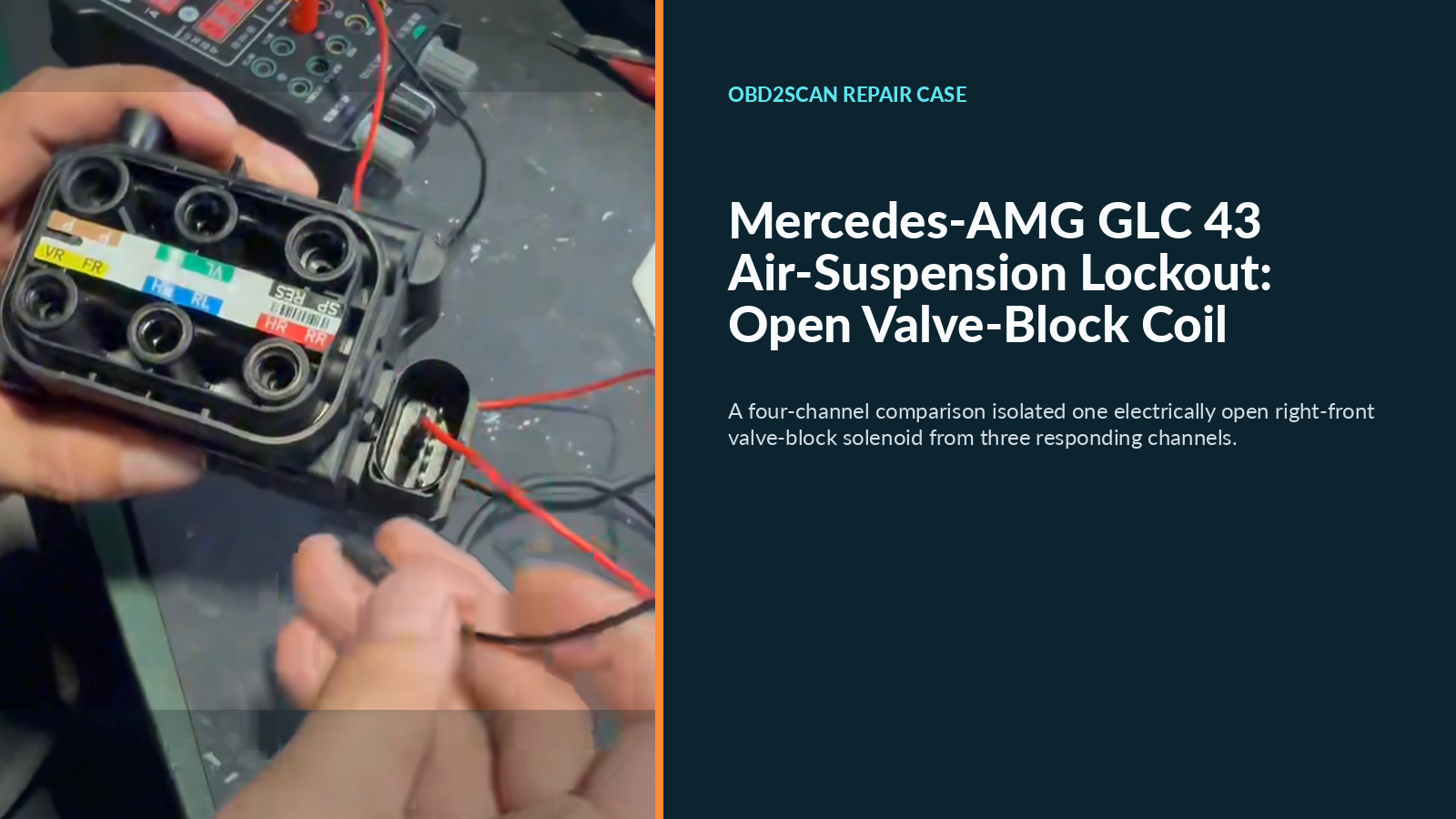
This Mercedes-AMG GLC43, reported at 60,000 km, lost air-suspension height control during driving and displayed an 80 km/h restriction; the case record calls it a 2020 model, while the video says 2021, so the year remains conflicted. Initial checks reportedly found no external air-spring leak and normal compressor pressure. Wiring-diagram-led comparison of the removed valve block confirmed one open right-front solenoid coil; replacing the block, restoring its line connections, clearing faults, and calibrating height returned the vehicle to normal operation.
Case at a glance
| Element | This case |
|---|---|
| Vehicle | Mercedes-AMG GLC43, 60,000 km; page says 2020 and video says 2021 |
| Complaint | Air-suspension warning, 80 km/h restriction, height adjustment disabled |
| Confirmed fault | Open-circuit right-front solenoid coil inside distribution valve block |
| Repair | Complete valve block replaced; four line ends cleaned |
| Restoration | DTC clearing, Airmatic initialization, four-wheel height calibration |
| Verification | Height restored and speed-restriction warning disappeared; extended test not reported |
The stored circuit clue narrowed the branch
The vehicle arrived with height adjustment inoperative after the warning appeared on the road. The case record reports that the exterior air springs showed no leak and that the compressor could establish normal pressure. It also describes a valve-solenoid actuation circuit record that had changed from intermittent to persistent, although the exact DTC and full scan export are not published.
Those findings made the air distribution valve a candidate; they did not yet identify which internal channel had failed. A compressor that creates pressure cannot prove that every downstream valve opens. Likewise, a valve-related record does not distinguish a coil, connector, harness, driver, or mechanical valve problem without further evidence.
The diagram turned four channels into a comparison
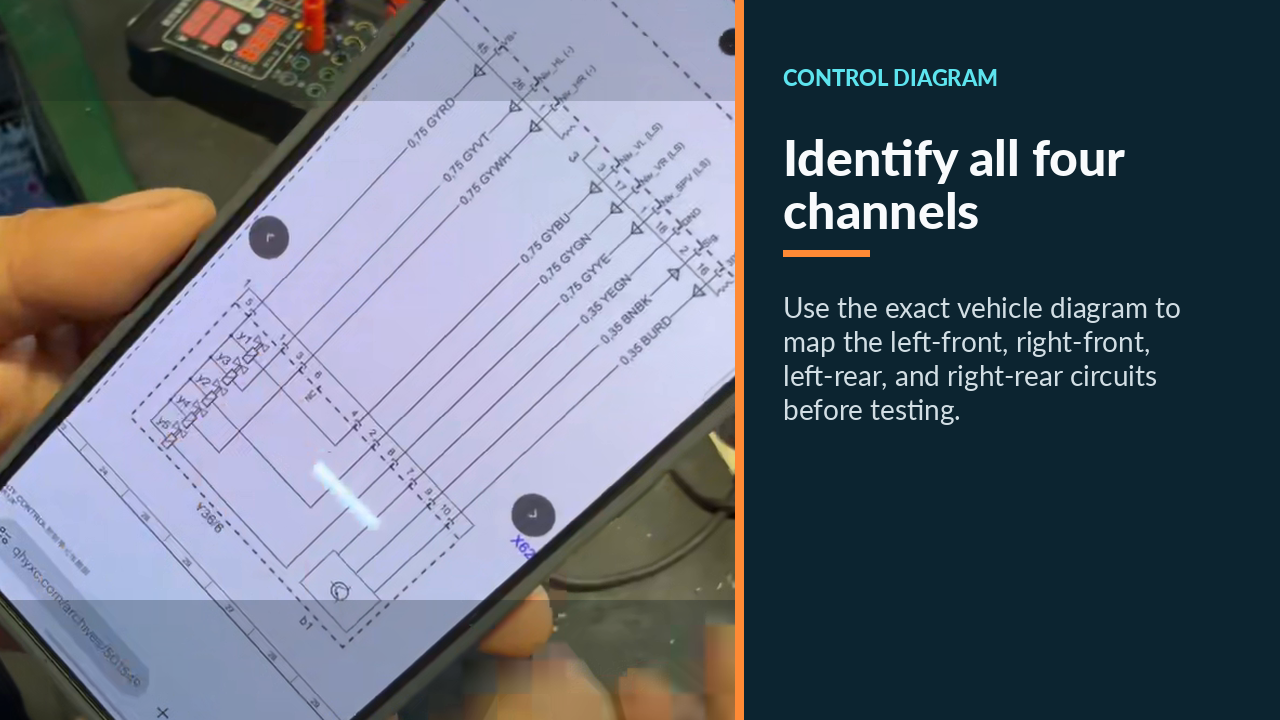
The workshop obtained the applicable control diagram and used its terminal definitions to identify the valve block’s left-front, right-front, left-rear, and right-rear solenoid circuits. The block was removed for individual off-car checks. This step matters because it made the four channels comparable inside the same assembly.
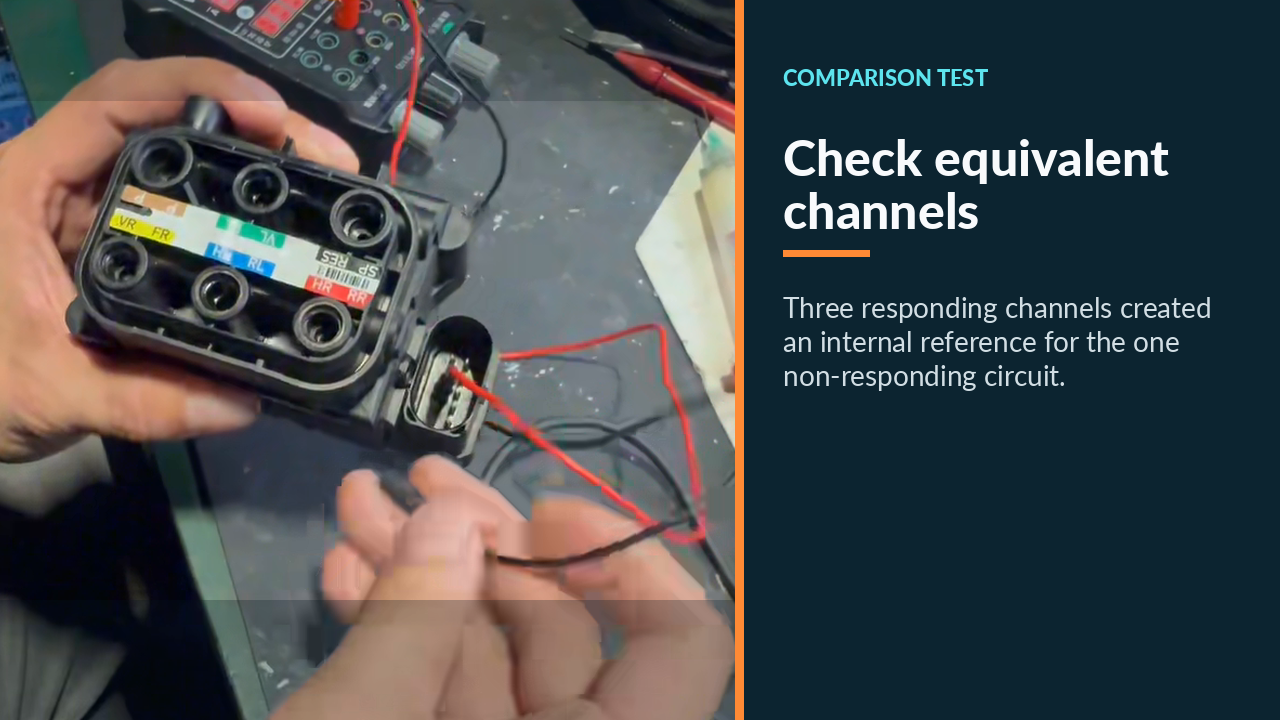
With the wiring diagram and four valve-block channels available for comparison, the MRCARTOOL B550 circuit analyzer can quickly check coil continuity and circuit behavior before the complete valve block is condemned.
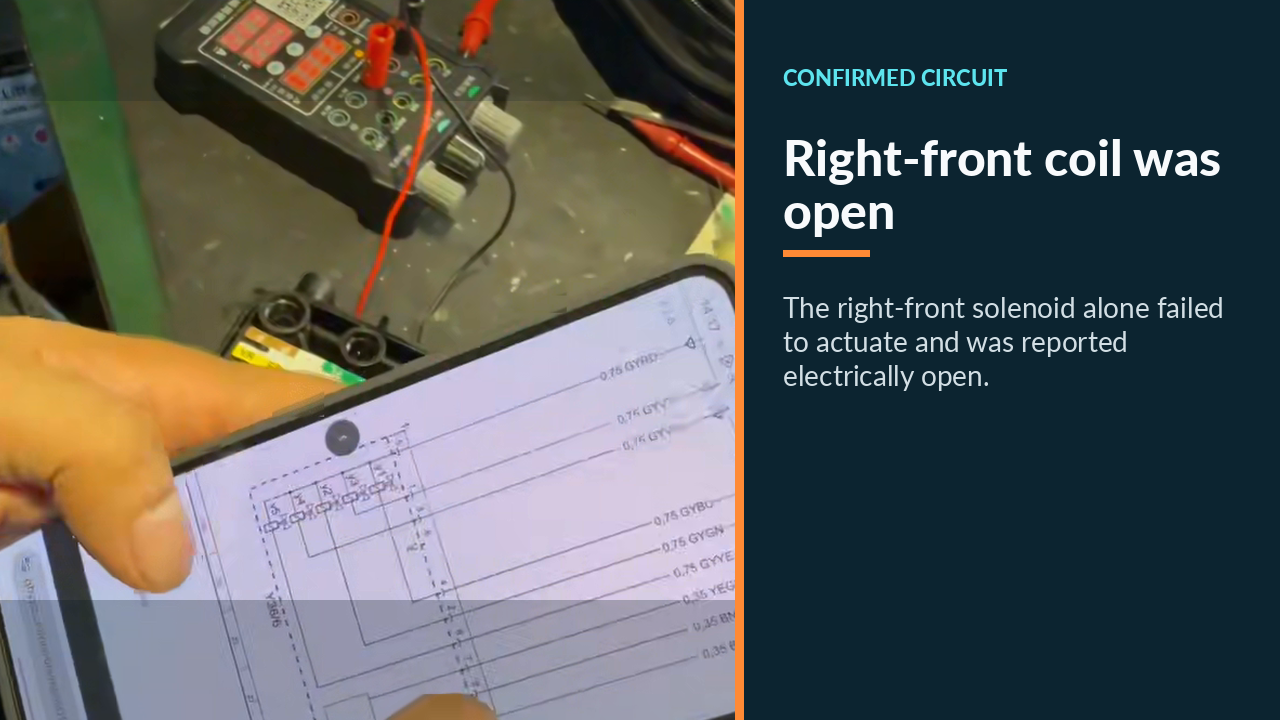
The left-front, left-rear, and right-rear solenoids reportedly actuated with a clear mechanical response. The right-front channel did not respond, and its coil measured as an open circuit. Three responding channels established an internal comparison; the one silent, open channel supplied the confirming result. That is stronger than replacing the block solely because a controller mentioned it.
The public evidence intentionally stops short of a bench-test recipe. It does not publish pin numbers, the resistance range, power-supply limits, pulse duration, connector protections, or a safe pressure state. Applying voltage to an unidentified valve assembly can damage a component or create an unsafe pneumatic condition. Exact vehicle information and qualified procedures are required.
What the workshop replaced and restored
With the right-front coil confirmed open, the workshop replaced the complete air-suspension distribution valve block with a new original-specification assembly. The old coil was the confirmed electrical failure; the complete block was the service unit actually replaced.
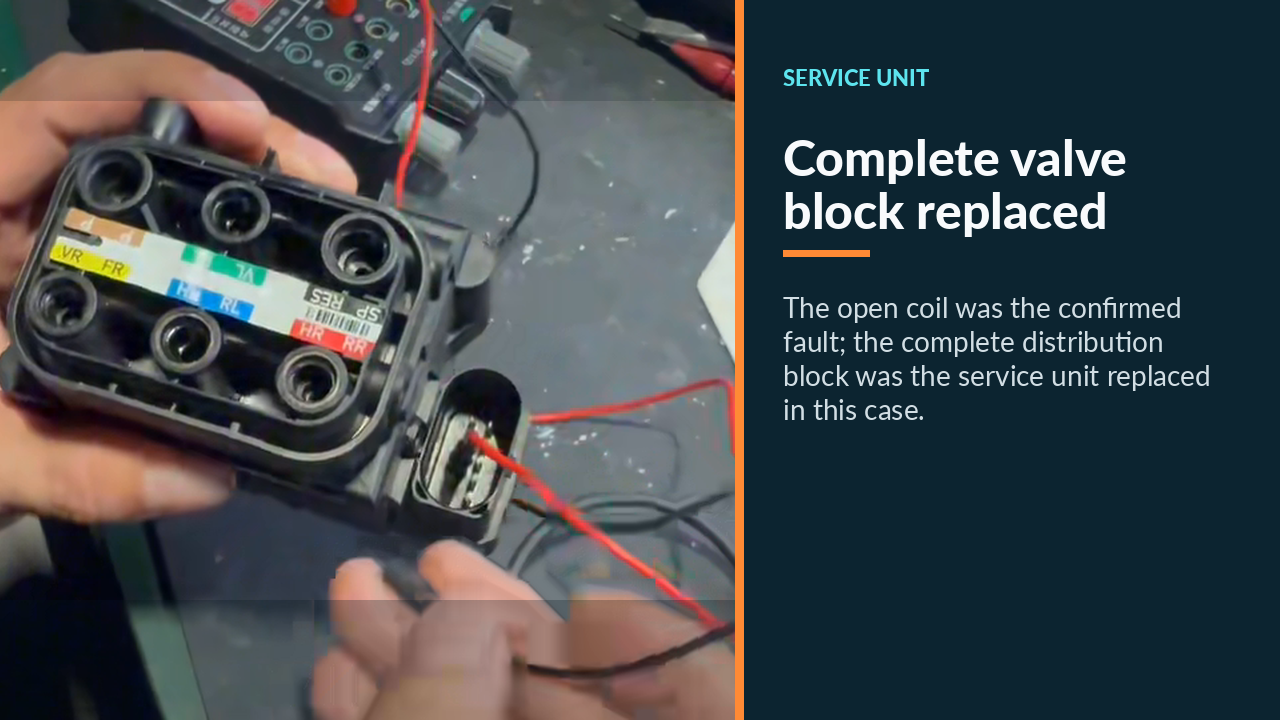
During installation, the four colored high-pressure line ends were reportedly cleaned before reconnection. The case record also says the compressor inlet filter and desiccant condition were checked as protection against moisture, but it does not report replacing them. Keeping those actions separate prevents inspection from being mistaken for additional parts replacement.
After mechanical installation, historical chassis DTCs were cleared. The workshop then performed Airmatic initialization and four-wheel height balancing/calibration so the controller and new valve block could resume coordinated height control. These restoration steps were part of completing the repair, not evidence that the old block had been faulty.
Verification returned to the roadside complaint
The case record reports that the replacement block routed air to all four channels, vehicle height returned to its specified operating position, and the 80 km/h restriction disappeared. That result addresses both functions that had failed: height control and the instrument restriction.
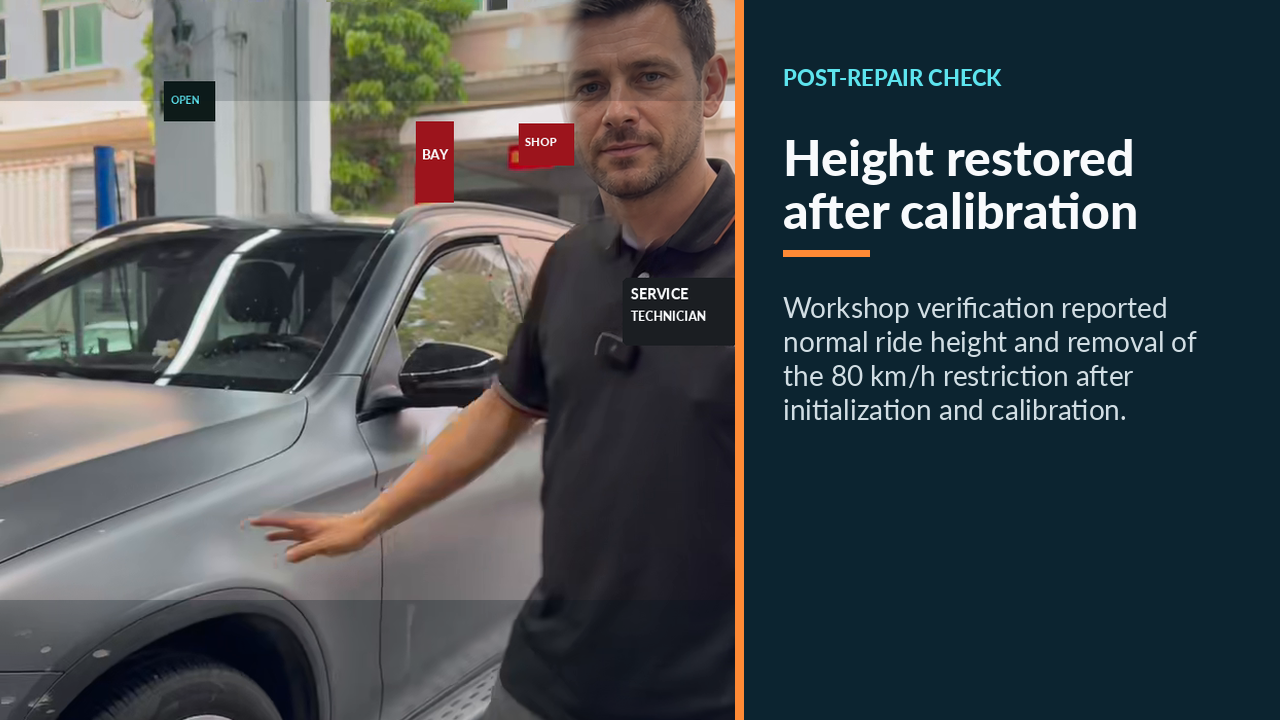
Verification remains bounded. No road-test distance, repeated height cycles, parked height-retention interval, exact final measurements, or later rescan is published. The supported conclusion is a successful workshop function and warning recheck after calibration, not a long-term guarantee.
How this case transfers—and where it does not
On a similar vehicle, preserve the exact DTC status and scan context, confirm actual compressor output and external leakage, then use the exact wiring and pneumatic information to test the implicated path. If several equivalent channels exist, comparing their behavior can expose one outlier without treating every valve-block code as a replacement verdict.
This GLC43 had one electrically open right-front coil confirmed against three responding channels. Another height-control failure may come from an air spring, line, compressor, connector, wiring, height sensor, controller output, or a mechanically stuck valve. The transferable lesson is the comparison structure; the pin-out, values, part number, and calibration procedure must come from the exact vehicle, especially while this record’s model-year conflict remains unresolved.









Comments 0
Questions, fixes, and real-world diagnostic notes from readers.
Be the first to share a diagnostic result or ask a follow-up question.