
2013 Buick Verano Intermittent No-Start and Stall: The Fuse Bus Nuts Were Loose

Stalls When The Fuse Bus Moves? Test The Joints
Intermittent stalls are often described as mysterious because everything looks normal once the car is stationary. The Verano offered a better clue: a stored battery-voltage plausibility fault and a running engine that died when one main power joint moved. A fuse can be intact while the bolted connection beside it interrupts the entire car.
One useful machine class at this stage is a bounded measurement tool, chosen only after the circuit or system question is defined. The MRCARTOOL B550 is one route for that supporting task. B550 can support polarity, voltage and voltage-drop checks on identified 9–30-volt circuits. Do not inject power into data or module circuits; it cannot set torque, prove clamping force or remove unfused-battery risk.
This article follows one documented vehicle. Its cause is a useful diagnostic pattern, not a failure-rate claim and not permission to replace the same part on a similar symptom. The goal is to show which evidence changed the decision and how the repair was verified.
Quick answer: The fuse elements were not the failure. Loose bolted connections interrupted main power; movement reproduced the stall and specified torque restored stable operation.

In this guide
- Intermittent main power can mimic many faults
- Use B1517 as a direction, not a parts order
- An intact fuse can still have a bad connection
- Measure before moving the main bus
- Reproduce the stall without creating a short
- Clean and torque every affected joint
- Protect the repaired power distribution
- Repeat starts, idle and a loaded road test
Intermittent main power can mimic many faults
A main-power interruption can stop an engine and reset several modules at once. Secure clothing and tools around the battery; an unfused positive bus can deliver destructive current if bridged to ground. Keep the vehicle in the failed state long enough to capture evidence, but never extend a test beyond the point where a stall, brake event, refrigerant release or moving component creates risk.
Use B1517 as a direction, not a parts order
B1517 5A in the BCM described implausible battery voltage while BCM communication still worked. Save when it set and compare module voltages instead of assuming the BCM itself is faulty. Write down the conditions before disconnecting anything. That record is what lets a later change mean something instead of becoming another uncontrolled attempt.
An intact fuse can still have a bad connection
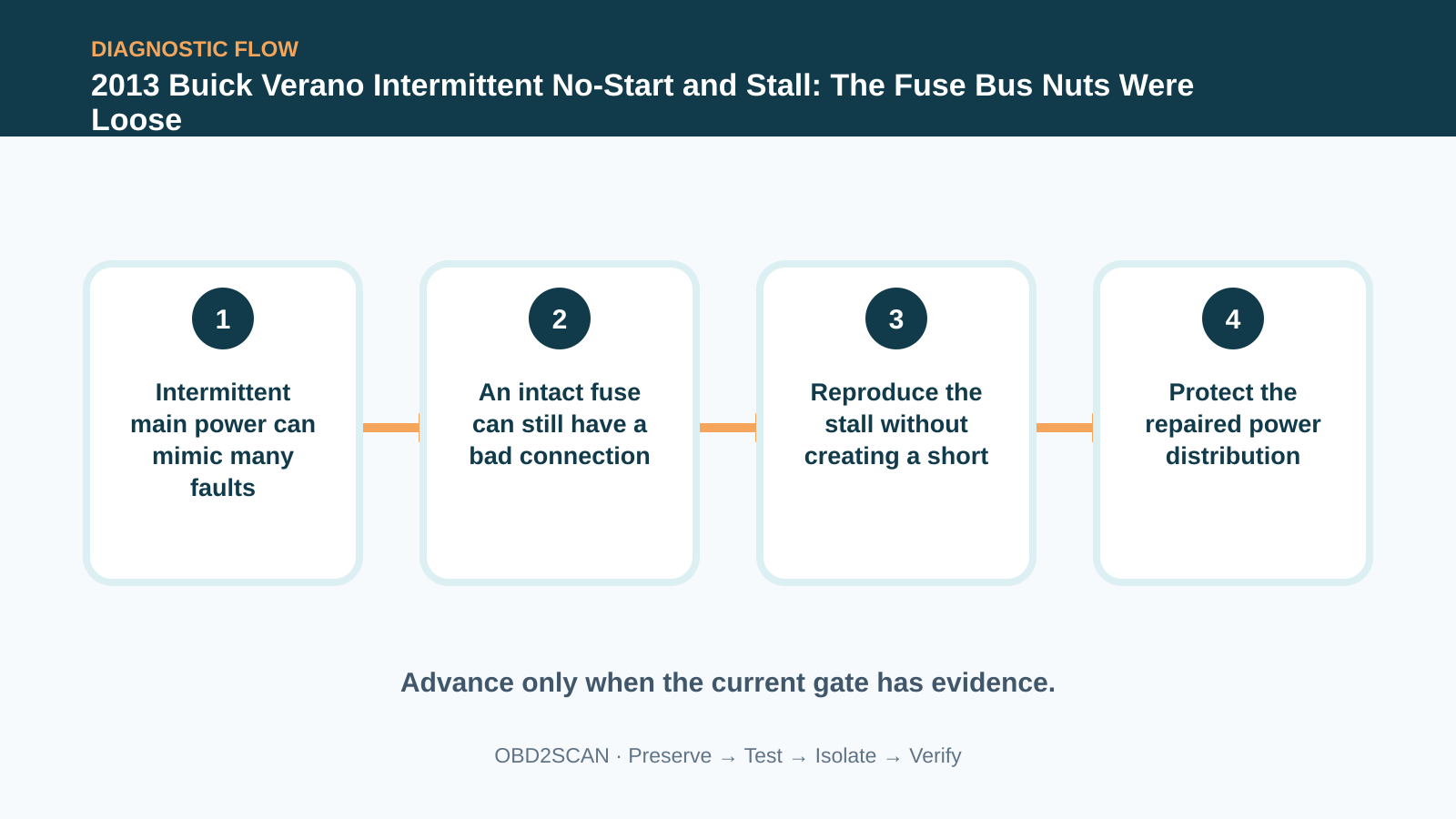
Inspect both fuse elements and their source/load joints. Hairline heating, discoloration, loose studs and relaxed nuts can interrupt current even when every visible strip remains continuous. Use service information for the exact engine, build and option set. A correct test on the wrong pin or configuration can produce a precise but useless answer.
Measure before moving the main bus
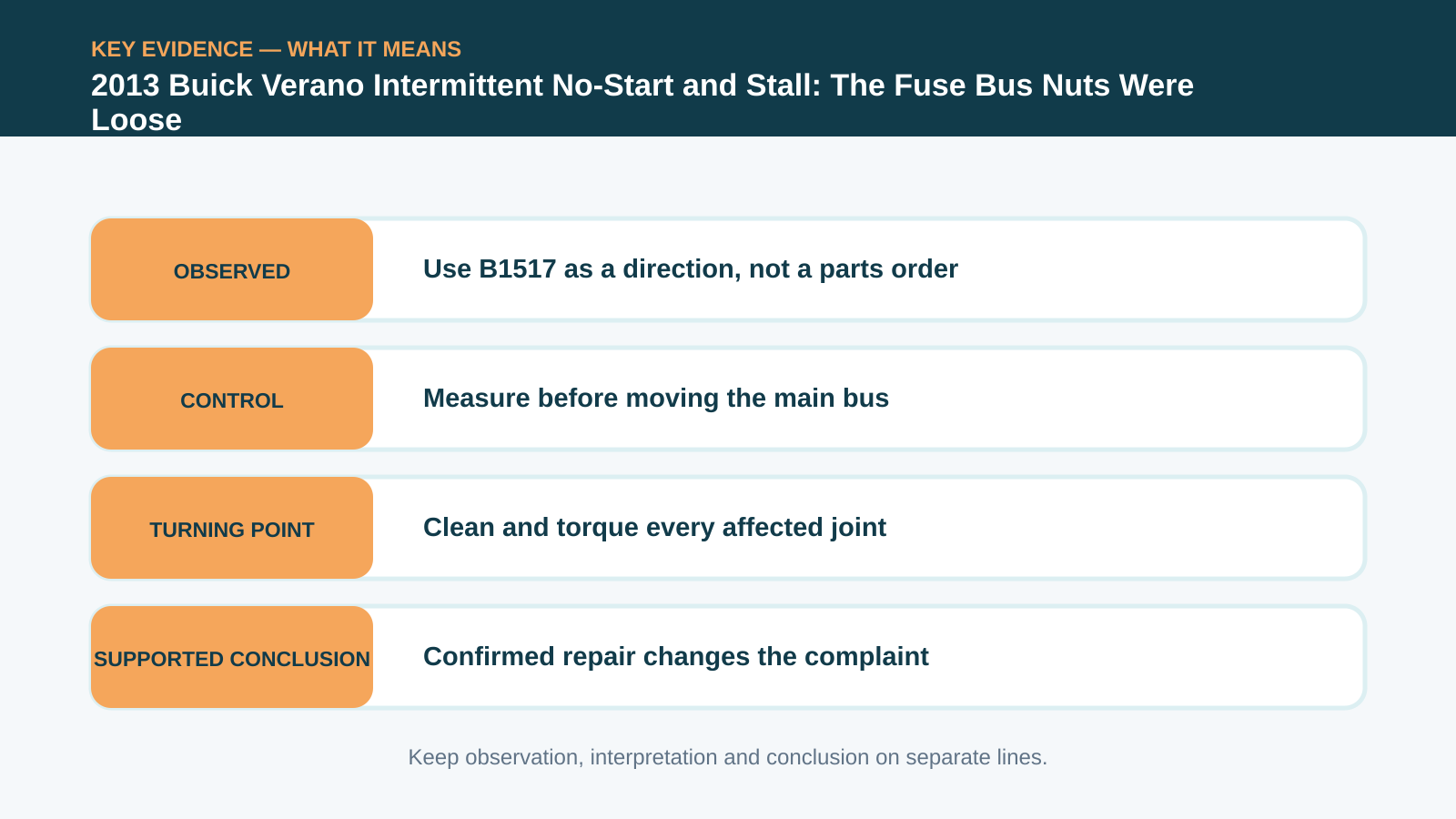
Measure voltage drop across each joint under a controlled load before moving it. A static twelve-volt reading on both sides can miss resistance that appears only when current or vibration changes. This is the turning point in the documented case. It gains weight because earlier branches were tested and because the symptom changed with one controlled condition.
| Observation | What it supports | What it does not prove |
|---|---|---|
| B1517 stored | Voltage plausibility was disturbed | BCM is faulty |
| Fuse strips intact | Elements are not open | Bolted joints carry load |
| Movement stalls engine | Main joint is intermittent | Wiggling is a safe repair |
| Torque restores stability | Loose joints were causal | All power faults are fixed |
Reproduce the stall without creating a short
The running engine died as the positive bus connection was gently moved. Reproduce only with insulated access and measurement in place; never lever or short a live battery distribution point for the sake of a wiggle test. Separate observation from inference: record what moved, opened, failed or remained stable, then state only the component or path that result actually narrows.
Clean and torque every affected joint
Disconnect power by the service procedure, clean approved contact surfaces and inspect heat damage. Torque every affected bus nut to specification rather than tightening the one that happened to move first. The repair must remove the demonstrated mechanism and restore mechanical support, sealing, torque or terminal fit—not merely make the symptom disappear once.
Protect the repaired power distribution
Restore covers, strain relief and cable routing so engine movement cannot reload the joint. A connection repair includes mechanical support and corrosion protection, not only a favorable voltage reading. Reassemble to the original protection standard. Clear codes only after preserving the pre-repair record and confirming the relevant controller is online.
Repeat starts, idle and a loaded road test
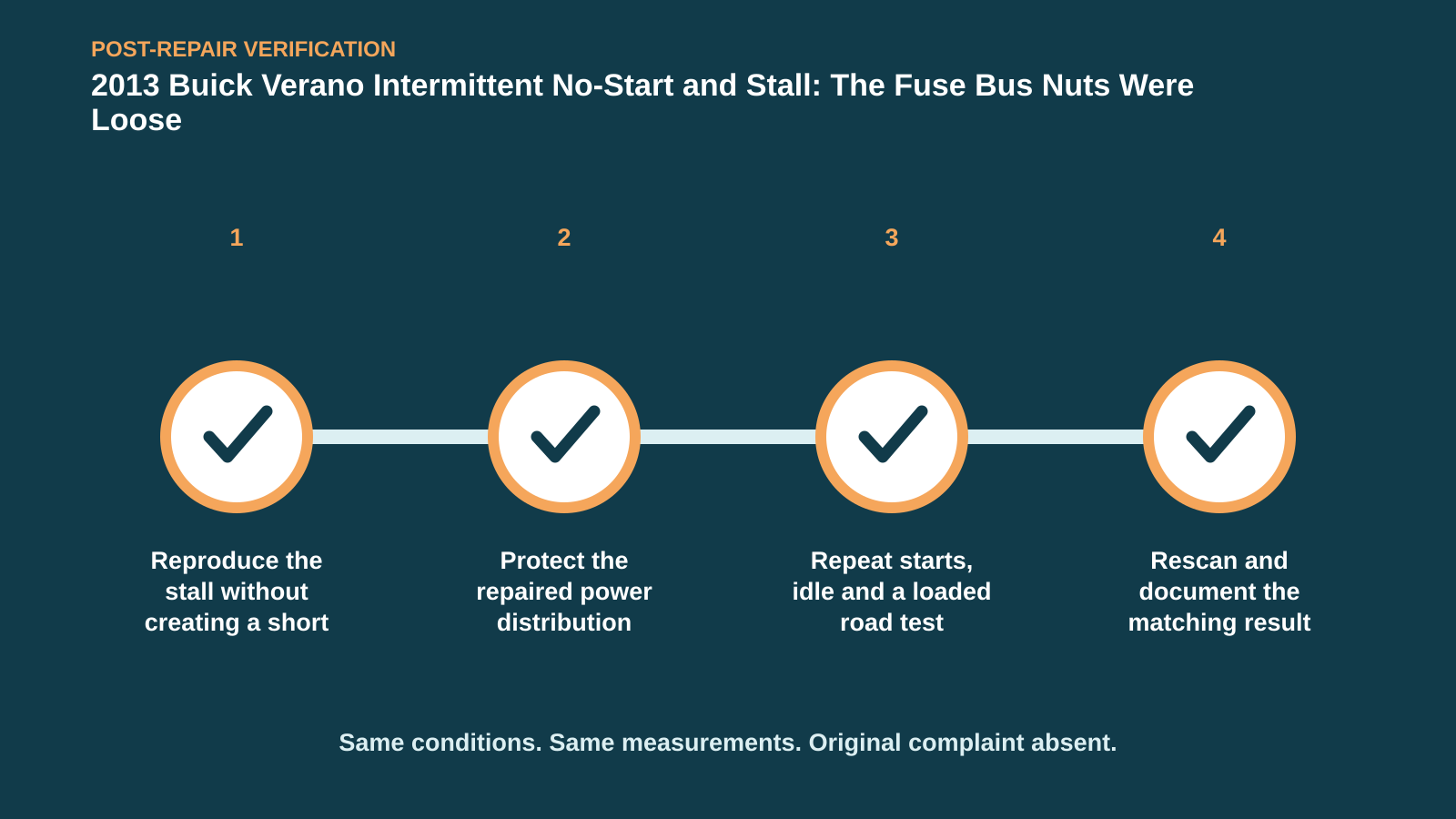
Perform repeated starts, idle with electrical loads, a controlled harness movement check and a road test over ordinary vibration. Rescan B1517 and compare module supply voltage before calling the simple fix complete. Use the customer’s original complaint as the final test specification. Matching conditions and a post-repair scan are stronger closure than a quiet bay or a cleared warning lamp.
For the owner or service adviser, the useful explanation has three parts: what was observed, why the decisive test narrowed the fault, and which original condition was repeated after repair. It should not promise that every similar vehicle needs the same component. This was one evidence chain on one vehicle, and the appropriate next step on another car may change with build data, prior work, safety condition and test results. That honest boundary makes the case easier to trust and more useful at the next diagnostic visit.
The fuse elements were not the failure. Loose bolted connections interrupted main power; movement reproduced the stall and specified torque restored stable operation. The reusable lesson is narrower and more valuable: Make the reproduced stall the pivot, then distinguish an intact fuse element from the bolted connections feeding it.








Comments 0
Questions, fixes, and real-world diagnostic notes from readers.
Be the first to share a diagnostic result or ask a follow-up question.