
BMW 220i F22 Headlight Module Water Damage: Coding and Calibration Case

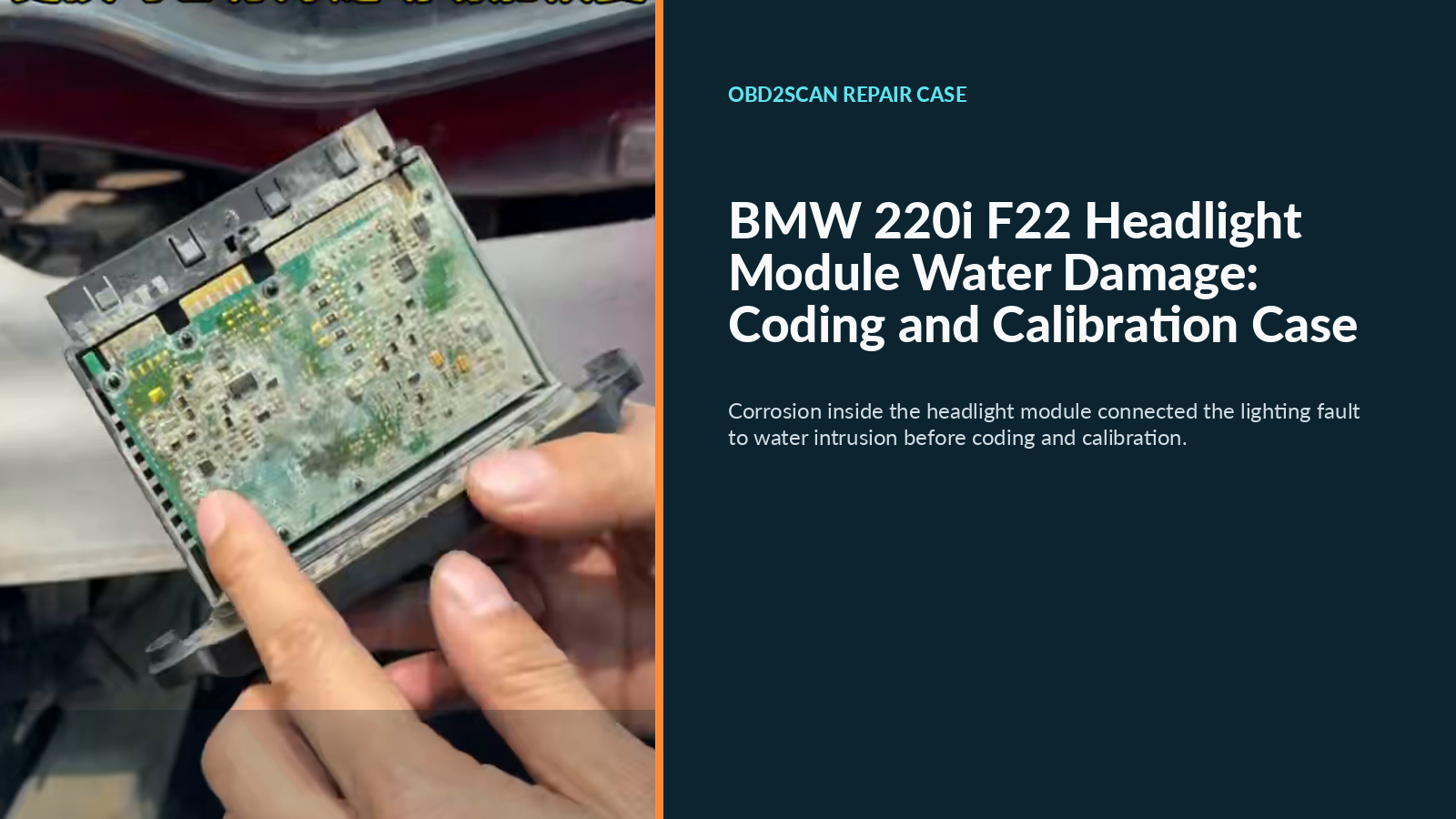
This BMW 220i F22 arrived with a headlight-system warning, a failed daytime running light, and no adaptive-headlight function. Inspection localized the problem to the lower lamp control module, where opening the case exposed water residue and severe circuit-board corrosion. The workshop addressed the lamp sealing defect, installed a compatible module, restored its vehicle configuration, initialized the adaptive system, and verified every affected lighting function before and during a road check.
The available record does not report model year, VIN, engine, mileage, module part number, or diagnostic software version. Those omissions matter because F22 is useful chassis context, not enough information to select a module or reproduce a programming procedure.
Case at a glance
| Item | Case detail |
|---|---|
| Vehicle | BMW 220i, F22; model year, engine, and mileage not reported |
| Driver complaint | Headlight-system warning, DRL inoperative, adaptive-headlight function lost |
| Initial localization | Control module at the bottom of the headlight assembly |
| Confirming evidence | Water residue and severe corrosion visible inside the opened module |
| Confirmed fault | Water-damaged lower headlight control module |
| Related repair | Lamp assembly or surrounding sealing defect inspected and repaired; exact entry path not reported |
| Component repair | Compatible replacement module installed |
| Restoration | Vehicle configuration written; programming/coding and adaptive-headlight initialization/calibration completed |
| Verification | Low beam, high beam, DRL, automatic leveling, adaptive operation, cleared warning, and road operation checked |
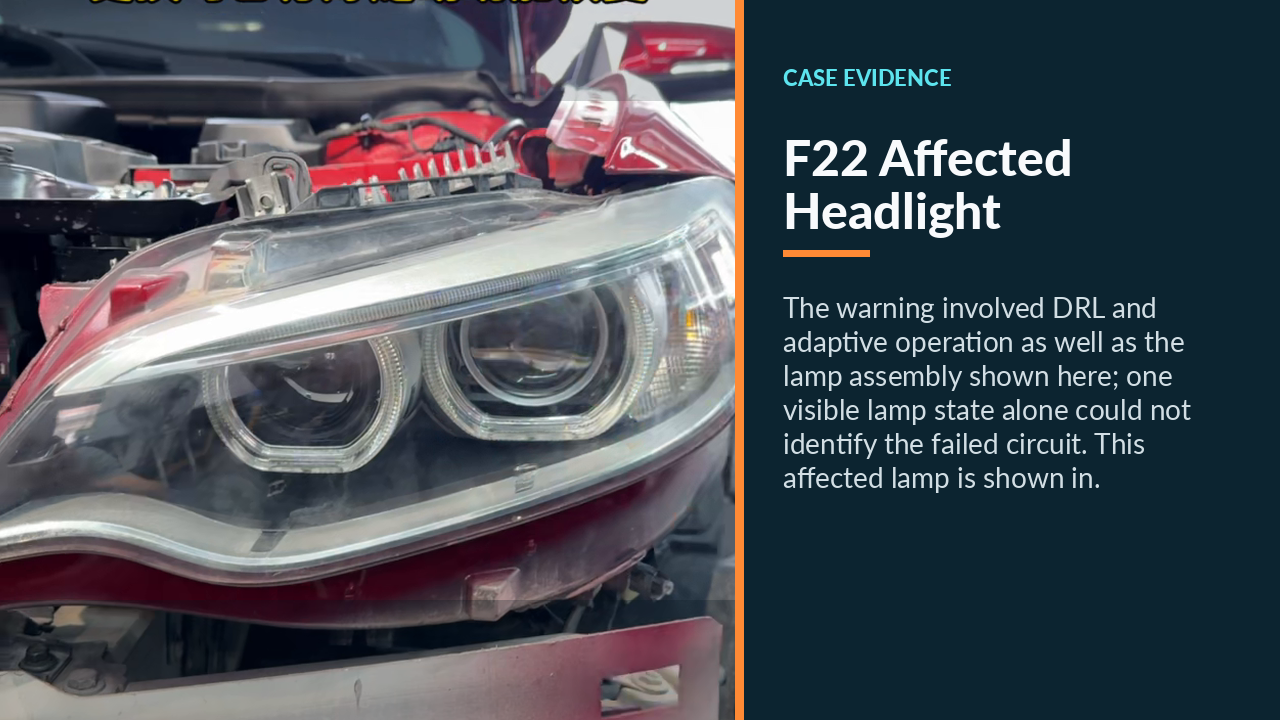
A warning covering several functions needed localization
The instrument message did not identify a replaceable part. The failed DRL and missing adaptive response showed that the complaint crossed more than one lamp function, but a shared symptom can still come from supply, communication, wiring, a module, or the lamp assembly itself. Treating the cluster message as a parts order would have skipped the evidence step.
The workshop traced the problem to the control unit mounted at the bottom of the headlight. Once removed and opened, its printed circuit board showed widespread residue and corrosion consistent with water intrusion. That direct condition tied the multi-function complaint to a damaged component much more strongly than the warning alone.
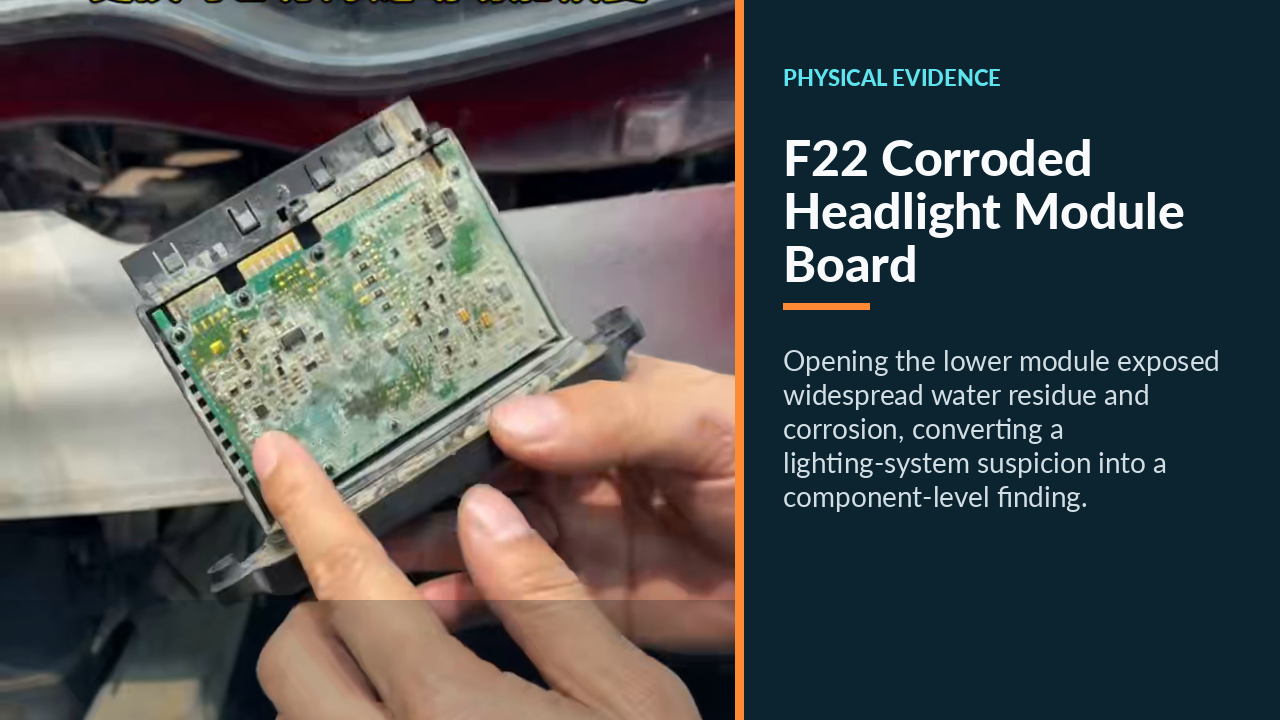
This frame confirms damage inside this module; it does not identify the precise route water followed into the lamp. The case record names an aged seal or external ingress as possible paths and says the lamp assembly or surrounding housing defect was repaired. Without a documented leak trace, the safer record is “sealing defect addressed,” not a guessed gasket or crack.
Stopping moisture came before fitting electronics
Replacing a corroded controller without correcting the moisture path would expose the new electronics to the same failure mechanism. The reported sequence therefore included inspection and repair of the lamp assembly or adjacent housing seal before module installation. Exact drying, seal preparation, leak-check method, and replacement-part choice are not published.
For a similar vehicle, the technician still has to confirm the exact build, locate the real entry path, inspect connectors and wiring for migration, and decide whether the lamp enclosure remains serviceable. Severe corrosion can also make a board-level repair unreliable. This case records replacement of the module used on this car; it is not evidence that every water-marked controller should be repaired or automatically replaced.
Hardware installation did not finish the repair
The replacement module required the vehicle’s configuration data. The workshop wrote the relevant VO/FA configuration, completed programming and coding, then performed steering/adaptive-headlight initialization and AFS calibration. Those restoration events are part of the repair outcome, not optional polish after the lamp turns on. During coding and calibration, the AUTOOL EM355 ECU programming power supply can provide stable 12-volt support so a voltage drop does not interrupt module setup; its output must first be matched to the vehicle and battery.
This is a qualified programming task. Incorrect module application, unstable programming voltage, interrupted communication, or a wrong procedure can leave the lighting system unavailable or create additional faults. The video does not provide a safe menu-by-menu method, support-voltage specification, or coding dataset, so none is reconstructed here. Exact-build BMW service information and compatible diagnostic equipment control those details.
BMW’s official owner-manual lookup is the appropriate route for vehicle-specific warning and lighting-operation guidance. Workshop programming and calibration procedures must likewise be selected for the exact VIN and installed hardware.
Verification covered the whole original complaint
One illuminated headlight would have been an incomplete result. The case record documents checks of low beam, high beam, daytime running light, automatic leveling, and adaptive steering-light operation after coding and calibration.
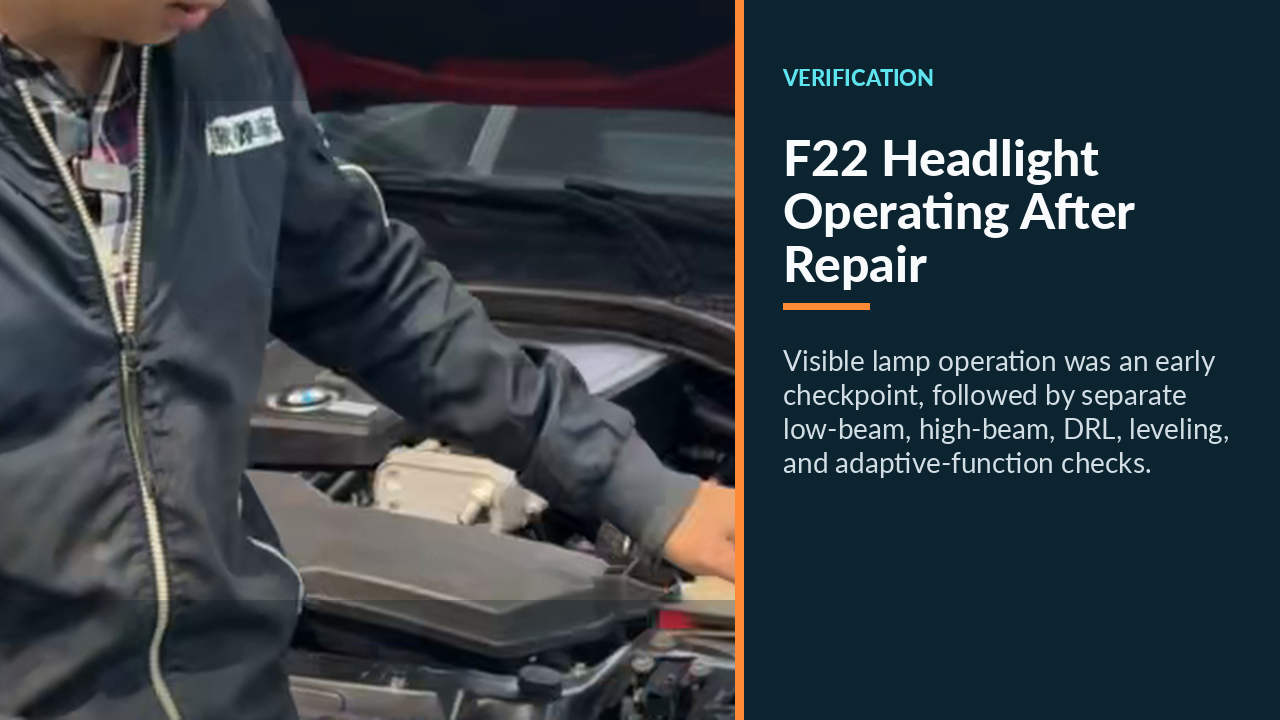
The instrument warning was also checked and reported cleared. A road test then challenged the adaptive function under vehicle operation rather than accepting a static workshop sweep as the whole answer. The available record does not state the route, distance, aiming measurements, or calibration targets, so the closure is reported without invented numbers.
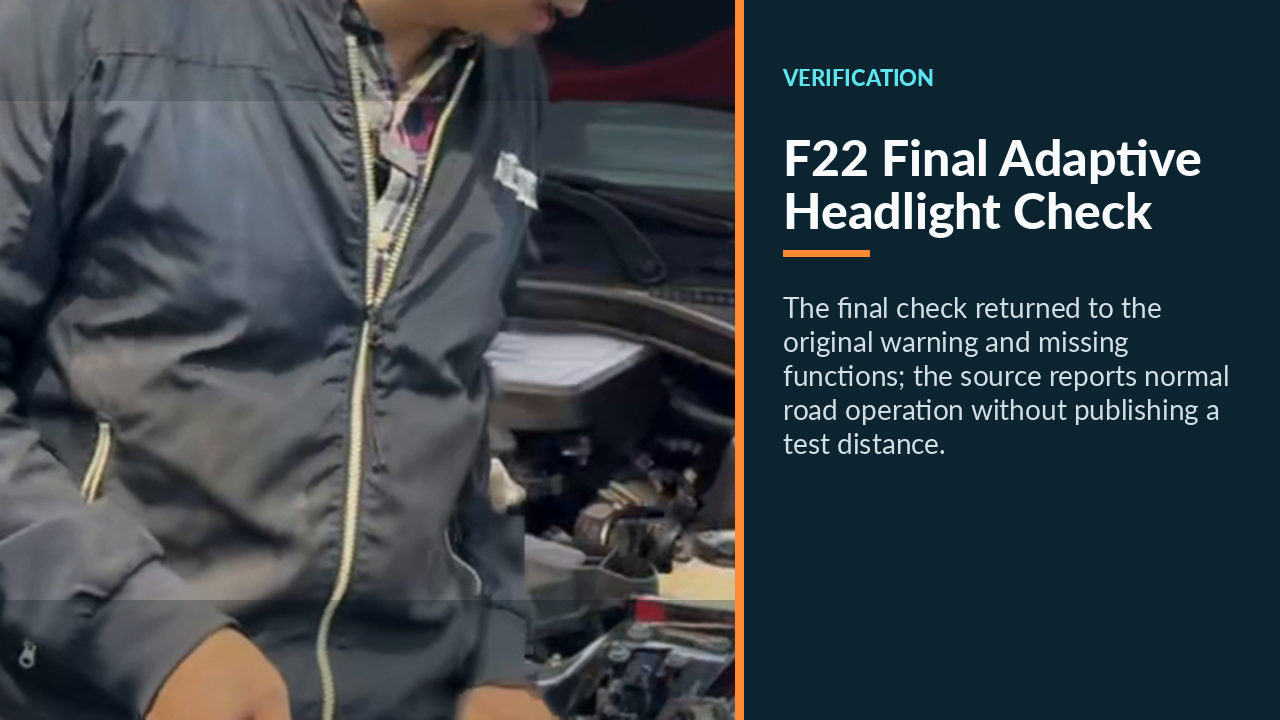
Any final release still needs the exact-vehicle lighting checks required by current service information, including aim and warning-status confirmation where applicable. If condensation returns, a warning reappears, or one function remains inconsistent, the moisture path, connectors, wiring, communication faults, and lamp hardware need renewed diagnosis instead of repeated coding.
What transfers to another lighting case
Start by writing down each failed function rather than calling the complaint simply “a bad headlight.” Localize the shared path, inspect for direct physical evidence, and separate a suspected water route from an observed damaged module. If replacement is justified, stop the ingress first, confirm exact application, restore configuration and calibrations, then verify the same warning and every function that originally failed. That evidence chain—not an F22 badge or a corroded board photo—is the reusable lesson from this repair.








Comments 0
Questions, fixes, and real-world diagnostic notes from readers.
Be the first to share a diagnostic result or ask a follow-up question.