
2014 Ford Edge Battery Kept Dying: The Park Switch Woke the Cluster Every 15 Minutes

Battery Dead Again? Log The Wake-Up
The Ford Edge did not fail every night. That was the point. Some mornings it started normally; on others, even a recently installed battery was too weak to crank. The first hour after key-off looked busy but explainable. The useful evidence arrived much later: a short, repeating wake-up that ordinary spot checks kept missing.
For a compatible lead-acid system, a tester that can record low-current behavior is useful before modules are accused. The AUTOOL BT880 is one option for that opening screen. BT880 can log compatible 12/24-volt lead-acid system leakage from 15 mA to 5 A and screen the battery. It cannot identify the waking module, interpret sleep strategy or replace an ammeter setup selected from service information.
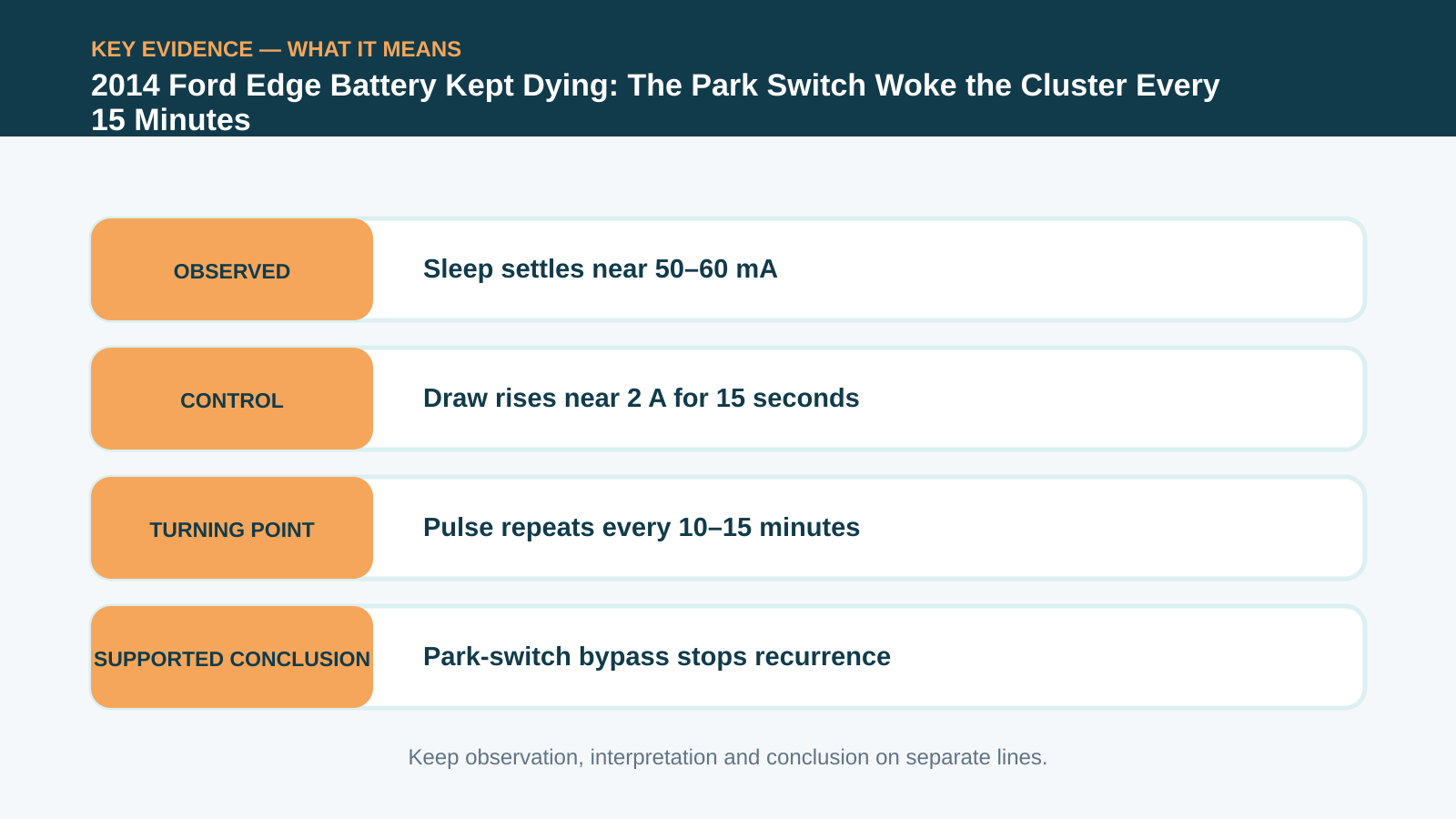
After sleep current settled near 50–60 mA, the vehicle intermittently drew about 2 A for roughly 15 seconds every 10–15 minutes. The PRNDL lamps sometimes remained on, linking the event to park-state logic. Bypassing the redundant park switch stopped the drain; the recommended shifter repair and a four-month no-recurrence report closed the case.
Quick answer: A redundant park switch intermittently woke the cluster, producing a repeating draw long after normal shutdown activity had ended.

In this guide
- A dead battery is the aftermath, not the fault
- Separate shutdown time from true sleep
- Capture the event instead of pulling random fuses
- Follow the dashboard clue to park status
- Why the first suspects were reasonable but wrong
- Use the park-switch bypass as an A/B test
- Repair the shifter circuit, not the symptom
- Make time part of the verification
A dead battery is the aftermath, not the fault
A discharged battery tells you only that stored energy was lost or never replenished. Test battery condition and charging performance, inspect terminals, and document how long the vehicle sat. In this case, even the replacement battery failed after being repeatedly depleted, so starting with a known-good, fully charged battery was necessary. It was not the final diagnosis. Ask the driver which doors were opened, whether a remote-start system was used, and whether the problem followed short trips. Those details define a repeatable overnight test instead of another morning rescue.
Separate shutdown time from true sleep
Modern vehicles may remain active after the key is removed. The Edge held a higher draw for about an hour while its natural-vacuum leak-detection system completed normal work, then fell to roughly 50–60 mA. Pulling fuses during that phase would confuse intended shutdown activity with a fault. Lock the vehicle as the owner does, defeat only the latches required by the service procedure, keep keys and remotes away, and record the entire transition. The meaningful baseline is current after every controller has had time to sleep—not a universal minute count borrowed from another model.
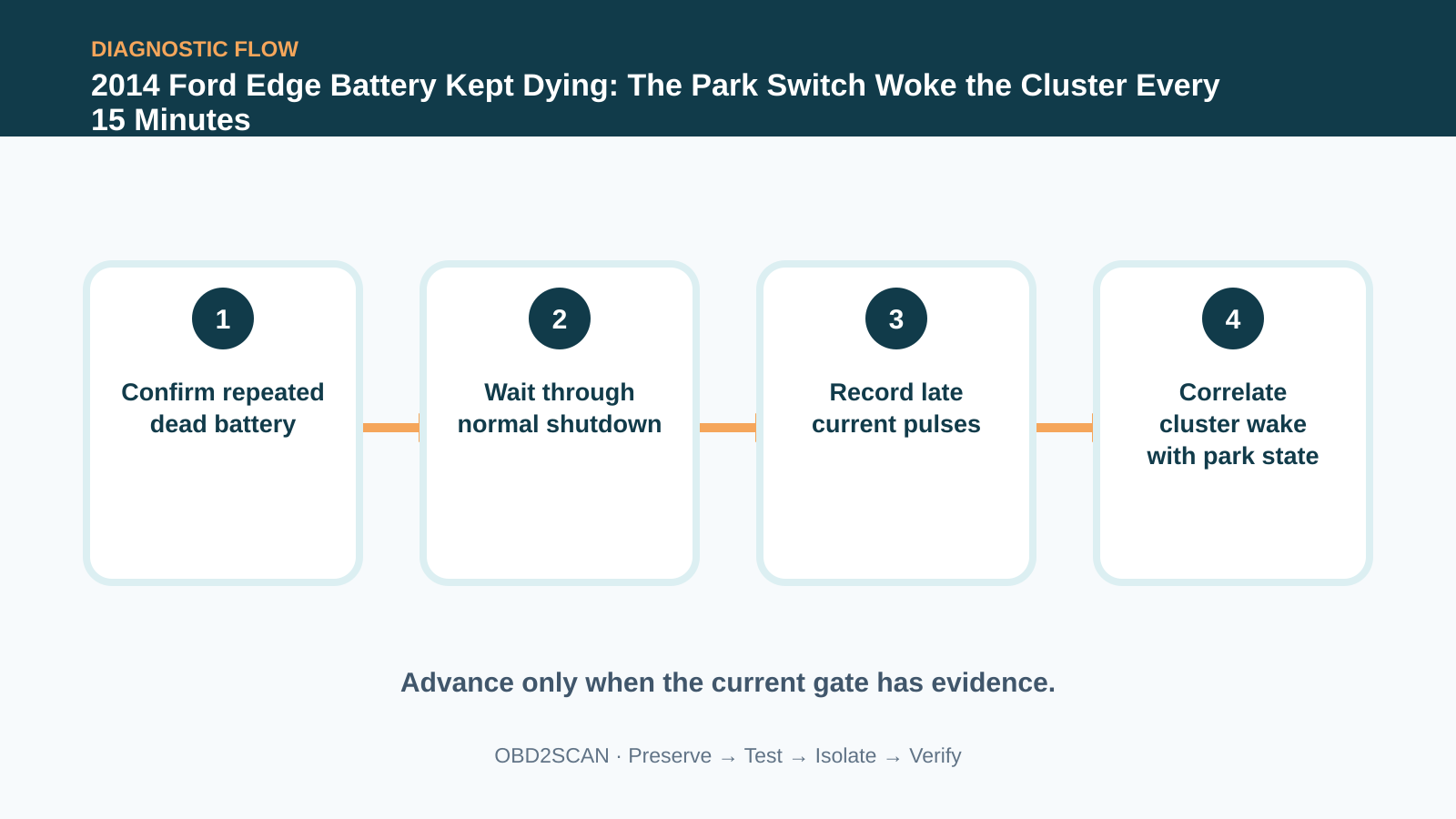
Capture the event instead of pulling random fuses
Five mornings produced no abnormal draw. On the next useful night, the recorder caught a pulse near 2 A lasting about 15 seconds and repeating every 10–15 minutes. That pattern is more informative than a single high number because it describes a module waking, doing something, then sleeping again. A fuse-voltage-drop survey can help while the event is present, but an event may finish before every panel is checked. Use a low-current clamp or approved series connection, protect meter fuses, and do not open the circuit in a way that resets the very module you are trying to observe.
Follow the dashboard clue to park status
The decisive clue appeared without a scope: the transmission-range lamps sometimes stayed illuminated after parking. The shifter included a redundant park switch, and a false park state could keep the instrument cluster awake. Compare commanded and reported park status if scan data supports it, then inspect the switch circuit and connector. A dashboard lamp is not proof that the switch itself failed; a chafed wire or module input could create the same state. It is simply a visible event that can be time-correlated with the current pulse.
| Observation | What it means | What it does not prove |
|---|---|---|
| Higher draw during the first hour | Normal shutdown work may still be active | Every early milliamp is acceptable |
| 50–60 mA after sleep | A usable baseline for this case | A universal specification for all vehicles |
| Repeating 2 A, 15-second pulse | Something wakes on a schedule or input | Which module caused the wake |
| PRNDL lamps remain on | Park-state logic is involved | The switch is faulty without an A/B test |
Why the first suspects were reasonable but wrong
Several tempting suspects were checked. Rear-window motors had a reputation for drains on this platform, but thermal inspection and access work did not tie them to the event. Two aftermarket modules under the dash were disconnected, yet the pulse remained. That negative evidence matters. Pattern failures and aftermarket equipment belong high on a probability list, but neither should survive a controlled test that leaves the symptom unchanged. Reconnect only after documenting the result, and avoid turning a tidy installation into the villain merely because it is not factory equipment.
Use the park-switch bypass as an A/B test
Bypassing the redundant park switch under a documented circuit plan stopped the wake-up over the observation period. That is a strong A/B result: fault present with the normal input, absent when the questionable state is removed. It still does not authorize a permanent jumper, because the park input may affect starting, warning and shift logic. The source recommended the Ford shifter assembly. Before installation, verify connector tension and the wire between the switch and receiving module so a harness fault is not hidden by movement during the test.
Repair the shifter circuit, not the symptom
Repair the verified park-status path rather than treating a disconnected switch as the solution. The documented recommendation was the shifter assembly that contains the redundant park switch. Follow Ford removal and adjustment procedures, protect console trim and connectors, and make sure the selector engages every range correctly after assembly. Confirm the starter interlock and reverse lamps behave as specified. If testing instead exposes damaged wiring or terminals, repair that evidence rather than replacing an unaffected shifter. The permanent work should restore the intended input and every safety function the input supports.
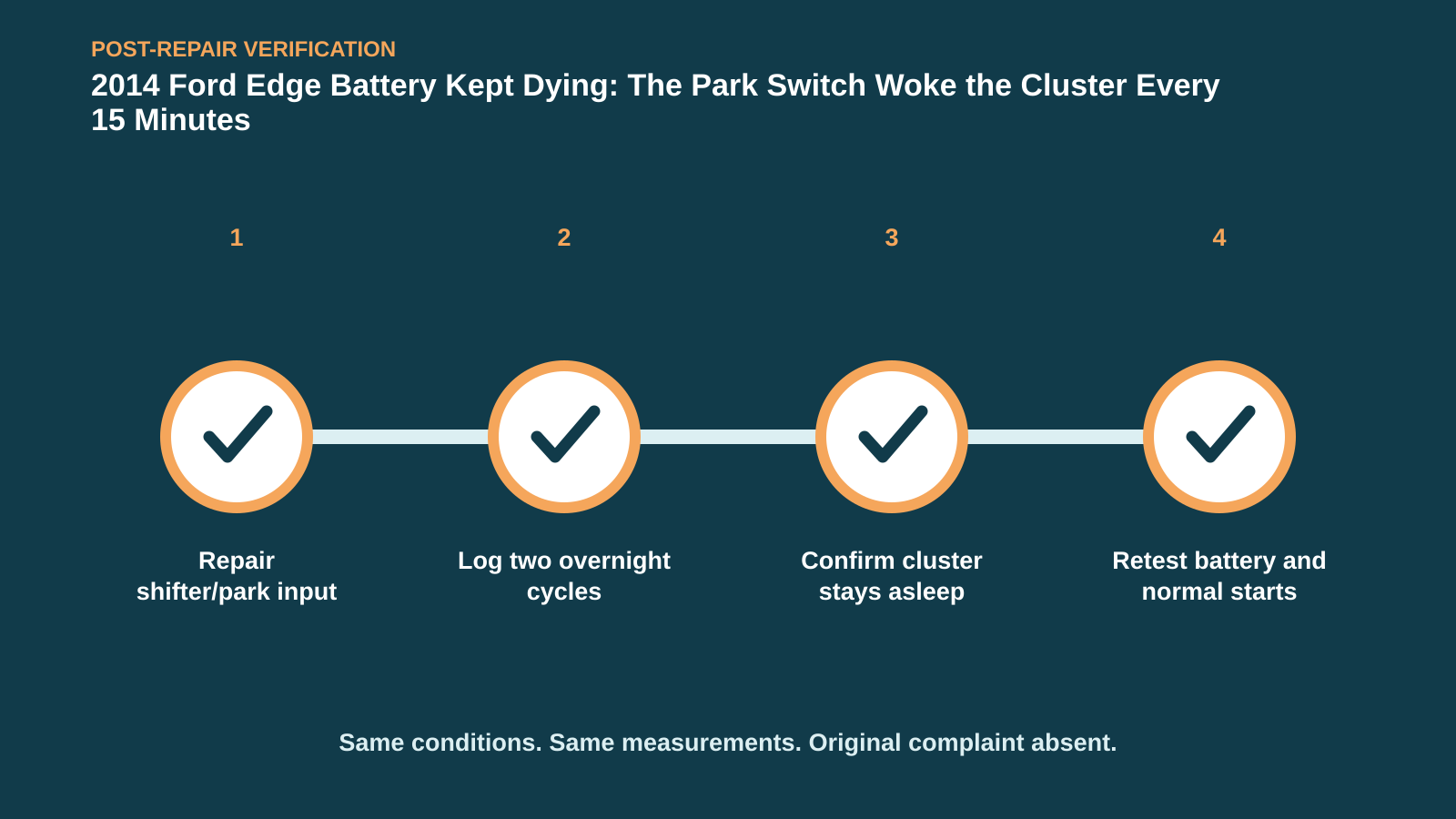
Make time part of the verification
After repair, repeat the exact ownership routine—drive, use normal accessories, park, lock and leave the vehicle. Capture at least two full nights, because one quiet hour did not reproduce this fault. Confirm the PRNDL lamps extinguish, current reaches the established sleep baseline, and no periodic pulse returns. Then retest battery health and starting performance. The published follow-up reported more than four months without another dead battery, valuable real-world evidence that the repair survived far longer than the diagnostic bypass.
The fix was a small switch inside a large system, but the diagnostic tool was patience. Once shutdown, sleep and recurrent wake-up were treated as three separate states, the dead battery stopped being mysterious.










Comments 0
Questions, fixes, and real-world diagnostic notes from readers.
Be the first to share a diagnostic result or ask a follow-up question.