
2007 Toyota Highlander Lost Steering Assist as Fluid Rose: Sludge Was Trapping the Pump’s Flow Valve

Fluid Rises As Steering Assist Disappears?
<strong>Quick answer:</strong> The rising fluid level and disappearing assist reflected a circulation problem, not a simple low-fluid complaint. Contamination restricted the pump’s flow-control valve; cleaning the contaminated path and correctly bleeding fresh fluid restored steering. This article follows one documented vehicle. It explains the evidence chain, not a universal failure rate or a direction to replace the same part on every similar car. Stop whenever the test would involve overheated brakes, high current, moving parts, refrigerant handling or an uncontrolled road condition.
When the reservoir is cool enough to sample safely, an optical fluid-condition tool such as AUTOOL AS507 Power Steering Fluid Tester can document contamination and temperature as supporting evidence before service. It cannot measure pump pressure or flow, find a stuck valve, identify the correct fluid by color, or make an overflowing hot hydraulic system safe to open.
The Highlander’s reservoir looked fuller precisely when steering assist disappeared. That apparent contradiction was the best evidence in the case because it described where the fluid was no longer circulating.
Quick answer: The rising fluid level and disappearing assist reflected a circulation problem, not a simple low-fluid complaint. Contamination restricted the pump’s flow-control valve; cleaning the contaminated path and correctly bleeding fresh fluid restored steering.

In this guide
Stop when assist and fluid level become unstable
Loss of steering assist combined with reservoir overflow is a stop condition. Park safely, avoid the belt and hot fluid, and do not remove the cap until the procedure and temperature allow it. Continuing to drive can make steering effort unpredictable and spread fluid onto hot or rotating parts. Preserve the original condition before changing it. The first observation is the control sample against which every later test must be compared.
Record the level-assist cycle
The fluid level moved in a revealing cycle: after fluid blew out and the reservoir level fell, assist returned; as the apparent level rose again, assist disappeared. Record this behavior at idle and with steering input only as safely specified. Adding fluid to a reservoir that is already backing up can worsen the overflow. Use service information for the exact engine, build date and options. A correct method on the wrong terminal can create a precise but useless result.
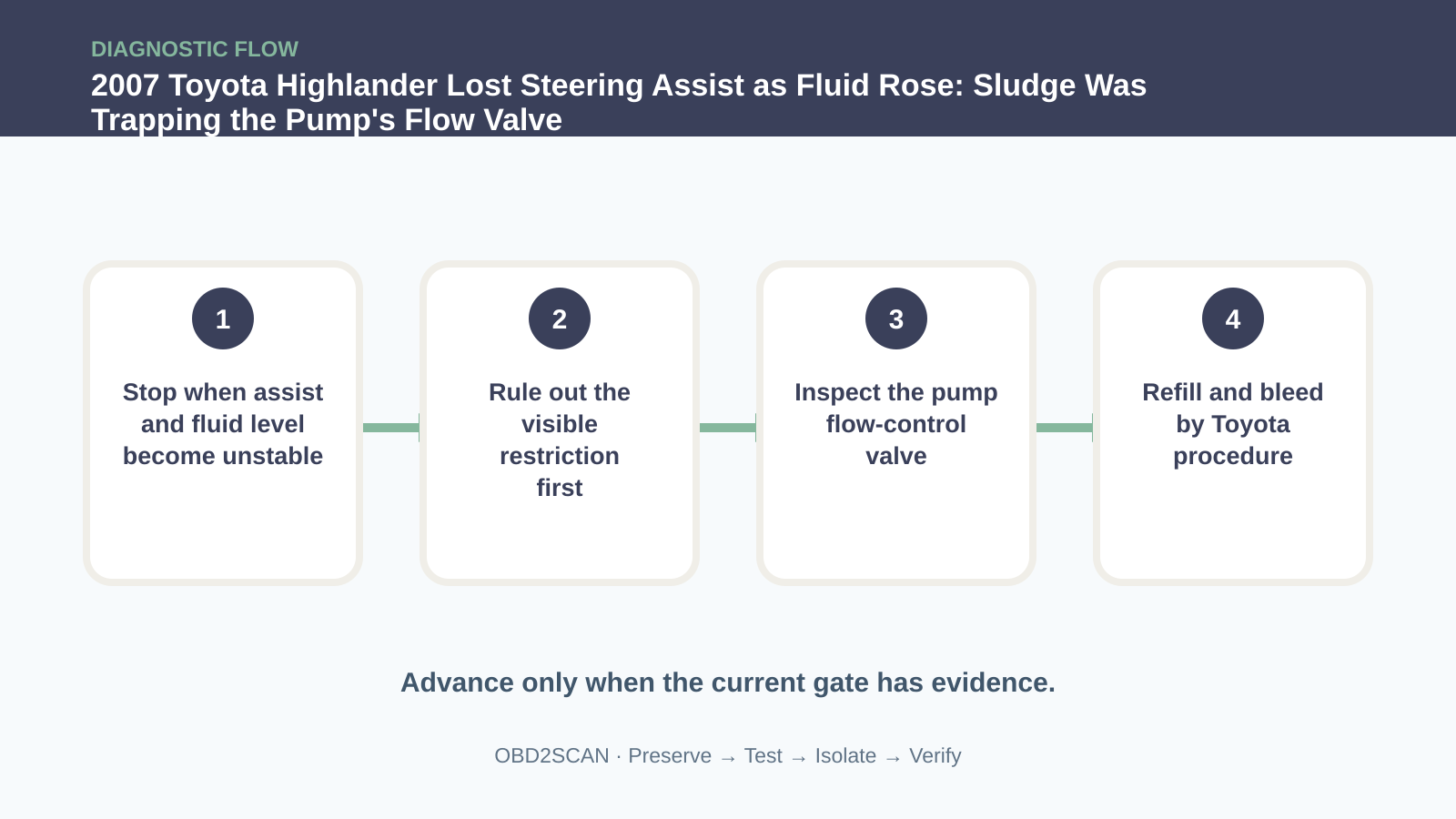
Rule out the visible restriction first
No hose was visibly kinked and the steering system had not been touched during the unrelated service. Inspect routing, collapsed hose walls, aeration and belt drive anyway, but use that history to resist blaming the most recent maintenance without a mechanism. Treat prior work as evidence, not blame. A repair that made no change can narrow the case when its installation and test conditions are verified.
Treat sludge as evidence of system condition
The reservoir showed gunk and sludge. Contamination supports a restriction or degraded-fluid path, but color alone cannot identify material or prove the pump. Sample only when safe, compare with the specified fluid and inspect whether debris has migrated through the reservoir screen and lines. At this stage, separate what was observed from what is inferred. The observation should remain true even if the current theory is later rejected.
| Observation | What it supports | What it does not prove |
|---|---|---|
| Reservoir level rises as assist fades | Circulation restriction is plausible | System needs more fluid |
| Sludge is visible | Contamination is present | Pump is automatically failed |
| Flow valve is cleaned | Regulating path is restored | All contaminated parts are reusable |
| Bleed restores stable assist | Restricted flow was causal here | Any noisy pump only needs cleaning |
Inspect the pump flow-control valve
The pump flow-control valve regulates hydraulic delivery. A valve that sticks with contamination can produce noise, poor circulation and changing reservoir behavior. Removal and inspection require cleanliness; a small particle introduced during diagnosis can recreate the same restriction. This is the decision point in the documented case. Its value comes from changing one bounded condition while leaving the rest of the system intact.
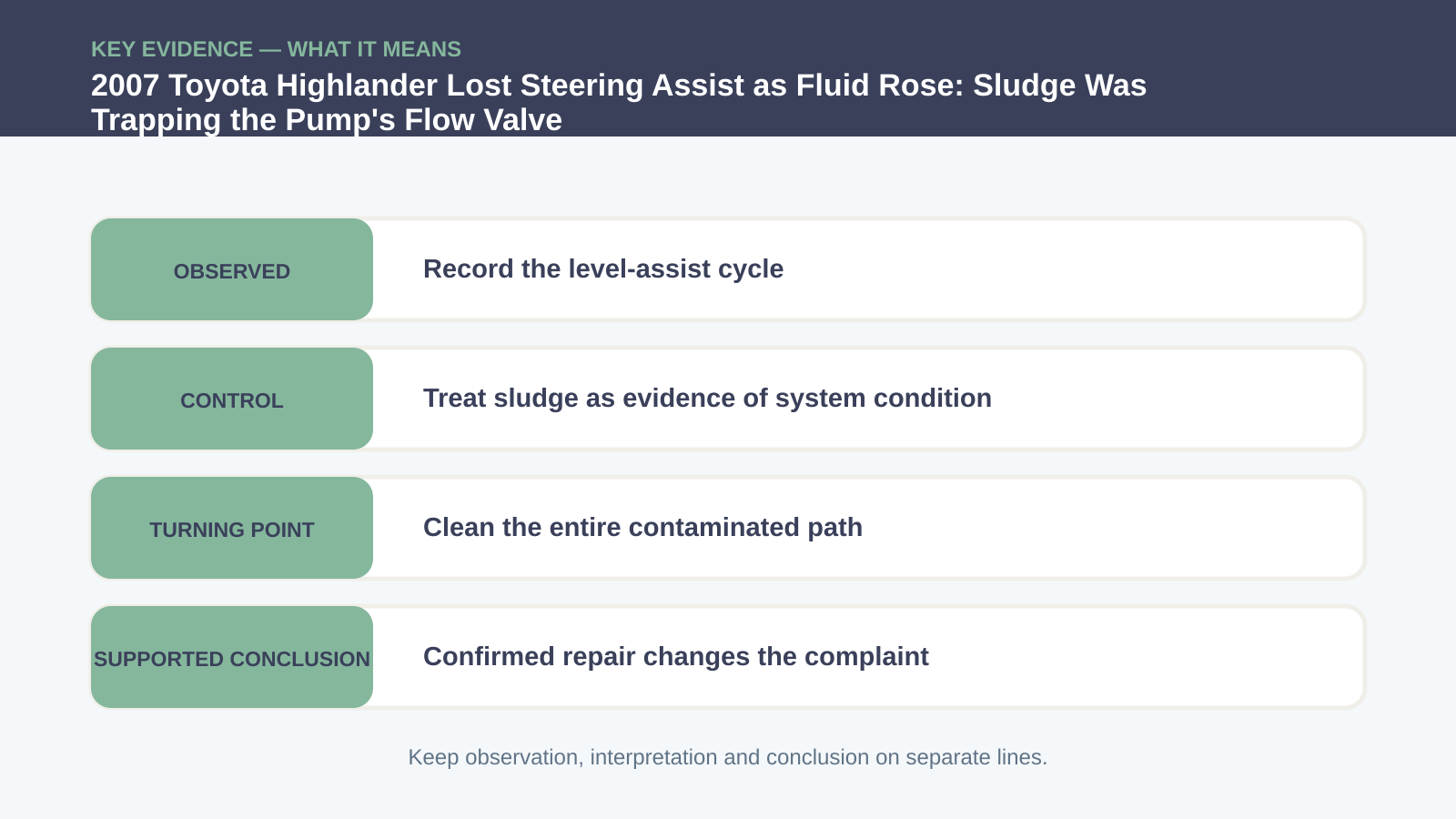
Clean the entire contaminated path
In the documented repair, the valve, lines and reservoir were cleaned. Any flushing or use of compressed air must follow the applicable procedure and component limits; never atomize unknown fluid toward people or the shop. Replace damaged hoses or screens rather than treating cleaning as universally sufficient. A confirmed component still needs a repair that restores sealing, support, torque, routing or terminal fit—the physical conditions that keep the fault from returning.
Refill and bleed by Toyota procedure
Refill with the exact specified fluid and bleed air by Toyota’s method. Monitor foaming, level and pump noise without holding the steering against the stops. Aerated fluid can mimic a remaining pump problem, so allow bubbles and temperature to stabilize before judging assist. Reassemble protective covers and retainers before declaring success. A diagnostic shortcut must not become the next failure mechanism.
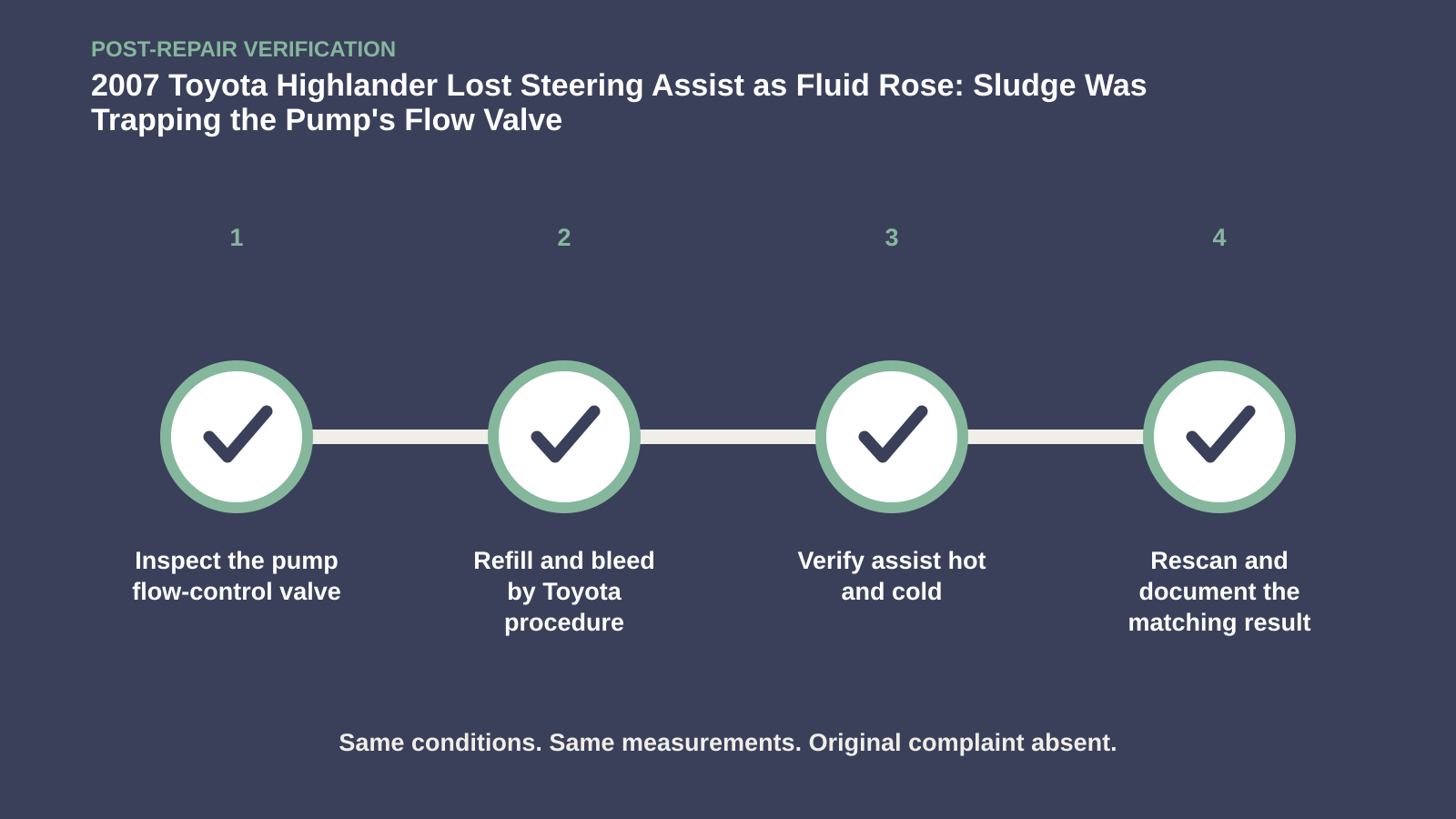
Verify assist hot and cold
Verify consistent assist from cold through operating temperature, stable reservoir level, no leaks and no abnormal pump noise. Inspect belt contamination and complete a controlled road test. This case closes on restored circulation; another Highlander with metal debris or pump damage may need a different repair. Use the customer’s original complaint as the final specification. A cleared code, quiet bay or one good key cycle is not equivalent to reproducing and passing that condition.
If you are bringing a similar symptom to a shop, arrive with the useful conditions rather than a requested part: whether the vehicle was cold or hot, the exact speed or switch position, which warning lamps appeared, what changed after a restart, and a chronological list of earlier repairs. A short video can preserve an intermittent sound or lamp pattern, but record it only while parked or with a passenger handling the camera. Ask the technician to retain the pre-repair scan and measurements, explain the test that separated the failed path from the alternatives, and show how the original complaint was repeated afterward.
For the owner or service adviser, a useful repair explanation has three parts: what was observed, why the decisive test narrowed the fault, and which original condition passed after the repair. It should also say what the test did not prove. That boundary prevents a memorable case from becoming an automatic parts recommendation.
The rising fluid level and disappearing assist reflected a circulation problem, not a simple low-fluid complaint. Contamination restricted the pump’s flow-control valve; cleaning the contaminated path and correctly bleeding fresh fluid restored steering. The reusable lesson is narrower and more valuable: Build suspense around the reservoir level moving opposite to steering assist, then resolve it with flow rather than quantity.









Comments 0
Questions, fixes, and real-world diagnostic notes from readers.
Be the first to share a diagnostic result or ask a follow-up question.