
2012 Acura RDX Has Low Power and P2263: Check Whether the Wastegate Can Move

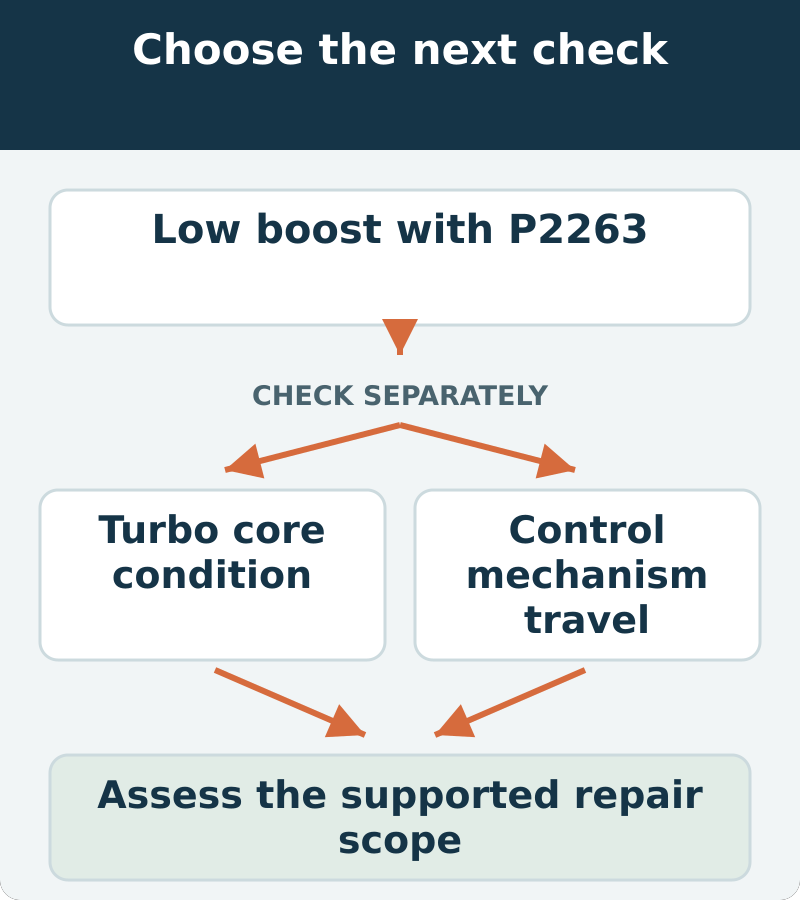
Quick answer: Low boost does not by itself prove the turbocharger rotating assembly has failed. The control mechanism and its mechanical travel deserve their own assessment.
A low-power turbocharged vehicle does not automatically need a new turbo core. Its control mechanism also deserves attention. An articulating camera such as the AUTOOL SVB308 can help a technician view a concealed linkage on cool, disabled equipment. The picture can show condition and access; it cannot establish boost pressure, permitted travel or repairability.

In this guide
A turbocharger has controls as well as a rotating core
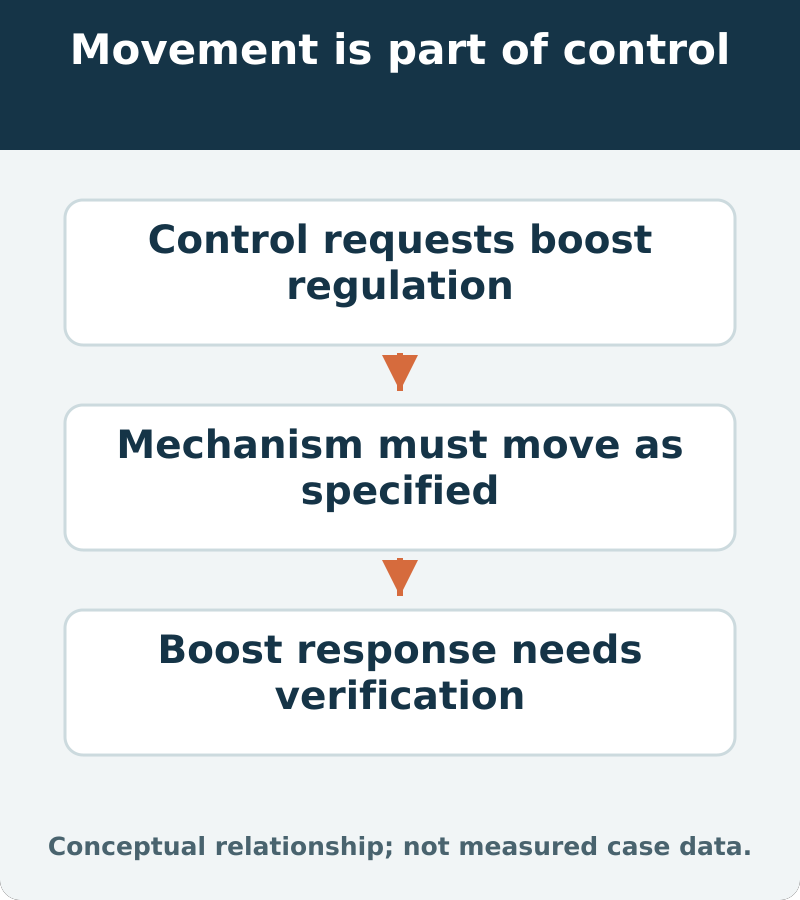
The turbo system has a rotating assembly and mechanisms that control how it operates. A performance complaint can therefore involve more than the condition of the rotating core. The repairer needs to assess the relevant air path, control requirements and mechanical behavior before deciding the replacement scope.
For the owner, the useful question is whether the estimate rests on a confirmed defect or only on low boost. Keep the exact code and complaint together. Neither should be discarded, but neither is a universal instruction to replace an entire assembly. A component name in a code description often identifies the system being assessed rather than the failed part.
What inspection can reveal while the engine is off
A cooled, disabled inspection may reveal corrosion, physical interference or other visible concerns around a mechanism. The technician then decides which approved checks are needed. A still image of a linkage cannot show that it travels correctly under every relevant condition.
Do not force a lever by hand, apply a general-purpose lubricant or place a camera near a running turbo drive or hot exhaust. Access and temperature are safety requirements, not inconveniences to work around. If the area is difficult to see, professional visual documentation may help explain the diagnosis without requiring the owner to touch or dismantle it.
A stuck mechanism still needs a repairability decision
Finding a seized or corroded mechanism creates another decision: is an approved, durable repair possible, or does the condition require replacement? The answer depends on the component design and actual damage. It cannot be supplied by the cost of a can of lubricant.
Ask the workshop to explain the permitted repair method, the condition that makes it suitable and any limitation or follow-up. The original case’s short-term success should not be expanded into a promise that every stuck wastegate can safely be freed. Corrosion severity and long-term behavior were not fully documented there. A cheaper intervention is only attractive if it is appropriate for the hardware.
In the published ALLDATA case, the RDX lacked power and stored P2263 with an intake check-valve fault. After the check valve showed no problem, inspection found a wastegate seized by corrosion. Freeing and lubricating the mechanism restored the reported performance. The account provides no corrosion-depth assessment or long-term durability record.
Do not adjust boost to hide the problem
Changing a boost setting to compensate for a mechanical control concern would introduce a new variable instead of settling the defect. Request restoration to the specified operation, not an adjustment designed to make the vehicle feel stronger while the underlying problem remains uncertain.
This also helps compare repair options fairly. One estimate may replace damaged hardware; another may propose a permitted service operation. Ask each provider what evidence supports its approach and what result it will verify. Do not compare them solely by the immediate bill or assume that the most expensive assembly is necessarily the best-supported diagnosis.
Keep the other fault in the reassessment
A case can focus on the finding that changed the repair while leaving less detail about another recorded fault. On your vehicle, any remaining or recurring code still needs assessment. It should not be dismissed merely because power improved after work on a visible mechanism.
Ask how the repairer will reassess the relevant control and air-path concerns once the confirmed defect is addressed. This is a decision point, not a demand for every possible test. If the original condition is gone and the required checks are satisfactory, that supports release. If contradictory evidence remains, the investigation stays open.
What to monitor after the car regains power
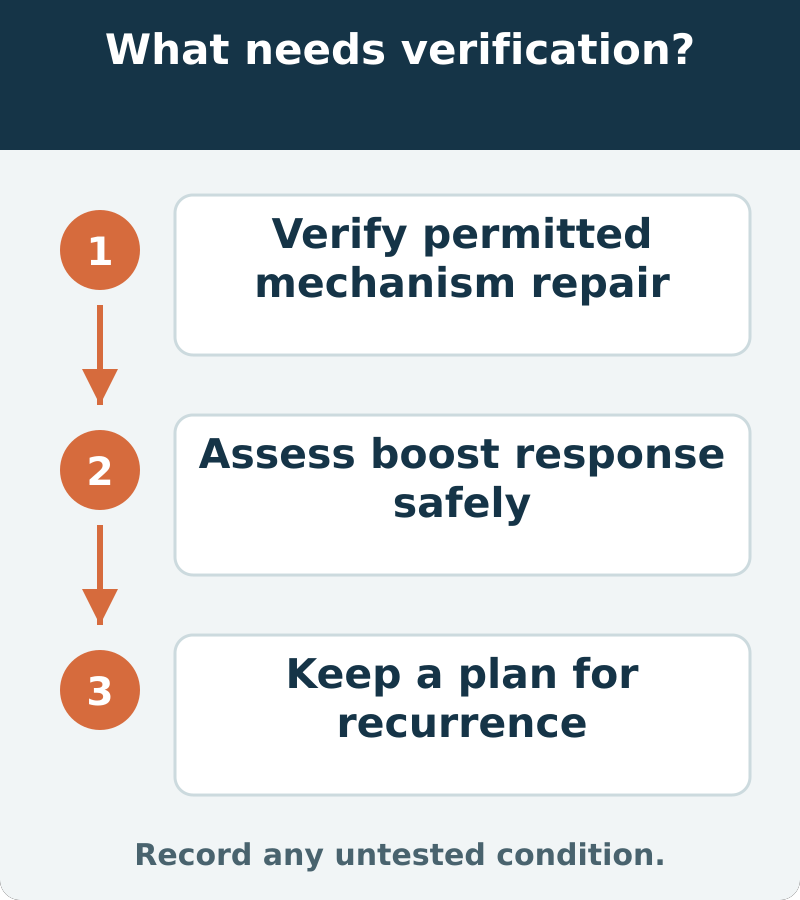
Collect a clear account of what was repaired, why it was considered serviceable and what post-repair behavior was checked. Ask for any recommended follow-up and the appropriate response to returning power loss or warnings.
Do not perform a hard public-road acceleration test to prove the repair yourself. Follow the workshop’s use advice, particularly if the original problem made merging or climbing unsafe. This RDX case is valuable because it expands the question from “is the turbo bad?” to “what part of its operation is failing?” The resulting repair decision should follow the condition found, not a blanket preference for cleaning, adjustment or replacement.








Comments 0
Questions, fixes, and real-world diagnostic notes from readers.
Be the first to share a diagnostic result or ask a follow-up question.