
2005 GMC Canyon Braked One Wheel by Itself: Live Data Caught the Right-Front Hub

One Wheel Brakes By Itself?
Intermittent brake lockup is not a symptom to reproduce in traffic. On a controlled loop, four wheel-speed traces let one right-front signal identify itself without guessing at an ABS module.
When this diagnostic path reaches a measurement question, the useful machine type is one that answers only that question. For that supporting role, the AUTOOL DM303 Circuit Tester is one practical option. A meter with waveform capability can inspect an accessible wheel-speed signal at a verified test point. It cannot substitute for synchronized four-wheel scan data, make a public-road lockup test safe, or prove the hub from a stationary reading.
<strong>Quick answer:</strong> The module acted on a false right-front speed signal. A repeatable PID dropout and hub damage justified assembly replacement, after which the codes and unwanted intervention ended. This article follows one documented vehicle. It explains the evidence chain, not a universal failure rate or a direction to replace the same part on every similar car. Stop whenever the test would involve overheated brakes, high current, moving parts, refrigerant handling or an uncontrolled road condition.
Quick answer: The module acted on a false right-front speed signal. A repeatable PID dropout and hub damage justified assembly replacement, after which the codes and unwanted intervention ended.
In this guide
Uncommanded braking changes the test venue
An ABS event that locks or slows one wheel can change vehicle direction. Testing belongs on a closed low-speed course with a qualified driver, observer and clear stop rule. Save C0221 and C0040 before repair; never chase intermittent lockup in normal traffic. Preserve the original condition before changing it. The first observation is the control sample against which every later test must be compared.
Save both ABS codes before clearing
Inspect tire sizes, inflation, wheel bearings, sensor connectors and visible harness routing before a road loop. Tire mismatch can create speed disagreement, while a loose hub can disturb the air gap. These checks narrow risk but cannot replace data captured when the event occurs. Use service information for the exact engine, build date and options. A correct method on the wrong terminal can create a precise but useless result.
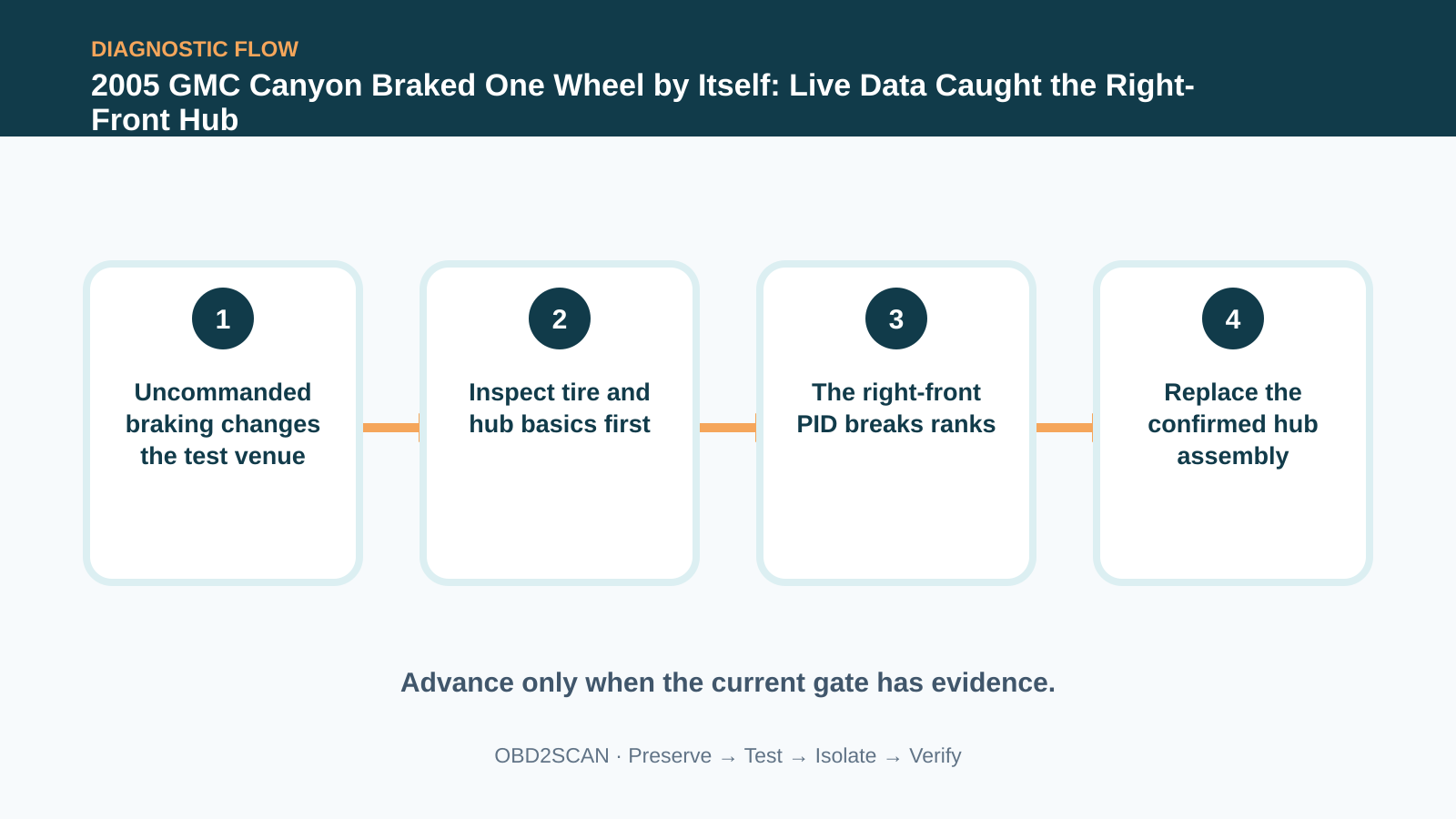
Inspect tire and hub basics first
Graph all four wheel-speed PIDs on one time axis through the speed and maneuver that reproduce the complaint. Use the same route and direction each pass. A single displayed number updates too slowly and makes a momentary dropout easy to miss. Treat prior work as evidence, not blame. A repair that made no change can narrow the case when its installation and test conditions are verified.
Graph all four wheel speeds together
The right-front trace dropped and became erratic while the other three remained plausible. That comparison matters more than an arbitrary speed value. It connects the module’s intervention to one false input, but the signal still could fail at sensor, connector, harness or hub. At this stage, separate what was observed from what is inferred. The observation should remain true even if the current theory is later rejected.
| Observation | What it supports | What it does not prove |
|---|---|---|
| C0221/C0040 stored | Wheel-speed path needs testing | Hub is failed |
| RF PID drops alone | Right-front input is false | Sensor versus wiring is settled |
| Hub damage found | Mechanical source is supported | Connector is perfect |
| New hub passes same road loop | Assembly was causal | One trip proves durability |
The right-front PID breaks ranks
Raise and support the Canyon, then inspect the right-front hub for play, roughness, corrosion, impact and wiring damage. Back-probe only approved terminals. A scope can inspect signal shape, while scan data shows what the controller actually receives; neither alone proves mechanical condition. This is the decision point in the documented case. Its value comes from changing one bounded condition while leaving the rest of the system intact.
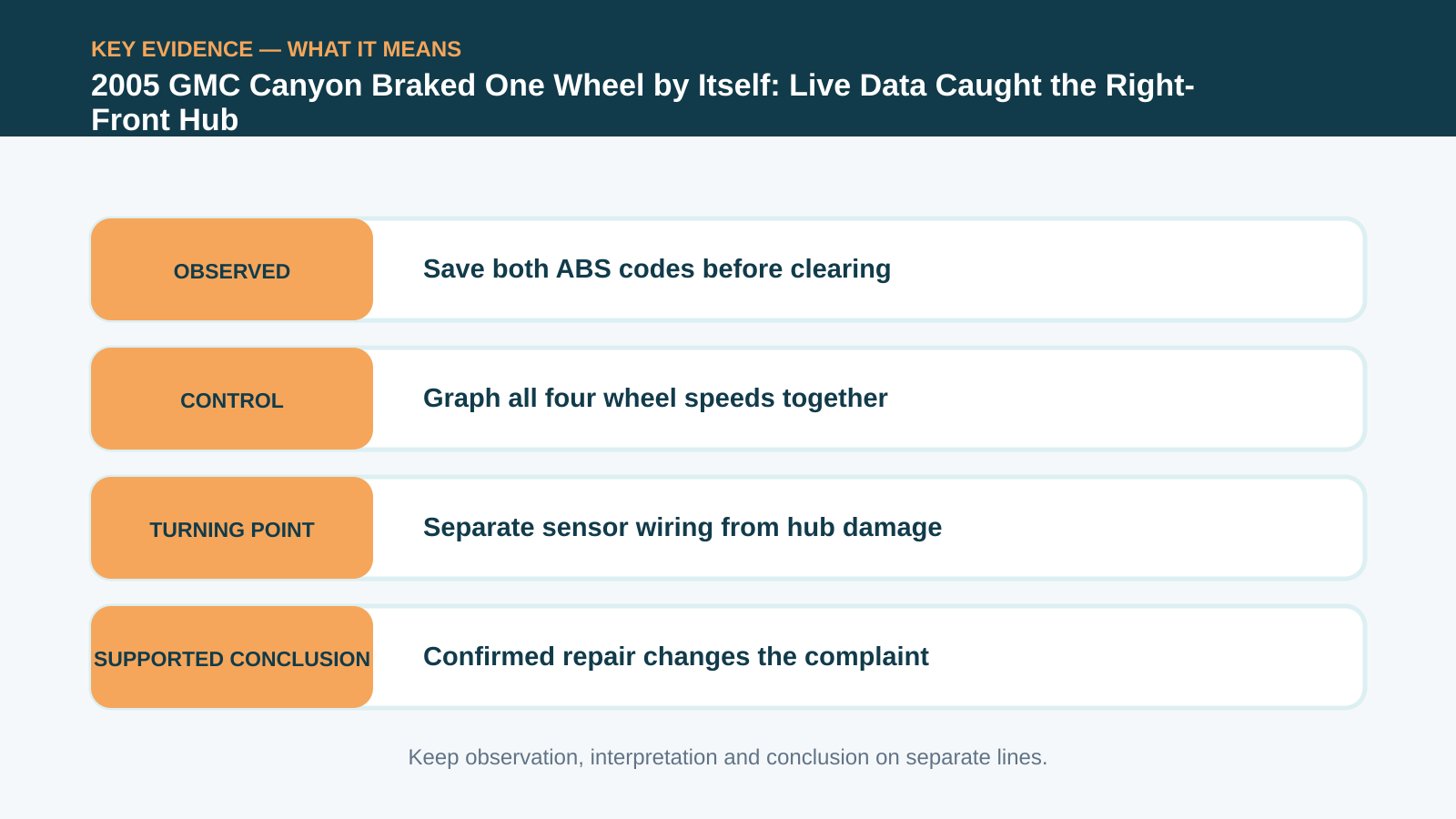
Separate sensor wiring from hub damage
Damage at the hub supported replacement of the integrated assembly. Clean the mounting surface, route the sensor lead exactly, torque fasteners to specification and protect the connector. A pinched new lead can produce the same code before the truck leaves the lift. A confirmed component still needs a repair that restores sealing, support, torque, routing or terminal fit—the physical conditions that keep the fault from returning.
Replace the confirmed hub assembly
Clear codes only after retaining the evidence. At low speed, confirm each wheel reports from the first movement and no trace drops through turns. Then increase speed gradually on the closed route while monitoring for unintended ABS operation. Reassemble protective covers and retainers before declaring success. A diagnostic shortcut must not become the next failure mechanism.
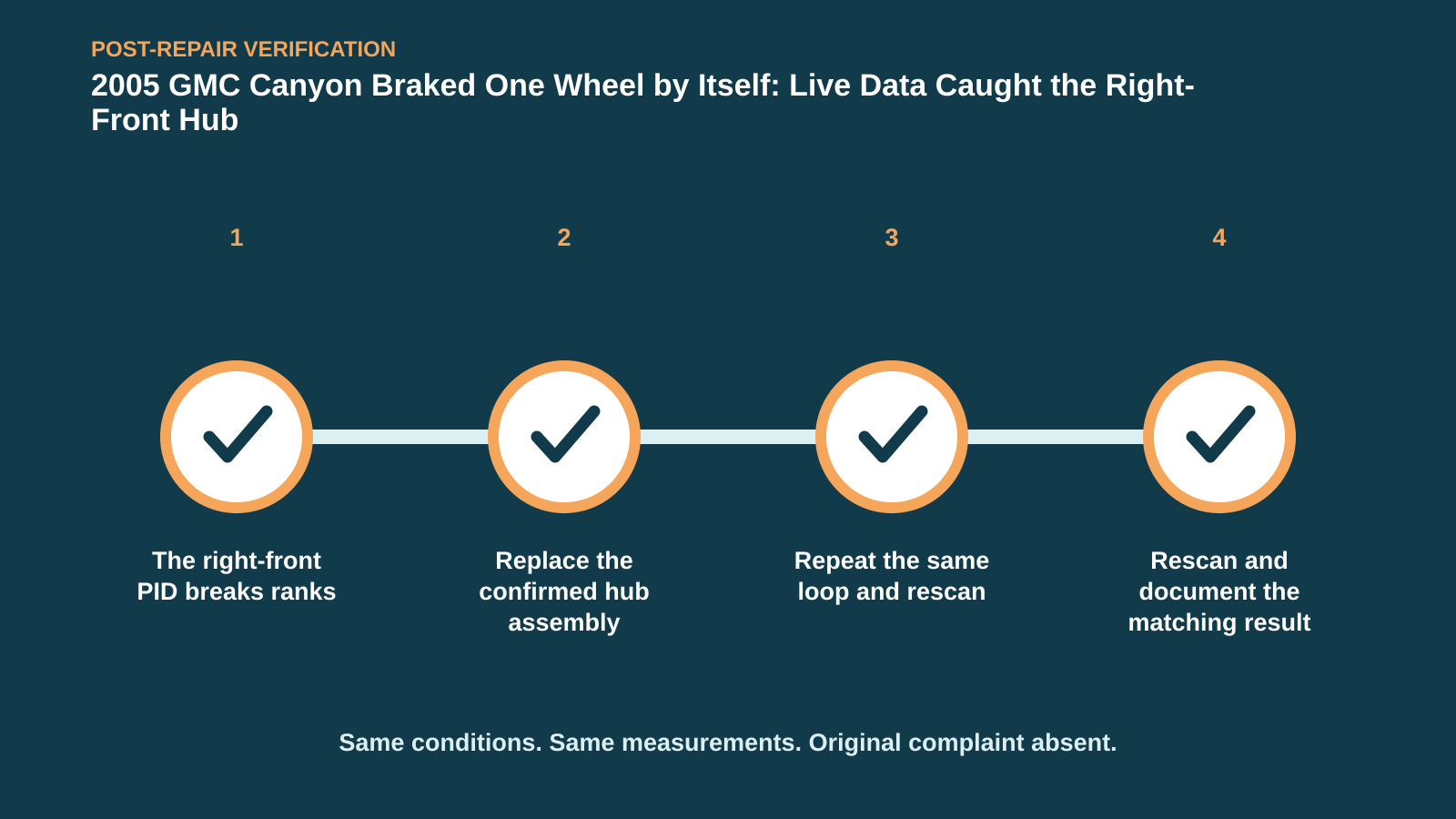
Repeat the same loop and rescan
Repeat the original lockup condition several times, test normal straight braking and rescan. Inspect hub temperature and fastener security after the drive. Stable four-wheel data, no intervention and no returning codes make the repair stronger than a warning lamp that happens to stay off. Use the customer’s original complaint as the final specification. A cleared code, quiet bay or one good key cycle is not equivalent to reproducing and passing that condition.
If you are bringing a similar symptom to a shop, arrive with the useful conditions rather than a requested part: whether the vehicle was cold or hot, the exact speed or switch position, which warning lamps appeared, what changed after a restart, and a chronological list of earlier repairs. A short video can preserve an intermittent sound or lamp pattern, but record it only while parked or with a passenger handling the camera. Ask the technician to retain the pre-repair scan and measurements, explain the test that separated the failed path from the alternatives, and show how the original complaint was repeated afterward.
For the owner or service adviser, a useful repair explanation has three parts: what was observed, why the decisive test narrowed the fault, and which original condition passed after the repair. It should also say what the test did not prove. That boundary prevents a memorable case from becoming an automatic parts recommendation.
The module acted on a false right-front speed signal. A repeatable PID dropout and hub damage justified assembly replacement, after which the codes and unwanted intervention ended. The reusable lesson is narrower and more valuable: Center the story on the safe road loop and the one PID that breaks ranks.






Comments 0
Questions, fixes, and real-world diagnostic notes from readers.
Be the first to share a diagnostic result or ask a follow-up question.