
Komatsu 138US Hunted and Smoked Only When Hot: A MAF Housing Had Cut the Boost Hose

Hunts Only When Hot? Watch The Boost Hose
A 2016 Komatsu 138US ran acceptably cold, then hunted and made black smoke under hydraulic load after it warmed. The fault looked electronic from the seat because engine speed rose and fell in a repeatable cycle. From the top of the machine, however, the cycle had a sound: boost air escaping through a hose rubbed open by the adjacent airflow-meter housing.
A low-pressure automotive smoke machine can help screen accessible intake joints with the engine off. The MRCARTOOL T80 is one example that can support this early leak search after the intake is isolated correctly. T80 can introduce low-pressure smoke to screen accessible intake joints with the engine off. It does not reproduce hot dynamic boost, may miss a slit that opens only under higher pressure and cannot justify operating an excavator outside a safe load procedure.
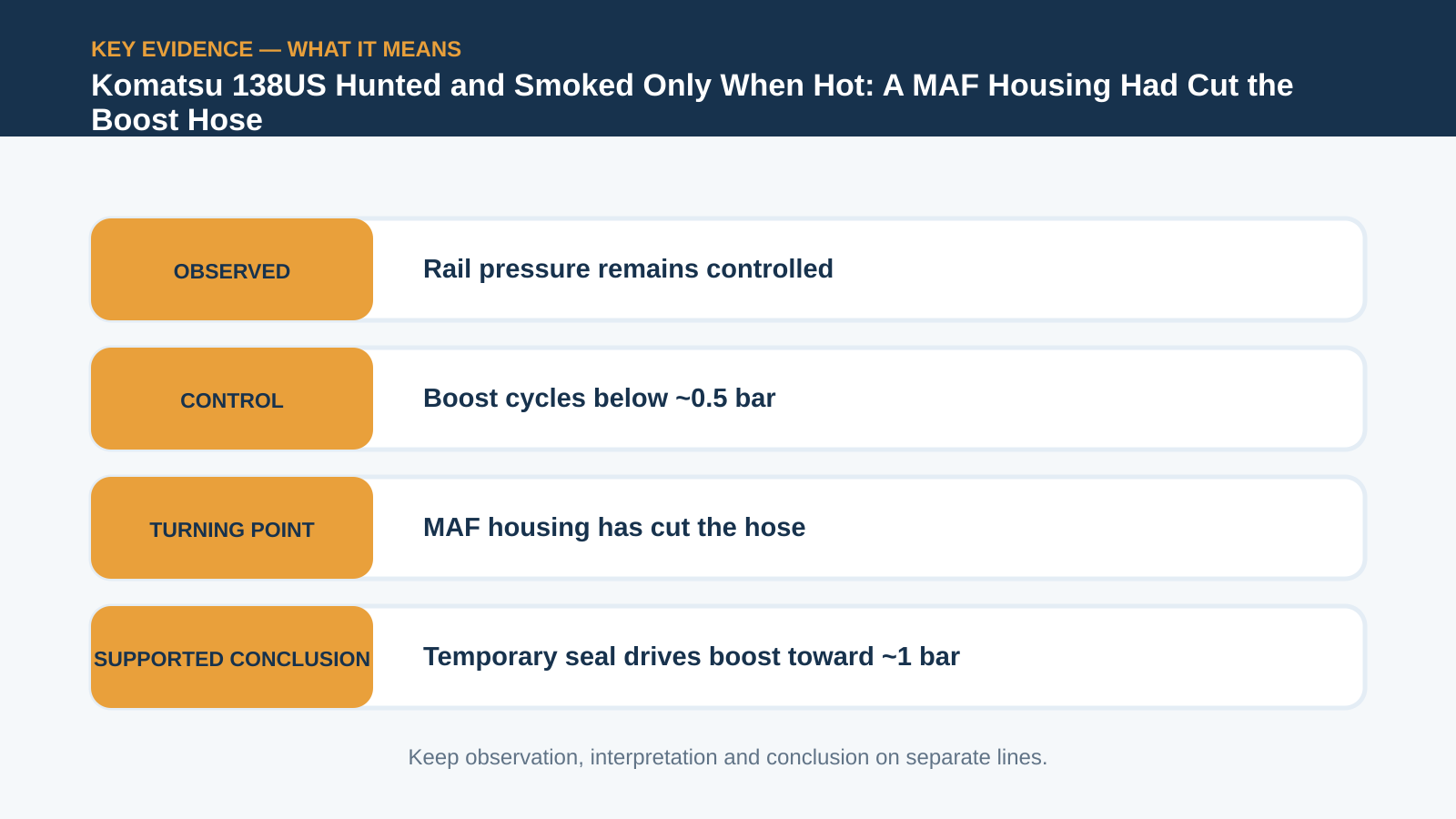
Hydraulic pressure was correct at roughly 340 bar and fuel rail pressure followed command, but boost fell below about 0.5 bar and rebuilt repeatedly. A controlled temporary seal made pressure rise steadily toward 1 bar, stopped the hunt and greatly reduced smoke. That A/B result confirmed the leak; the durable completion is correct hose replacement and clearance correction, not leaving the temporary patch in service.
Quick answer: Hydraulic and rail pressure remained credible, but hot boost cycled below 0.5 bar. A MAF housing had cut the boost hose; a controlled seal stopped the hunt.
In this guide
- Reproduce the complaint from cold to fully hot
- Prove the hydraulics are not overloading the engine
- Use rail pressure to move fuel down the list
- Watch airflow and manifold pressure through the hunt
- Listen from the place the operator cannot
- Trace every rub point in the boost path
- Use a temporary seal only as an A/B test
- Fit the hose and verify the same hot load again
Reproduce the complaint from cold to fully hot
Reproduce the complaint as a temperature-and-load timeline. Record coolant and intake temperatures, engine rpm, hydraulic function and time from cold start. Use a qualified operator and keep every person outside the machine’s swing, crush and attachment zones. Do not deadhead hydraulics longer than the manufacturer permits. Stop for uncontrolled movement, severe smoke, overheating or abnormal turbo noise. A problem that appears only hot often depends on softened rubber, expanded clearances or heat-soaked electronics; warming the machine is part of the test, not a nuisance.
Prove the hydraulics are not overloading the engine
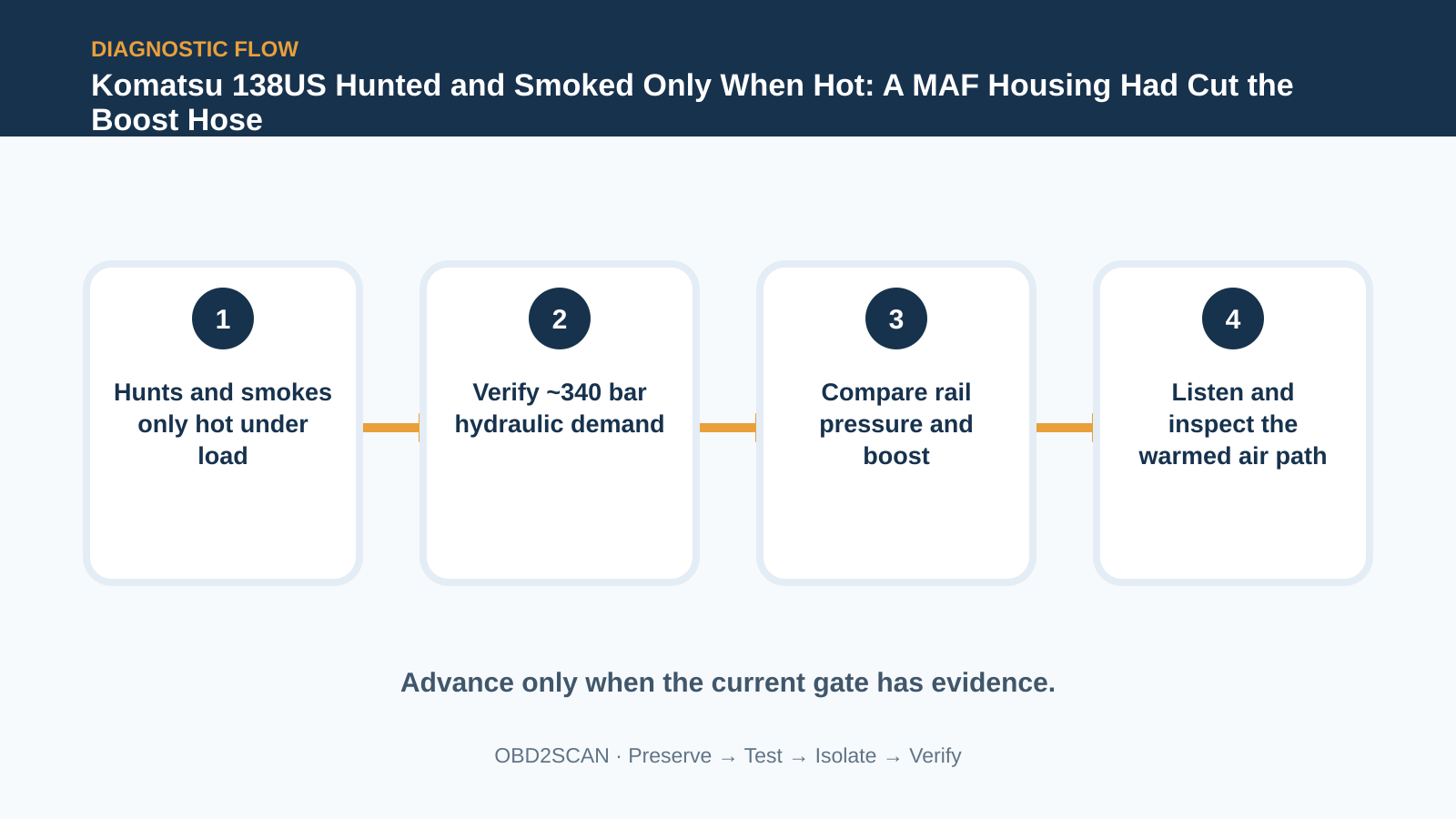
Before blaming the engine, prove the hydraulic load is reasonable. The system in this case reached about 340 bar, consistent with the service expectation used during diagnosis. Watch whether one function creates the symptom or any high-load command does. Excessive hydraulic pressure can drag engine speed down, while low pressure can point to a separate hydraulic problem. Use rated transducers and trained procedures. Once load pressure is correct, the hunt deserves an engine air, fuel and control investigation rather than relief-valve adjustment.
Use rail pressure to move fuel down the list
Compare rail-pressure command and actual value through several hunt cycles. If actual pressure repeatedly collapses before rpm falls, fuel supply or control deserves priority. Here, rail behavior remained controlled enough to move fuel down the list. Also check engine speed sensing and injector balance as appropriate, but resist replacing fuel parts because the exhaust is black. Black smoke tells us oxygen and delivered fuel are mismatched; it does not say whether the missing air escaped, was restricted or was never commanded.
Watch airflow and manifold pressure through the hunt
Capture airflow and manifold pressure from cold through the loaded hot event. Boost in the documented test cycled below about 0.5 bar instead of building steadily. Align that trace with rpm and hydraulic load. A smoke test can reveal a static opening before operation, but hot rubber may open differently and some slits leak mainly under positive pressure. Never pressurize beyond the intake-system procedure. Data’s role is to choose the air path confidently enough that physical inspection becomes focused rather than a tour of the entire engine.
Listen from the place the operator cannot
Move to a position where the operator cannot listen. From the service platform, the escaping-air sound became clear. With the machine shut down, locked out and cool enough to touch, trace the turbo-to-intercooler hose by hand and eye. Look at hidden undersides, clamps and every hard object close to the hose. The airflow-meter housing had cut through it. A borescope or mirror can help with inaccessible surfaces, but the important inspection includes the contact relationship, not just the hole.
| Observation | Meaning in this case | What it did not prove alone |
|---|---|---|
| Hydraulic pressure about 340 bar | Machine load was credible | Engine air path was healthy |
| Rail pressure follows command | Major fuel-pressure collapse less likely | Every injector is perfect |
| Boost cycles below about 0.5 bar | Air delivery repeatedly fails under load | Exact leak location |
| Temporary seal approaches 1 bar | Rub-through caused the hunt | Patch is a permanent repair |
Trace every rub point in the boost path
A temporary seal was used only to change one variable for a controlled repeat test. It made boost build steadily toward about 1 bar, stopped hunting and sharply reduced smoke. That is strong cause-and-effect evidence. Remove the temporary material after the test. Adhesive, tape or an improvised sleeve may fail with heat, oil and boost, and loose material can enter the intake. Fit the correct pressure- and temperature-rated hose, renew damaged clamps and change the housing or routing clearance that created the rub.
Use a temporary seal only as an A/B test
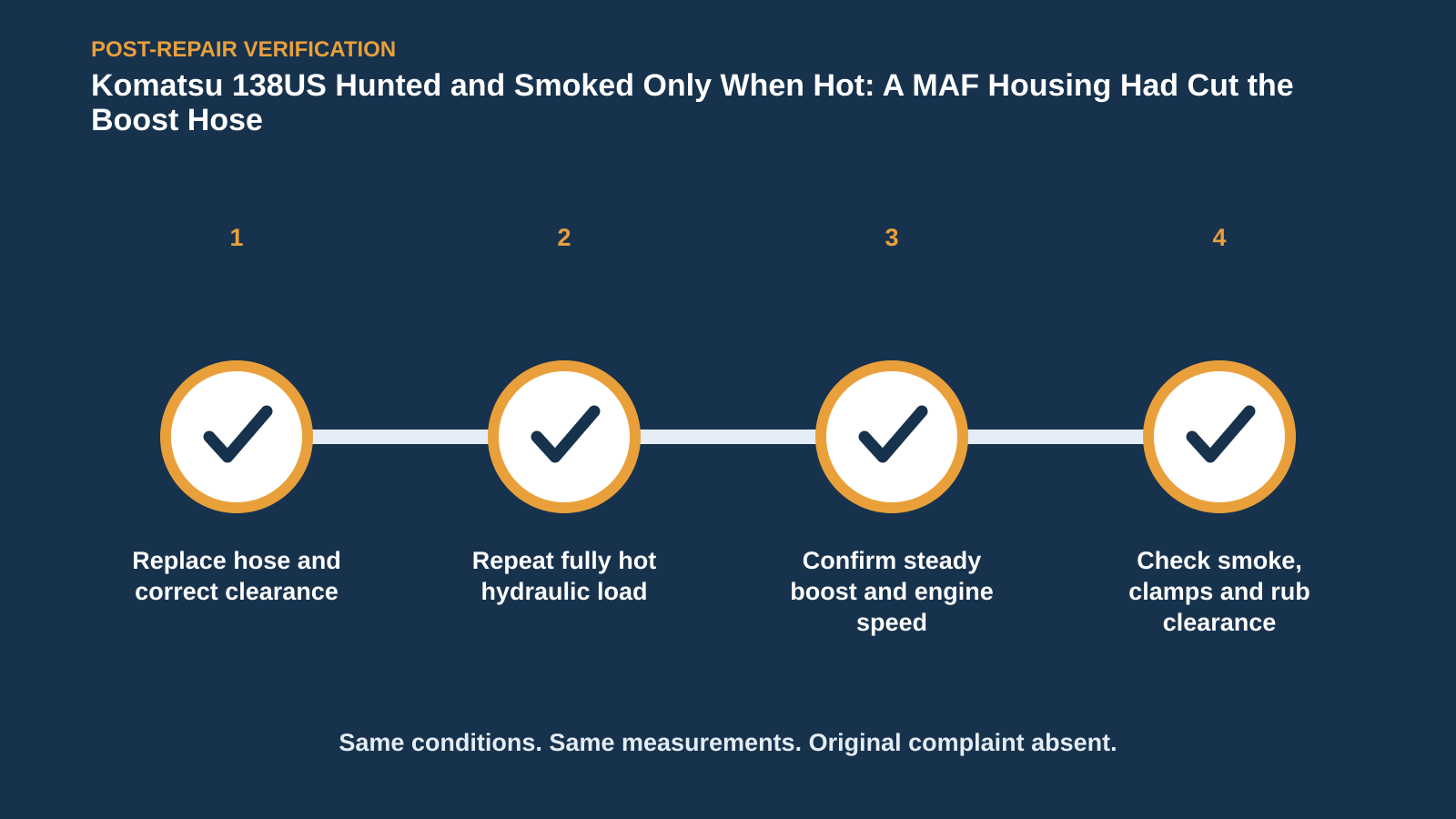
Repeat the full hot hydraulic-load test—not an unloaded throttle snap. Compare boost rise, engine speed, rail behavior and smoke against the original recording. Inspect the new hose under engine movement to ensure it cannot touch the housing. Recheck clamp seating and listen for leaks after heat soak. The source case documented the temporary seal’s immediate A/B improvement; a responsible completed repair adds permanent hose replacement and a same-condition validation rather than presenting the patch as the finish.
Fit the hose and verify the same hot load again
Give the operator a practical watch list: return of black smoke under the same function, new air-rush noise, oily mist around boost joints or a change in power only after warm-up. Schedule a clearance inspection after the hose has experienced real work. This was one machine with one physical rub point, not evidence that every hot-hunting Komatsu has the same hole. The repeatable method is to separate load, fuel and air—and then place a human where the failing system can be heard.
The graphs selected the intake system; a technician’s ears found the exact spot. Data and physical inspection were not competing methods here—they met at the hose, and the controlled seal made the diagnosis answer back.








Comments 0
Questions, fixes, and real-world diagnostic notes from readers.
Be the first to share a diagnostic result or ask a follow-up question.