
1999 Chevy Silverado C0237 Was Not a Wheel-Speed Fault: The EBCM Crashed Class 2

Abs Code—But The Whole Data Line Drops
At 40 to 50 mph, the Silverado turned on its ABS and brake lamps while the fuel and volt gauges fell. C0237 seemed to point toward wheel speed, but a wheel sensor cannot easily explain two unrelated gauges and the simultaneous disappearance of PCM and ABS scan data. The live event was larger than the history code.
A breakout box can provide non-destructive access to the identified diagnostic-link power, grounds and single-wire data line. The AUTOOL OBD2 Breakout Box Premium can support that observation when paired with the correct meter or scope. The OBD2 breakout box can expose the identified Class 2 DLC line plus DLC power and grounds for measurement. It cannot separate SP205 branches, decode module intent or make unplugging a controller safe without a wiring diagram.
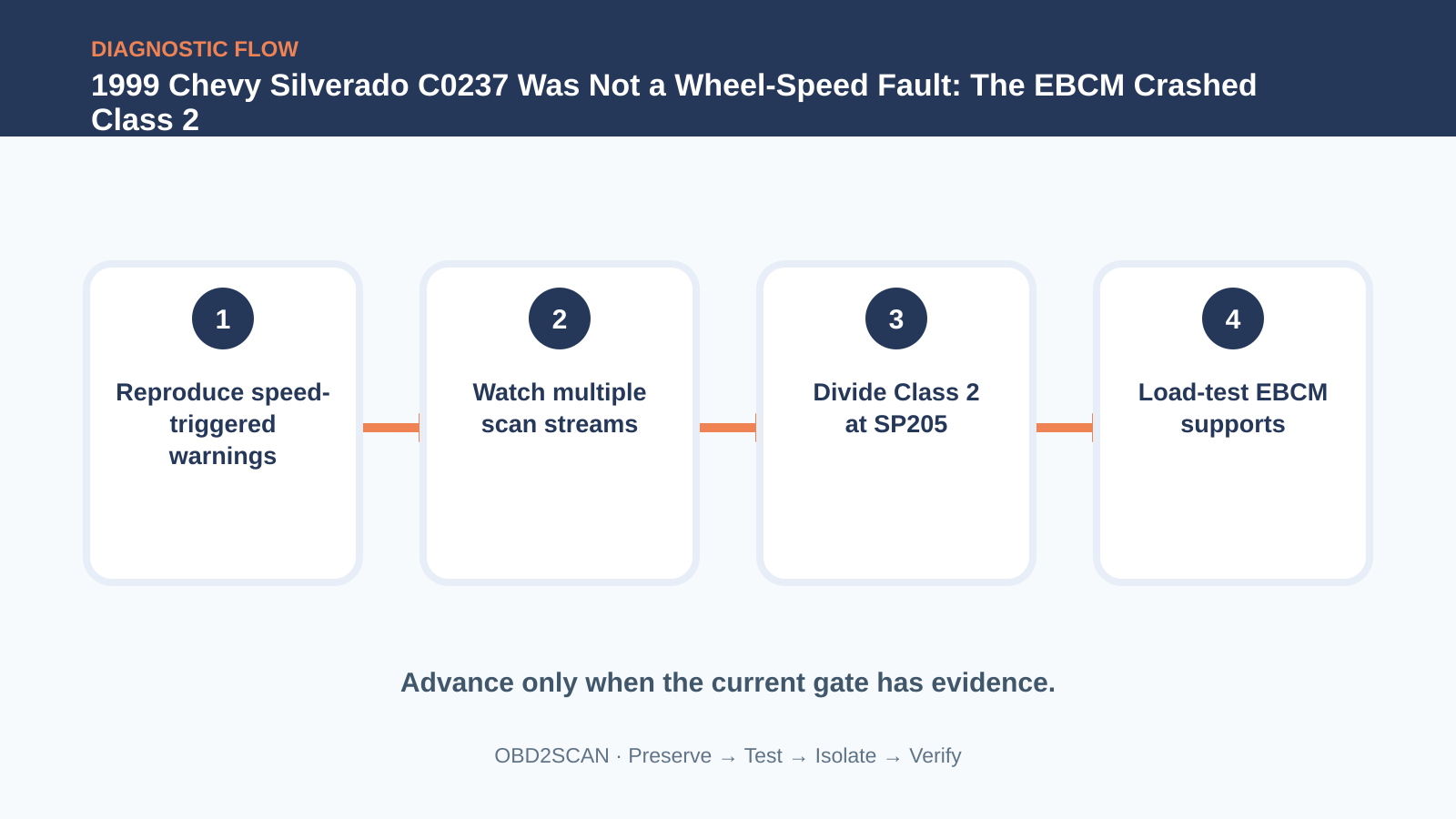
The technician reproduced the speed-dependent failure, saw communication vanish from two controllers, and divided the Class 2 network at splice pack SP205. Removing the EBCM branch stopped the collapse. After the module’s connector, power and frame ground passed inspection and a headlamp load test, EBCM replacement restored the truck without the warning or gauge event.
Quick answer: Live data and gauges failed together because the EBCM crashed the Class 2 bus; its power and ground passed before replacement.
In this guide
- C0237 was history, not the whole event
- Reproduce the 40-to-50-mph failure safely
- Notice which scan streams disappear together
- Use SP205 to divide the Class 2 network
- EBCM isolation stopped the collapse
- Load-test power and ground before condemning it
- Replace the module only after its supports pass
- Road-test gauges, lamps and communication together
C0237 was history, not the whole event
Read C0237 in context before following its tree. Determine whether it is current, history or intermittent, save freeze-frame if available, and scan every module that will communicate. In this truck the complaint included an ABS lamp, but also a red brake lamp and two gauges falling together. Ask what happens first and at exactly what speed. Verify brake-fluid level and basic brake safety before any road test. A stored code remains useful history; it simply should not be allowed to erase a broader live symptom that points beyond one wheel circuit.
Reproduce the 40-to-50-mph failure safely
Reproduce the event on a safe route with a second technician or controlled chassis equipment so the driver is not watching a scan tool. Begin below the trigger speed, log module communication and gauge data, and stop if braking behavior becomes abnormal. The 40-to-50-mph window is a condition, not proof of a rotating part. Road vibration, charging load, network traffic or a module routine can all change with speed. Repeatability lets the workshop compare one network configuration with another without turning random connector movement into a conclusion.
Notice which scan streams disappear together
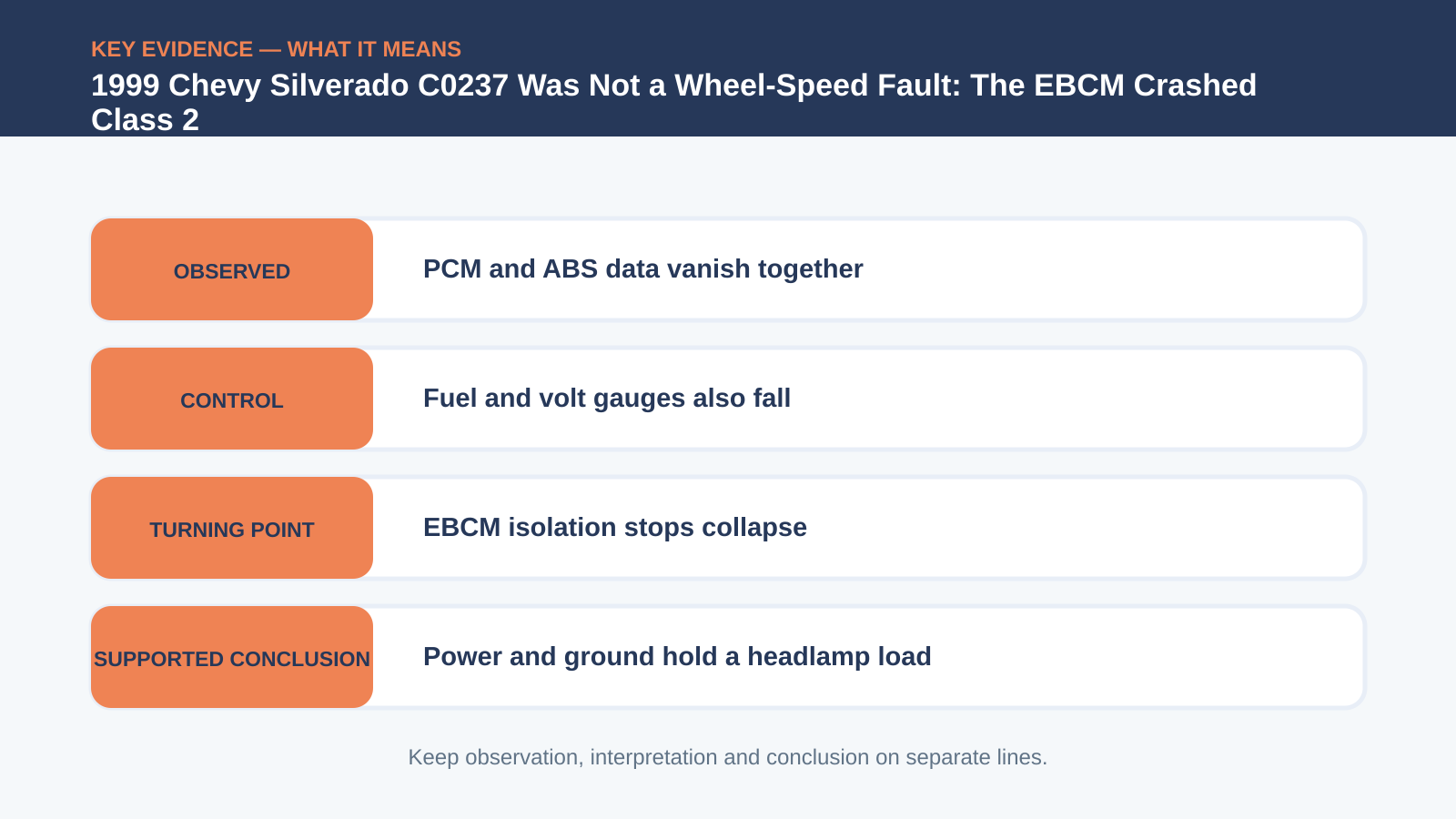
When the failure appeared, scan data from both the powertrain controller and ABS controller disappeared. That matters more than a single no-communication message after key-off. The fuel and volt gauges also lost information, which is consistent with a shared Class 2 communication disturbance. Check diagnostic-link power and grounds first, then observe the single-wire bus with the correct equipment. Do not expect a basic code reader to remain authoritative while the communication path it uses is collapsing. The absence of data during the event is itself data.
Use SP205 to divide the Class 2 network
The Silverado’s splice pack SP205 provided a legitimate way to divide the Class 2 network into branches. Use the exact wiring diagram, connector views and module shutdown instructions for the vehicle; do not pull random modules on a powered bus. Label each branch and change only one at a time. If the network returns when one branch is isolated, the suspect boundary includes that branch, its harness and its module. It does not yet prove the controller is internally failed. This disciplined division turns a vehicle-wide symptom into a manageable section of wire.
| Observation | Diagnostic meaning | Remaining question |
|---|---|---|
| C0237 stored as history | ABS saw an earlier speed-related fault | Is it cause or collateral evidence? |
| PCM and ABS data vanish together | Shared communication is disturbed | Which branch is loading the bus? |
| Fuel and volt gauges fall simultaneously | Event extends beyond wheel-speed data | Is power, ground or Class 2 lost? |
| EBCM branch removed and symptom stops | Fault is confined to that branch | Module, connector or wiring? |
EBCM isolation stopped the collapse
With the EBCM branch disconnected at SP205, the truck could pass through the former speed window without the communication and gauge collapse. Reconnect it and confirm the failure returns before assigning cause, provided the procedure is safe and no required braking control is compromised. An isolation test is persuasive because it changes one electrical participant rather than replacing a part. Still inspect the wire from the splice to the EBCM for a rub-through or short; a damaged branch can pull a bus down just as effectively as failed module electronics.
Load-test power and ground before condemning it
The EBCM connector and frame ground were inspected, then power and ground were challenged with a headlamp as a meaningful load. This is different from seeing 12 volts on a high-impedance meter. Corrosion or a broken strand can display voltage with almost no current yet collapse when the module operates. Choose a load the circuit is designed to support, protect electronic outputs, and measure voltage drop on both sides. In this case the feeds and grounds held the load, removing the module’s basic supports from the remaining explanation.
Replace the module only after its supports pass
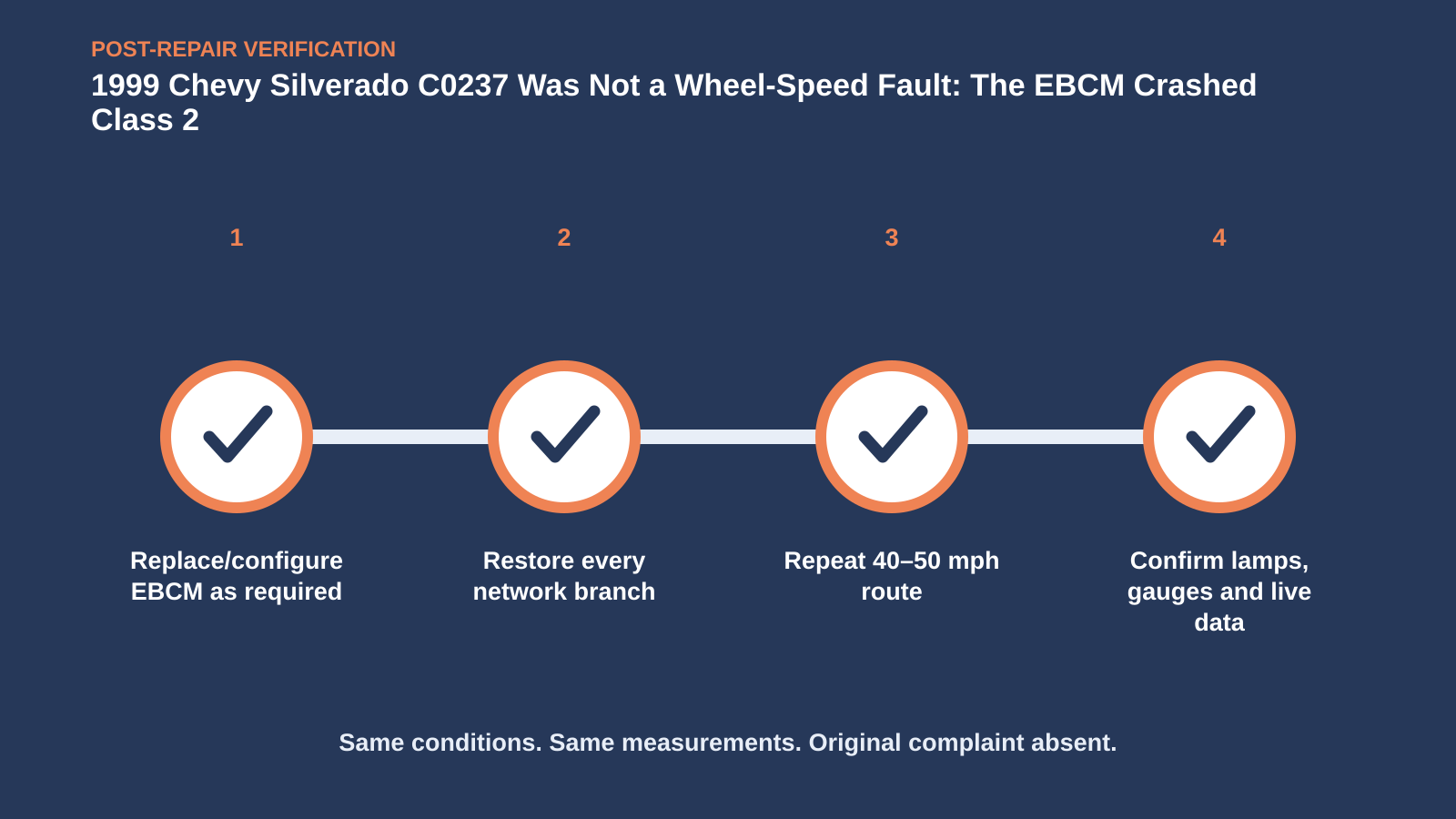
Only after network isolation and loaded support-circuit checks did EBCM replacement become justified. Follow service information for battery state, module handling, setup and any required bleeding or programming. Repair terminal tension or frame-ground problems rather than hiding them beneath a new controller. Clear codes after the original record is preserved. A successful module swap here does not make every C0237 an EBCM fault; the decisive evidence was the repeatable whole-network event and the branch-specific A/B test.
Road-test gauges, lamps and communication together
The final road test must revisit the same 40-to-50-mph threshold while watching more than the ABS lamp. Confirm fuel and volt gauges remain stable, PCM and ABS data continue updating, no current or pending chassis codes return, and braking remains normal. Recheck charging voltage and all network modules after the drive. The documented replacement stopped the combined event, closing both halves of the complaint. A repair that only cleared C0237 but left the gauges falling would have failed the driver’s actual problem.
C0237 invited a wheel-speed repair, but the truck told a wider story. Once the lost scan streams and falling gauges were treated as one network event, SP205 and a real load test made the EBCM conclusion defensible.









Comments 0
Questions, fixes, and real-world diagnostic notes from readers.
Be the first to share a diagnostic result or ask a follow-up question.