
2018 Ford Escape Cranked After an Engine Swap but Would Not Start: The Pulley Had Moved

Cranks After Engine Swap? Audit The Unkeyed Pulley
The original Escape engine ran before removal; the used replacement cranked but never fired. That before-and-after boundary is more valuable than a long generic no-start list. Fuel, spark and crank-sensor checks were present, so the investigation moved to a component delivered already attached to the engine—and to an assumption that had never been verified.
One useful machine class at this stage is a bounded measurement tool, chosen only after the circuit or system question is defined. The AUTOOL DM303 is one route for that supporting task. DM303 can support bounded checks of an identified crank or cam sensor circuit and view one signal. It cannot display two-channel phase, set timing, replace Ford alignment tools or authorize blind probing.
This article follows one documented vehicle. Its cause is a useful diagnostic pattern, not a failure-rate claim and not permission to replace the same part on a similar symptom. The goal is to show which evidence changed the decision and how the repair was verified.
Quick answer: Fuel and ignition were present, but the replacement engine’s loose unkeyed balancer shifted mechanical timing. Correct positioning with Ford tools restored starting.
In this guide
- After a swap, the work boundary matters
- Prove the engine has the three starting requirements
- Do not repeat known-good parts as a strategy
- Ask what arrived already assembled
- An unkeyed balancer can move without looking broken
- Use the specified alignment tools
- Torque is part of timing accuracy
- Verify start quality and correlation after repair
After a swap, the work boundary matters
Define the handoff: the original engine ran, the no-start began immediately after the swap, and the replacement arrived with covers and balancer installed. That sharply raises the value of installation-state checks. Keep the vehicle in the failed state long enough to capture evidence, but never extend a test beyond the point where a stall, brake event, refrigerant release or moving component creates risk.
Prove the engine has the three starting requirements
Confirm adequate fuel pressure, a credible spark event, compression or mechanical breathing, and usable crank/cam information. Starting fluid that changes nothing is a clue, not permission to ignore safe fire controls. Write down the conditions before disconnecting anything. That record is what lets a later change mean something instead of becoming another uncontrolled attempt.
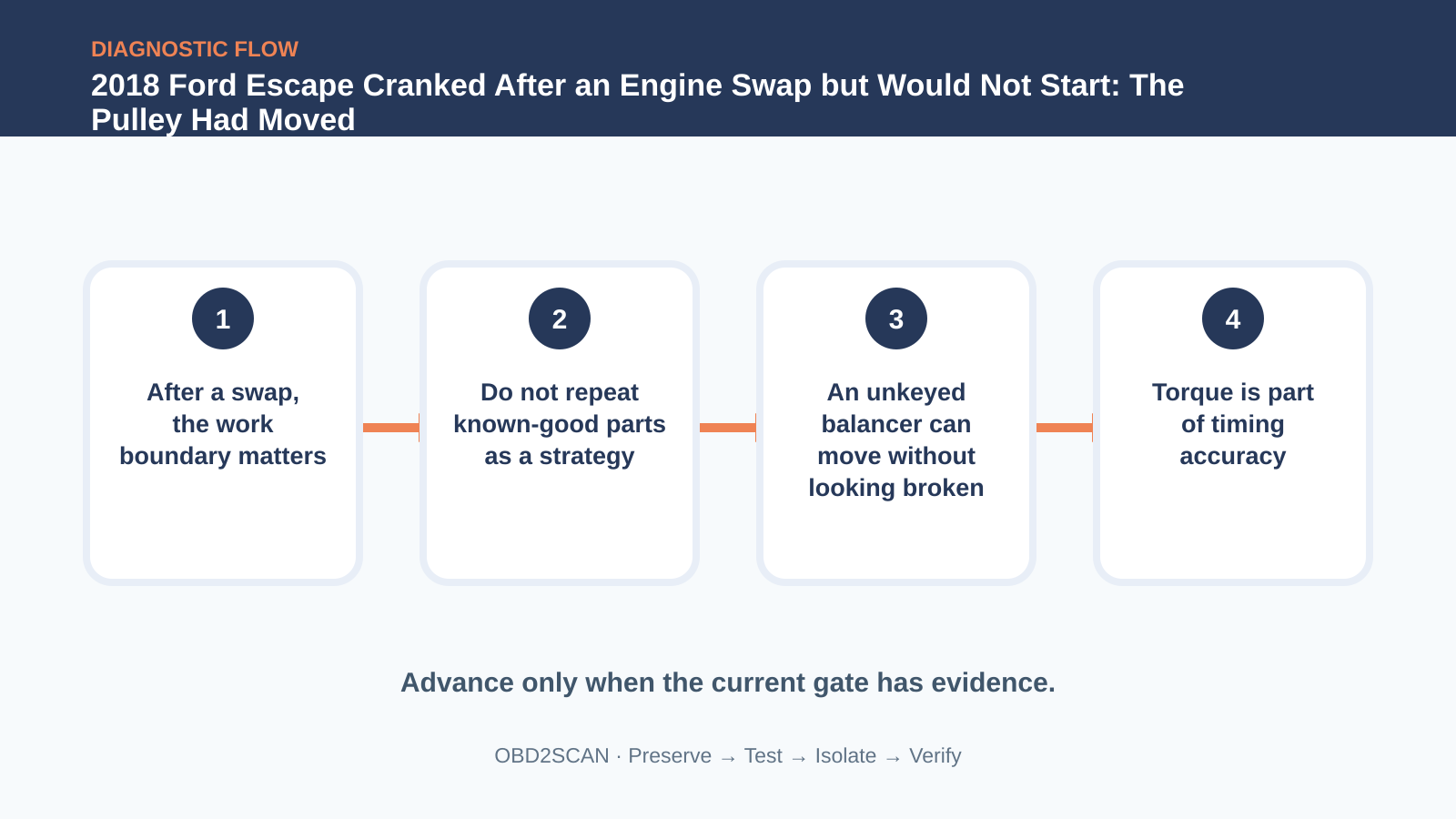
Do not repeat known-good parts as a strategy
Moving the original sensor, coils and plugs to the used engine did not change the outcome. Each unchanged substitution reduces the value of repeating the same parts path and increases the value of phase evidence. Use service information for the exact engine, build and option set. A correct test on the wrong pin or configuration can produce a precise but useless answer.
Ask what arrived already assembled
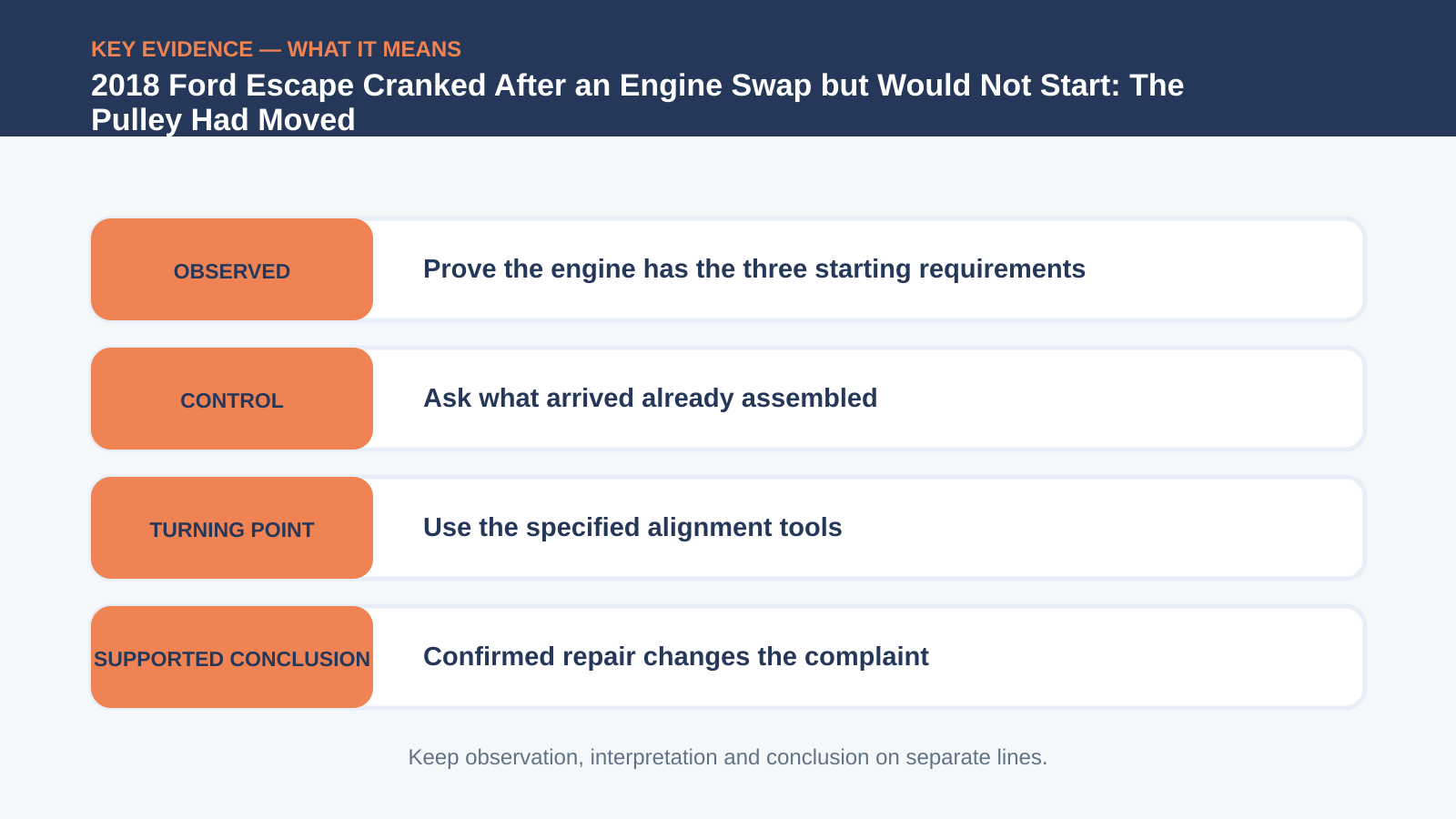
Ask which fasteners could have been loosened before shipment. The harmonic balancer was already on the used engine, so its center bolt and position belonged inside the diagnostic boundary even though the timing cover looked untouched. This is the turning point in the documented case. It gains weight because earlier branches were tested and because the symptom changed with one controlled condition.
| Observation | What it supports | What it does not prove |
|---|---|---|
| Fuel and spark present | Basic outputs exist | Mechanical phase is correct |
| Original parts change nothing | Those substitutions did not solve it | Every sensor is good |
| Balancer bolt loose | Unkeyed joint may have moved | Position is known |
| Alignment restores start | Shifted position caused no-start | All swap work is certified |
An unkeyed balancer can move without looking broken
On this engine the balancer joint is unkeyed. Once its bolt loosened, the pulley could shift without a missing key or dramatic break, leaving spark and fuel present at the wrong mechanical relationship. Separate observation from inference: record what moved, opened, failed or remained stable, then state only the component or path that result actually narrows.
Use the specified alignment tools
Support the engine and follow Ford service information. Use the specified holding and alignment tools; paint marks, piston-stop guesses or impact-gun positioning are not substitutes for the controlled reference. The repair must remove the demonstrated mechanism and restore mechanical support, sealing, torque or terminal fit—not merely make the symptom disappear once.
Torque is part of timing accuracy
Clean or replace one-time-use fasteners as specified and apply the exact torque-angle sequence. Clamping force is part of timing integrity on an unkeyed joint, not merely a final assembly detail. Reassemble to the original protection standard. Clear codes only after preserving the pre-repair record and confirming the relevant controller is online.
Verify start quality and correlation after repair
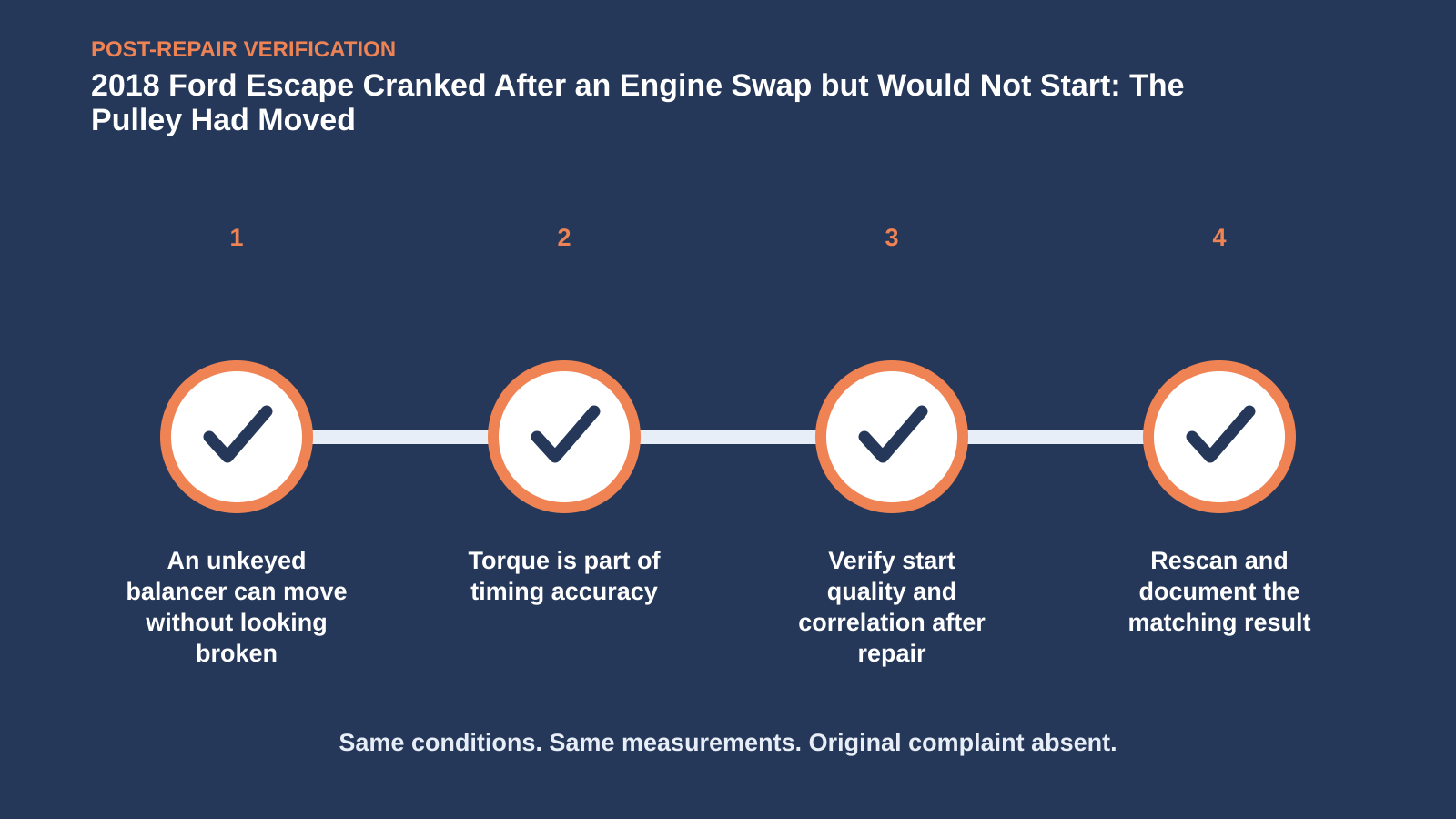
After the engine starts, listen, check leaks and charging, scan for correlation faults and repeat hot and cold starts. A single start proves the turning point, while repeated operation proves the repair held. Use the customer’s original complaint as the final test specification. Matching conditions and a post-repair scan are stronger closure than a quiet bay or a cleared warning lamp.
For the owner or service adviser, the useful explanation has three parts: what was observed, why the decisive test narrowed the fault, and which original condition was repeated after repair. It should not promise that every similar vehicle needs the same component. This was one evidence chain on one vehicle, and the appropriate next step on another car may change with build data, prior work, safety condition and test results. That honest boundary makes the case easier to trust and more useful at the next diagnostic visit.
Fuel and ignition were present, but the replacement engine’s loose unkeyed balancer shifted mechanical timing. Correct positioning with Ford tools restored starting. The reusable lesson is narrower and more valuable: Organize the case around what arrived attached to the used engine and what the installer reasonably—but incorrectly—assumed was untouched.









Comments 0
Questions, fixes, and real-world diagnostic notes from readers.
Be the first to share a diagnostic result or ask a follow-up question.