
2017 Mercedes GLC300 Lost Power with P029921: Leaking Turbo Vacuum Actuator Replaced


A 2017 Mercedes-Benz GLC300 with an M274 engine arrived; its chassis code and mileage were not reported. The driver reported weak acceleration at highway speed, with the car feeling short of power when asked to accelerate harder. The case confirmed that the turbo boost-control vacuum actuator could not hold vacuum, replaced that actuator, and reported normal power afterward.
Case at a glance
| Item | This vehicle |
|---|---|
| Vehicle | 2017 Mercedes-Benz GLC300, M274 engine; chassis not reported |
| Mileage | not reported |
| Complaint | Weak acceleration at highway speed and reduced power under stronger demand |
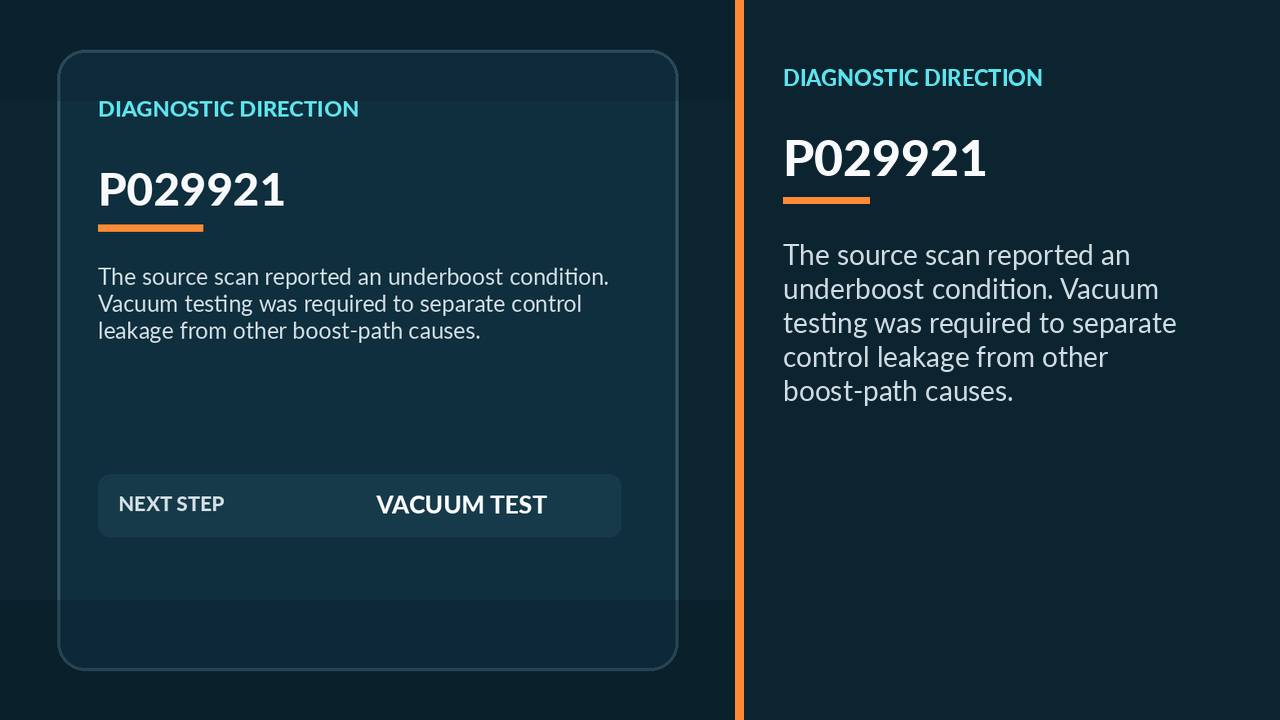
| Diagnostic clue | P029921: turbocharger 1 boost pressure too low; signal amplitude below minimum |
| Confirmed fault | Turbo boost-control vacuum actuator leaked and would not hold vacuum |
| Actual repair | Replaced the leaking vacuum actuator; no hose or turbocharger replacement was documented |
| Restoration | Replacement installed and vacuum connection restored; code clearing, adaptation, and rescan not reported |
| Verification | Replacement held vacuum in the comparison; the case record then reported normal power after installation |
Highway acceleration exposed the problem
The complaint had an operating condition, not just a vague description. The GLC300 felt weak during highway driving when the driver demanded acceleration. That provided a useful target for diagnosis: find what prevented the engine from producing expected boost under load.
The available record does not report mileage, warning-lamp state, freeze-frame data, weather, or how long the problem had been present. Those gaps matter because they prevent a complete baseline from being reconstructed, but they do not erase the reported highway-power complaint.

P029921 pointed toward underboost, not a part
The diagnostic display showed P029921, described in this case as turbocharger 1 boost pressure being too low, with signal amplitude below the minimum. That tied the driver’s lack of acceleration to an underboost direction. It still did not prove whether the problem was in the intake air path, vacuum supply, a hose or connection, the actuator, its control, or the turbocharger itself.
The case record reports that diagnostic equipment and a vacuum pump were used to examine the vacuum-control system. It provides no freeze-frame values, requested-versus-actual boost log, commanded actuator position, smoke-test result, or measured vacuum specification. The code therefore belongs at the start of the evidence chain, not at its conclusion.
The old actuator released when it should have held
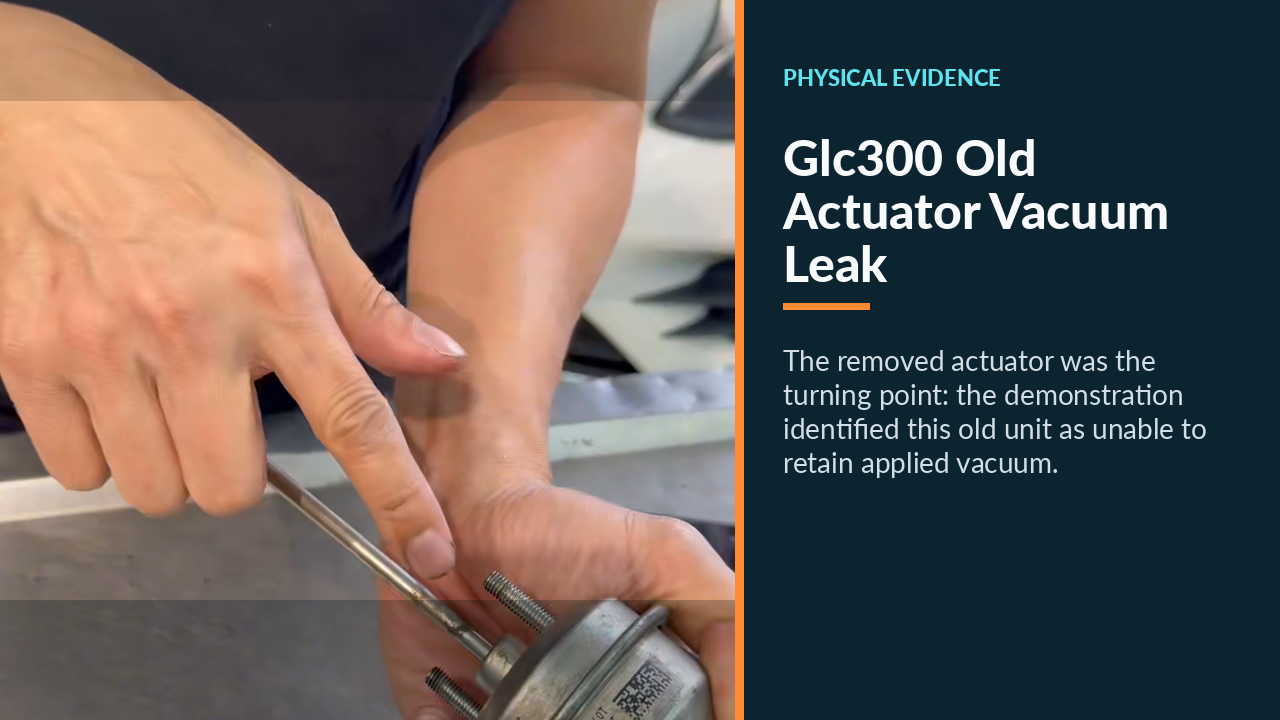
The decision became component-specific at the removed turbo boost-control vacuum actuator. In the demonstration, applied vacuum did not remain in the old unit: it could not retain the condition needed to keep its rod displaced. That behavior is the case’s diagnostic turning point because it changed a system-level suspicion into evidence against one part. At the actuator test, the AUTOOL PT502 vacuum gauge can document whether vacuum is created and held, making it easier to separate an actuator leak from a supply, hose, or boost-control problem.
No numeric vacuum level, hold duration, or leak rate was published, so none should be supplied after the fact. Likewise, the case record discusses vacuum pipes as possible leak locations but does not document a particular failed pipe on this vehicle. The confirmed fault stays with the actuator that failed the hold comparison.
The replacement supplied a direct comparison
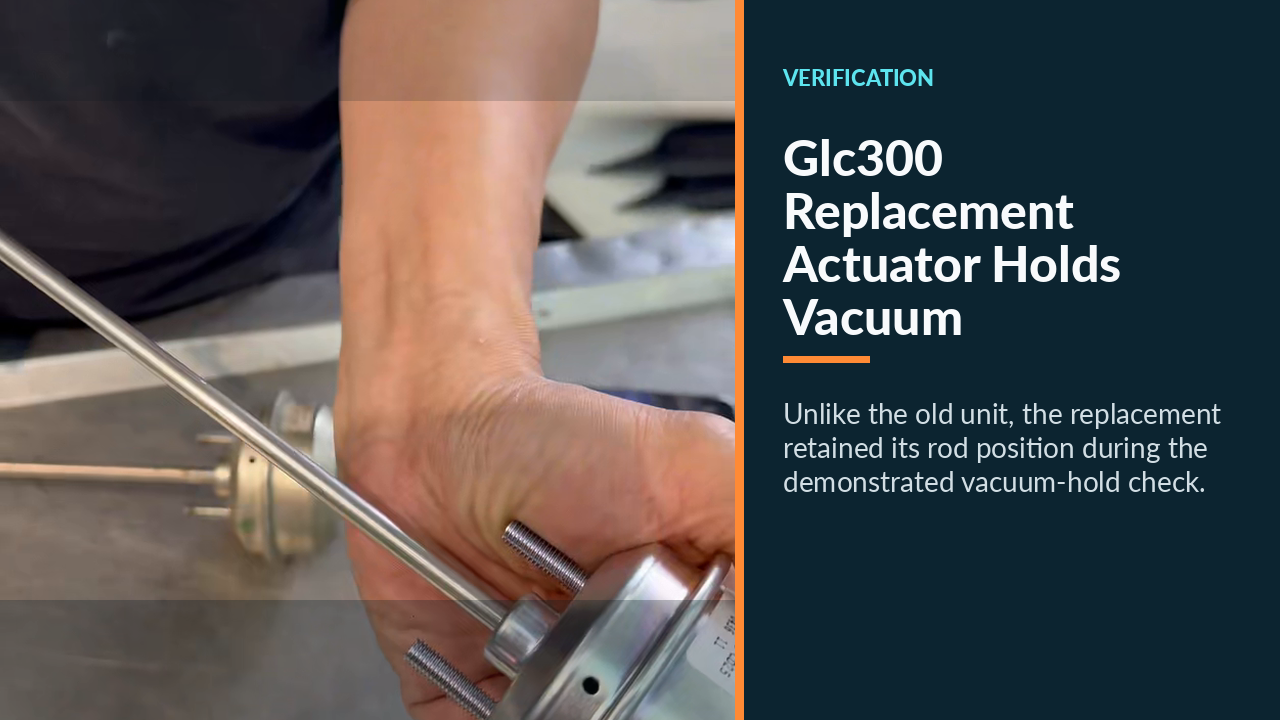
The replacement actuator was checked in the same visible way. It retained its displaced rod position rather than relaxing like the removed unit. This did two jobs: it provided a functional contrast with the failed part and screened the replacement before installation.
That comparison supports the narrow repair decision, but it is not a complete boost-system test. A part that holds vacuum on the bench still has to be installed correctly and work with the vehicle’s vacuum supply, lines, control command, linkage, and turbo hardware.
One actuator defined the repair boundary
The documented repair was replacement of the leaking turbo boost-control vacuum actuator. The case record shows the old and new units and reports installing the replacement. It does not document replacement of a vacuum hose, turbocharger, boost sensor, or other air-path component, so those possibilities do not belong in the completed-work list.
At a broad level, the old actuator had to be accessed and removed, the replacement installed, and its connection restored. Part number, rod adjustment, fastener torque, and any model-specific setup are not reported. Those details must come from the exact vehicle’s current service information; guessing them would turn this case account into an unsafe procedure.
Normal power was reported, with a short verification horizon
The first verification layer occurred before installation: the replacement held vacuum while the failed unit did not. The second layer returned to the driver’s complaint. After installation, the reported that the GLC300’s power was normal again, directly challenging the original weak-acceleration symptom.

The reported result is useful but immediate. No test distance, equivalent highway-load retest, requested-versus-actual boost data, repeat DTC scan, adaptation, or later owner follow-up was provided. The evidence supports a complaint-matched staged result, not a guarantee about long-term durability.
A first-check route for another underboost complaint
For a similar loss of power, first preserve the operating condition and scan record before clearing anything: speed, load, warning state, freeze-frame data, and requested versus actual boost when available. Next, inspect the intake and vacuum paths from low intrusion to high intrusion, checking connections and hoses before isolating the actuator and control supply. If an actuator is tested, record the applied vacuum and whether it holds, then compare the result with exact service information. After repair, restore all connections, complete any specified setup, rescan, inspect for leaks, and challenge the original complaint under a safely comparable load.
This GLC300’s answer was one actuator that failed a vacuum-hold comparison and was followed by reported normal power. Another vehicle with P029921 or weak acceleration should not receive the same part until its own air-path, vacuum, electrical-control, linkage, and turbocharger evidence points there.










Comments 0
Questions, fixes, and real-world diagnostic notes from readers.
Be the first to share a diagnostic result or ask a follow-up question.