
2003 Honda Accord P0341 Returned on the Second Start: The Chain Had Reached Its Limit

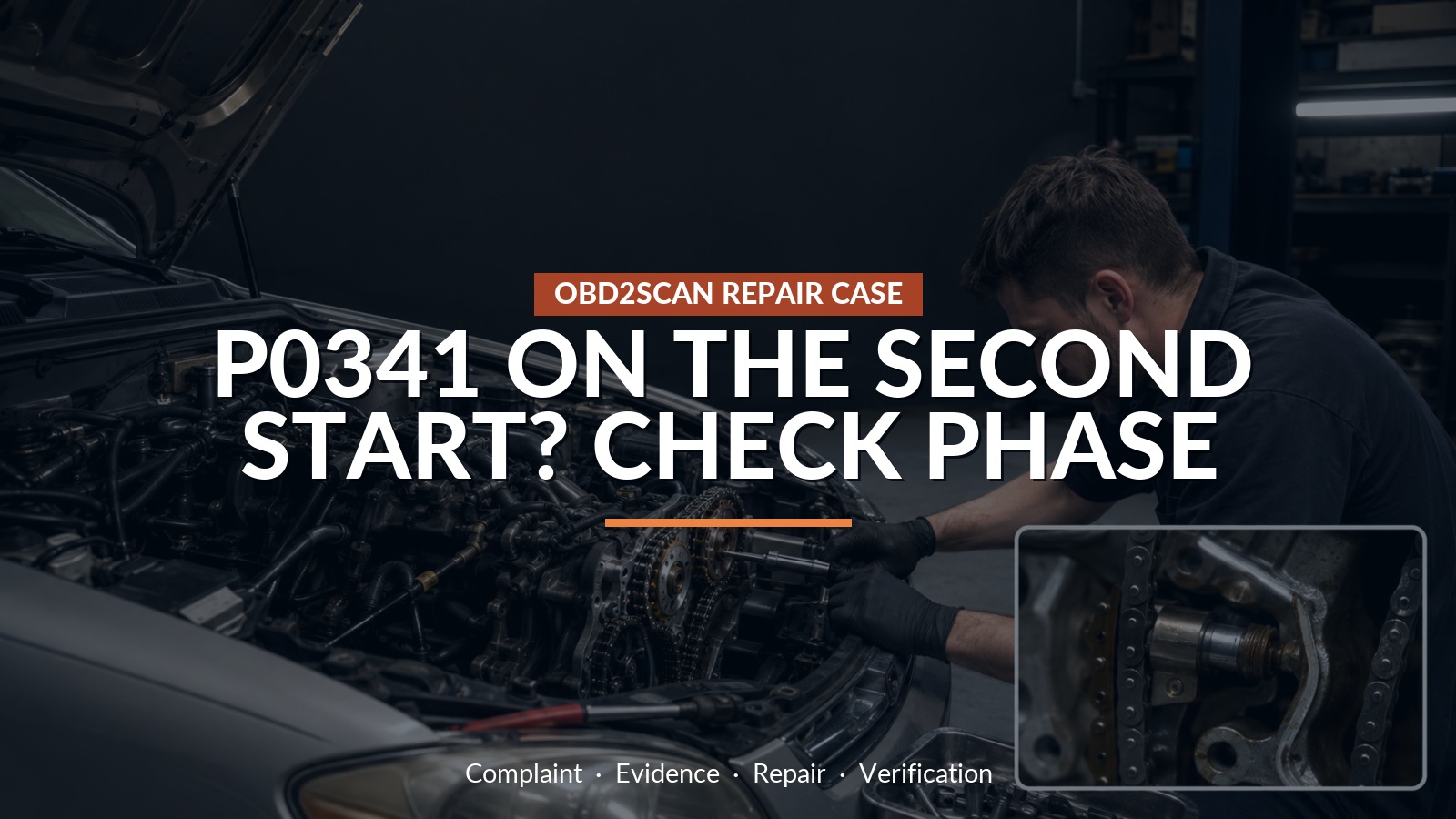
P0341 On The Second Start? Check Phase
The Accord did something unusually helpful: P0341 returned predictably on the second start. At 195,000 miles, it would have been easy to call the cam sensor old and install one. But the repeatable trigger said the controller was comparing cam and crank phase under a particular condition—not necessarily losing either signal.
A graphing meter can support an identified low-voltage sensor check before the engine is opened. The AUTOOL DM301 is one option for that bounded task. DM301 can observe one identified cam or crank signal at a time and perform low-voltage checks. It cannot prove correlation without synchronized channels, establish mechanical timing or replace the Honda service procedure.
The VTEC oil-control solenoid moved, the cam gear’s locking function was checked, and physical timing inspection showed the chain system had reached its wear limit. Timing marks and tensioner extension supported replacing the chain, guides and tensioner as a set. The published case explains that repair direction but does not include a synchronized post-repair phase capture, so final proof remains a defined test rather than an invented result.
Quick answer: P0341 described a cam/crank relationship error; VTEC and physical timing checks supported a stretched timing chain rather than a sensor guess.
In this guide
- A repeatable second-start code is valuable
- P0341 reports relationship, not a parts verdict
- Rule out VTEC control before opening the front cover
- Check whether the cam gear is locked
- Read timing marks in the correct rotation direction
- Tensioner extension turns wear into evidence
- Replace the timing set as a system
- Repeat the second start before calling it closed
A repeatable second-start code is valuable
A fault that occurs on the second key cycle gives the workshop a controlled experiment. Begin with a charged battery, record coolant temperature and leave the engine off for the same interval before each trial. Save P0341 status and freeze-frame before clearing it. Note whether the first start is clean, how long the engine runs and whether power loss appears before the second start. Repeat only as needed; an engine with suspected timing wear should not be revved for curiosity. The stable trigger makes every later change meaningful because the same sequence can challenge the system again.
P0341 reports relationship, not a parts verdict
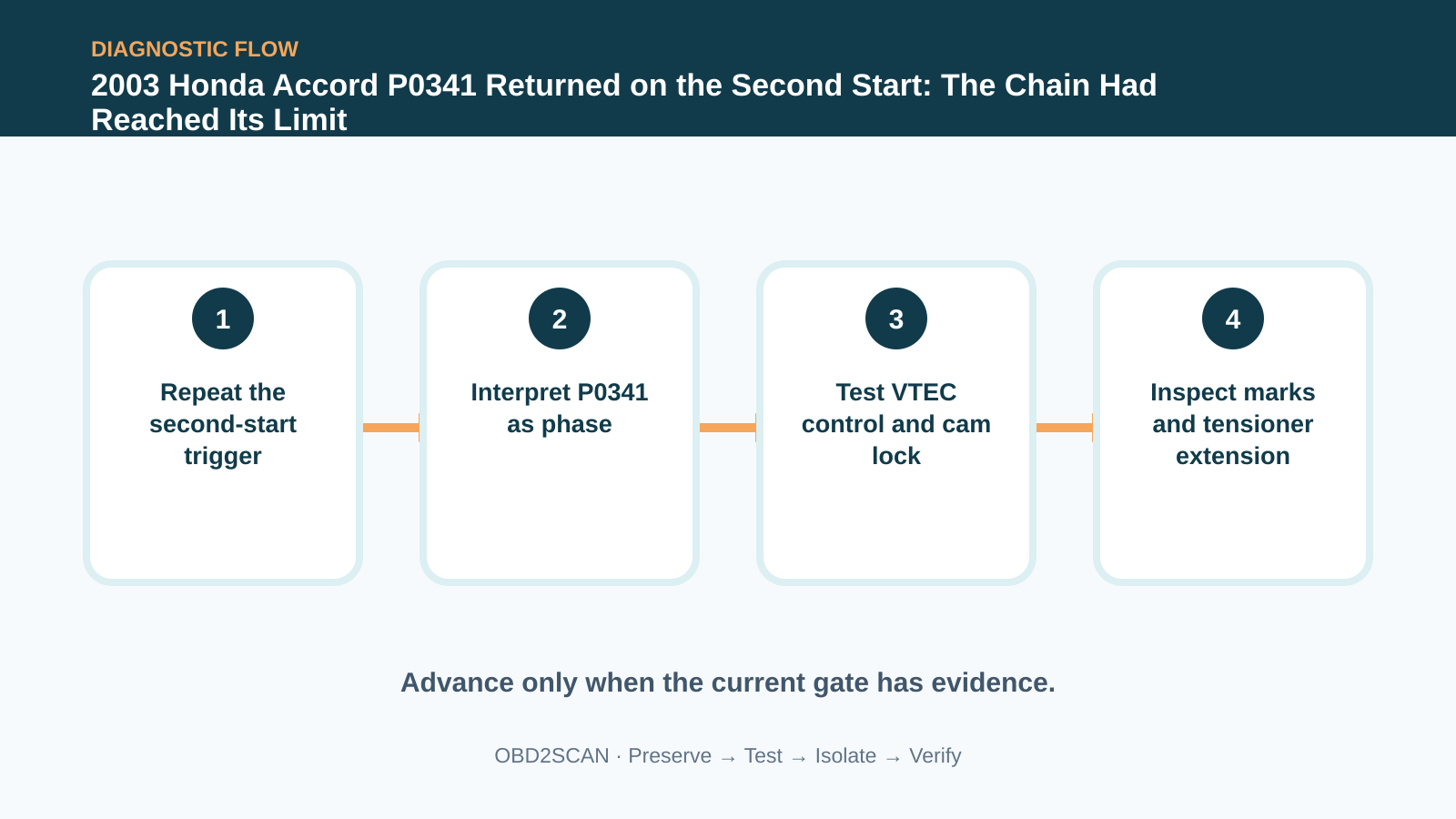
P0341 describes an implausible relationship between camshaft and crankshaft information on this application. It does not automatically say that the cam sensor is electrically open or that the crank sensor is dead. Inspect connectors, grounds, supply and harness routing, and check for related circuit codes. If a signal must be observed, use the service diagram and a safe backprobe. A single-channel trace can show whether one sensor toggles, but correlation requires both signals on the same time base and a known-good reference. Parts replacement cannot repair a correct signal arriving at the wrong mechanical angle.
Rule out VTEC control before opening the front cover
Honda’s variable valve timing system adds another possible route to phase disagreement. Verify engine-oil level, viscosity, condition and pressure prerequisites before commanding or removing anything. In the documented case, the VTEC oil-control solenoid was checked and could move, which kept a simple stuck-solenoid explanation from carrying the diagnosis. Inspect the screen and passages as the service procedure directs, and distinguish an electrical command from actual oil delivery. Low pressure, contamination or a sticking mechanism can change cam behavior, but a functioning solenoid does not certify the chain or cam gear.
Check whether the cam gear is locked
The cam gear must return to and hold its specified locked position when the control system is not advancing it. Rotate and inspect only by the approved procedure; do not use the starter with tools near the chain. If the gear does not lock, variable timing can mimic chain error. If it locks correctly, the base relationship becomes the next question. This sequence prevents the timing cover from becoming an expensive shortcut. It also prevents a new chain from being asked to work with a faulty actuator that can move the cam away from its commanded position.
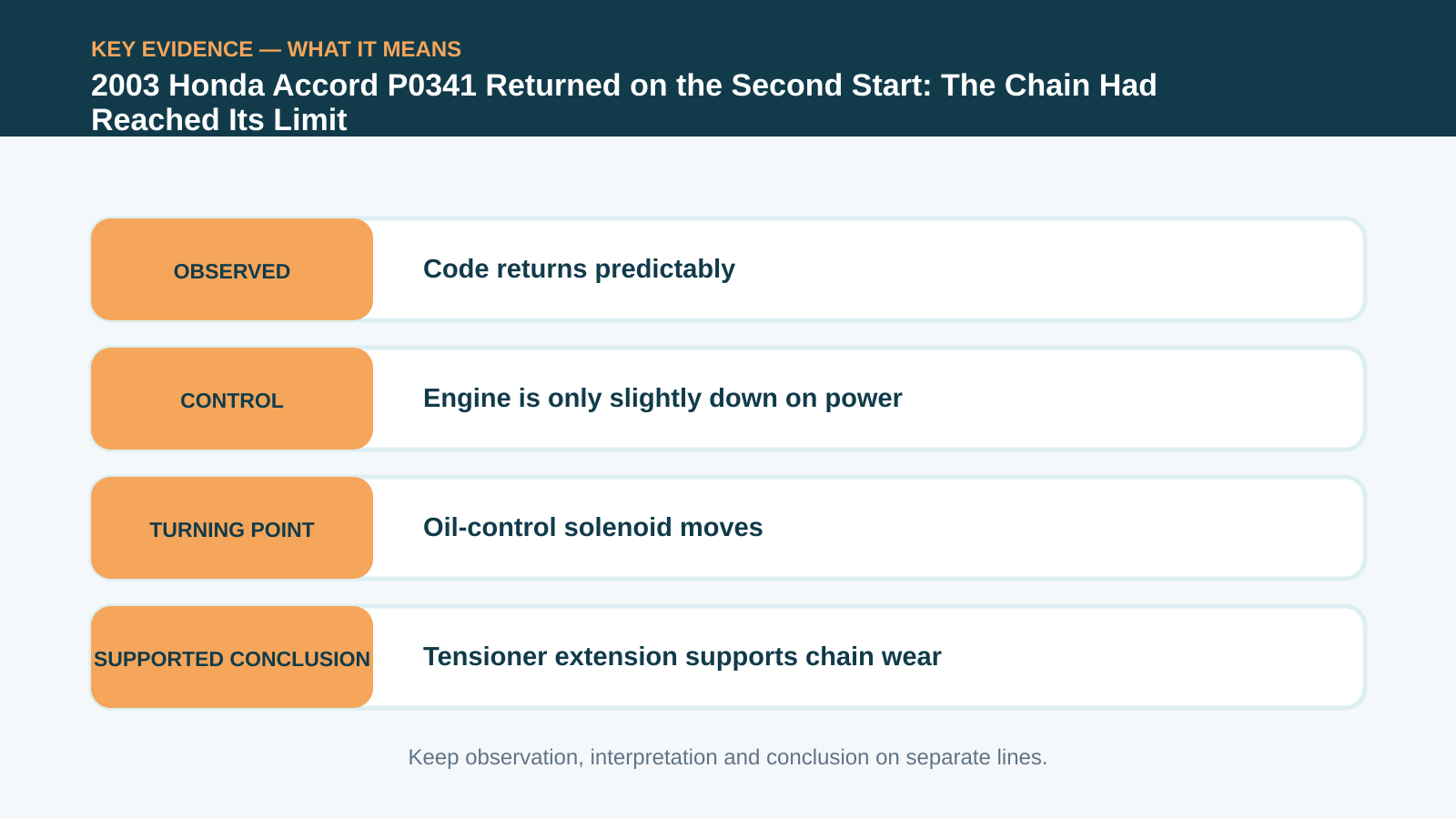
| Evidence | What it supports | What it cannot prove alone |
|---|---|---|
| P0341 returns on the second start | Repeatable cam/crank disagreement | A failed cam sensor |
| VTEC solenoid moves | Solenoid is not mechanically frozen | Oil pressure and cam command are perfect |
| Cam gear lock checks correctly | Base gear can hold its home state | Chain has not elongated |
| Timing marks and tensioner extension disagree | Mechanical timing set has worn | Post-repair correlation is normal |
Read timing marks in the correct rotation direction
Turn the engine only in the specified direction and align the correct crank and cam references. Rotating backward can unload the tensioner and create a misleading mark position. Photograph the marks square-on, because parallax can make a small error look larger or smaller. A chain may elongate gradually enough that the engine still starts and runs while the controller reaches its learned phase limit. That fits the slight loss of power in this case better than a sensor that simply stops producing a signal. Compare the physical position with current Honda service information, not a generic chain diagram.
Tensioner extension turns wear into evidence
Tensioner extension converts an impression of looseness into physical evidence. Excessive extension means the tensioner has spent much of its available travel compensating for accumulated wear in the chain, guides and sprockets. Inspect guide faces, oil feed, debris and the teeth and actuator surfaces. Do not judge one component in isolation: a new chain on worn guides or a damaged tensioner can start with poor control. Likewise, timing-cover debris deserves an oil-system inspection rather than being cleaned away without asking where it came from.
Replace the timing set as a system
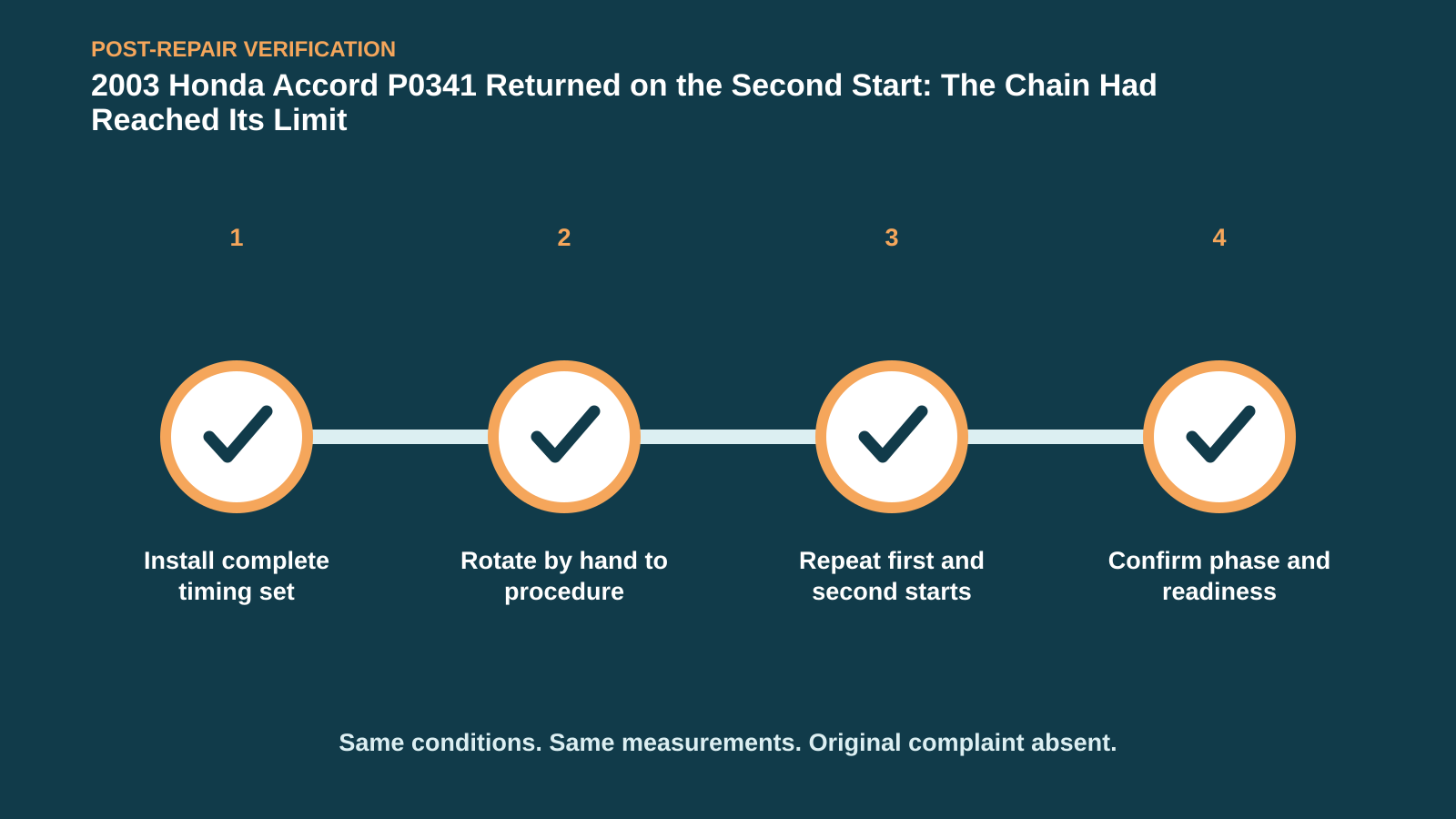
The repair direction was complete timing-set service—chain, guides and tensioner—while inspecting the related gear and oil-control components. Lock the engine at the documented position, use the specified holding tools and torque procedure, and verify every mark before releasing the tensioner. Rotate the engine by hand through the required cycles and recheck alignment before cranking. Keep sealant away from oil passages and address any maintenance problem that accelerated wear. This is interference-engine work where one tooth and one loose fastener can turn a diagnostic job into internal damage.
Repeat the second start before calling it closed
Final verification should deliberately repeat the behavior that made the fault useful: cold or matched-temperature first start, the same run interval, shutdown and second start. Confirm P0341 remains absent from current and pending status, startup is quiet, power has returned and commanded versus actual cam angle follows correctly through a controlled drive. Ideally, save a synchronized cam/crank capture and compare it with a known-good pattern. The source explains the worn-chain diagnosis and service process but does not publish that measured after-capture, so this case remains open at the verification boundary.
The second start was not an inconvenience to work around; it was the case’s best test fixture. Used consistently, it moved P0341 from a sensor guess to a mechanical phase diagnosis—and defines the exact challenge the completed repair still needs to pass.










Comments 0
Questions, fixes, and real-world diagnostic notes from readers.
Be the first to share a diagnostic result or ask a follow-up question.