
2014 Toyota Camry P0171: A Split Intake Boot and the Drive Cycle That Cleared the Code

P0171 Fixed? Let The Monitor Prove It
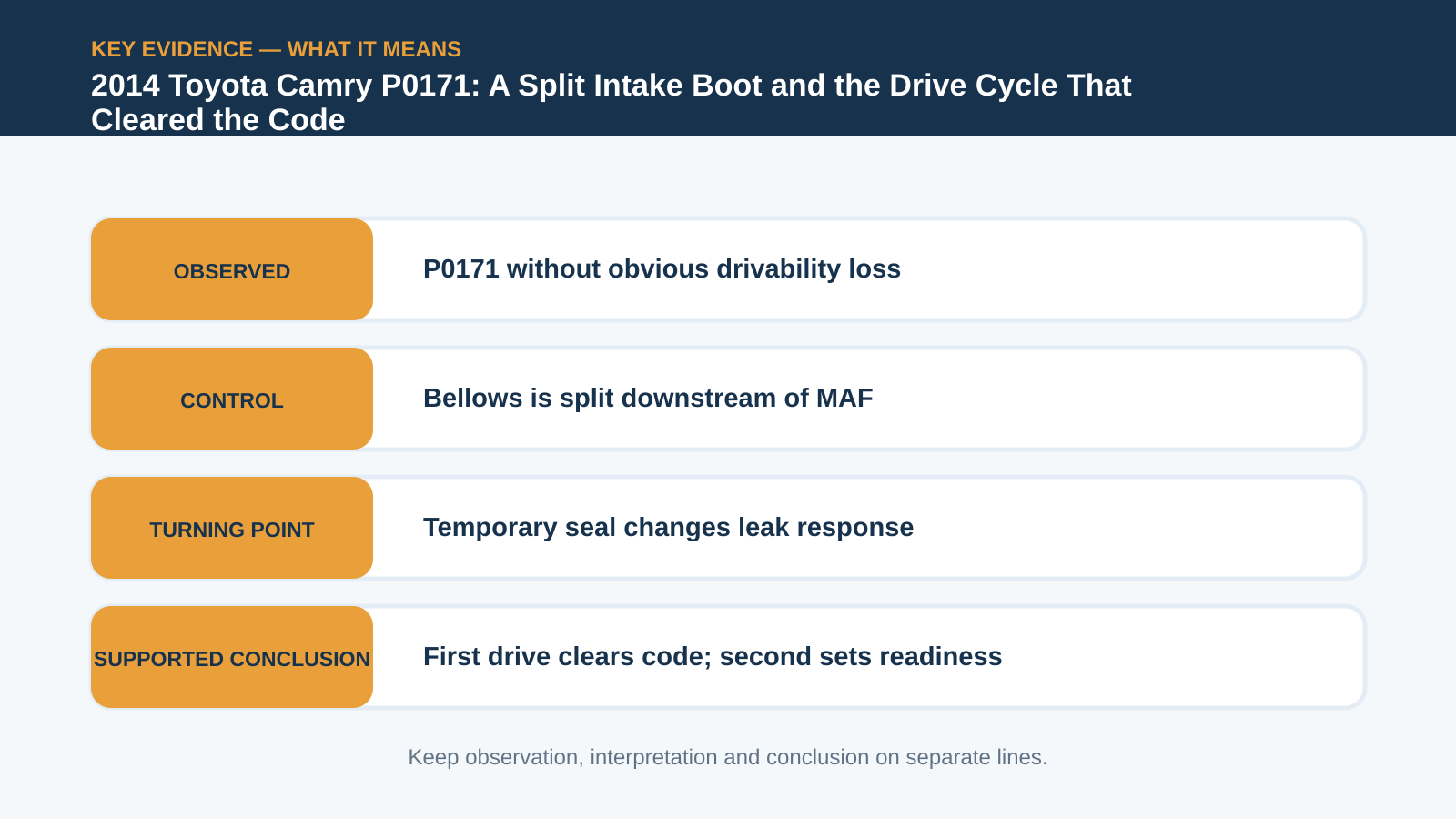
The 2014 Toyota Camry carried P0171 and an illuminated MIL, yet the driver noticed no loss of power or fuel economy. The physical fault was simple: a split accordion bellows between the MAF sensor and throttle body. The interesting part came after the new boot was fitted, when the scan tool would not clear the code and disconnecting the battery would have erased useful readiness information.
A correctly configured low-pressure smoke machine can make an intake leak visible after the system is isolated. An FXTUL Automotive Smoke Machine is one available route for that job when the selected model’s instructions suit the vehicle. An FXTUL automotive smoke machine can support a correctly isolated, low-pressure intake leak check when the chosen model’s ratings and instructions fit the system. It cannot show fuel trims, command monitors or make tape a permanent repair.
Smoke and a brief temporary seal confirmed that air was entering downstream of the MAF, and permanent boot replacement restored the intake. Toyota service information then supplied the monitor conditions. On the first drive, trims normalized and P0171 self-cleared with no pending fault. A second drive completed all readiness monitors, including EVAP, without disconnecting the battery.
Quick answer: A split intake bellows admitted air after the MAF. Boot replacement fixed the leak; two monitor drives self-cleared P0171 and completed readiness.

In this guide
- P0171 can exist without an obvious driving complaint
- Read trims before touching the intake
- Inspect every bellows fold after the MAF
- Use smoke and a temporary seal as confirmation
- Replace the boot and repeat the airflow test
- When the scan tool cannot clear the code
- Use service information to run the monitor
- Confirm trims, DTC state and readiness together
P0171 can exist without an obvious driving complaint
Save freeze-frame data, fuel trims, load, rpm and coolant temperature before touching the intake. P0171 means the control system reached a lean correction limit under the conditions defined by that calibration; it does not identify a vacuum leak by itself. Compare short- and long-term trim at idle and increased rpm. A leak often has a larger percentage effect at idle, while a fuel-delivery shortage can worsen with load. Check for accompanying MAF, oxygen-sensor or misfire codes and confirm the engine configuration.
Read trims before touching the intake
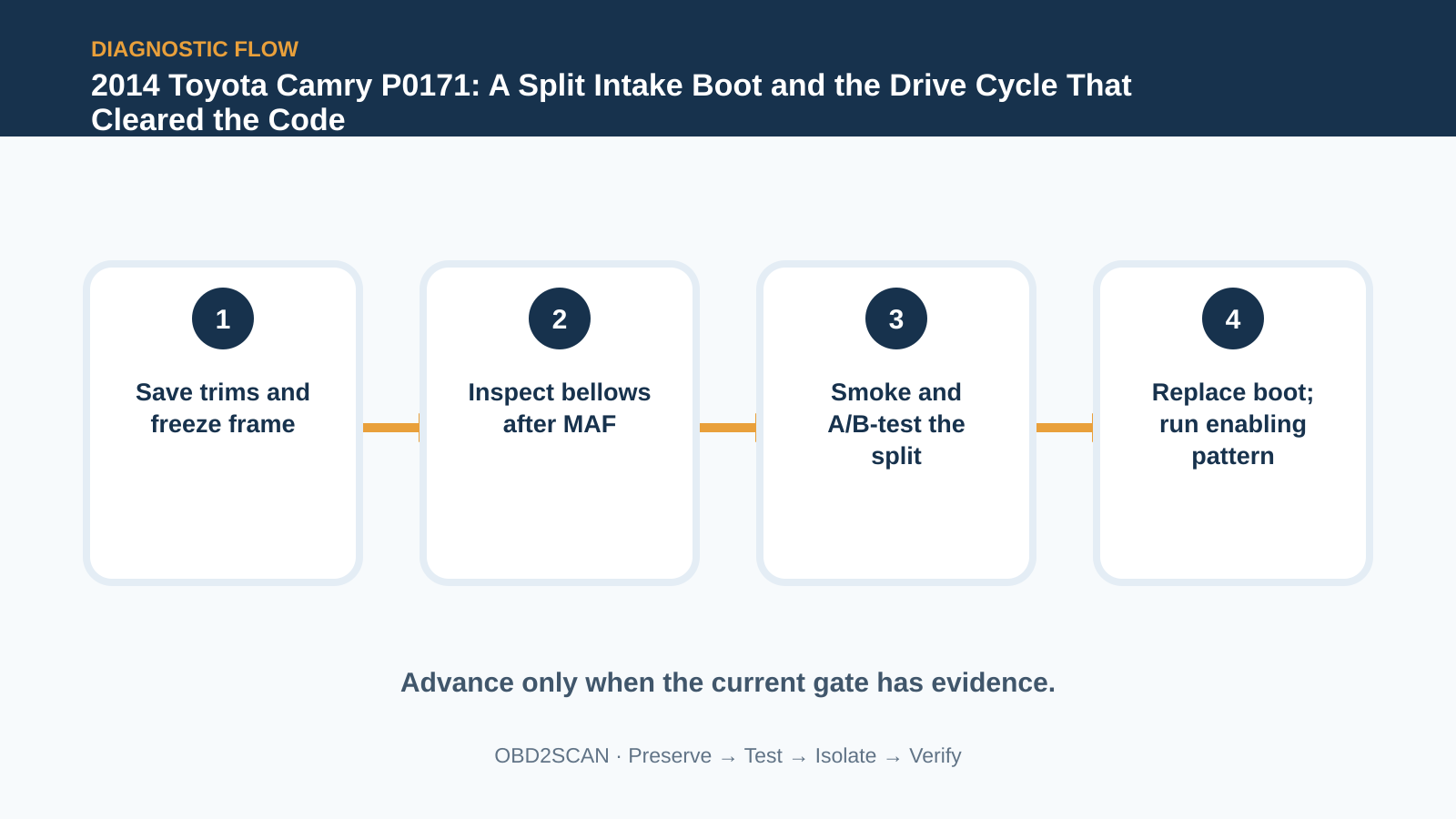
Observe trim response before spraying chemicals or disconnecting hoses. Compare commanded equivalence, upstream sensor behavior and MAF plausibility. Check fuel pressure only with rated equipment and the Toyota procedure. In this Camry, the owner did not feel a drivability problem, which makes baseline data even more important: the MIL is the complaint, and the monitor that set it must eventually be allowed to judge the repair.
Inspect every bellows fold after the MAF
Flex the intake duct through every accordion fold with the engine off and cool. The split sat between the MAF and throttle body, allowing air that the MAF had not measured. Inspect clamps, resonators, PCV branches and the lower surface that is hidden when installed. Oil softening, age or engine movement may open a crack only in certain positions. Do not replace an oxygen sensor merely because it reports the oxygen created by unmetered air.
Use smoke and a temporary seal as confirmation
Introduce smoke at the lowest effective pressure and isolate the path according to the equipment and vehicle instructions. Protect sensors and never pressurize a system beyond its rating. A temporary seal can provide a short stationary A/B check: trims improve and smoke stops when the split is covered. Remove the temporary material immediately afterward. Tape exposed to heat, oil and engine motion is diagnostic evidence, not an intake repair.
Replace the boot and repeat the airflow test
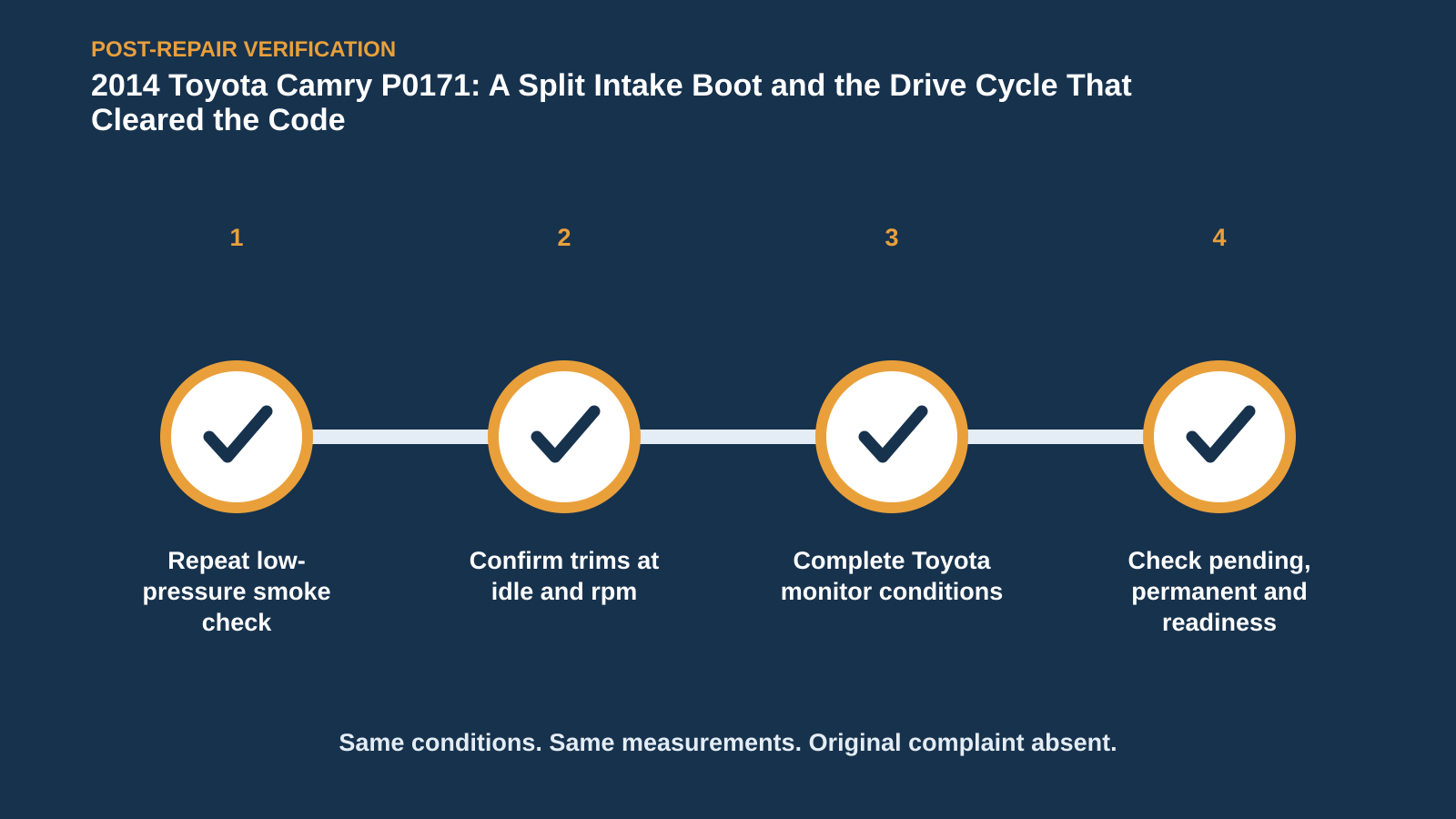
Fit the correct molded boot, seat both ends squarely and restore every breather branch and clamp. Check engine movement and neighboring brackets so the new duct is not twisted or rubbing. Repeat the smoke test and watch fuel trims at the same idle and raised-rpm points. The permanent repair is the new air-tight duct. If trims remain high, continue testing rather than assuming the most visible leak was the only one.
| Stage | Evidence | Decision |
|---|---|---|
| Before repair | P0171 with lean fuel correction | Determine whether air or fuel explains it |
| Physical inspection | Bellows split after MAF | Unmetered-air path found |
| Smoke/temporary seal | Leak and trim response change | Split is causally connected |
| First/second drive | Normal trims, code clears, monitors complete | Repair and emissions state verified |
When the scan tool cannot clear the code
The available scan tool reportedly would not clear the DTC. Instead of disconnecting the battery, the technician consulted service information. The source describes the relevant monitor as continuous early in closed loop and records enabling conditions including load above 12 percent and engine speed below 800 rpm, plus a two-trip logic and an approximately 35-percent threshold used in that account. Use current Toyota data for the exact calibration; do not copy those figures blindly to another vehicle.
Use service information to run the monitor
Create a safe drive that satisfies the documented warm-up, closed-loop, load and idle conditions without trying to game public traffic. On the first drive, the Camry’s trims looked normal, P0171 cleared itself and no pending code appeared. That is the ECM observing that the failure criteria are no longer met. Preserve the readiness state rather than erasing it with battery disconnection, particularly where an emissions inspection follows the repair.
Confirm trims, DTC state and readiness together
A second drive left the ECM free of the code and completed all monitors, including EVAP. Confirm confirmed, pending and permanent-code status separately; a permanent code may require monitor completion even after the MIL turns off. Record short- and long-term trim under the original conditions and inspect the new boot after heat soak. Repair, self-clear and readiness completion are three distinct checkpoints, and this case documented all three.
Finding the split fixed the air path. Letting the monitor rerun proved the car agreed. That second half of the case is why service information can be as important after a repair as it was before it.








Comments 0
Questions, fixes, and real-world diagnostic notes from readers.
Be the first to share a diagnostic result or ask a follow-up question.