
2007 Dodge Ram P0301 Misfire: The Exhaust Stroke Revealed a Broken Lifter

P0301 With Spark? Read The Exhaust Stroke
<strong>Quick answer:</strong> The useful evidence was not P0301 alone. A restricted-looking exhaust event in the pressure trace led to a safe visual check of rocker movement, which exposed the broken lifter; replacement restored smooth running. This article follows one documented vehicle. It explains the evidence chain, not a universal failure rate or a direction to replace the same part on every similar car. Stop whenever the test would involve overheated brakes, high current, moving parts, refrigerant handling or an uncontrolled road condition.
A conventional cylinder-compression instrument can establish whether one cylinder builds pressure differently before deeper mechanical work; AUTOOL PT610 Cylinder Pressure Gauge is a digital option for that bounded comparison. It does not reproduce a running in-cylinder pressure waveform, identify intake versus exhaust valve motion, or prove a lifter without valvetrain inspection.
Cylinder-one misfire evidence was easy to collect and easy to misread. Spark and injector timing looked correct; the exhaust stroke in an in-cylinder pressure trace was what finally turned P0301 into a valvetrain investigation.
Quick answer: The useful evidence was not P0301 alone. A restricted-looking exhaust event in the pressure trace led to a safe visual check of rocker movement, which exposed the broken lifter; replacement restored smooth running.
In this guide
Begin with what P0301 cannot name
P0301 says cylinder one contributes poorly; it does not distinguish ignition, fuel, compression, valve motion or control. Preserve misfire counts and conditions, then disable the engine safely for intrusive tests. Repeatedly running a hard misfire can overheat the catalyst or worsen mechanical damage. Preserve the original condition before changing it. The first observation is the control sample against which every later test must be compared.
Confirm spark and injection timing
Spark and injection timing checked correctly in the documented case. Those results removed two common branches but did not prove fuel delivery volume or mechanical condition. The next useful test had to ask whether the cylinder could move air through a complete four-stroke cycle. Use service information for the exact engine, build date and options. A correct method on the wrong terminal can create a precise but useless result.
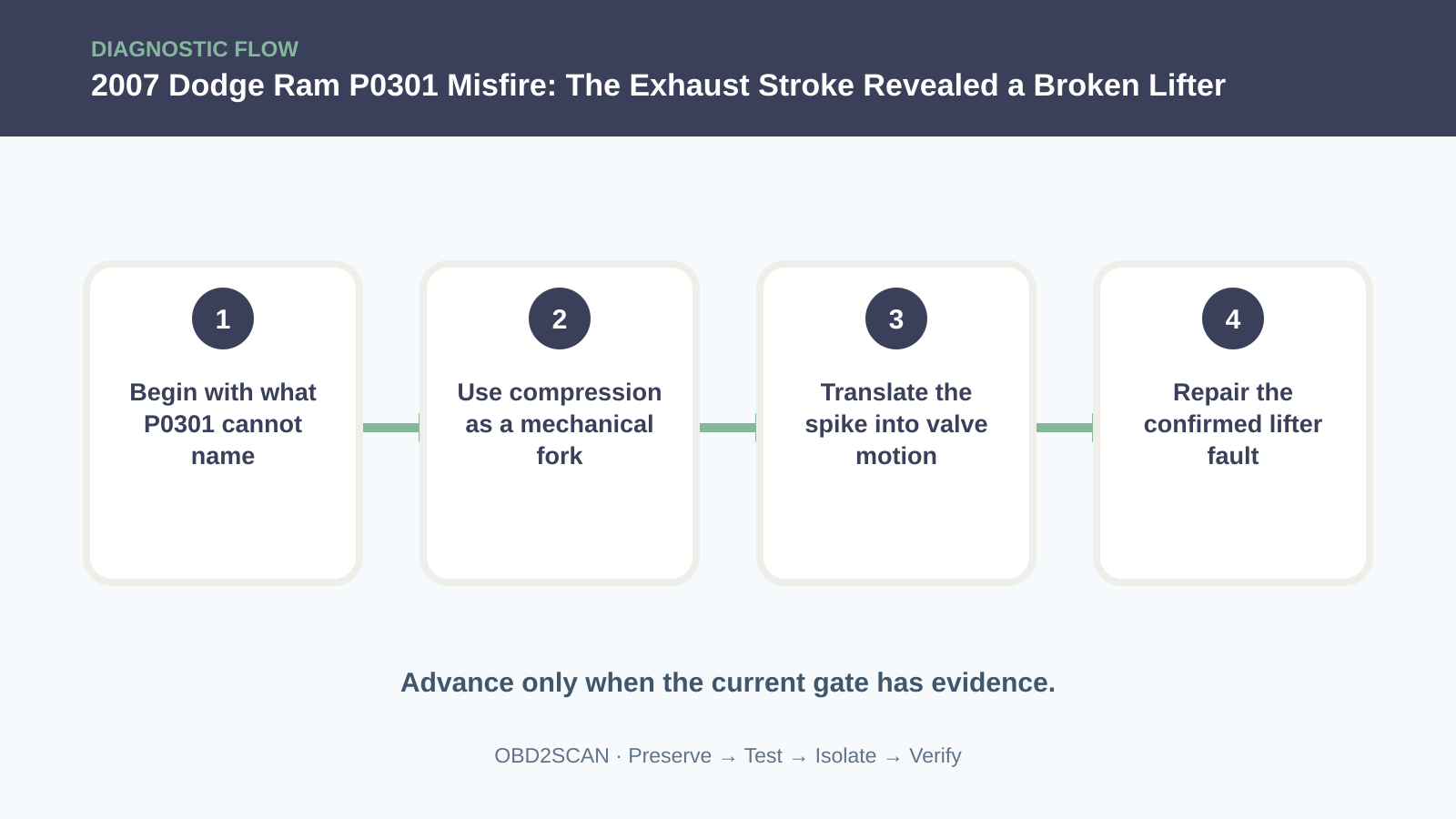
Use compression as a mechanical fork
A static compression comparison can flag a weak cylinder, while a pressure transducer adds crank-angle shape. Always use the specified disable procedure, correct adapter and secure hose routing. On an engine with mechanical noise or abnormal pressure, stop cranking if the test suggests contact or binding. Treat prior work as evidence, not blame. A repair that made no change can narrow the case when its installation and test conditions are verified.
Read the exhaust stroke, not just peak pressure
The important feature was elevated pressure during the exhaust stroke, not merely peak compression. A cylinder that cannot expel gas can build an abnormal exhaust hump. Pattern interpretation requires a time/crank reference and a known-good comparison; one unlabeled waveform is not a parts verdict. At this stage, separate what was observed from what is inferred. The observation should remain true even if the current theory is later rejected.
| Observation | What it supports | What it does not prove |
|---|---|---|
| P0301 stored | Cylinder one contribution is low | Ignition is the cause |
| Spark and injection timing pass | Two branches lose priority | Fuel volume and mechanics pass |
| Exhaust-stroke pressure rises | Exhaust flow or valve motion is suspect | The lifter alone is proved |
| Rocker barely moves; lifter broken | Mechanical evidence identifies the fault | No companion wear exists |
Translate the spike into valve motion
A restricted exhaust event directed attention to exhaust-valve motion. That inference earned a visual valvetrain check, not an automatic lifter order. Other causes—rocker, pushrod, spring, cam lobe or obstruction—still had to remain possible until movement was observed. This is the decision point in the documented case. Its value comes from changing one bounded condition while leaving the rest of the system intact.
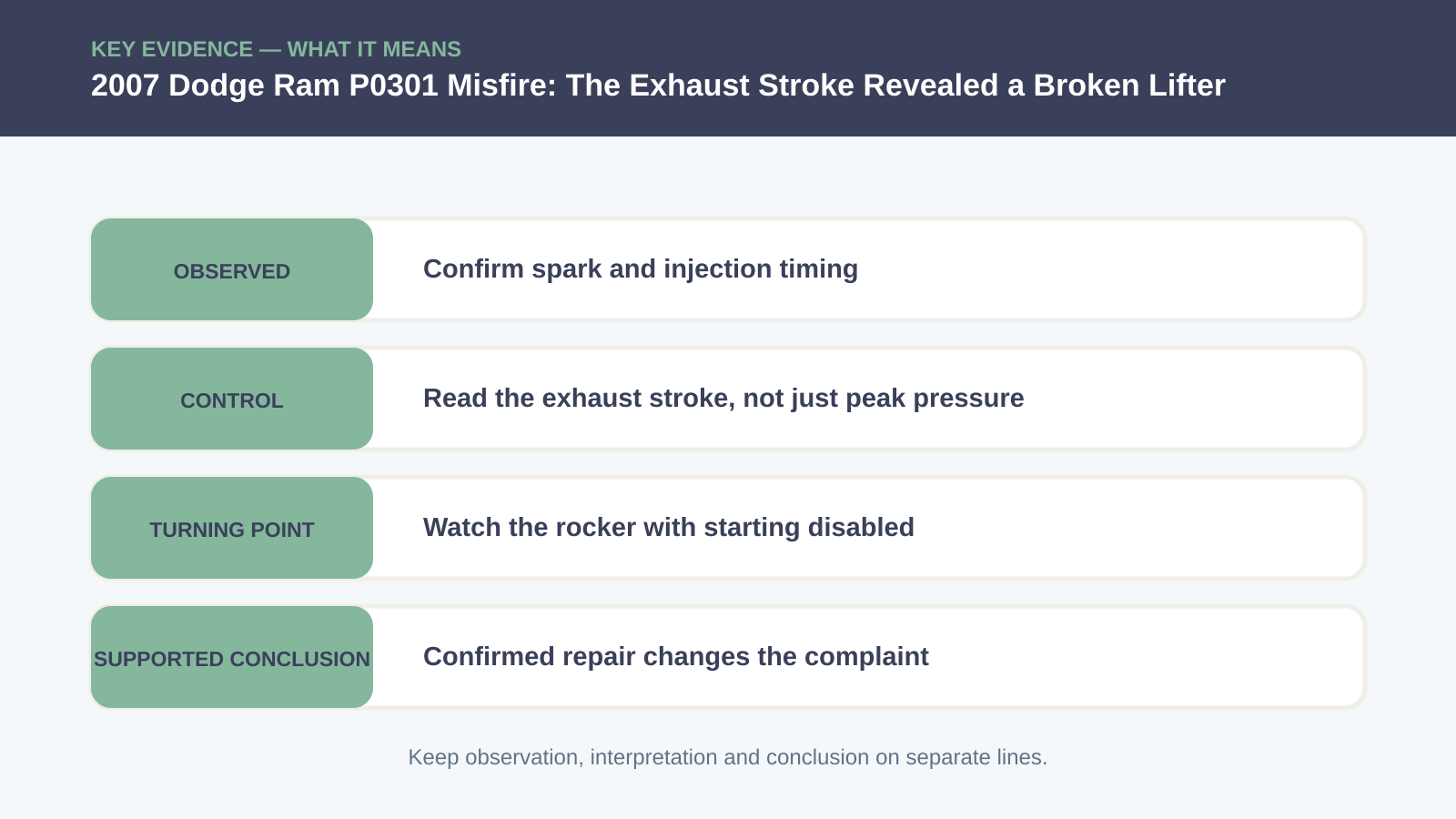
Watch the rocker with starting disabled
With ignition and fuel disabled and the valve cover removed according to procedure, the cylinder-one exhaust rocker barely moved. The physical observation joined the waveform to the valvetrain, and further inspection found the lifter broken. Keep hands, clothing and tools clear during any crank observation. A confirmed component still needs a repair that restores sealing, support, torque, routing or terminal fit—the physical conditions that keep the fault from returning.
Repair the confirmed lifter fault
Repair scope should follow the failure and any debris or companion damage found during disassembly. Lubrication, lifter/cam condition, correct torque and clean sealing surfaces matter. Replacing the named lifter without understanding wear or oil contamination can leave the mechanism at risk. Reassemble protective covers and retainers before declaring success. A diagnostic shortcut must not become the next failure mechanism.
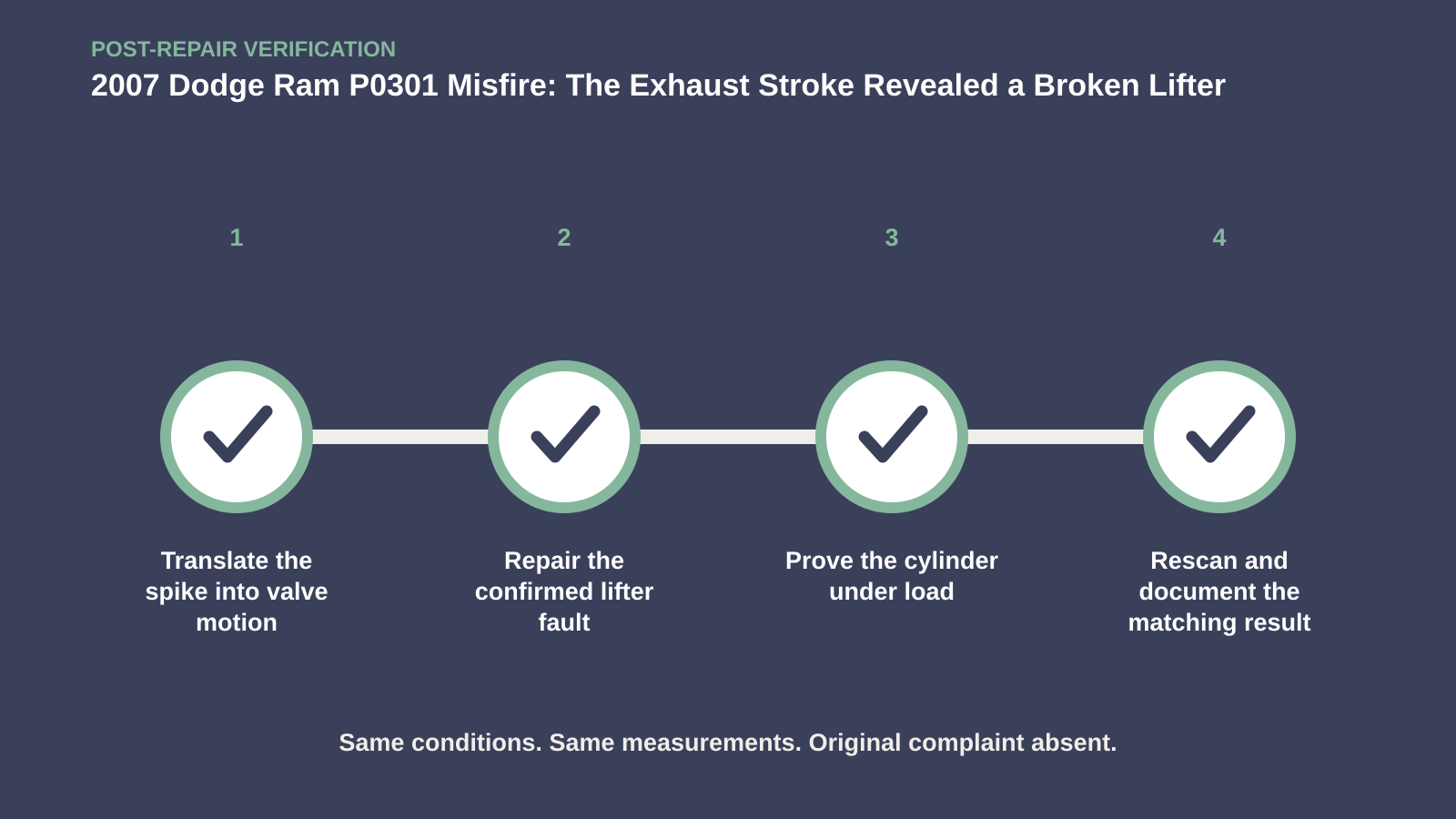
Prove the cylinder under load
After reassembly, verify oil pressure/warnings, quiet valvetrain operation, cylinder contribution and misfire counts at idle and load. Rescan after a complete drive cycle. The repair is credible because the same cylinder that failed now contributes normally—not because P0301 was simply erased. Use the customer’s original complaint as the final specification. A cleared code, quiet bay or one good key cycle is not equivalent to reproducing and passing that condition.
If you are bringing a similar symptom to a shop, arrive with the useful conditions rather than a requested part: whether the vehicle was cold or hot, the exact speed or switch position, which warning lamps appeared, what changed after a restart, and a chronological list of earlier repairs. A short video can preserve an intermittent sound or lamp pattern, but record it only while parked or with a passenger handling the camera. Ask the technician to retain the pre-repair scan and measurements, explain the test that separated the failed path from the alternatives, and show how the original complaint was repeated afterward.
For the owner or service adviser, a useful repair explanation has three parts: what was observed, why the decisive test narrowed the fault, and which original condition passed after the repair. It should also say what the test did not prove. That boundary prevents a memorable case from becoming an automatic parts recommendation.
The useful evidence was not P0301 alone. A restricted-looking exhaust event in the pressure trace led to a safe visual check of rocker movement, which exposed the broken lifter; replacement restored smooth running. The reusable lesson is narrower and more valuable: Teach the four strokes through the bad trace, then show how the waveform earns removal of the valve cover.








Comments 0
Questions, fixes, and real-world diagnostic notes from readers.
Be the first to share a diagnostic result or ask a follow-up question.