
Kubota KX161 Could Not Lift Its Tracks: Measure Relief Pressure Before Blaming the Pump

Weak Digging? Measure Pressure Before The Pump
A Kubota KX161-3ST could not lift its own tracks with the blade and boom. That practical complaint was more useful than the word “weak” because it supplied a repeatable before-and-after test. The engine loaded and the pump moved oil, but average hydraulic pressure remained near 200 bar—below the documented range used for this machine.
An inspection camera can help a trained technician read a hidden pump plate or inspect an accessible relief area only after lockout and depressurization. The AUTOOL SVB308 is one supporting visual option for that narrow task. SVB308 can help inspect an accessible relief-valve area or pump plate after the machine is locked out and depressurized. It cannot measure hundreds of bar, replace a rated hydraulic transducer or make relief adjustment safe for an untrained person.
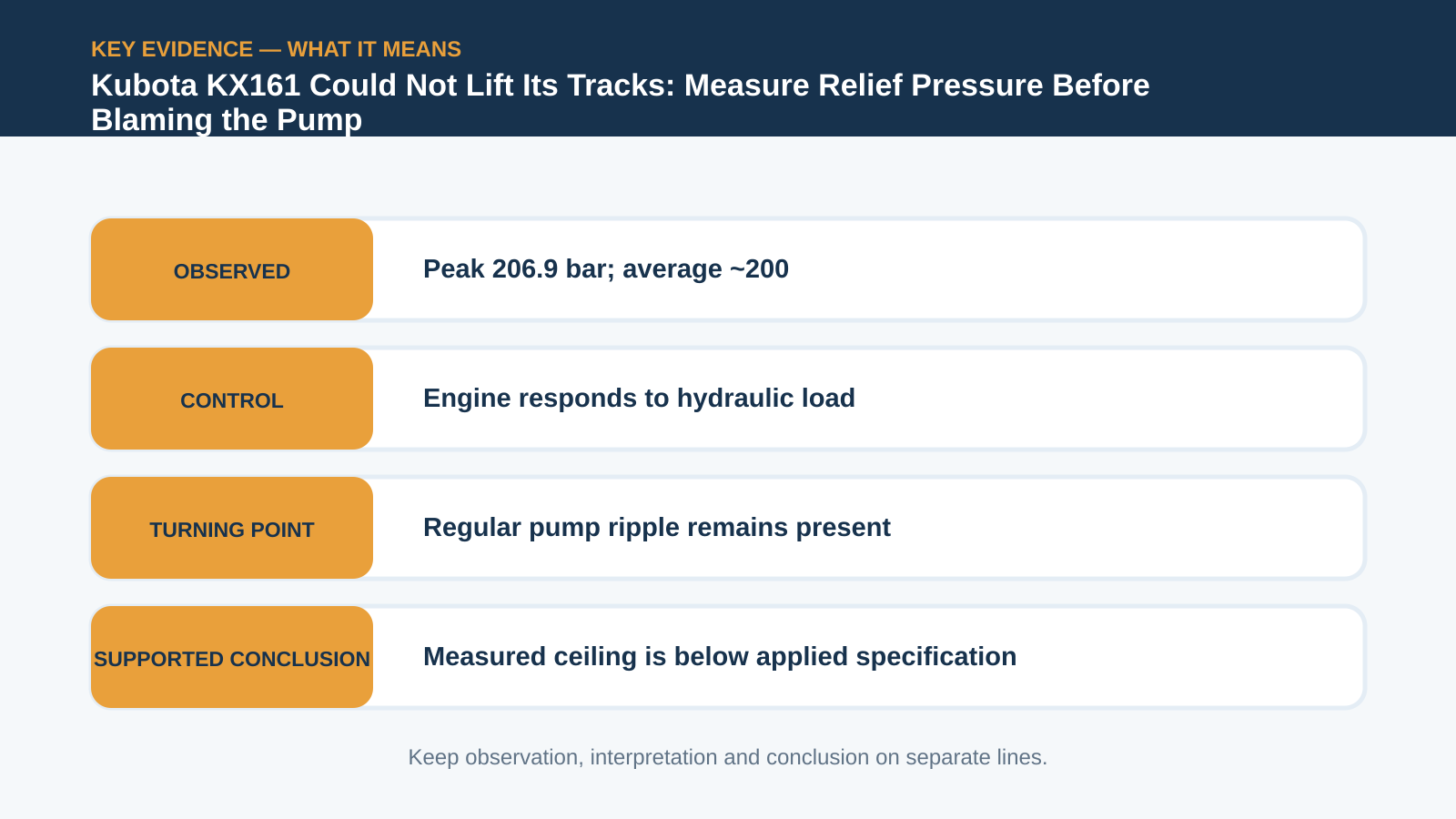
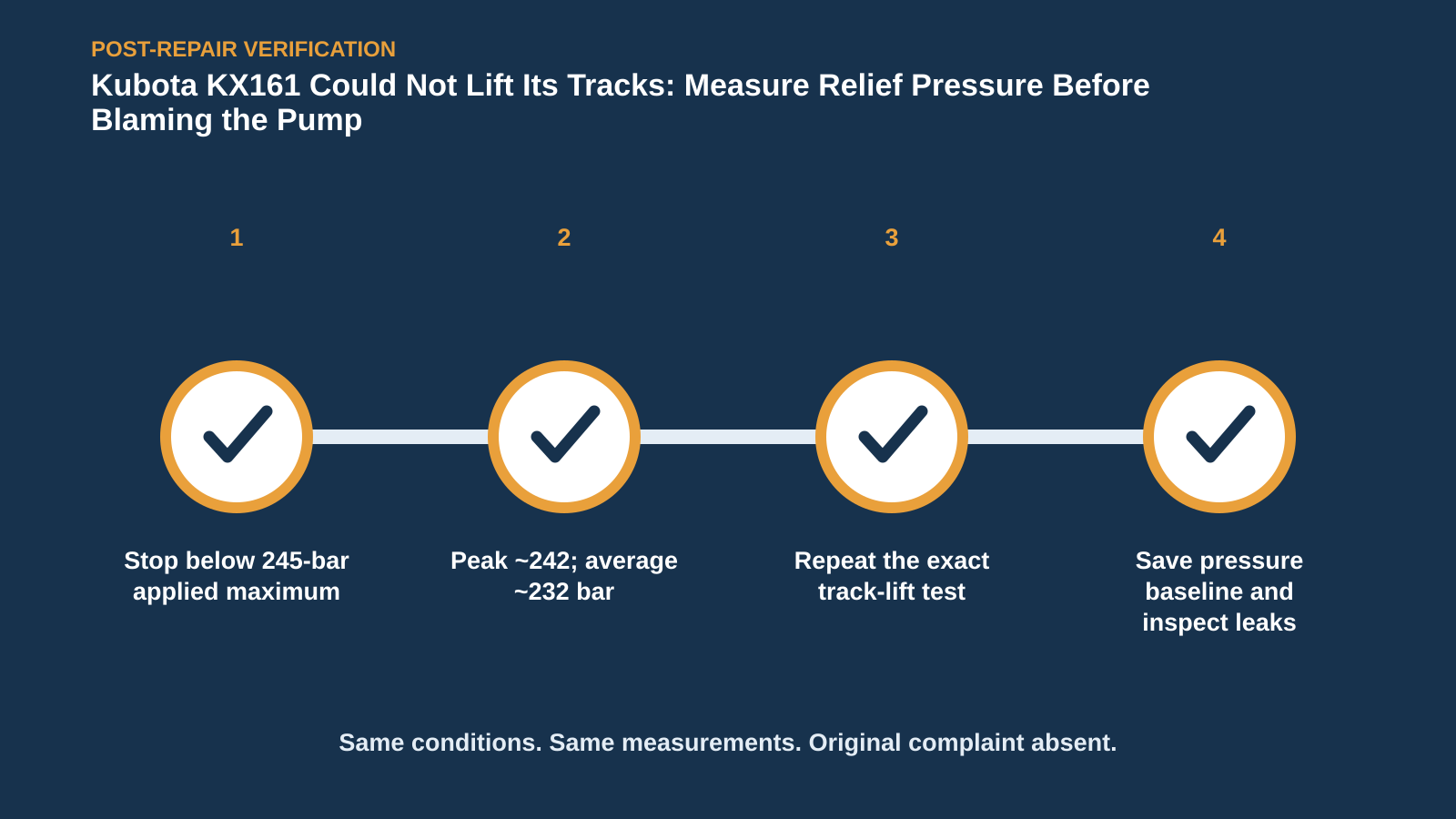
A rated pressure capture peaked at 206.9 bar with the average close to 200. Under continuous measurement, a qualified technician made a controlled two-stage relief adjustment; peak pressure reached about 242 bar and average about 232, still below the 245-bar maximum applied in the case. The excavator then lifted its tracks. This is measurement-led service work, not a DIY adjustment recipe.
Quick answer: The excavator averaged about 200 bar and could not lift its tracks. A qualified measured relief correction raised average pressure to about 232 bar and restored the test.
In this guide
- Turn ‘weak digging’ into one repeatable test
- Explain flow and pressure without jargon
- Watch engine speed while loading the service
- Read pump ripple without condemning the pump
- Find the correct pump and system limits
- Leave relief adjustment to trained technicians
- Raise pressure slowly under continuous measurement
- Repeat the track-lift test and save the baseline
Turn ‘weak digging’ into one repeatable test
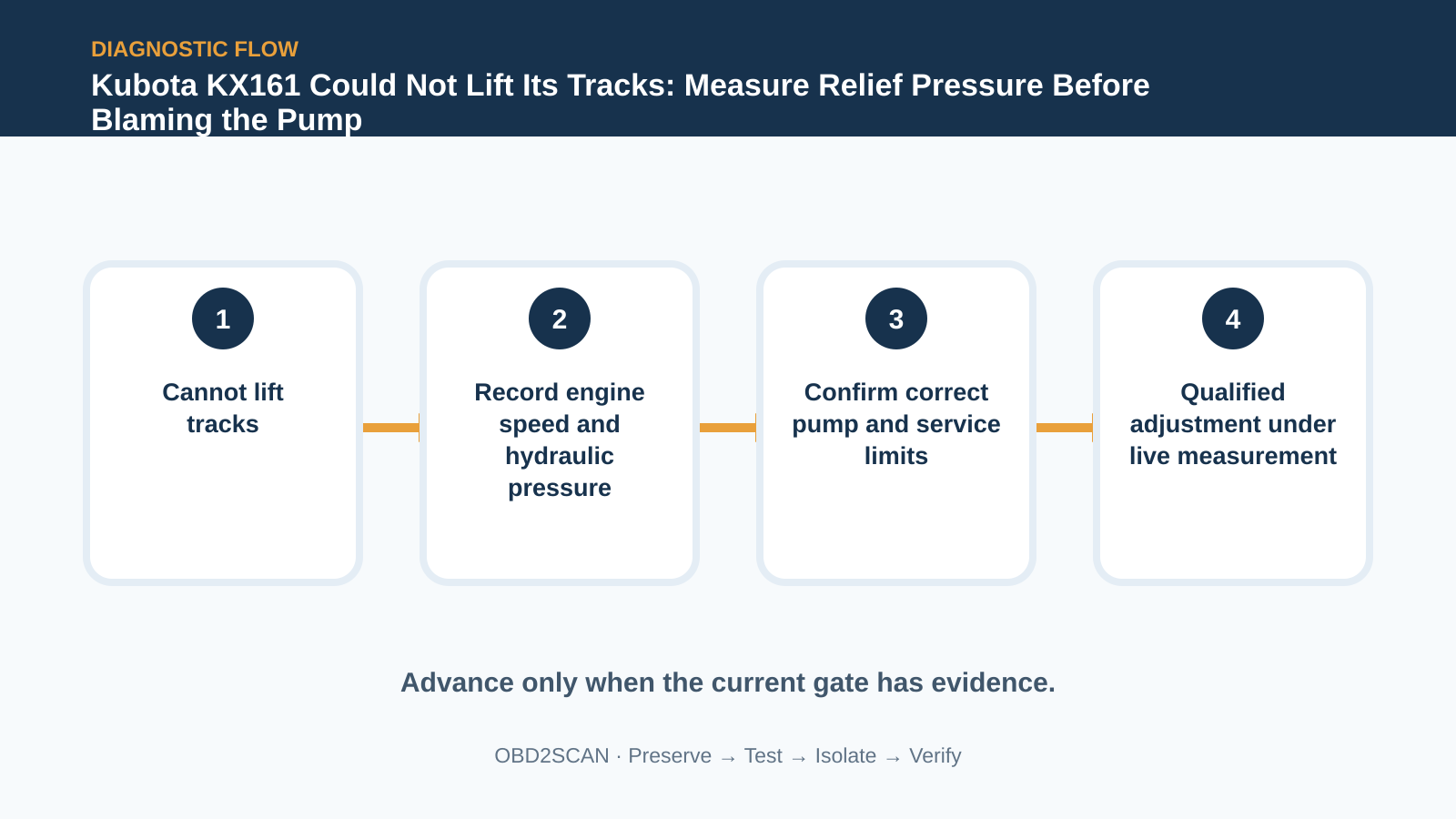
Turn the operator’s complaint into a safe functional baseline. On firm level ground, with an exclusion zone and a qualified operator, record whether the blade and boom can lift the tracks as intended. Note oil temperature, engine speed, attachment and which function is commanded. Never work below a raised machine or use the hydraulic system as the only support. Lower the machine before repositioning equipment. A repeatable test helps, but personnel safety and the manufacturer’s lift procedure determine whether it may be performed at all.
Explain flow and pressure without jargon
Flow determines potential speed; pressure reflects resistance and available force. A machine can move cylinders quickly without a load yet fail when digging because it cannot build pressure. Conversely, raising relief pressure will not cure a worn pump that cannot deliver flow. Observe cylinder speed, leakage, oil condition and engine response, then install rated pressure and, if needed, flow instrumentation at specified ports. Keep every hose and transducer above the expected maximum with protection against rupture.
Watch engine speed while loading the service
Engine speed dropped by about 216 rpm when the service was loaded, showing that the powertrain felt the hydraulic demand. That is context, not a pass/fail number for every KX161. Compare commanded rpm, actual rpm and pressure through the event. If the engine collapses before pressure rises, engine output or excessive demand may lead. Here, the modest, repeatable load response accompanied a stable but low pressure ceiling, keeping hydraulic setting and leakage questions ahead of an engine replacement theory.
Read pump ripple without condemning the pump
The pressure trace included a regular pump ripple rather than a chaotic loss, and the system peaked at 206.9 bar while its working average stayed near 200. Ripple reflects pumping events and circuit dynamics; it should not automatically condemn rotating parts. Use correct sample rate and sensor location, compare several functions, and look for instability or missing events. The meaningful finding was the pressure ceiling relative to the pump and system data, not whether the graph appeared perfectly smooth.
Find the correct pump and system limits
Identify the exact pump—KYB PSVL-54 in the documented research—and obtain the machine-specific pressure limits, test speed, temperature and adjustment sequence. Do not borrow a forum number from a similar excavator. Confirm gauge accuracy and determine whether main, port or secondary reliefs affect the test. An apparently low value can come from the wrong port, cold oil, a leaking service or a transducer that is unsuitable for the pressure range.
| Baseline | Before correction | After correction |
|---|---|---|
| Peak pressure | 206.9 bar | About 242 bar |
| Average under test | About 200 bar | About 232 bar |
| Applied maximum limit | Not reached | Kept below 245 bar |
| Track-lift function | Could not lift | Lifted as expected |
Leave relief adjustment to trained technicians
Relief adjustment exposes people and components to stored energy and should be performed only by trained technicians. Mark the starting position, move in small increments and watch pressure continuously. The case used a two-stage approach and stopped at roughly 242 bar peak, with average around 232, below the 245-bar ceiling applied by the technician. If pressure jumps, oscillates or exceeds the limit, release the command immediately. Turning the adjuster without live measurement is not diagnosis.
Raise pressure slowly under continuous measurement
To verify the repair, repeat the original track-lift test on the same surface and at comparable oil temperature. Confirm the machine now raises as expected, but also check cycle time, engine response, noise, temperature and leaks across every affected service. A higher gauge number alone can hide a new problem if hoses, cylinders or the pump were overloaded. Save the before/after traces and lock or seal the adjuster according to procedure so vibration cannot undo the setting.
Repeat the track-lift test and save the baseline
Use the new baseline for maintenance. If digging power fades again, compare pressure and cycle time before anyone turns the relief a second time; internal wear or leakage may now be responsible. Inspect oil and filters as the service schedule requires. This one documented Kubota responded to a measured correction, but that does not make relief adjustment the answer to all weak excavators. The valuable habit is to define one functional failure, measure within limits and repeat the identical test.
The repair was persuasive because the numbers and the practical test agreed: pressure rose within the chosen limit, and the machine again lifted its tracks. Neither result required guessing that the pump was worn out.






Comments 0
Questions, fixes, and real-world diagnostic notes from readers.
Be the first to share a diagnostic result or ask a follow-up question.