
Honda Civic FK2 No-Start With an Idle Rattle: The Timing Chain Had Moved

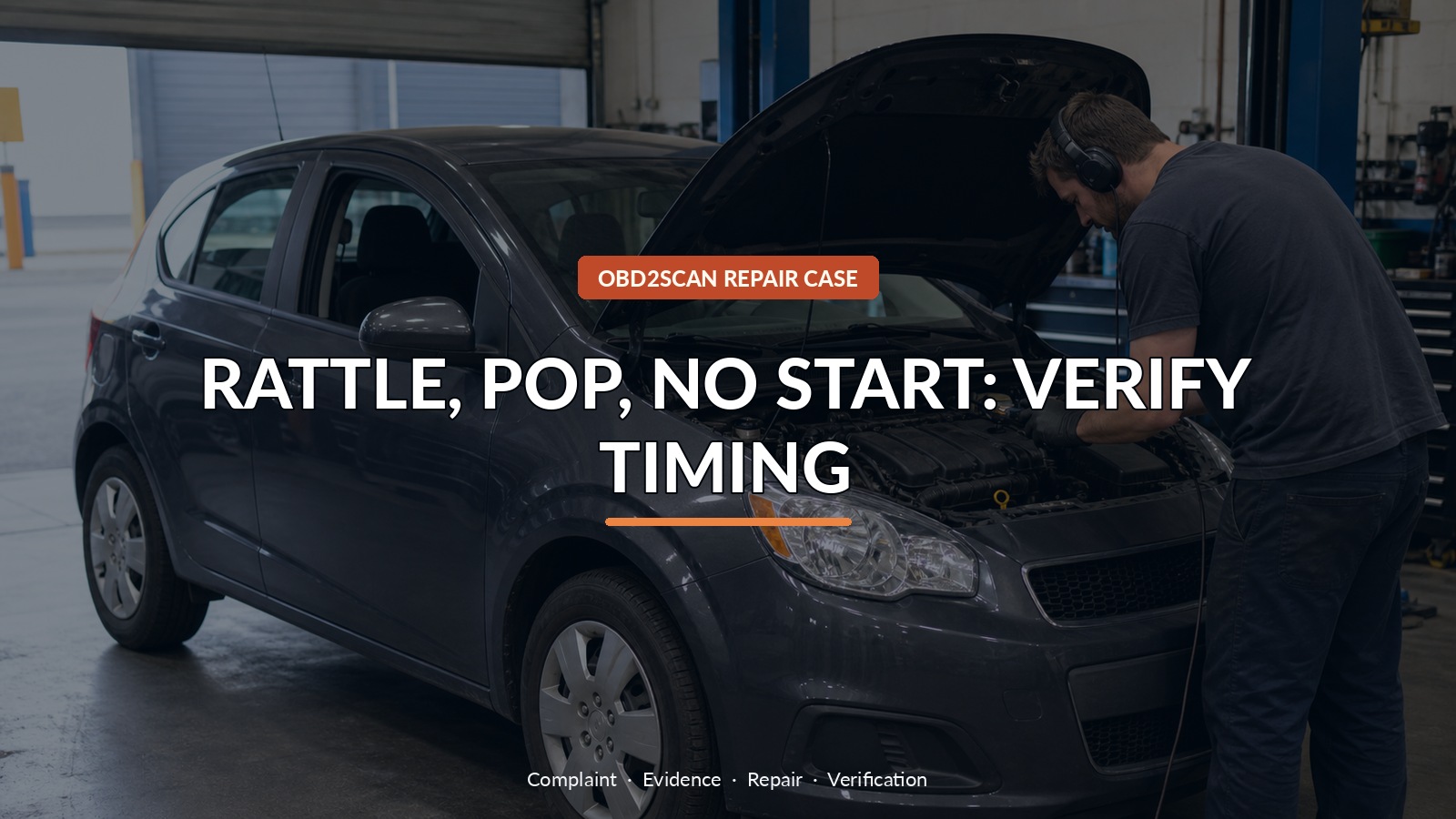
Rattle, Pop, No Start: Verify Timing
Before this Civic became a crank-no-start, it had been warning in a quieter language: rattle at idle, popping, and abnormal running. The repair made sense only after those earlier events were placed back in order. Compression, intake behavior, and cam/crank correlation showed that mechanical timing had moved and valvetrain damage had followed.
Once safe access has been created, an articulating inspection camera such as the AUTOOL SVB308 can document reachable guide, sprocket, cylinder, or valve-area evidence without adding a product image to the diagnosis. SVB308 can document accessible guide, sprocket or cylinder-area condition after safe access is created; an image cannot measure cam/crank phase, confirm valve sealing or replace compression and leak-down testing.
This is an incident reconstruction, not a universal Civic failure forecast. The reader-facing priority is simple: if a new timing-area rattle is followed by popping or a no-start, stop repeated cranking, preserve the sound and test mechanical synchronization before buying ignition parts.
Quick answer: The Civic’s earlier rattle and popping mattered. Compression, intake pulse, and correlation evidence showed shifted timing plus valvetrain damage—not a simple ignition no-start.
In this guide
- Write down the symptom before the no-start
- Listen once and stop repeated cranking
- Check compression and intake pulse behavior
- Compare cam and crank position
- Open the timing area only after correlation fails
- Inspect beyond the chain itself
- Set mechanical timing and repair valve damage
- Prove the fix with start quality, noise and correlation
Write down the symptom before the no-start
Ask what the engine did on its last successful starts. Was the rattle limited to the first second, present at warm idle, or changing with speed? Did popping come from the intake or exhaust? Did the engine stop while driving or fail after being parked? Save any code and record the cranking sound. A timing chain that has moved can change compression and valve events, so repeated attempts may add damage. Disconnecting the battery or clearing faults removes context without making the engine safer to crank.
Listen once and stop repeated cranking
Listen during one controlled crank with fuel or ignition disabled according to the service procedure. An uneven cadence suggests cylinders are not producing similar compression; an unusually fast, smooth crank can mean compression is low across several cylinders. Stop for metallic contact, binding, or backfire. Inspect oil level and history, because tensioner operation and chain wear depend on lubrication. A clean scan with a normal crankshaft-speed signal does not rule out shifted mechanical timing. The control unit can see rotation while the valves open at the wrong moments.
Check compression and intake pulse behavior
Use relative compression to compare cylinders, then conventional compression or leak-down where the results and engine position make it safe. Add an intake-pressure or pulse measurement if available. Regular intake pulses show each cylinder drawing in sequence; a missing, reversed, or badly timed pulse points toward valve motion. This Civic’s rattle became meaningful when it was paired with abnormal breathing. Low compression still does not identify a chain by itself—it can come from valves, rings, head sealing, or a test performed at the wrong throttle and battery condition.
Compare cam and crank position
Capture crank and cam position together during cranking and compare the phase with a trusted pattern for the exact engine. Confirm sensor supply and signal quality so a missing edge is not mistaken for mechanical shift. When the patterns are individually clean but their relationship is wrong, inspect base timing. A correlation test is especially valuable on a no-start because it avoids forcing repeated combustion attempts. Save the trace and mark the engine state; after repair, the same capture should demonstrate that synchronization returned.
| Observation | What it changes |
|---|---|
| New timing-area rattle plus popping | Limit cranking and check synchronization early |
| Uneven relative compression | Identify which cylinders need mechanical follow-up |
| Clean cam/crank signals with wrong phase | Inspect base timing rather than replacing sensors |
| Correct phase but leakage remains | Continue valve, ring, or head-sealing diagnosis |
Open the timing area only after correlation fails
Remove the necessary timing covers only after the measurements justify access. Set the engine at its specified reference and check marks, guide faces, tensioner travel, chain elongation, and sprocket condition. Do not rotate the cam and crank independently on an interference engine unless the procedure provides a safe position. In the documented case, the chain, tensioner, and guide were worn. That physical result explained the rattle and the shifted phase, but the popping and compression results still required inspection beyond the chain.
Inspect beyond the chain itself
Inspect cam lobes, followers, valve movement, and sealing for any cylinder implicated by the pulse and compression tests. A replacement chain cannot straighten a valve that contacted a piston or restore a damaged camshaft surface. This repair required a chain kit, a replacement camshaft, and inlet-valve work. Parts choice and machine work must follow measured condition, not the desire for a single tidy cause. Photograph contact marks and verify guide, oil feed, and tensioner condition so the new timing system is not installed over an unresolved lubrication problem.
Set mechanical timing and repair valve damage
Assemble with the exact timing-locking method, fastener rules, and lubrication steps. Turn the crank manually through the specified cycles and recheck marks before using the starter. Confirm valve movement and compression return, then start without racing the engine. Oil pressure should build promptly and the former rattle or popping should be absent. If contact, uneven cranking, or a timing fault remains, shut down. A quiet engine is encouraging, but a fresh chain can also quiet one symptom while incorrect phase persists.
Prove the fix with start quality, noise and correlation
Repeat the pre-repair correlation capture and intake-pulse check at the same practical state. Compare cranking cadence, compression balance, start time, idle sound, and stored codes. Let the engine cool fully and perform another start, because the original history included idle and start behavior. The documented repair produced normal correlation and a stable intake pattern. Close the job with a record of the chain and valvetrain findings rather than reducing the story to “timing kit fitted.” The evidence should explain why every repaired part was necessary.
The earlier rattle was not background noise; it was the first chapter. By reconstructing the sequence, the diagnosis moved from a generic no-start toward timing, then from timing toward the damaged valves and cam that a chain kit alone could not fix. The humane version of this repair is the one that prevents more cranking, explains why the engine must be opened, and proves breathing and synchronization before handing the Civic back.





Comments 0
Questions, fixes, and real-world diagnostic notes from readers.
Be the first to share a diagnostic result or ask a follow-up question.