
Coolant Color Looks Right but Protection Is Unknown? Test Chemistry Before Trusting Appearance

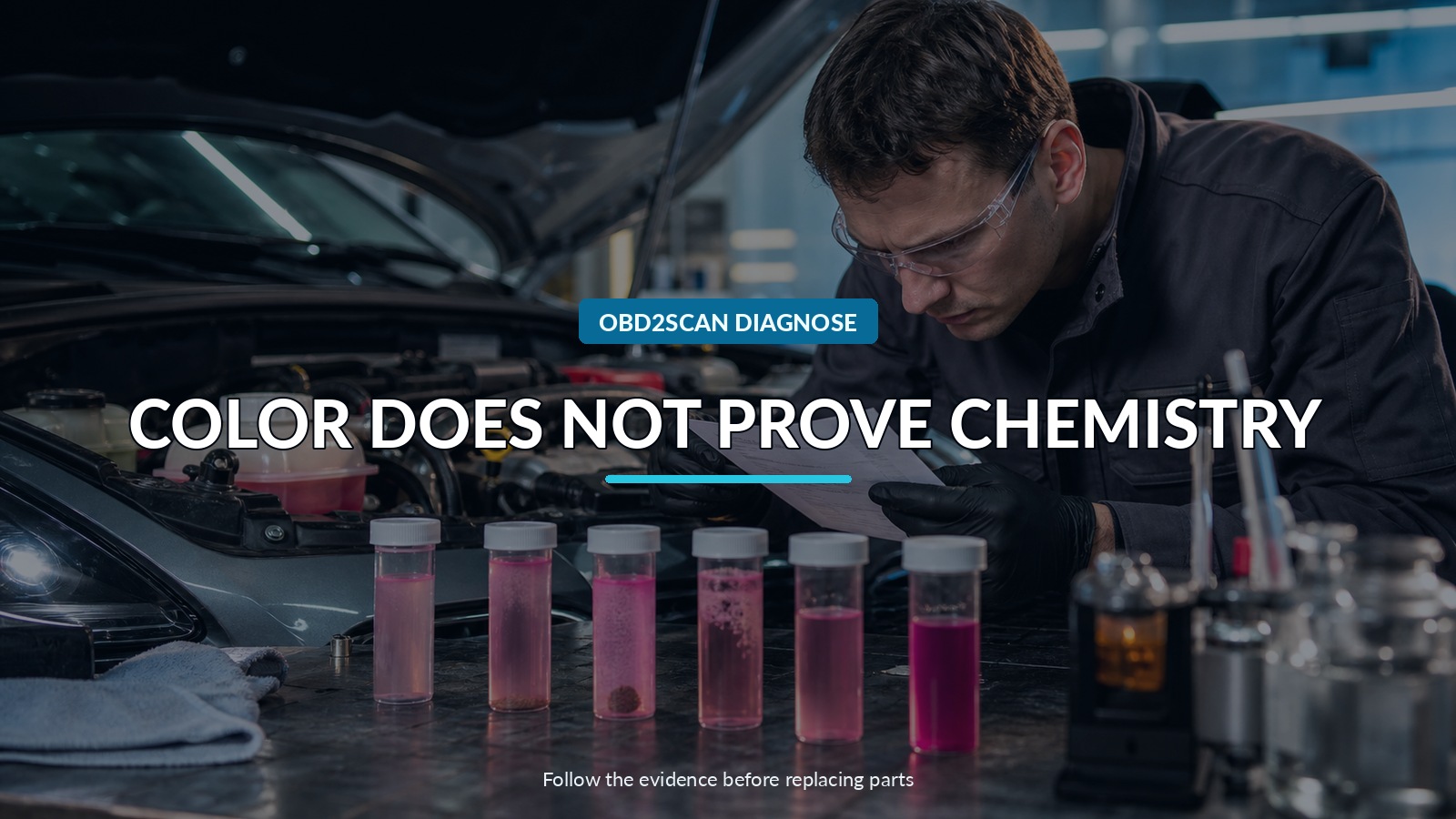
Color Does Not Prove Chemistry
Green, blue, pink, orange, or nearly clear coolant can all look “right” to someone—and color can still be the least reliable fact in the reservoir. Dyes are not a universal chemistry code. Different formulations may share a color, and incompatible products can mix into a shade that appears clean long before deposits or corrosion become visible.
A property-specific tester can answer one bounded question when its method is understood. The AUTOOL AS509 coolant boiling-point tester can add thermal information, but it cannot identify inhibitor family, prove mix compatibility, measure freeze point, certify corrosion reserve, or locate a cooling-system fault.
When service history is unknown, split the remaining question into properties. Is the fluid the specified chemistry? Is its concentration suitable for freeze protection? Can it resist boiling in the operating system? Is the inhibitor package compatible and serviceable? Is there contamination? One visual observation cannot answer all five.
Quick answer: Ignore color as a universal chemistry code. Identify the OEM specification and mixing history, then test freeze protection, boiling behavior, contamination, compatibility, and cooling-system performance with methods matched to each question.
In this guide
Retire the color chart
Color is worth recording because it can help identify a change, leak trail, or obvious contamination. It is not a reliable cross-brand specification. Marketing names, regional products, dyes, aging, and prior top-ups defeat the idea that one hue always equals one coolant technology.
Start with the vehicle identification and current service information. Record the exact coolant specification, any approved part numbers, concentration requirements, and service interval. The answer may be a manufacturer specification rather than a generic category printed on the front of a bottle.
Inspect the reservoir and radiator only when safe and cold. Never remove a pressurized cap from a hot system. Note clarity, floating material, gel, crystals, oil film, rust, deposits, and the difference between reservoir and radiator samples where the design allows safe comparison.
Reconstruct what may have been mixed
Ask who last serviced or topped up the system, what container was used, whether water was added, and whether any component was replaced. Check invoices, bottle remnants, labels, and service stickers. “It was the same color” is not a product identification.
Estimate how much uncertain fluid could have entered. A small emergency top-up with water creates a different decision from a full refill with an unknown coolant. Account for heater cores, auxiliary loops, battery or power-electronics circuits, and other reservoirs on hybrid or electric vehicles; not every coolant circuit uses the same fluid.
If the wrong product or contamination is strongly suspected, do not try to prove compatibility by appearance. Contact the vehicle maker’s service information or coolant supplier with the exact specifications. Mixing may reduce inhibitor performance or create deposits even when the mixture remains transparent.
Match each test to one question
A refractometer or hydrometer may estimate concentration or freeze protection, but the scale and method must match the fluid family. A boiling-point tester addresses another thermal property. pH, conductivity, reserve alkalinity, inhibitor concentration, and laboratory analysis each answer narrower chemical questions and require validated procedures.
| Decision question | Useful evidence | What it does not prove alone |
|---|---|---|
| Will it resist freezing? | Correctly selected concentration/freeze test | chemistry compatibility or corrosion reserve |
| What is its boiling protection? | Valid boiling-point method plus cap/system context | pressure integrity or inhibitor identity |
| Is it the approved coolant? | Label, service record, part number, specification | current concentration or contamination |
| Is the system healthy? | Pressure, temperature, flow, fan, pump, and leak tests | fluid identity from one reading |
Use clean sampling tools and avoid cross-contamination between vehicles. Record sample temperature and instrument setup. If a result conflicts with history or another property, repeat it with a fresh sample before making a service decision.
Understand pressure and boiling together
The cooling system raises the coolant’s effective boiling margin by operating under controlled pressure, and coolant concentration also affects thermal behavior. A sample property does not certify the cap, reservoir, hose, gasket, or system pressure boundary. A weak cap or leak can allow boiling under conditions where the fluid itself tests plausibly.
Conversely, an abnormal boiling-point screen does not name the cause. Dilution, wrong mixture, contamination, method error, or sample handling may be involved. Confirm with the approved procedure and the system’s actual symptom.
If the vehicle overheats, loses coolant, pushes fluid out, has poor cabin heat, or develops pressure unusually quickly from cold, diagnose that event. Check level, leaks, cap performance, airflow, fan command, thermostat behavior, pump flow, radiator condition, combustion-gas evidence, and any model-specific circuit. Do not substitute a chemistry screen for cooling-system diagnosis.
Decide whether to correct, exchange, or investigate
If records confirm the approved coolant and tests show only a concentration issue, the service information may permit a calculated correction. Do not casually remove and add concentrate without considering total system capacity and mixing. Verify the final result after circulation and cooling.
If identity or compatibility is uncertain, a complete service using the approved method may be more defensible than trying to balance an unknown mixture. But “complete” is vehicle-specific: drain points, heater valves, auxiliary circuits, vacuum fill, bleed procedures, and trapped volume vary. A simple radiator drain may leave much of the unknown fluid behind.
If deposits, oil, fuel, sealant, or corrosion products are present, find the source. Fresh coolant cannot repair a failed heat exchanger, head gasket, leaking oil cooler, or deteriorating component. Aggressive chemical flushing can also harm a system when used without approval.
Protect modern multi-circuit vehicles
Hybrids and electric vehicles may have separate loops for the engine, inverter, battery, charger, or cabin system. Their coolants may have specific electrical, material, or service requirements. Identify each reservoir before sampling or filling, and follow high-voltage safety procedures.
Low conductivity is sometimes discussed as though one handheld reading certifies electrical safety. It does not. Instrument method, temperature, contamination, and manufacturer limits matter. Never open or service a high-voltage cooling circuit unless trained and equipped for that vehicle.
Similarly, diesel engines, wet-liner applications, and heavy-duty systems may require attention to cavitation protection and additive condition beyond consumer color or freeze tests. The application defines the chemistry question.
Avoid corrective shortcuts
Do not choose coolant from color, mix concentrates by guesswork, or assume tap water is harmless. Water quality can add minerals and ions; use the water type specified by the manufacturer when dilution is allowed. Premixed product removes one calculation but still must match the required specification.
Avoid universal claims such as “all coolants are compatible” or “one color means long life.” Read the full specification and approvals, not just broad marketing language. Do not add stop-leak or supplemental additives unless the vehicle maker explicitly calls for them.
Label any service container and keep funnels, pumps, and recovery equipment clean. Cross-contamination during an otherwise correct service can recreate the uncertainty you were trying to remove.
Verify chemistry and system performance separately
After correction or refill, complete the specified bleed or vacuum-fill procedure, bring the system through an approved heat cycle, and let it cool fully. Recheck level, concentration or freeze protection with the appropriate method, and any other property that drove the service decision. Inspect for leaks and confirm stable cabin heat, fan operation, and operating temperature.
The final answer should be more precise than “the coolant is the right color.” It should identify the approved specification and service history, document the properties actually measured, and verify that the cooling system performs normally. Anything less leaves chemistry and mechanics mixed into the same unresolved guess.









Comments 0
Questions, fixes, and real-world diagnostic notes from readers.
Be the first to share a diagnostic result or ask a follow-up question.