
Battery Tests Good but the Engine Cranks Slowly? Follow the Starting Circuit

Good Battery, Slow Crank
A battery can pass its own exam while the starting system fails the commute from the posts to the starter. Conductance testing estimates battery condition under a defined model; slow cranking is a whole-system event involving state of charge, connections, cables, solenoid contacts, starter current, temperature, oil viscosity, and mechanical drag.
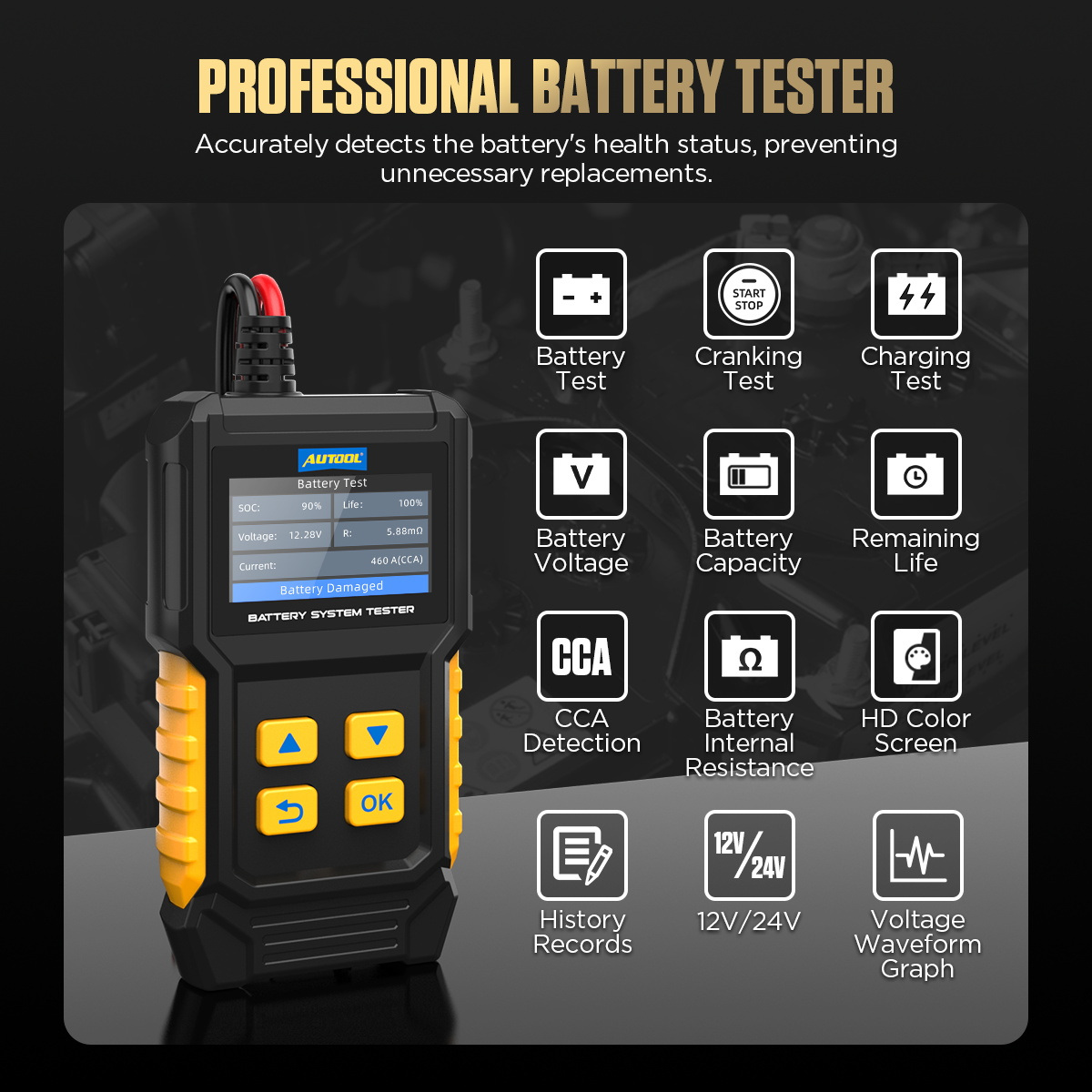
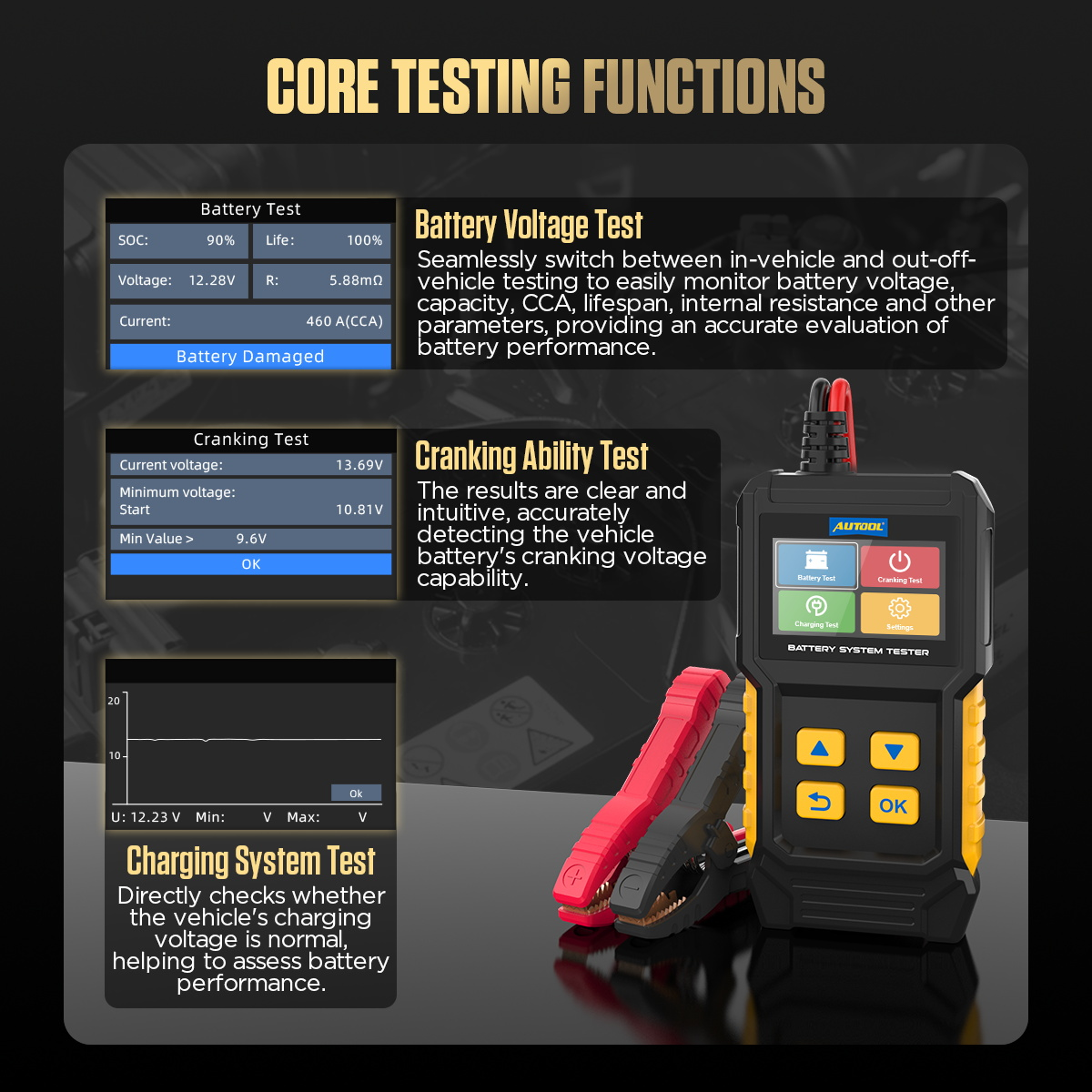
To decide whether the battery is only the starting point, use a 12-volt analyzer that can repeat battery, cranking, and charging screens with the correct battery type and rating entered. A compact example is the AUTOOL BT360 battery and starting-system analyzer, which covers common 12 V lead-acid selections and can show what happened during crank. That screen does not locate a cable voltage drop, measure starter current, or prove that the engine turns freely, so a passing result should move the diagnosis downstream rather than close it.
Think of diagnosis as an energy audit. Verify that the account is funded, then follow every transfer until the starter converts electrical energy into rotation. Keep clear of belts and fans. Hybrid, high-voltage, 24 V, and non-lead-acid systems require their own procedures and tools.
Quick answer: A battery pass closes only the battery-screening branch. Confirm charge and correct test settings, observe voltage during the actual slow crank, audit positive and ground paths under load, then investigate starter demand or engine drag before replacing parts.
In this guide
Separate battery health from cranking performance
“Good battery” can mean several things: acceptable conductance, charge acceptance, open-circuit voltage, capacity, or a recent parts-store screen. Ask which test, battery type, rating, temperature, state of charge, and connection points produced the result. A wrong rating entry or battery chemistry selection can change the interpretation. Testing on dirty clamp surfaces can judge the connection rather than the posts.
Slow crank is also a description that needs precision. Does speed remain uniformly low, hesitate at one crankshaft position, click once, click repeatedly, improve with a jump source, fail hot, or fail after sitting? Does the instrument cluster reset? Does the starter run without engaging? These patterns spend energy differently.
| Finding | What it supports | What remains open |
|---|---|---|
| Battery conductance pass | Battery may meet the tester’s model now | State of charge, cables, starter, engine drag |
| Voltage falls during crank | Starting event is demanding or supply is weak | Where the loss occurs |
| Jump source improves crank | More delivered energy changes the symptom | Battery versus connection versus temperature |
| One-position hesitation | Possible mechanical/starter segment issue | Needs controlled rotation/current evidence |
Record the slow-crank condition
Capture ambient or underhood temperature, soak time, key state, warning messages, security behavior, and whether accessories dim. Record battery terminal voltage before, during, and after the event with leads on the posts—not only on removable clamps. Save cranking duration and speed data if the scan tool reports it reliably. Do not continue repeated long attempts; overheating a starter or cables can turn a diagnostic symptom into damage.
Inspect terminal fit, corrosion, cable swelling, broken insulation, engine-to-body straps, starter connections, and recent service areas. A cable can look clean externally while corrosion advances under insulation. Heat discoloration and a connection that becomes warm after a short crank are clues, but never touch a potentially hot conductor or use temperature alone as proof.
Confirm the engine has the correct oil and no known liquid-lock, seizure, or timing concern before treating every slow crank as electrical. Abnormal mechanical noise, sudden lockup, or a history of coolant/fuel ingestion is a stop condition.
Confirm state of charge before judging
A condition tester works best on a correctly identified, adequately charged battery. Let surface charge dissipate according to the tool or service procedure; select flooded, AGM, gel, or EFB only when the label and application support it; enter the actual rating standard and value. If the tester requests charge-and-retest, do that before condemning or clearing the battery.
Open-circuit voltage is not capacity, and conductance is not a full reserve-capacity test. Parasitic draw can leave a healthy battery discharged. A charging fault can repeatedly underfund it. Temperature changes available output. Compare the result with age, service history, charge state, and repeated behavior rather than asking one screen to answer every battery question.
Watch voltage and cranking behavior together
Connect at the battery posts and observe voltage during the same crank that produces the symptom. Pair it with audible/observed crank speed and, when available, current and RPM. Exact acceptable values vary by vehicle, battery, temperature, and procedure; use service data rather than a universal internet cutoff. The shape and consistency can be as useful as the minimum.
A relatively stable battery-post voltage with slow rotation directs attention toward path loss, starter efficiency, or mechanical load. A severe collapse can reflect a discharged/weak battery, excessive starter current, locked mechanical load, or an internal fault. A momentary connection dropout may reset modules. Measure first, then divide the system; do not replace the battery just because voltage changed during a high-current event.
Audit the positive path
During cranking, measure from battery positive post to the starter B+ terminal with equipment and connections rated for the circuit. This is a voltage-drop test across the entire positive route. If the loss is excessive according to the vehicle procedure, divide the route across post-to-terminal, cable sections, junctions, fuses where fitted, and solenoid contacts. High current makes small resistance visible.
Do not disconnect high-current cables while cranking or place a conventional meter in series unless the exact method and rating allow it. Keep leads away from moving parts and hot exhaust. Remote batteries and pyrotechnic disconnects introduce additional connections and safety controls; follow the actual diagram.
Audit the ground path
Measure from starter housing or specified engine ground point to battery negative post during the same event. Then divide engine strap, body ground, battery terminal, and cable. Painted mounting surfaces, loose starter bolts, corroded crimps, and missing straps after engine work can consume the ground-side budget. A temporary correctly rated bypass may help diagnosis only when the procedure makes it safe; it is not a finished repair.
| Energy audit result | More likely area | Next evidence |
|---|---|---|
| High positive loss | Cable, terminal, junction, solenoid contact | Section voltage drops under crank |
| High ground loss | Engine/body strap, ground terminal, mounting | Section ground drops under crank |
| Low path losses, high current, slow crank | Starter or mechanical load | Current waveform, rotation/mechanical checks |
| Low path losses, low current, slow/no crank | Solenoid/contact/internal open or command | Starter terminal and control evidence |
Consider starter load and engine drag
Once delivery paths pass, current becomes useful. A suitable clamp and scope can compare current, voltage, and relative compression rhythm. Excess current with uniformly slow speed may indicate starter friction or engine drag; low current with poor output may point to internal electrical loss. Uneven repeating peaks can motivate a mechanical/compression investigation, but a current waveform alone does not identify the failed cylinder or component.
Confirm that accessories, belt-driven components, oil viscosity, temperature, and engine condition are considered. A hot starter that slows only after heat soak differs from a cold engine with heavy oil. Removing belts, plugs, or disabling fuel/ignition is procedure-dependent and can create hazards; use service information or outsource when the mechanical path is uncertain.
Compare battery-tool routes
No auditable model-level market-share dataset supports a ranking here. Midtronics and Bosch provide established professional analyzer ecosystems and guided workflows. Clore/SOLAR and TOPDON offer other battery/starting routes. Fluke meters and PicoScope/current-clamp systems localize delivery and dynamic behavior rather than merely screening the battery. A carbon-pile or controlled load tester answers a different capacity question and must be used safely.
| Route | Best at | Tradeoff |
|---|---|---|
| Compact conductance analyzer | Fast battery, crank, and charge screening | Relies on correct setup; limited localization |
| Professional analyzer ecosystem | Documentation, fleet/shop workflow, support | Higher equipment band |
| Meter plus current clamp/scope | Cable loss, current, dynamic starter evidence | More setup and interpretation |
| Controlled load test | Direct loaded battery evidence when specified | Heat, safety, and battery-condition constraints |
| Outsource/no-buy | Rare high-current or hybrid cases | Less immediate control |
If the missing evidence is a repeatable battery, crank, and charge screen, a compact conductance analyzer can collect it before the circuit is disturbed. The BT360 is one such route for common 12 V lead-acid work; enter the battery information from the label, stabilize state of charge, and treat its result as the first line of the energy audit. Once the battery screen is plausible but the crank remains slow, switch to a quality meter for voltage-drop localization and add a current clamp or scope only when current or dynamic behavior will separate the remaining causes.
Professional Midtronics or Bosch platforms are a better fit when fleet documentation, guided workflow, support, and throughput matter more than compact ownership. A controlled load test answers another question again. Choose the least complicated method that supplies the evidence currently missing, then follow the energy to the point where it is lost.
Turn four readings into one starting-system story
Create a simple synchronized worksheet: battery-post voltage, positive-path drop, ground-path drop, and starter current or cranking speed. If instruments cannot capture all four simultaneously, repeat only brief safe cranks under comparable temperature and charge state, allowing the starter to cool as specified. Label every lead location. A reading taken on a clamp cannot be compared directly with one taken on the lead post when terminal contact is the suspect.
This story prevents two common errors. First, a battery screen can pass while cable losses starve the starter. Second, a replacement battery can temporarily mask a dragging starter by supplying more current. Follow the energy to the point where the behavior changes; do not stop at the first component that can improve it.
Intermittent starts need time context
For a once-a-week complaint, ask the driver to record temperature, parking duration, click/no-click, light behavior, and whether a second attempt succeeds. A parasitic draw, terminal that changes with temperature, worn solenoid contact, heat-soaked starter, or security/command issue produces a different timeline. A battery analyzer used after a successful drive may see a recently charged battery and miss the overnight condition.
If parasitic draw becomes the leading branch, switch methods. The vehicle must enter its documented sleep state, and current measurement must not wake networks or bypass the battery sensor. That is a separate diagnosis; slow cranking is the symptom that opened the file, not proof of a drain.
Repeat the cold or hot condition
Repair the proven connection, cable, ground, starter, charging issue, battery condition, or mechanical cause. Clean and torque connections according to service information, restore boots and routing, and remove temporary bypasses. Repeat battery screening with the same correct selections, then repeat cranking measurements at the posts and across both paths.
Most important, recreate the condition that mattered: the next cold soak, the hot restart after a drive, or the electrical load that exposed the issue. Confirm normal starting speed, stable module operation, and no related codes. A complete record says which part of the budget failed and shows delivered voltage/current behavior after repair. A green battery screen alone cannot close a slow-crank case; the engine starting normally under the original condition can.
Questions to settle before selling a starter or battery
Why did a jump start fix it if the battery passed? The added source can raise available voltage and mask cable loss, cold battery limitations, or high starter demand. Repeat controlled post and path measurements; improvement is a clue, not component identification.
Can terminal cleaning be the diagnosis? It can be the repair when loaded drop across the terminal was excessive and falls after correct service. Document before/after loss and torque/protection. Cleaning everything first may fix the car but erase knowledge of which connection failed.
What if the analyzer says replace but the engine cranks normally? Confirm battery type, rating, charge, temperature, post contact, and repeat instructions. Then reconcile the result with manufacturer guidance and another appropriate method. A screen should influence a decision, not override contradictory system evidence without review.
The short version at the vehicle
- Confirm that the engine can be cranked safely and that the symptom is truly slow rotation.
- Identify battery chemistry/rating and test after addressing state of charge.
- Measure at the lead posts during the failing crank; save minimum/shape and observed speed.
- Test positive and ground path loss during the same state using rated equipment.
- If delivery is sound, correlate starter current, rotation, temperature, and mechanical condition.
- Repair only the failed part of the energy path, then recreate cold/hot soak.
This order prevents the green-screen trap. It also prevents a cable or starter from being blamed before the battery is adequately charged and correctly identified. If the starter location, remote battery path, battery sensor, pyrotechnic disconnect, or hybrid architecture makes lead placement uncertain, use the service procedure or a qualified shop rather than improvising on a high-current circuit.
Decision rule: A battery screen closes only the battery branch. Release the vehicle after the full starting path delivers energy and the original temperature/soak condition produces normal rotation. If no safe high-current method is available, outsource before replacing parts by probability.










Comments 0
Questions, fixes, and real-world diagnostic notes from readers.
Be the first to share a diagnostic result or ask a follow-up question.