
Mk7 or Mk7.5 GTI? Identify the 2015–2021 U.S. Car and Its Equipment

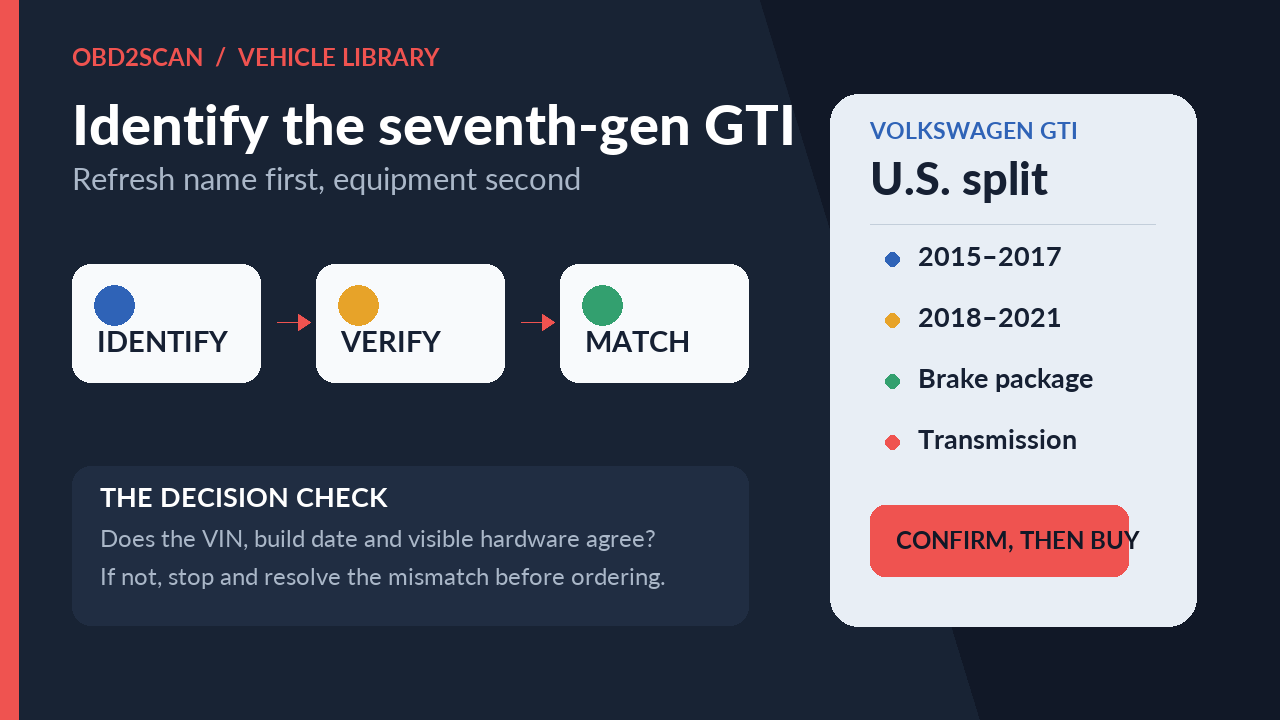
For U.S.-market GTIs, 2015–2017 is the original Mk7 phase and 2018–2021 is the refreshed phase commonly called Mk7.5. Volkswagen describes the 2018 car as an updated seventh generation; “Mk7.5” is useful enthusiast shorthand, not a complete factory fitment code. Confirm model year, VIN, trim, brakes, lighting, transmission, and installed hardware before parts.
Fast answer
- The 2018 U.S. model year is the practical visual and equipment refresh boundary.
- Revised lamps, bumpers, trim and infotainment help identify a refresh, but retrofits can copy the appearance.
- Performance-brake equipment, manual versus DSG, lighting package, driver assistance and trim can matter more than Mk7/Mk7.5 for a specific part.
- A seventh-generation Golf R or regular Golf is not a GTI catalog substitute even though all use the MQB platform family.
In this guide
1. Use the U.S. model-year split
| Common name | U.S. GTI model years | Meaning |
|---|---|---|
| Mk7 | 2015–2017 | Original U.S. seventh-generation phase |
| Mk7.5 | 2018–2021 | Updated seventh-generation phase, also called the facelift |
Volkswagen’s 2018 U.S. press material calls the Golf line the seventh generation and describes an extensive update. That phrasing matters: a Mk7.5 is not the eighth-generation GTI. It remains in the seventh-generation MQB family while receiving visible and equipment changes.
Use model year rather than first registration. A car built late in one calendar year is commonly sold as the next model year. Decode the VIN and confirm the certification-label build month if the listing is vague.
2. Cross-check the visible changes, then look for retrofits
The 2018 update brought revised bumpers and lighting details, LED daytime-running-light treatment, LED taillamps, and larger infotainment displays depending on trim. Those cues make a fast parking-lot identification possible. They do not prove the complete configuration.
Headlamps, taillamps, bumpers, screens, steering wheels, and trim can be retrofitted. If an early VIN wears later lamps, identify the lamp part number, connector, control modules, coding, and adapter harness. Order for the installed conversion only after you understand which factory and retrofit pieces are present.
“Fits Mk7” is too broad for lighting
Check original phase or facelift, halogen or factory LED system, left/right side, market, connector, control modules, and coding. Similar lens shapes do not guarantee electrical compatibility.
3. Identify the equipment that changes parts
Brakes: Early cars could have standard or larger performance-package brakes; later trim packaging changed. Measure the rotor and identify the caliper/option data rather than inferring brake size from red paint or wheel design.
Transmission: Record six-speed manual or DSG, then identify the exact transmission code and production phase for fluid, filter, clutch, flywheel, mount, axle, and software decisions. “Automatic GTI” is not enough.
Differential: Cars with the electronically controlled front differential require their own fluid/service and electronic considerations. Verify factory equipment instead of assuming every performance-brake car has the same complete package.
Suspension: Standard dampers, adaptive chassis control, ride-height changes, and aftermarket coilovers affect parts and alignment. Photograph the installed strut/damper labels.
Infotainment and assistance: screen size, head unit generation, Fender audio, camera, parking sensors, forward-assistance radar, and steering-wheel controls can change connectors, modules, trim and calibration.
4. Avoid the orders that most often go wrong
- Water pump/thermostat assemblies: verify the engine code, VIN production split and current supersession. The GTI water-pump/thermostat guide explains the job boundary but does not replace a VIN lookup.
- Intake manifolds: confirm engine code, sensor/actuator arrangement and part-number supersession before using the Mk7 GTI intake-manifold guide.
- Brake kits: use measured rotor diameter, thickness, caliper and wear-sensor requirements—not “GTI red calipers.”
- Headlamps and taillamps: match phase, technology, market, modules and coding.
- Wheels: verify diameter, width, offset, bolt pattern, center bore, load rating, brake clearance, tire size and TPMS strategy.
5. Create a GTI fitment record
Record: U.S. market, VIN, model year, build month, Mk7 or refreshed phase, trim, engine code, manual/DSG transmission code, differential equipment, brake rotor size, lighting type, adaptive suspension, and major retrofits. Add photos of the door label, underhood emissions label, brake caliper/rotor, and original part numbers.
Then phrase the order precisely: “U.S. 2019 GTI SE, DSG, factory LED lamps, electronically controlled front differential, verified brake size.” If the supplier’s fitment tool cannot represent those fields, ask for a VIN and part-number check. Mk7.5 gets you to the correct shelf; the equipment record gets you the correct box.
Official sources used for this guide
- 2018 Volkswagen Golf GTI Press Kit — Volkswagen of America
- 2018 Volkswagen Golf Press Kit — Volkswagen of America
- 2017 Golf GTI Product Release — Volkswagen of America
- NHTSA VIN Decoder — National Highway Traffic Safety Administration
What a successful identification looks like
You can state the market, VIN-confirmed model and body, production date, engine, drivetrain, and the equipment relevant to the job. The catalog result and the hardware on the vehicle agree, and the supplier can confirm a current part number for that exact record.









Comments 0
Questions, fixes, and real-world diagnostic notes from readers.
Be the first to share a diagnostic result or ask a follow-up question.