
Audi A4 B8, B8.5, or B9? A U.S. Owner’s Identification Guide

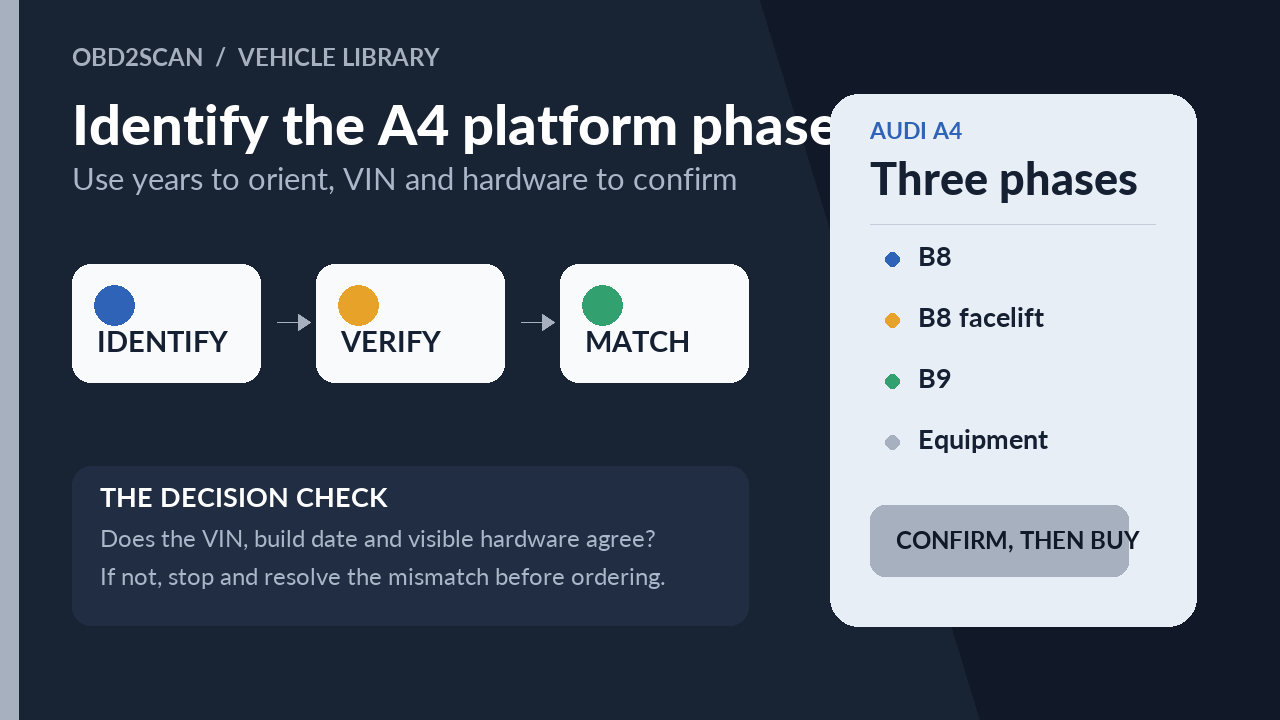
For U.S.-market A4 sedans, B8 usually means 2009–2012, B8.5 means the facelifted 2013–2016 cars, and B9 begins with the redesigned 2017 model. “B8.5” is convenient enthusiast shorthand; Audi service documents may call it the B8 facelift. These labels orient the search, while the VIN, build date, engine, quattro system, lighting, brakes, and options decide fitment.
Fast answer
- B8.5 is a facelifted B8, not a separate clean-sheet generation.
- B9 is the next platform generation and should not be treated as another B8 facelift.
- A4, A5, allroad, S4, and Q5 can share platform-era concepts without sharing every part or procedure.
- Confirm sedan/wagon/body, engine code, transmission, front-drive/quattro, production date and original part number.
In this guide
1. Use the U.S. sedan timeline
| Common label | U.S. A4 sedan shortcut | Meaning |
|---|---|---|
| B8 | Generally 2009–2012 | Original phase of the platform generation |
| B8.5 | Generally 2013–2016 | Facelifted B8; Audi documents may say “B8 facelift” |
| B9 | Generally 2017 onward | Next A4 platform generation |
This map is for U.S. model-year shopping. Global launch dates, Avant availability, allroad naming, and registration calendars differ. Near any boundary, decode the VIN and read the driver-door production label.
NHTSA-hosted Audi service and recall documents use B8 and B9 terminology and explicitly describe some later cars as “facelift B8.” That makes B8.5 useful translation rather than a magic field guaranteed to appear in the VIN decoder.
2. Read the facelift cues carefully
The facelift changed headlamp and grille treatment, bumpers, lighting electronics, interior controls/infotainment details, and available powertrain or equipment combinations. The exact list depends on body and trim. From a distance, the front lamps and grille are the fastest clue between early B8 and facelift B8.
Appearance remains secondary evidence. A collision repair can install an aftermarket bumper; owners retrofit lamps, grilles, steering wheels, and multimedia units. If visible cues conflict with the VIN year, read the lamp, module, bumper, and harness part numbers. A converted front end may require a mixture of original and facelift components rather than a single catalog click.
3. Shared platform does not mean shared fitment
B8-era A4, A5, S4/S5, Q5, and related cars share an architectural family and many service concepts. Body shape, axle load, engine, transmission, quattro version, steering, brakes, cooling, exhaust, suspension calibration, electronics, and market equipment can differ. “Fits Audi B8” is therefore a starting description, not proof.
For example, the Audi B8 front-control-arm guide explains the work pattern, but the correct arms still depend on VIN, model/body, axle and suspension. The B8 S4 water-pump/thermostat guide belongs to its specific supercharged powertrain, not to every B8 A4.
A4 versus S4
S-line appearance on an A4 does not turn it into an S4. Full S models can use different engines, brakes, cooling, suspension, exhaust, body details and electronics.
4. Verify the fitment-critical details
- Body: sedan, Avant/wagon, or allroad; U.S. availability changes by year.
- Engine: exact engine code, emissions family and production split—not simply “2.0T.”
- Transmission/drivetrain: front-wheel drive or quattro and the exact automatic/manual transmission code.
- Steering and suspension: production phase, dynamic steering, sport suspension, electronic damping, axle load and wheel package.
- Brakes: measured rotor dimensions, caliper, wear-sensor arrangement, option code and axle.
- Lighting: pre-facelift/facelift/B9, lamp technology, adaptive function, market, control modules and coding.
- Infotainment: MMI generation, screen/control unit, audio package, connectors, component protection and software.
For electronics, a matching plug does not prove compatibility. Ask whether component protection, online authorization, calibration, coding, or parameterization is required before buying a used unit.
5. Write a useful A4 description
Combine market, model year, body, platform phase, build month, engine code, transmission, drivetrain and the relevant option. For example: “U.S. 2014 A4 sedan, facelift B8, 2.0T engine code verified, quattro, eight-speed automatic, factory xenon lighting.”
Provide the VIN privately to the supplier and compare the old part number against the current Audi supersession. If a catalog returns both early and late choices, use the VIN break and installed hardware. The B8/B8.5/B9 label puts the car in the right generation; the detailed description prevents the wrong-generation shortcut from becoming a wrong part.
Official sources used for this guide
- 2017 Audi A4 Press Kit — Audi of America
- Audi VIN Decoder / Model Identification — Audi of America / NHTSA
- Audi Recall Report: B8 Facelift and B9 — Audi of America / NHTSA
- NHTSA VIN Decoder — National Highway Traffic Safety Administration
What a successful identification looks like
You can state the market, VIN-confirmed model and body, production date, engine, drivetrain, and the equipment relevant to the job. The catalog result and the hardware on the vehicle agree, and the supplier can confirm a current part number for that exact record.







Comments 0
Questions, fixes, and real-world diagnostic notes from readers.
Be the first to share a diagnostic result or ask a follow-up question.