
BMW 5 Series Codes Explained: F10, F18, G30, and G38 Without the Guesswork

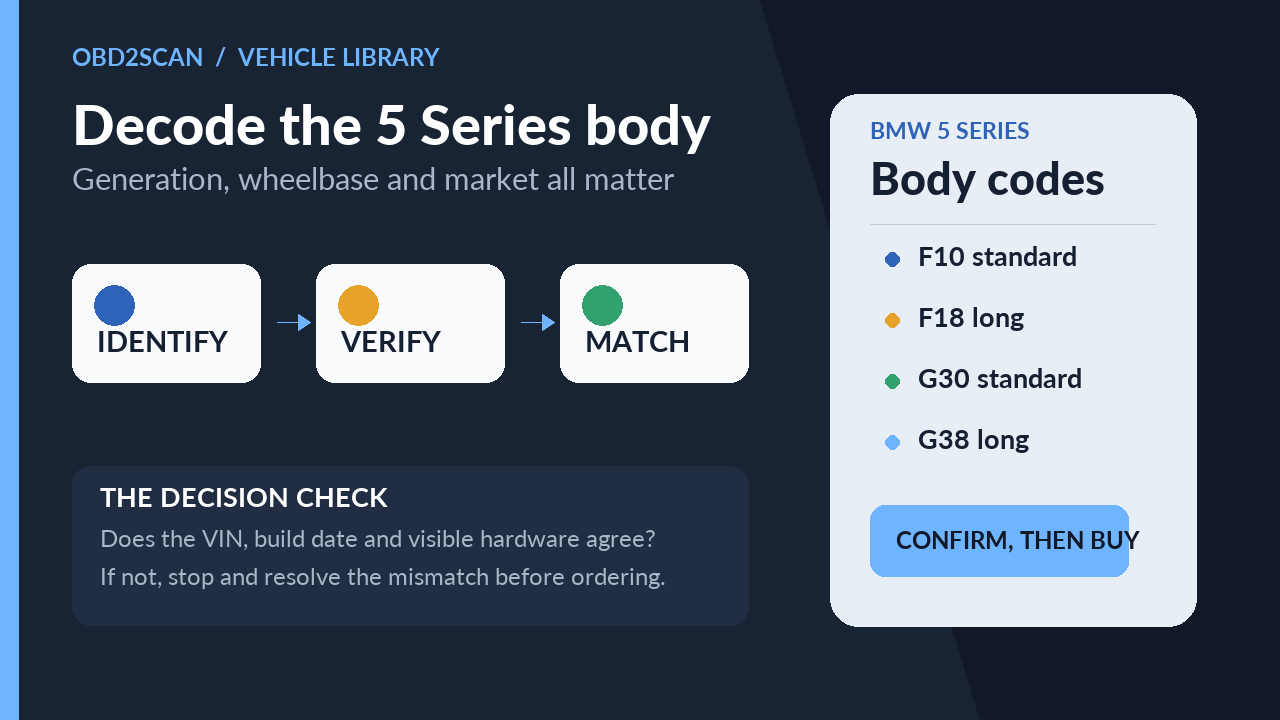
F10 and G30 refer to two successive standard-wheelbase BMW 5 Series sedans. F18 and G38 are their long-wheelbase counterparts developed primarily for China. The code is more useful than a badge, but it still does not identify the engine, drivetrain, brake package, or production split. For parts and service, pair the body code with the VIN and build date.
Fast answer
- A U.S.-market 2011–2016 5 Series sedan is generally an F10; a 2017–2023 sedan is generally a G30.
- F18 and G38 mean a long-wheelbase sedan, not a trim level or engine family.
- The number after 5—such as 528i, 535i, 540i, or 530e—does not uniquely describe every mechanical configuration.
- Confirm market, wheelbase, engine, drivetrain, and production date in a VIN-specific catalog.
In this guide
1. Use the four-code map
| Code | What it identifies | Practical U.S. context |
|---|---|---|
| F10 | Sixth-generation standard-wheelbase 5 Series sedan | Usually 2011–2016 model-year U.S. sedans |
| F18 | Long-wheelbase version related to F10 | Primarily a China-market configuration; investigate imports carefully |
| G30 | Seventh-generation standard-wheelbase 5 Series sedan | Usually 2017–2023 model-year U.S. sedans |
| G38 | Long-wheelbase version related to G30 | Developed for the Chinese market, with rear-compartment and dimensional differences |
BMW’s U.S. launch material calls the 2017 G30 the seventh generation, so the cleanest dividing line for a U.S. sedan shopper is the 2017 model year. Production and registration calendars differ in other markets. A 2017 date in an advertisement is therefore not enough: decode the VIN and identify the original market.
You may also encounter F11 for the wagon, F07 for the earlier 5 Series Gran Turismo, and other related codes. Those cars can share engines or electronics while using different body, interior, suspension, hatch, exhaust, or cooling parts. Do not collapse every “F-generation 5 Series” into F10.
2. F18 and G38 are more than extra rear legroom
A long-wheelbase code describes a different body configuration. The longer center structure changes dimensions and can affect doors, glass, headliner, carpets, exhaust sections, propeller shaft, brake lines, wiring, trim, underbody panels, and rear-seat equipment. The long-wheelbase car may also carry market-specific software, emissions equipment, lighting, infotainment, and powertrain combinations.
This is why an imported F18 should not be entered into a U.S. parts website as “the closest 535i.” Even when the engine family is shared with an F10, the part being ordered may be body-, market-, or production-specific. The same warning applies to G38 versus G30.
Import check
If the windshield VIN does not decode cleanly in NHTSA, preserve the original market documents and use a BMW catalog that covers that market. U.S. recall, emissions, and parts listings may not represent an imported long-wheelbase car.
3. The trunk badge does not finish the identification
Within F10 alone, U.S. buyers encountered four- and six-cylinder gasoline cars, a V8, diesel, hybrid, rear-wheel drive, and xDrive. G30 added its own gasoline, plug-in hybrid, performance, and all-wheel-drive combinations. A 530, 535, or 540 badge helps narrow the search, but badge conventions changed over time and badges can be removed or replaced.
The official model designation also does not settle optional hardware. Wheel size cannot prove brake size. An M Sport bumper cannot prove an M Sport factory build. A used control module may have been coded to another car. Treat the VIN build data and the hardware on the lift as two records that must agree.
If your immediate question is the engine rather than the body, use the companion BMW N55 versus B58 identification guide. For N55 service context, the N55 valve-cover and PCV guide shows why an engine-family match matters before a procedure is chosen.
4. Where the code changes a parts or service decision
- Body and lighting: F10 and G30 lamps, bumpers, sensors, cameras, and control architecture are not a facelift swap.
- Suspension: wheelbase, axle load, adaptive suspension, rear air suspension on related body styles, xDrive, and performance packages can change components.
- Brakes: verify rotor dimensions, caliper and option code; “fits F10” is too broad for a confident order.
- Cooling and intake: engine designation, emissions market, and production split determine hoses, pumps, charge-air parts, and sensors.
- Electronics: generation, option list, hardware index, software level, and coding requirements all matter.
A good listing answers all of those filters. A poor listing uses a wide year range and a photo of a similar part. If the seller cannot check a BMW part number against the VIN, compare the number on the original part and confirm the current supersession elsewhere.
5. Verify your exact 5 Series in four lines
- Decode the 17-character VIN and record original market, model year, body, and drivetrain.
- Read the build month at the driver door and retrieve the VIN-specific factory option list from a trusted BMW system.
- Confirm the engine designation, driven wheels, suspension and brake equipment on the car.
- Enter the VIN—not only “2014 535i” or “2018 540i”—into the current parts or service catalog.
The result should read like “U.S.-market G30 sedan, June 2018 build, B58, xDrive, option-specific brakes,” not simply “5 Series.” That is the level of identity needed to select parts and instructions without guessing.
Official sources used for this guide
- BMW Model Year 2011 Fall Update — BMW Group PressClub USA
- The All-New 2017 BMW 5 Series — BMW Group PressClub USA
- New BMW 5 Series for the Chinese Market — BMW Group PressClub Global
- NHTSA VIN Decoder — National Highway Traffic Safety Administration
What a successful identification looks like
You can state the market, VIN-confirmed model and body, production date, engine, drivetrain, and the equipment relevant to the job. The catalog result and the hardware on the vehicle agree, and the supplier can confirm a current part number for that exact record.




Comments 0
Questions, fixes, and real-world diagnostic notes from readers.
Be the first to share a diagnostic result or ask a follow-up question.