
Ford Bronco vs. Bronco Sport: Similar Name, Different Vehicle

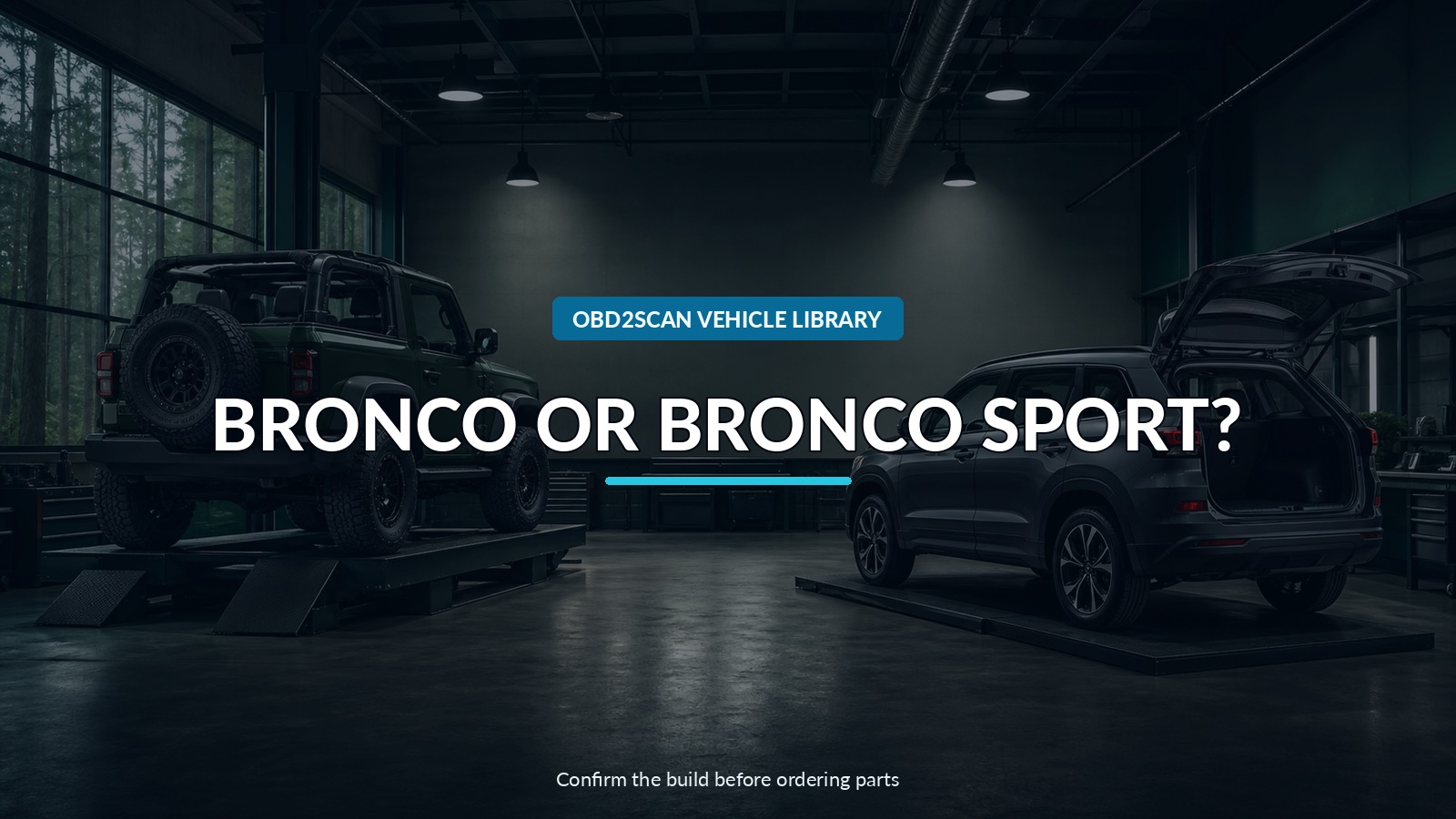
Conceptual identity-verification scene: Bronco Or Bronco Sport?
Bronco Sport is not a Bronco trim. It is a separate vehicle line. The U.S. Bronco is a body-on-frame SUV offered with two or four doors and a removable roof; the Bronco Sport is a smaller unibody five-door SUV with a fixed roof. That architecture split should happen before anyone discusses a Badlands badge, engine, axle or accessory.
The names are close enough to contaminate searches, invoices and marketplace listings. Put the exact model on the first line, then add VIN, build date, engine, transmission, drivetrain, roof/doors, grade and job-specific options. Shared styling is a clue to the family relationship, not evidence of interchange.
Think of the comparison as a nameplate collision: the spelling overlaps, but the platforms do not. One architecture question resolves most of the confusion before trim language enters the conversation.
Quick answer: Bronco is a body-on-frame two- or four-door removable-roof SUV; Bronco Sport is a unibody five-door fixed-roof SUV. Confirm the exact model before engine, drive, grade, and options.
In this guide
Split the shared name in one sentence
| Identity field | Bronco | Bronco Sport |
|---|---|---|
| Basic architecture | Body-on-frame | Unibody |
| Factory doors | Two or four | Five-door body |
| Roof | Removable systems offered | Fixed roof |
| Rear access | Side-hinged swing gate arrangement | Conventional liftgate arrangement |
| Catalog starting point | Bronco | Bronco Sport |
Ford’s 2021 technical specifications document these as different structures, sizes and powertrain families. If a parts site combines them under one “Bronco” result, return to the model selector instead of choosing by photograph.
Compare architecture, doors and roof
Start with the side and rear. A full-size Bronco’s separate frame, exposed removable-door/roof concept and rear-mounted spare create a very different package from the compact Sport. The Sport’s fixed roof, integrated five-door body and liftgate provide a rapid answer even when the grille lettering is cropped out.
Accessories can blur styling. Roof racks, lights, bumpers, wheels, decals and off-road tires do not change the underlying architecture. Avoid using ride height or the word “Badlands” because Ford has used that grade name on both lines.
Match the factory model record
Read the windshield VIN and certification label, and compare them with title/registration. Ford build data should return Bronco or Bronco Sport explicitly. The NHTSA VIN Decoder is a useful independent check when a used listing is ambiguous.
Copy production month as well as model year. A current model-year catalog can include running changes, and an early-build part may not match a later revision. If the physical VIN and records disagree, stop; do not decide identity from the cleaner-looking label.
Build the configuration after the split
For Bronco, record two- or four-door, roof system, engine, manual or automatic transmission where applicable, transfer case/drive equipment, axle and grade. For Bronco Sport, record engine, automatic transmission, all-wheel-drive equipment, grade and relevant option packages. Those fields determine very different mechanical and electrical branches.
Body work needs even more detail: side, door count, camera/radar, lamp type, parking sensors and connector count. Roof work must identify the exact factory system and panel position. Brake and suspension work needs the installed package, wheel and component dimensions rather than a shared model-name search.
Do not let a shared trim reopen the question
Badlands, Big Bend and other familiar language can appear in searches for both vehicles. A trim badge cannot overrule the model record. Likewise, a seller may shorten “Bronco Sport Outer Banks” to “Bronco Outer Banks,” dropping the word that matters most.
Keep the model and grade in separate fields. “Bronco Sport / Badlands” is clear; “Bronco Badlands” invites the wrong catalog. This small formatting habit also improves estimates and service history.
Audit accessories and collision repairs
Front clips, lamps, grilles, tailgate pieces, wheels and interior screens can be replaced. Photograph the installed part number and connector or mounting pattern. For used assemblies, request the donor VIN and factory model rather than accepting “came off a 2021 Bronco.”
If an accessory claims compatibility with both lines, verify that it is truly universal—perhaps a portable item—rather than assuming structural mounting points match. Body architecture makes broad interchange especially unlikely.
Connector language needs the same separation. A generic OBD connector or shared fastener does not mean the vehicles use the same module, network, calibration or bracket. For a scan or programming job, select the exact model and model year in the service system, confirm the reported VIN, and stop if the module list conflicts with the factory build.
Write the exact Ford identity
A good handoff reads: “U.S. 2022 Bronco Sport, five-door unibody, VIN/build and production date verified, engine/automatic/AWD configuration recorded, Badlands grade confirmed, installed component number photographed.” A full Bronco line should state door count and roof system.
Once the first line says the exact vehicle, the similar name stops being a problem. Everything after it becomes ordinary configuration work.





Comments 0
Questions, fixes, and real-world diagnostic notes from readers.
Be the first to share a diagnostic result or ask a follow-up question.