
Which Subaru Outback Generation? 2010-2014, 2015-2019, 2020-2025, or 2026+

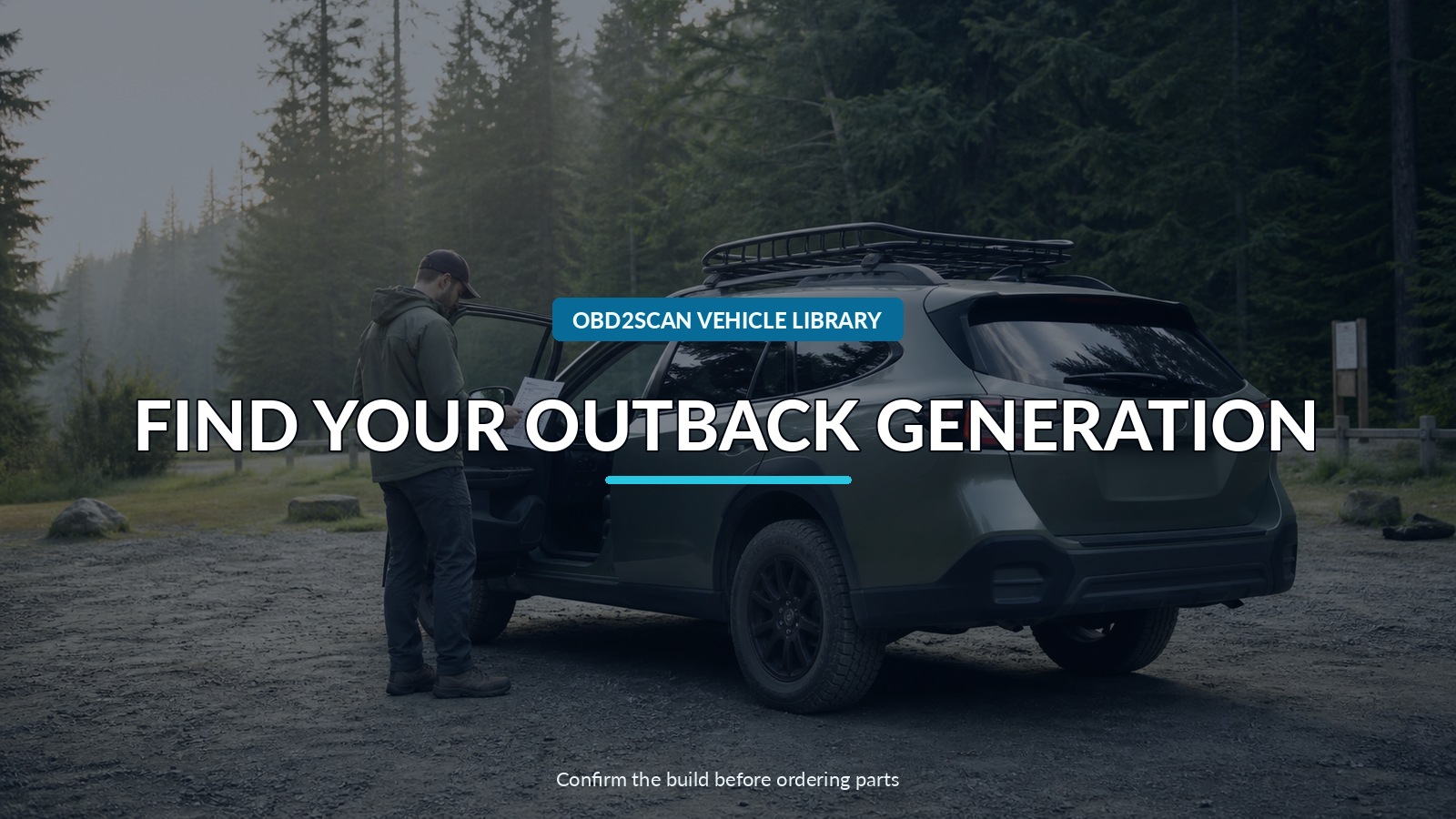
Conceptual identity-verification scene: Find Your Outback Generation
Modern Outback identification now has four clear trail markers: 2010–2014 is the fourth generation, 2015–2019 the fifth, 2020–2025 the sixth, and the redesigned 2026 begins the seventh. That timeline gets you to the right map; engine, transmission, trim, market, production date, and installed hardware get you to the destination.
Start at the windshield VIN and driver-door label. Continue to the underhood labels, Subaru’s manual or build resources, and the OEM catalog result. Roof racks, cladding, grille, lamps, and center-screen layout are useful from across a parking lot, but repair and retrofit work can move those trail markers.
The task is identification, not a ranking of which Outback is most reliable. Keep reliability, symptoms, and repair procedures out of the generation decision until the exact vehicle is known.
Quick answer: For U.S. Outbacks, 2010–2014 is generation four, 2015–2019 five, 2020–2025 six, and 2026+ seven. Verify production date, engine, transmission, drivetrain, options, and installed hardware.
In this guide
Follow the four-generation timeline
For U.S. vehicles, use this as the opening branch:
| U.S. model years | Generation | High-level identity task |
|---|---|---|
| 2010–2014 | Fourth | Record engine, transmission, drivetrain and build split |
| 2015–2019 | Fifth | Separate model year, 2.5i/3.6R-era powertrain and equipment |
| 2020–2025 | Sixth | Separate naturally aspirated and XT turbo branches, options |
| 2026 onward | Seventh | Use the redesigned vehicle’s own catalog and production data |
Subaru officially introduced the 2026 as the seventh-generation Outback. Older articles that stop at six generations are now incomplete, so check the date of any overview before borrowing its boundary.
Use the trailhead walkaround
Photograph the complete side profile, front corner, rear badge area, dashboard, and roof system. Fourth-, fifth-, sixth-, and seventh-generation vehicles have distinguishable proportions and styling. Screen orientation and dashboard architecture are especially quick cues between the later families.
Treat every clue as provisional. A Wilderness-style accessory does not create a Wilderness build. Wheels, racks, cladding, lamps, grilles, and head units can be replaced. A removed 3.6R or XT badge does not rewrite the engine bay.
Confirm the labels and factory record
Match the windshield VIN, door certification label, registration, and OEM record. The NHTSA VIN Decoder supplies an independent check, while Subaru’s manual portal helps route the vehicle to model-year-specific documentation. Record production month/year because mid-cycle and running changes do not always align with a calendar boundary.
Underhood labels help identify engine and emissions family. For a used engine, transmission, module, lamp, or body component, photograph the installed number and connectors. A VIN describes the original build; the old part verifies the current assembly.
Add the engine and equipment branch
The fourth- and fifth-generation ranges include six-cylinder 3.6R configurations as well as four-cylinder vehicles. Later sixth-generation shopping introduces XT turbo configurations alongside naturally aspirated versions, and Wilderness equipment can alter relevant suspension, wheel, trim, and underbody details. The seventh generation begins another new catalog family.
Do not infer engine from a trim abbreviation alone. Record the engine code or factory description, transmission, drivetrain, wheel/tire package, and the option that controls the requested part. For towing, suspension, brakes, cooling, exhaust, or driveline work, add physical hardware evidence.
Do not use generation as a service specification
“Sixth-generation Outback” does not supply an oil capacity, torque value, alignment target, battery procedure, or software routine. Open the manual or service information for the exact model year, engine, and build. This boundary keeps a Vehicle Library page from becoming an unsafe universal repair procedure.
It also prevents a common used-parts error: assuming a component from any year in a generation interchanges. Connectors, revisions, sensors, calibration requirements, and option packages can change inside the row.
Owners sometimes call a late vehicle by the next model year because it was purchased near a launch, or call an early vehicle by its production calendar year. Keep three dates separate: production date, official model year, and registration or sale date. Only the first two normally route manufacturer information; the purchase date is history, not generation evidence.
Prepare the catalog handoff
Write market, model year, production date, generation, VIN, engine, transmission, trim/equipment where relevant, wheel/brake information for chassis parts, and the installed part number. Ask a dismantler for the same donor fields. A photograph of the donor number is stronger than a handwritten “2015–2019.”
If documentation and appearance disagree, stop. A collision-repaired vehicle may have later-looking panels; a drivetrain swap may make original-build data incomplete. Describe both the factory car and the current assembly rather than hiding the conflict.
Mark a successful identification
A useful final line reads: “U.S. 2022 Outback, sixth generation, production date and VIN verified, XT turbo powertrain and drivetrain recorded, trim-dependent equipment checked, installed number matched.” The 2026-and-newer line should explicitly say seventh generation.
That compact record does what a trail marker should: it gets the next person onto the correct route while reminding them that a route name is not the entire map.


Comments 0
Questions, fixes, and real-world diagnostic notes from readers.
Be the first to share a diagnostic result or ask a follow-up question.