
2006 Acura MDX Idles Rough but Smooths Out: Check Valve Clearance Before Another Sensor

Quick answer: A rough idle that improves above idle can still have a mechanical cause. Sensor information can direct attention to valve clearance, but only the specified clearance check settles it.
An engine that becomes smoother above idle can tempt you toward another sensor or intake-cleaning service. Before spending again, check what has actually been established about the engine’s mechanical condition. On a used MDX, a timing-belt invoice and a valve-clearance record are not the same document, and one should not be treated as evidence of the other.

In this guide
Smooth above idle does not clear the engine mechanics
Describe the transition: rough immediately after starting, rough only cold, or rough whenever the engine settles to idle. That pattern helps a technician choose an investigation, but it does not identify a part by itself. Do not repeatedly raise engine speed to make a severe misfire seem acceptable.
An improvement with speed is a change in conditions, not a certificate that the engine mechanics are healthy. The workshop needs to consider the complaint alongside the maintenance history and appropriate tests. If there is severe shaking, a warning requiring immediate action or mechanical noise, ask about stopping operation and recovery before planning further use.
Belt timing and valve clearance answer different questions
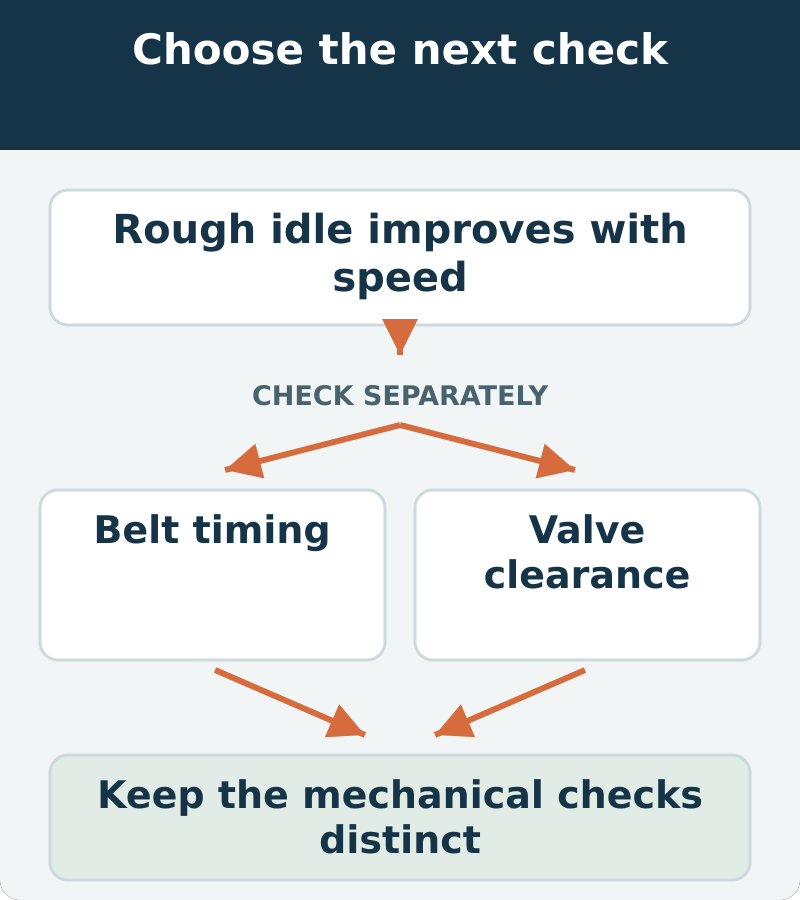
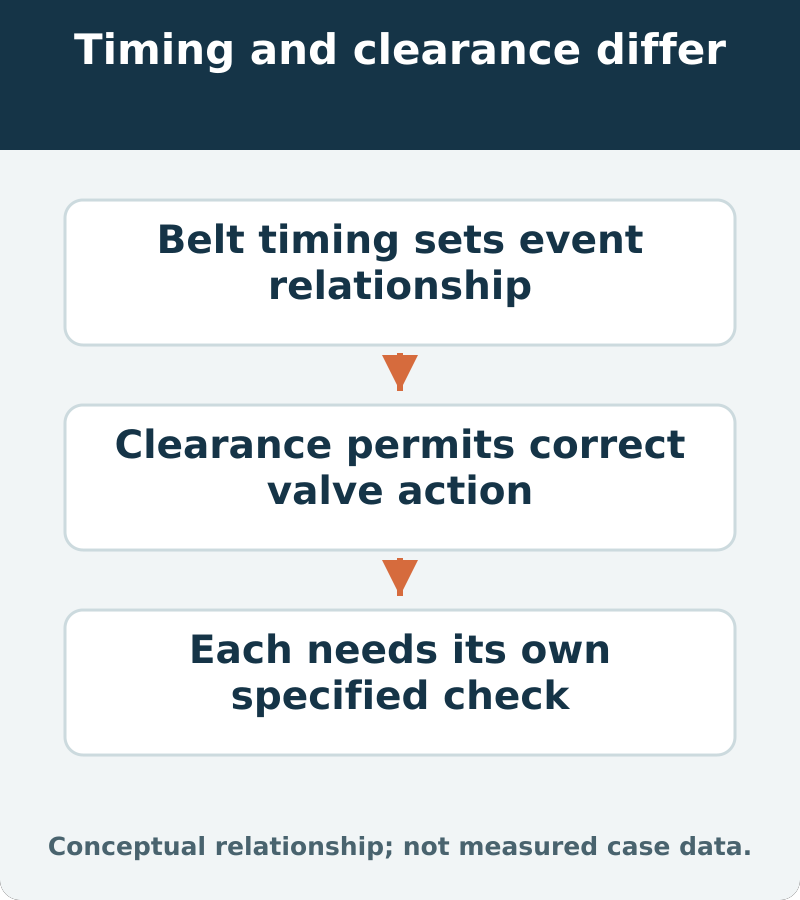
Belt timing concerns the relationship in which the engine’s rotating components are synchronized. Valve clearance concerns a specified mechanical gap in the valve-operating arrangement. They are different questions even though both involve the valvetrain.
This distinction is useful when reviewing service history. “The timing marks were checked” does not mean every valve clearance was measured. “The belt was replaced” does not tell you whether a separate clearance inspection was included. Ask for the actual work record rather than assuming that all valve-related maintenance was completed together. It may reveal a useful next check without requiring a theory about which earlier shop made a mistake.
Use MAP as a clue, not an adjustment gauge
Manifold absolute pressure information can point toward an engine breathing or operating concern, but it does not directly measure the gap at a valve. An unusual observation needs interpretation under the correct conditions and may justify a more direct mechanical check.
The diagram shows that distinction: clue, targeted inspection, decision. It contains no universal MAP-voltage target and no clearance specification. Do not use an online pressure number to order an adjustment automatically. Equally, do not replace the MAP sensor merely because its reading helped reveal another concern. Sometimes the sensor is reporting useful information about the engine rather than causing the complaint.
In the published ALLDATA case, the MDX idled roughly, especially cold, despite correct belt timing. Existing tests did not reveal an intake leak. An abnormal MAP observation prompted valve-clearance inspection, which found tight valves. Adjustment restored smooth idle. The source does not provide individual clearances or a complete long-term follow-up.
What a useful clearance record contains
A useful clearance record identifies the vehicle and engine, the required measurement conditions, what was found and what was adjusted. Ask whether the findings were compared with the applicable specification. You do not need to memorize the specification to understand that comparison.
Quiet operation is not a substitute for measurement, and a generic hot-versus-cold rule is not a substitute for the exact procedure. Valve access and adjustment require appropriate preparation and trained work. If the estimate includes adjustment, it should explain why it is supported and what completion checks will follow, rather than treating it as a universal rough-idle service for every older SUV.
When to keep looking beyond adjustment
An adjustment that improves operation is useful, but the repairer must still assess any remaining symptom or abnormal finding. If the idle stays rough, continuing to adjust without new evidence would repeat the same mistake as continuing to replace sensors without evidence.
Ask what the workshop will examine next if the expected improvement does not occur. The answer should depend on the results, not on a predetermined list of parts. This is also why a normal timing check should retain its limited meaning: it can settle one concern while leaving others open. A diagnosis grows by combining specific findings, not by turning one satisfactory check into approval of the whole engine.
Plan maintenance from the exact vehicle schedule
Use the exact vehicle’s maintenance requirements to plan future clearance-related service. Do not adopt a universal mileage from a repair story, and do not assume that a recently purchased used car has completed work that is absent from its records.
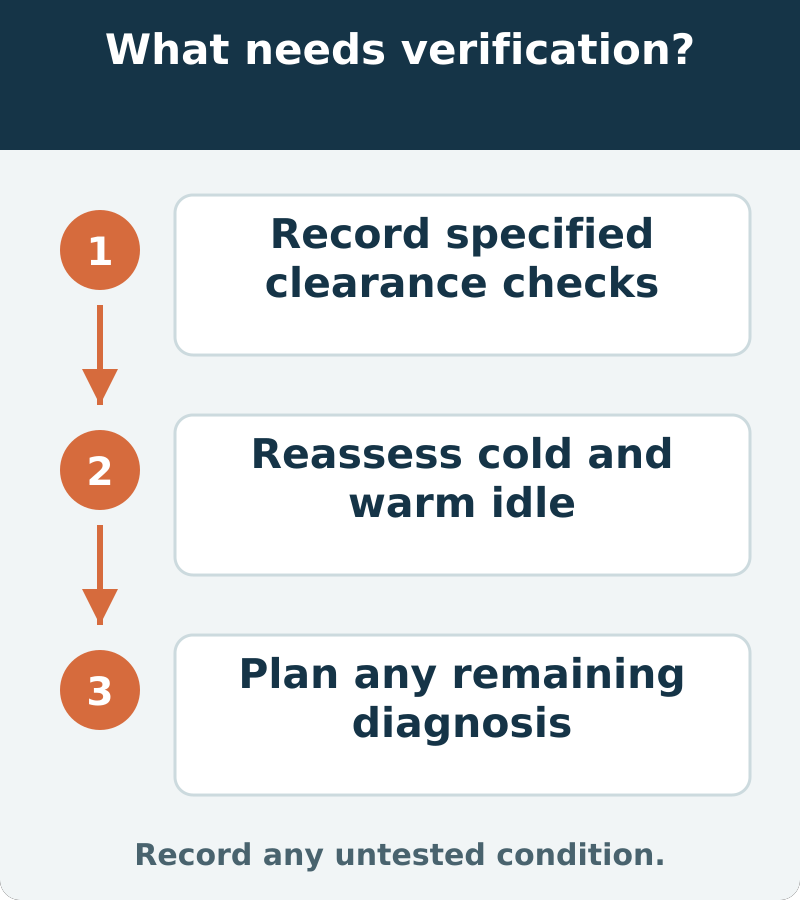
At collection, ask whether the original idle condition was reassessed appropriately and whether any further mechanical concern remains. Keep the measured or adjusted-clearance record with the belt-service history. They answer different future questions. The practical benefit of this case is knowing what to ask before another sensor purchase: has the engine received the direct mechanical check that the available clues actually justify?










Comments 0
Questions, fixes, and real-world diagnostic notes from readers.
Be the first to share a diagnostic result or ask a follow-up question.