Ford Coyote Gen 1, 2, 3, or 4? Identify the 5.0L Before a Swap

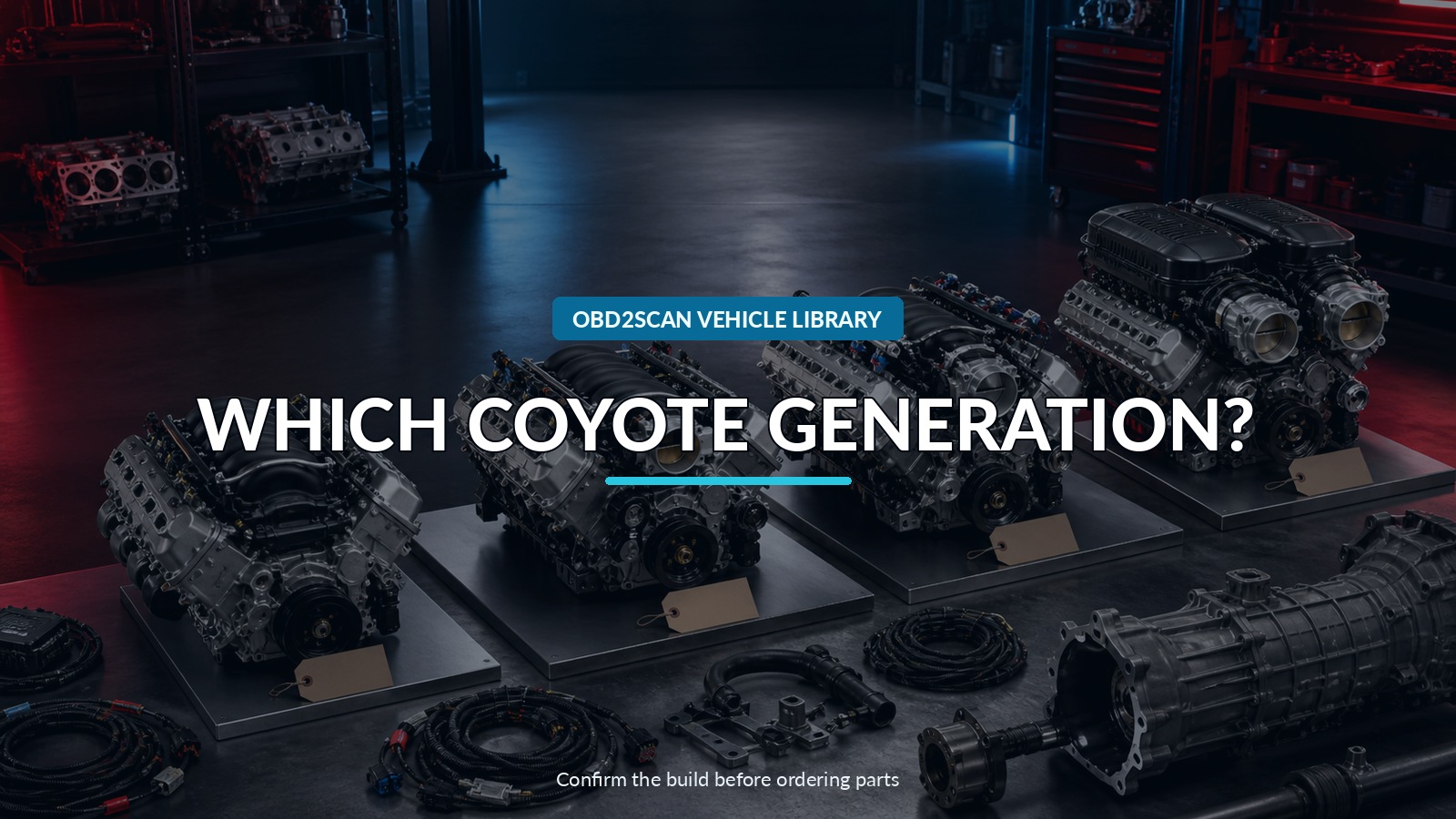
Conceptual identity-verification scene: Which Coyote Generation?
Four Mustang-generation cards give the Ford 5.0L Coyote a useful starting map: Gen 1 covers 2011–2014 Mustang GT, Gen 2 covers 2015–2017, Gen 3 covers 2018–2023, and Gen 4 begins with the 2024 Mustang. That map does not make every 5.0L donor equal. F-150 engines, Boss and specialty Mustang versions, and Ford Performance crate engines can differ from the standard Mustang GT configuration.
Before planning a swap, attach each engine to its donor application, tags and hardware. The seller’s generation label is the first card, not the complete deck.
This guide stacks the four Mustang-derived eras for orientation, then separates truck, specialty and crate donors so that a familiar nickname does not erase the controls and packaging a swap actually needs.
Quick answer: Mustang-derived Coyote Gen 1 is 2011–2014, Gen 2 is 2015–2017, Gen 3 is 2018–2023, and Gen 4 begins in 2024; donor application and hardware still control a swap.
In this guide
Lay out four Mustang-generation cards
| Mustang GT model years | Working Coyote generation | Useful orientation | Verification focus |
|---|---|---|---|
| 2011–2014 | Gen 1 | Original production Mustang Coyote | Donor VIN, castings, intake, controls |
| 2015–2017 | Gen 2 | Revised heads/valvetrain and intake features | Exact donor and installed components |
| 2018–2023 | Gen 3 | Dual port/direct fuel injection and major revisions | Fuel system, wiring, controls and transmission |
| 2024 onward | Gen 4 | Dual air boxes/throttle bodies on Mustang GT | Complete new induction/control package and donor build |
Ford Performance’s technical reference defines Gen 1 through Gen 3 for Mustang GT applications. Ford’s 2024 material identifies the Mustang’s fourth-generation Coyote and dual-intake/dual-throttle design.
Keep truck and specialty donors separate
An F-150 5.0L is not automatically a Mustang engine with a truck intake. Camshafts, compression, oiling, accessories, intake, exhaust, calibration and controls can differ by year and application. Boss, Mach 1, Bullitt, Dark Horse and other specialty configurations also require their exact donor identity.
Ask for the donor VIN and factory build record. Use the NHTSA VIN Decoder to confirm the donor vehicle, then obtain Ford-specific engine information. A crate engine should have its Ford Performance part number and documentation instead of a fictional donor year.
Read the engine, not the cover
Photograph the engine tag or serial evidence and the casting/part numbers on block, heads and major components. Record valve covers, front cover, intake manifold, throttle arrangement, fuel rails/injectors, high-pressure pumps where fitted, oil pan, exhaust manifolds and front accessory drive.
Decorative covers, intakes and valve covers can be swapped, so no single visual cue should assign the generation. Compare a group of features with the official technical reference and donor data. If those disagree, label the engine unresolved until deeper evidence is available.
Inventory controls, fuel and accessories
Gen 3’s combined port and direct injection makes the high- and low-pressure fuel systems, controller, harness and calibration central to a swap. Gen 4 adds a distinctive dual-airbox and dual-throttle strategy in the 2024 Mustang application. A bare long block does not include the systems needed to reproduce that factory operation.
List PCM/control pack, engine harness, body interface, pedal, sensors, mass-air or pressure hardware, fuel delivery, alternator, starter, air-conditioning compressor, power-steering solution where applicable and emissions equipment. Verify every connector and part number. “Complete engine” is a seller description; your inventory decides whether it is complete for this project.
Match the transmission interface
Record manual or automatic donor configuration, crank/flexplate/flywheel, clutch or converter, starter, bellhousing pattern, transmission controller strategy and vehicle-speed/gear information. A long block that physically bolts up may still require different controls or rotating hardware.
Oil-pan and accessory clearance also depend on the recipient chassis. Measure the actual engine with accessories installed and compare approved swap documentation. Do not turn fitment planning into structural modification instructions without engineering the recipient vehicle.
Treat mixed engines honestly
A Coyote can contain heads, intake, front cover, oil pan or accessories from another generation. Performance builds may also change cams, oil pump, timing components, fuel system and compression. Write “Gen 2-based short block with documented Gen 3 intake” if that is what the evidence supports; do not choose whichever generation is easier to sell.
For a used engine, request compression/leak-down or running evidence as condition information, but keep it separate from identity. A healthy unknown engine is still unknown, and an identified engine is not automatically healthy.
Plan documentation before fabrication. Save donor build data, photographs of tags and connectors, crate-engine instructions where applicable, and the final inventory of retained versus replaced components. If the swap later needs a sensor, belt, starter or calibration update, that record identifies which vehicle or kit should supply it. Without the record, every routine service item becomes another generation-guessing exercise.
Build the swap-ready identity line
A strong line reads: “U.S. 2019 Mustang GT donor, Gen 3 Coyote, donor VIN/build and engine tag verified, port/direct fuel system and control package inventoried, automatic-transmission interface and accessory drive recorded, component numbers photographed.” A truck donor must say F-150 explicitly.
The four cards make the family easy to discuss. The donor record, hardware inventory and control plan determine whether the engine belongs in the swap.




Comments 0
Questions, fixes, and real-world diagnostic notes from readers.
Be the first to share a diagnostic result or ask a follow-up question.