
2018 Jeep Wrangler JK or JL? Confirm It Before You Buy Parts

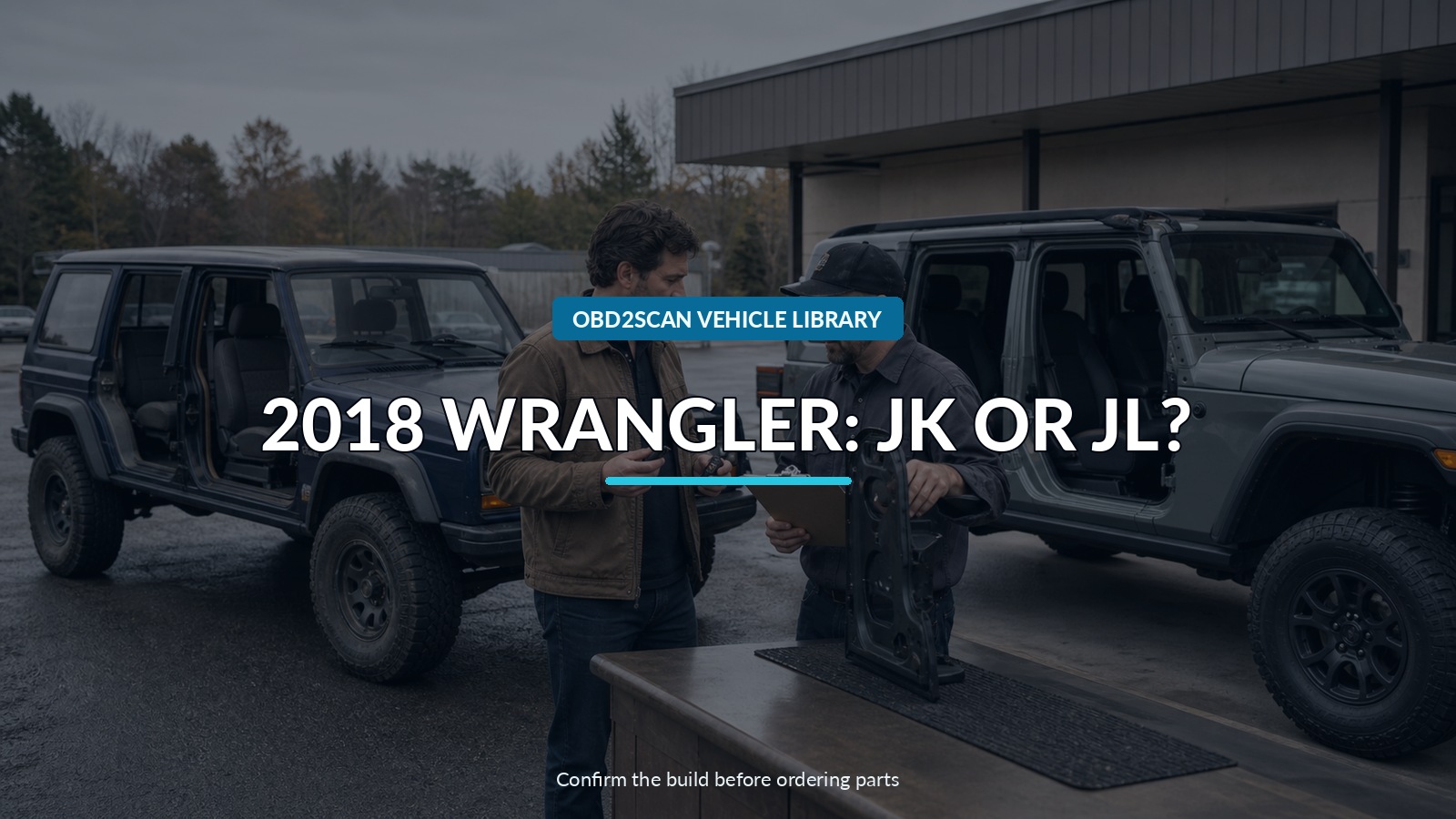
Conceptual identity-verification scene: 2018 Wrangler: Jk Or Jl?
A 2018 Wrangler can be an outgoing JK or an all-new JL. That overlap makes “2018 Jeep Wrangler” an incomplete identity for parts, accessories, service information, or a used-vehicle description. Write JK or JL before you write the trim.
The fastest sort uses door handles, fender and lamp treatment, hood and windshield hardware, and cabin controls. The reliable finish uses the physical VIN, build label, factory model record, body style, engine, transmission, axles, top and door configuration, and the number on the installed part.
Imagine two key fobs on a parts counter. Both belong to a 2018 Wrangler, but the keys do not tell you which chassis is outside. A thirty-second visual sort opens the right manual; a documented identity closes the order.
Quick answer: A 2018 Wrangler can be JK or JL. Use body hardware for the fast sort, then verify VIN/build identity, two- or four-door body, powertrain, axles, equipment, and installed part number.
In this guide
Put the 2018 overlap at the top
Jeep’s outgoing JK family ran through 2018 while the JL arrived for 2018. The manufacturer’s own materials use “2018 Wrangler JK” for the carryover vehicle and present the JL as the all-new 2018 Wrangler.
| Registration description | Possible identity | Do not order until you add |
|---|---|---|
| 2018 Wrangler | JK or JL | VIN/build record and body hardware |
| 2018 Wrangler Unlimited | Four-door clue, still JK or JL | Chassis, engine, transmission, axle, trim hardware |
| 2018 Rubicon | Equipment clue, still not a chassis answer | JK/JL plus actual axles, brakes, wheels, options |
The overlap is a production fact, not an edge case created by bad listings. Treat every 2018 as unresolved until the chassis family is explicit.
Make the quick body-hardware sort
On a largely stock vehicle, JK and JL differ in door-handle design, front-fender and lighting details, hood and windshield hardware, dashboard layout, and switchgear. The JL’s front fender treatment and newer cabin architecture are useful first-glance clues. Some outgoing vehicles also carry factory wording that explicitly includes JK.
Take photographs of the front corner, side door area, dashboard, and the labels. Do not rely on a grille alone. Owners frequently install bumpers, fenders, lamps, hoods, tops, doors, dashboards, and trim intended to change the look.
Close the answer with VIN and build evidence
Compare the windshield VIN to the certification label and paperwork. Check it with the NHTSA VIN Decoder and an appropriate Jeep catalog or build record. The returned model description must agree with the physical vehicle.
Record the production date, two-door or Unlimited body, market, and the powertrain shown by factory data. If the vehicle has a replacement tub, frame, or substantial modification, document the disagreement rather than assigning the whole Jeep from a single plate.
Add the configuration that changes fitment
JK or JL is the top catalog branch. Under it, write engine, transmission, transfer case where relevant, axle model and ratio, two- or four-door body, top and door equipment, wheel/brake package, and trim-dependent hardware. A Rubicon name does not excuse checking the axles actually installed.
This matters because Wranglers invite modification. Lift kits, axle swaps, steering conversions, aftermarket wheels, re-gearing, engine swaps, and armor can make original-build data insufficient for the component in front of you. Preserve two records when necessary: factory identity and current installed hardware.
Order accessories by interfaces, not promises
For a bumper, top, door, floor liner, fender, lamp, step, rack, or interior panel, compare mounting points and body style. For steering, brakes, axles, suspension, or driveline parts, record physical dimensions and installed numbers. For electronics, add connector shape, pin count, module number, and software or sales-code requirements where the official procedure calls for them.
A seller’s “2018–present” or “2018 Wrangler” claim is not enough. Ask whether the product is for JK, JL, or both, and whether two-door and Unlimited fitment differs. “Both” should be supported by separate hardware or documented common interfaces.
Handle modified and rebuilt Jeeps honestly
If the VIN says JK but front sheet metal looks like a JL, do not force a visual answer. Check frame/tub identity, labels, mounting architecture, and repair history. If an axle or engine is not original, identify that assembly by its own tag, casting, number, dimensions, and donor documentation.
Do not publish a full VIN or imply that an online decoder proves title legitimacy. Identification for parts is not a title inspection, and a title check is not proof that every assembly remains factory original.
Write the chassis-ready order line
A successful record reads: “2018 Wrangler JL, four-door Unlimited, production date/VIN verified, engine and transmission recorded, axle tags and installed component number photographed.” A JK line should be equally explicit.
That sentence keeps the shared year from following the part through every conversation. Once JK/JL and the actual hardware are both documented, catalogs and suppliers can answer a precise question instead of guessing which 2018 the customer meant.


Comments 0
Questions, fixes, and real-world diagnostic notes from readers.
Be the first to share a diagnostic result or ask a follow-up question.