
BMW N55 vs. B58: Identify the Engine Before You Order Parts

N55 and B58 are different generations of BMW turbocharged 3.0-liter inline-six engines. A 335i commonly points toward N55 and a 340i toward B58, but model, market, and production date control the answer. Confirm the engine designation through VIN-specific BMW data and the installed engine before ordering cooling, intake, ignition, gasket, or electronic parts.
Fast answer
- N55 uses BMW’s earlier single twin-scroll turbo inline-six architecture; B58 belongs to BMW’s newer modular engine family.
- Do not identify either engine from displacement, cylinder count, a 35i/40i badge, or an engine cover alone.
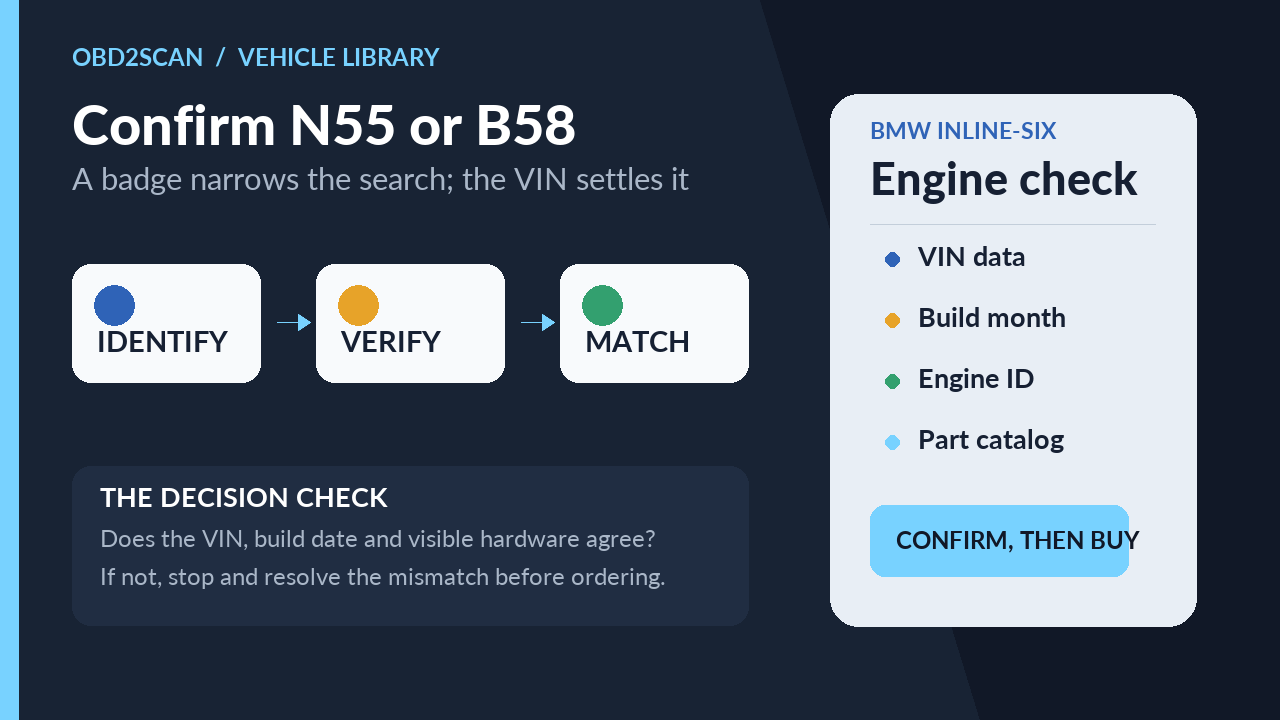
- Use the VIN and build month in a current BMW parts/service system, then compare engine identifiers and installed hardware.
- If the car has an engine swap, identify the engine and control system separately from the chassis VIN.
In this guide
1. The useful difference is architecture, not a horsepower argument
BMW introduced the N55 as a turbocharged inline-six combining direct injection, Valvetronic, and a single twin-scroll turbocharger. The later B58 is part of BMW’s modular engine family and arrived in U.S. production models such as the 2016 340i. Both descriptions sound similar at a distance: 3.0 liters, six cylinders in a row, direct injection, variable valve control, and turbocharging. That similarity is exactly why generic listings cause trouble.
The engines use different cooling layouts, intake and charge-air arrangements, housings, gaskets, sensors, control strategies, and many service procedures. A spark plug or oil filter listing may cover several applications, but that does not make the engines interchangeable as a system.
| Clue | What it can tell you | Why it is not final proof |
|---|---|---|
| 335i / 535i badge | Often narrows a U.S. car toward N55 | Markets, years and badge changes differ |
| 340i / 540i badge | Often narrows a U.S. car toward B58 | A badge can be changed and does not show engine revision |
| Engine-cover shape | Useful visual cross-check | Covers are removable and online photos are often mislabeled |
| VIN catalog result | Shows the factory engine application | A swapped car can differ from the factory record |
| Engine identifier and installed hardware | Confirms the physical engine | Must be read in the correct location and context |
2. Use the badge as a search filter, not as the answer
A practical U.S. example is the F30 3 Series: official BMW service tables list the 335i with N55 and the 340i with B58. In the 5 Series, the F10 535i is an N55 application, while the G30 540i moved to B58. Those examples help a shopper orient quickly, but they are not a universal decoder for every BMW, market, hybrid, or performance derivative.
Model-year advertisements are also noisy. A car may be listed by registration year, build year, or seller assumption. Start with the 5 Series body-code guide if the chassis generation itself is uncertain, then verify the engine as a separate field.
3. Make a positive N55 or B58 identification
- Decode the VIN. Record the complete model designation, model year, plant, and engine fields returned. Keep the full VIN private.
- Record the build month. Mid-year production splits are often more important than registration date.
- Query BMW-specific factory data. Use a current BMW parts or service system that returns the engine designation and VIN-specific catalog branch.
- Cross-check the engine. Compare the engine identifier, emissions label, control-unit identification, and installed layout with the factory result.
- Read the old part. For a close production split or suspected swap, capture the original part number before ordering.
The EPA emissions label may list an engine family or test group rather than the familiar N55/B58 name. That still helps: save it and let a knowledgeable supplier or service system map it. Do not force an online nickname onto a regulatory code because several variants can sit within one broad family.
4. These decisions change when N55 becomes B58
- Cooling: pumps, thermostats, heat-management layout, hoses, expansion components, and bleeding strategy must follow the exact engine and chassis.
- Charge air: the turbo, intake plumbing, charge-air cooling arrangement, pressure/temperature sensors, and seals are architecture-specific.
- Oil and crankcase ventilation: filter housings, gaskets, valve-cover/PCV arrangements, lines, and leak paths differ by engine and revision.
- Ignition and fuel: plugs, coils, injectors, high-pressure fuel parts, calibration indexes, and installation requirements require application-level checking.
- Electronics: sensors, harness branches, control software, and coding are not selected by “BMW 3.0 turbo” alone.
For an N55 identified car, the N5x oil-filter-housing guide and N55 valve-cover guide illustrate engine-specific service boundaries. They should not be treated as B58 procedures.
5. Treat an engine-swapped car as two identities
If the installed engine disagrees with the VIN record, write down both: the chassis identity and the donor-engine identity. Then determine which intake, cooling, wiring, fuel, exhaust, transmission, and control-system pieces came from each side. A swapped long block may retain the original chassis accessories; a complete donor conversion may not.
Do not order solely from the donor VIN unless the relevant subsystem followed the donor. Photograph connector counts and part numbers, and have software/coding compatibility checked before buying electronic parts. The goal is a positive statement—“factory B58 car, verified by VIN and installed engine” or “N55-to-B58 conversion with documented donor”—not a guess from the plastic cover.
Official sources used for this guide
- The 2011 BMW 135i Coupe and Convertible — BMW Group PressClub USA
- The New BMW 3 Series Sedan and Sports Wagon — BMW Group PressClub USA
- BMW Engine Model/Application Table — BMW of North America / NHTSA
- BMW TwinPower Turbo Technology — BMW Group PressClub USA
What a successful identification looks like
You can state the market, VIN-confirmed model and body, production date, engine, drivetrain, and the equipment relevant to the job. The catalog result and the hardware on the vehicle agree, and the supplier can confirm a current part number for that exact record.




Comments 0
Questions, fixes, and real-world diagnostic notes from readers.
Be the first to share a diagnostic result or ask a follow-up question.