
BMW N20 vs. B48: Identify the Four-Cylinder Before Engine Parts

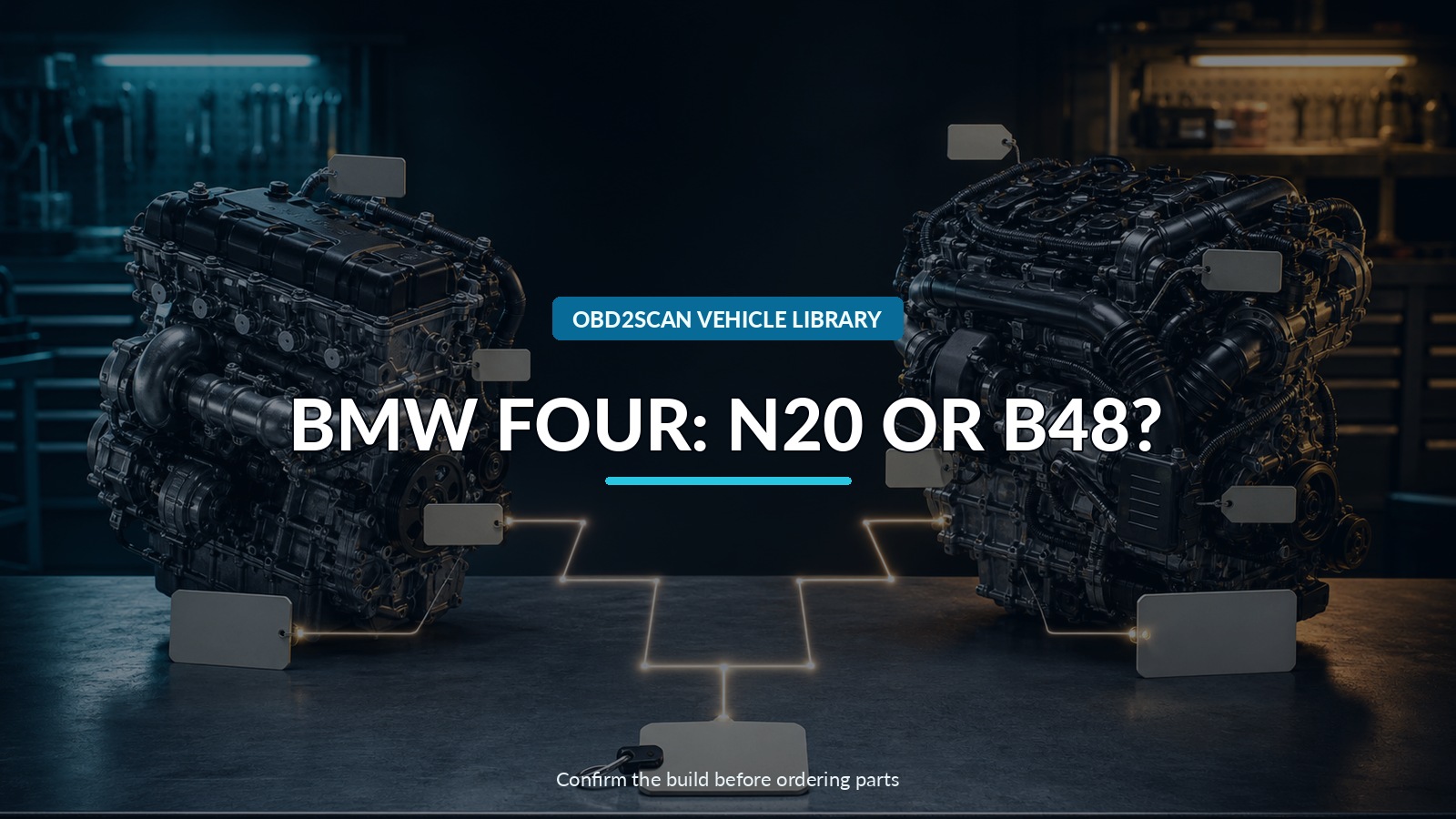
Conceptual identity-verification scene: Bmw Four: N20 Or B48?
BMW N20 and B48 are different turbocharged four-cylinder engine families, even though both can appear as 2.0-liter gasoline engines in nearby model years. In U.S. work, keep the emissions-related N26 and B46 siblings visible too. Displacement, a sales badge, or a plastic engine cover cannot identify the engine well enough for parts.
Climb from vehicle to installed component: physical VIN and BMW build data, exact engine designation and emissions branch, production date, layout and system cues, labels or castings, then part numbers. Stop as soon as two rungs disagree.
When a label or casting is physically obscured, a slim articulating inspection camera can document it without dismantling a cool, stationary engine. The MRCARTOOL borescope category is one such equipment route; the captured image still needs to be matched to BMW information and never authorizes probing near moving or hot parts.
Quick answer: Distinguish BMW N20/N26 from B48/B46 using VIN/build, exact engine and emissions designation, labels/castings, installed systems, and component numbers—not 2.0L alone.
In this guide
Start below the plastic cover
| Family | Broad orientation | U.S. sibling to keep visible | Identity authority |
|---|---|---|---|
| N20 | Earlier BMW turbo four-cylinder family | N26 emissions-related application | VIN/build, emissions label, exact designation, installed hardware |
| B48 | Newer modular B-series turbo four-cylinder family | B46 emissions-related application | The same evidence chain |
Do not convert this orientation into one universal crossover year. BMW introduced engine families by chassis, model, market, and production period. Two cars with the same sales badge can sit on opposite sides of a change.
Read the windshield VIN and certification label, retrieve BMW build data, and use the NHTSA VIN Decoder as another vehicle check. Record the production month, not only the registration year.
Climb from vehicle to engine code
Begin with the exact BMW model designation and chassis, then the engine named in the factory record. Photograph the underhood emissions label and engine identification evidence. Compare the record with the installed engine because replacements and swaps are possible.
Next inspect broad architecture: intake and exhaust side, turbo placement, charge-air plumbing, accessory drive, oil-filter/cooler area, fuel-system hardware, wiring, and mount or transmission interface. These cues can expose an incorrect listing, but none is strong enough alone.
Finally capture labels, castings, and complete component numbers. Search the exact BMW number and supersession in the catalog for the recorded VIN/build. A partial casting number may identify a housing family rather than the complete assembly.
Keep N26 and B46 on the ladder
In the U.S., emissions-related N26 and B46 designations can sit close to N20 and B48 in model discussions. Keep the exact factory engine and emissions application in the record. Do not silently translate N26 to N20 or B46 to B48 just because service conversations group them.
Emissions hardware, calibration, fuel and evaporative systems, sensors, exhaust aftertreatment, wiring, and certification requirements may differ. The underhood label and BMW service data control these decisions.
If an engine has been replaced with a related family, document the donor, retained controls, emissions equipment, and installed numbers. Do not relabel the whole vehicle from the long block alone.
Match air, fuel, cooling, and controls
Engine-family identification is not automatic interchange. Verify turbocharger, manifolds, injectors and high-pressure pump, charge-air path, cooling modules and hoses, oil system, sensors, harness, DME/controls, accessories, mounts, and transmission interface for the exact build.
For a used engine, ask for donor VIN/build, engine designation, emissions market, transmission, label/casting photos, connector inventory, and complete assembly boundaries. “Complete B48” should be replaced by a list of what is actually included.
Compression, leak-down, oil condition, or running video are condition evidence, not identity evidence. Keep the two questions separate.
Inspect hidden evidence safely
Only inspect a switched-off, secured, cool vehicle. Keep the camera probe away from belts, fans, pulleys, turbo/exhaust surfaces, high-voltage components, and openings where retrieval would require disassembly. Never rotate or start the engine with a probe inserted.
Capture an orientation view before the close-up so another technician knows where the marking sits. Then capture the entire label or casting in focus, including surrounding fasteners and housing features. Save the original file; a cropped number without context is easy to misattribute.
An image may confirm what is present, but BMW build and parts data are still needed to interpret the number and decide fitment.
Record the engine as installed
A useful line reads: “U.S. 2015 BMW 328i, chassis and production month verified, factory N20/N26 designation resolved from BMW build and emissions data, installed engine labels/castings and turbo/fuel hardware checked, component numbers photographed.” Use the same structure for B48/B46.
The ladder prevents a 2.0-liter badge from carrying more certainty than it deserves. It also preserves mixed or swapped hardware honestly when the car no longer matches one clean factory description.




Comments 0
Questions, fixes, and real-world diagnostic notes from readers.
Be the first to share a diagnostic result or ask a follow-up question.