
VW/Audi EA888 Gen 3 vs. Gen 4: Engine Code Beats Model-Year Guessing

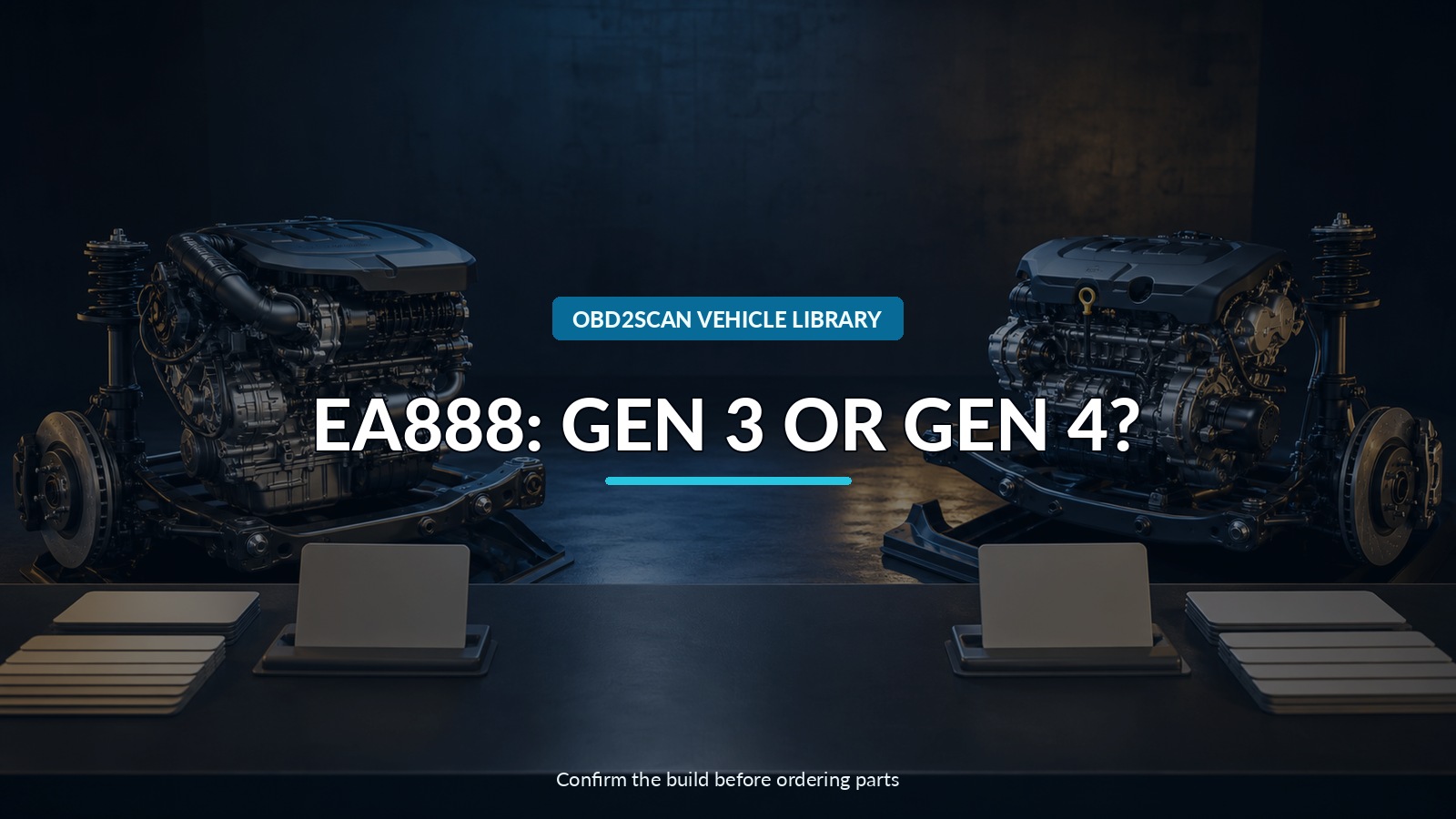
Conceptual identity-verification scene: Ea888: Gen 3 Or Gen 4?
An EA888 generation is the cover color of an engine passport; the engine code is the passport number. Gen 3, Gen 3B/B-cycle and Gen 4/evo4 describe related engineering families, but they do not identify every VW or Audi application. Model year, market, transverse or longitudinal layout, emissions package, software and installed hardware can all alter the parts branch.
A common U.S. shortcut is useful only as orientation: Mk7 Golf GTI uses third-generation EA888 applications, while Mk8 GTI uses EA888 evo4. Do not apply that one hatchback timeline to every A3, A4, Q-model, Jetta, Tiguan or global-market engine.
Treat the result like border control for parts: family name opens the desk, but code, market, orientation and installed equipment must all match before the request proceeds.
Quick answer: EA888 Gen 3, Gen 3B, and Gen 4/evo4 are broad families. Verify the OEM engine code, market, model, orientation, build, hardware, software, and part-number suffixes.
In this guide
Open the engine-family passport
| Passport field | What it narrows | What it cannot prove alone |
|---|---|---|
| EA888 Gen 3 | Broad earlier architecture | Engine code, market, orientation, turbo or calibration |
| Gen 3B / B-cycle description | Specific efficiency-oriented family/application context | A universal mid-year cutover |
| EA888 Gen 4 / evo4 | Newer fourth-generation architecture | Exact VW/Audi application and component revision |
| Engine code | OEM application identity | Current installed modifications or every supersession |
Volkswagen’s U.S. material calls the Mk8 GTI engine fourth-generation EA888/evo4 and identifies the preceding unit as the previous EA888. The engine code remains necessary because another model can use a different version in the same era.
Use Mk7 and Mk8 only as orientation
If the vehicle is a U.S. GTI, the Golf generation provides a fast first branch. Confirm the actual model year and VIN because a seller may use registration date, production date or “Mk7.5” facelift language inconsistently. A facelift does not automatically create a new engine generation.
For Audi and other Volkswagen applications, avoid the GTI shortcut. Longitudinal engines package the turbo, accessories, mounts, oiling and transmission interface differently from transverse engines. Market emissions rules and power ratings also change hardware and calibration.
Find the actual engine code
Use VW/Audi build and service information tied to the VIN. Locate engine-code evidence on the vehicle or engine according to model-specific service instructions, and compare it with the emissions label. Record market, model, production date and PR-code/build data.
The NHTSA VIN Decoder can confirm broad U.S. vehicle identity, but it is not a substitute for the engine code or PR-code list. A VIN may describe the factory engine while the car now contains a replacement long block.
Record market and engine orientation
Write “transverse” or “longitudinal” explicitly. Add front-, all- or rear-biased drivetrain description as appropriate, transmission code, emissions market and whether the vehicle is VW or Audi. This prevents an online listing for an EA888 turbo, pan or mount from appearing universal across packaging families.
Then photograph the installed intake, turbocharger label, fuel system, coolant module/hoses, oil filter housing, accessory drive, harness connectors and controller identifiers. These are comparison points, not invitations to identify a generation from one photograph.
Match hardware, software and suffixes
Copy the entire OEM part number, including revision suffix. VW Group supersessions can be precise, and a base number without suffix may hide a hardware or software change. For modules and actuators, confirm parameterization, component protection or programming requirements through official service information.
Modified cars need a second inventory. Record tune provider/version if documented, turbo, injectors, high-pressure fuel components, intake, intercooler, downpipe and sensors. A seller’s tuning label such as “Gen 3” may describe the aftermarket product category rather than prove the engine code.
Reject three passport errors
First, do not identify the engine from a 2.0 TSI cover; covers swap easily. Second, do not assume all vehicles changed from Gen 3 to Gen 4 in one model year. Third, do not treat Gen 3B as a simple chronological half-step shared across every market and orientation.
When build data, engine code and hardware disagree, preserve all three and investigate a replacement engine or mixed build. The correct result may be “factory engine X, installed long block Y with accessories Z.”
The same rule applies to imported engines and used controllers. A European engine code may resemble a U.S. application while carrying different emissions equipment, sensors or software. Record the donor market and do not translate a power rating into an engine code. For a controller, capture hardware and software numbers independently; matching the case or connector is only a physical screen.
Stamp the parts request with exact identity
A useful line reads: “U.S. 2020 VW application, transverse EA888 Gen 3 family, VIN/build and engine code verified, transmission and emissions market recorded, installed turbo/fuel/cooling component numbers photographed.” An evo4 line should include the exact engine code rather than stopping at Gen 4.
Family language makes the engine understandable. The code and installed hardware make it orderable.


Comments 0
Questions, fixes, and real-world diagnostic notes from readers.
Be the first to share a diagnostic result or ask a follow-up question.