
Land Rover Discovery No-Crank: Proving an Offline TCU Before Programming

Bottom line: A three-stage intermittent no-crank case that separates two convincing false fixes from an offline telematics module with good power, ground and CAN.
In this case
- Case at a glance
- The answer: the TCU was offline, but two other faults disguised it
- Fix an obvious defect without forcing it to explain everything
- Do not let a battery history dominate the case
- Capture the network while the vehicle is refusing to crank
- Check power, ground, CAN and connectors at the module
- Replacement was not complete until configuration was restored
- The lesson for intermittent network faults
- Minimum record to retain
Case at a glance
| Field | Case detail |
|---|---|
| Vehicle | 2018 Land Rover Discovery, about 22,000 miles |
| Complaint | Intermittent no-crank; audio failed around the same period |
| False fixes | Missing amplifier fuse and weak TCU backup cell |
| Decisive state | TCU offline during no-crank with good local power, ground and CAN |
| Repair | TCU replaced; BCM and second key programmed |
| Verification | Follow-up confirmed normal starting and driving |
The answer: the TCU was offline, but two other faults disguised it
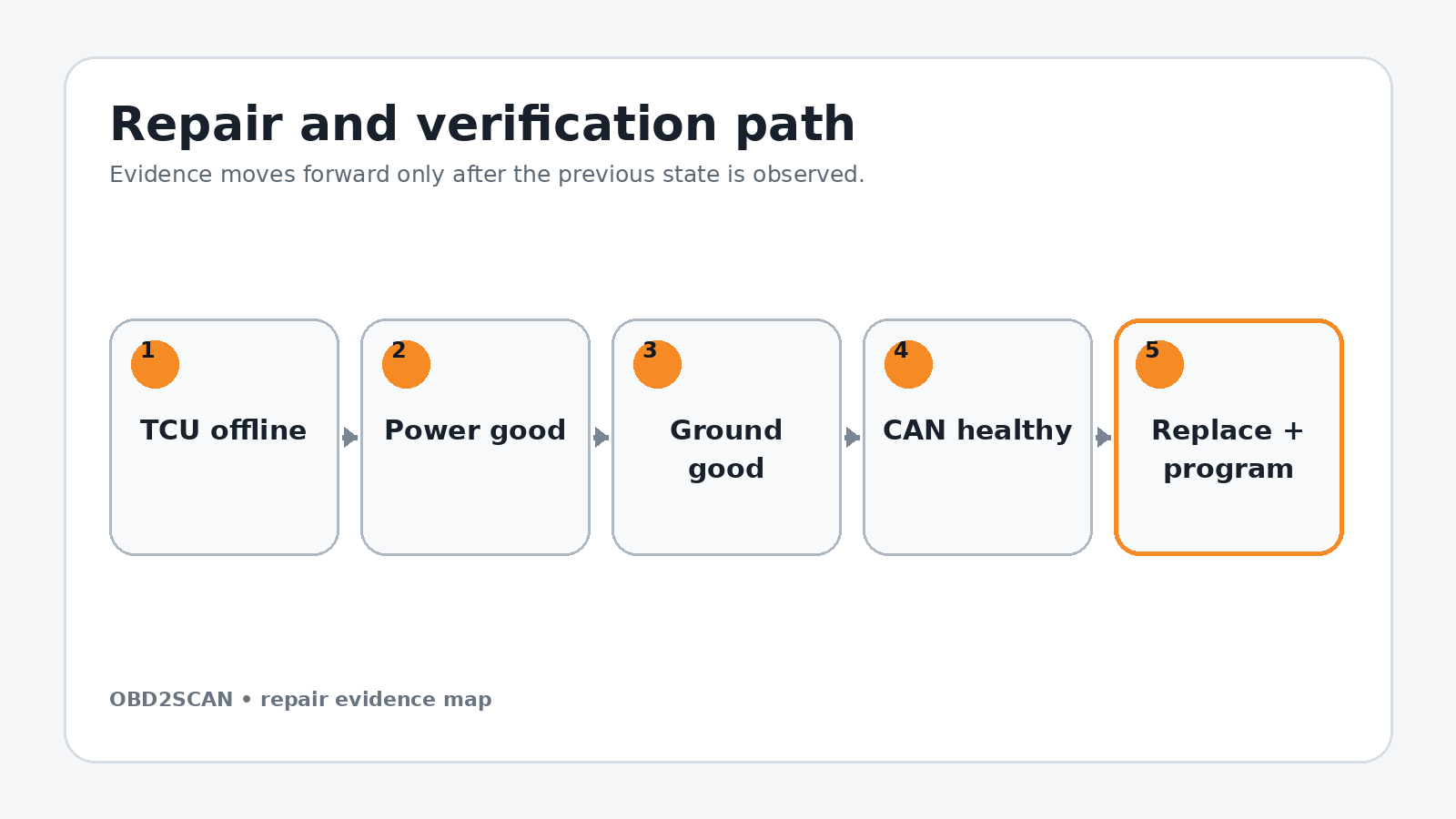
The intermittent no-crank ended only after the telematics control unit was replaced and the vehicle configuration and second key were programmed. During the failed-start state, the TCU would not communicate even though its local power, ground and CAN network signals were present. That is the decisive evidence.
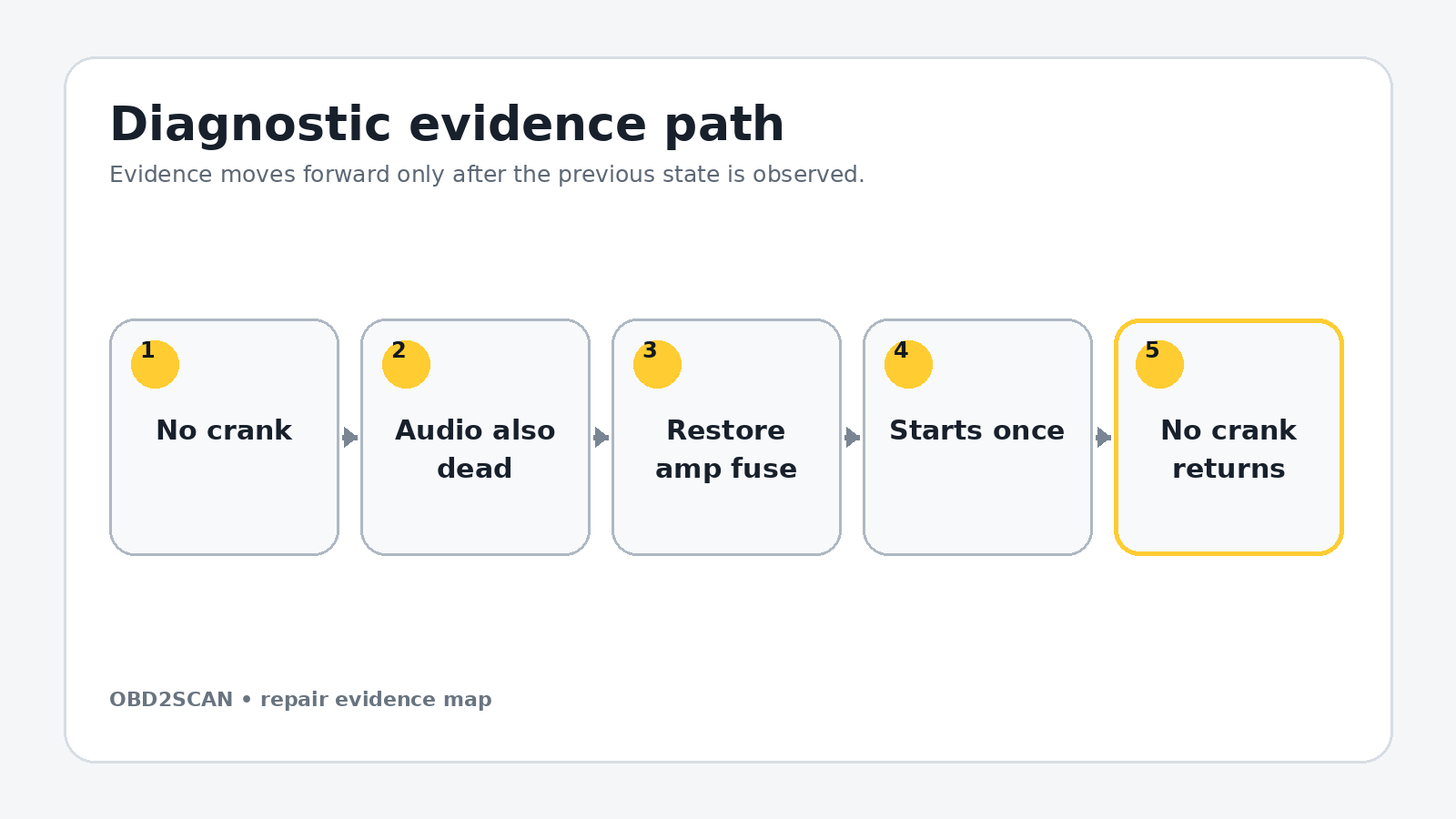
Two discoveries looked persuasive before that proof arrived. A missing 40-amp audio-amplifier fuse restored the dead audio system and coincided with a successful start. A weak TCU backup cell also failed a voltage check. Neither repair survived reproduction of the complaint.
Evidence boundary: The numeric values in this article belong to the documented vehicle unless an official applicability statement says otherwise.
Fix an obvious defect without forcing it to explain everything
The audio failure deserved correction because the amplifier fuse was genuinely missing. Restoring it repaired the audio system. The mistake would have been calling the no-crank solved simply because the engine happened to start at the same moment.
Intermittent faults reward false confidence. Record each complaint separately, apply one change, then reproduce the original starting sequence enough times and under the original conditions. Correlation earns a retest, not a final diagnosis.
Do not let a battery history dominate the case
The vehicle had received a battery and had spent months starting intermittently. A sleep-current check settled near 11 mA during the observed test, which did not support an active parasitic drain at that time. Battery replacement can temporarily improve voltage margin without repairing the module that intermittently refuses to participate.
Confirm charge, capacity and voltage drop using the battery testing guide. Then move on when the failed-start state occurs with stable supply voltage.
Capture the network while the vehicle is refusing to crank
A scan taken during a successful start can make an intermittent module look healthy. During the actual no-crank state, the TCU dropped offline. Other stored configuration and bus messages added context, but missing communication at the moment of failure became the high-value fact.
Use a full-network scan process: save the topology, note which modules respond, compare good and failed states, and resist clearing codes until the evidence is exported. Some architectures may not log the cross-module code you expect. During the failed-state network capture, the AUTOOL OBD2 Breakout Box Premium can provide quick access to DLC power, ground, and supported bus activity; the decisive checks still have to be repeated at the TCU connector.
Check power, ground, CAN and connectors at the module
The TCU had its required supply and ground. CAN High and CAN Low activity were present and plausible at the connector. The module remained nonresponsive. That combination moves the diagnosis away from a shared bus outage or missing feed and toward the TCU itself.
JLR service information for related Discovery-family intermittent no-crank complaints also requires connector inspection and a search for water ingress before replacement. Corrosion changes the repair: find and correct the leak path, not just the damaged electronics.
Safety boundary: Use current vehicle-specific service information, approved support and the correct test load before opening a circuit or assembly.
Replacement was not complete until configuration was restored
A replacement network module is not a plug-in finish. This vehicle needed the new TCU installed, the body-control configuration programmed and the second key addressed. Programming requires stable supported battery voltage, approved tooling and the correct software path.
The post-repair report confirmed normal starting and driving. A stronger shop record would also retain the final network scan, confirm SOS/connected functions, verify both keys, and perform multiple hot and cold start cycles.
Verification boundary: A cleared code is not a result by itself. Repeat the original operating condition and retain the measured before-and-after evidence.
The lesson for intermittent network faults
Repair real side faults, but keep them in their own column. Recreate the original failure. Compare module topology between good and bad states. At the missing module, prove feeds, grounds, network integrity and connector condition. Only then replace and program.
The most expensive false fix in a network case is often the one that appears to work once. Reproduction after every change is what separates progress from coincidence.
Minimum record to retain
Keep the initial scan before clearing anything, the exact ambient and operating condition that reproduces the complaint, and one labeled result for every branch tested. Save photographs or waveforms at their original resolution and identify the measurement point, scale, engine state and tool setup. A future technician should be able to distinguish a direct observation from an inference without reconstructing the whole visit from invoices. Retain exact vehicle identification with every saved measurement.
- Sleep draw was about 11 mA during the test and did not explain the no-crank.
- Restoring a missing amplifier fuse fixed audio but no-crank returned.
- A low TCU backup-cell voltage was corrected without curing the no-crank.
- TCU power, ground and CAN were present while the module remained offline.
This case includes a repair result, but the same-condition retest is still the reason the result is credible. Record what changed, what did not change, and which test was repeated after the work. Also retain any programming, adaptation or calibration report and a final whole-vehicle scan. If the symptom is intermittent, define a monitoring window instead of treating one successful start or one short drive as permanent proof.






Comments 0
Questions, fixes, and real-world diagnostic notes from readers.
Be the first to share a diagnostic result or ask a follow-up question.