
Porsche Cayenne Misfire Counts: When the Engine Wasn’t Misfiring

Bottom line: An NVH-led Cayenne Hybrid diagnosis where a failed clutch-plate damper created crankshaft speed variation that the ECU counted as combustion misfire.
In this case
- Case at a glance
- The answer: torsional vibration impersonated combustion misfire
- Understand what a misfire monitor actually measures
- A long list of new parts is evidence that the model is wrong
- Convert the vibration into frequency and order
- Use the NVH result to justify high-cost disassembly
- Physical inspection must agree with the frequency diagnosis
- When to leave the engine and enter NVH diagnosis
- Minimum record to retain
Case at a glance
| Field | Case detail |
|---|---|
| Vehicle | Porsche Cayenne V6 Hybrid |
| Complaint | Engine warning with huge recurring misfire counts |
| Prior work | Multiple ignition, fuel and sensor parts had already been replaced |
| Turning point | Repeatable 15 Hz resonance near 1,200 rpm |
| Diagnosis | Hybrid clutch-plate torsional damper failed |
| Repair | Hybrid clutch assembly replaced |
| Verification | Complaint and false misfire detection resolved |
The answer: torsional vibration impersonated combustion misfire
The cylinders were not repeatedly failing to burn in the way the counters suggested. A failed torsional damper in the hybrid clutch plate allowed a strong resonance around 15 Hz near 1,200 rpm. The resulting crankshaft-speed fluctuation looked enough like uneven combustion for the ECU to accumulate enormous misfire counts.
Frequency and order analysis moved the diagnosis out of the ignition and fuel systems. Physical inspection then confirmed that the clutch damper no longer provided its intended damping action. Replacing the hybrid clutch assembly resolved the warning and recurring counts.
Evidence boundary: The numeric values in this article belong to the documented vehicle unless an official applicability statement says otherwise.
Understand what a misfire monitor actually measures
Many misfire monitors infer combustion quality from tiny changes in crankshaft angular acceleration. A weak power stroke slows the crank slightly, so the strategy is effective. But driveline impacts, excessive torsional oscillation or a damaged damper can also modulate crank speed.
The misfire-pattern workflow remains the correct starting point. The escalation happens when counters are extreme yet plugs, coils, injectors, mixture, compression and the physical feel of the engine do not agree.
A long list of new parts is evidence that the model is wrong
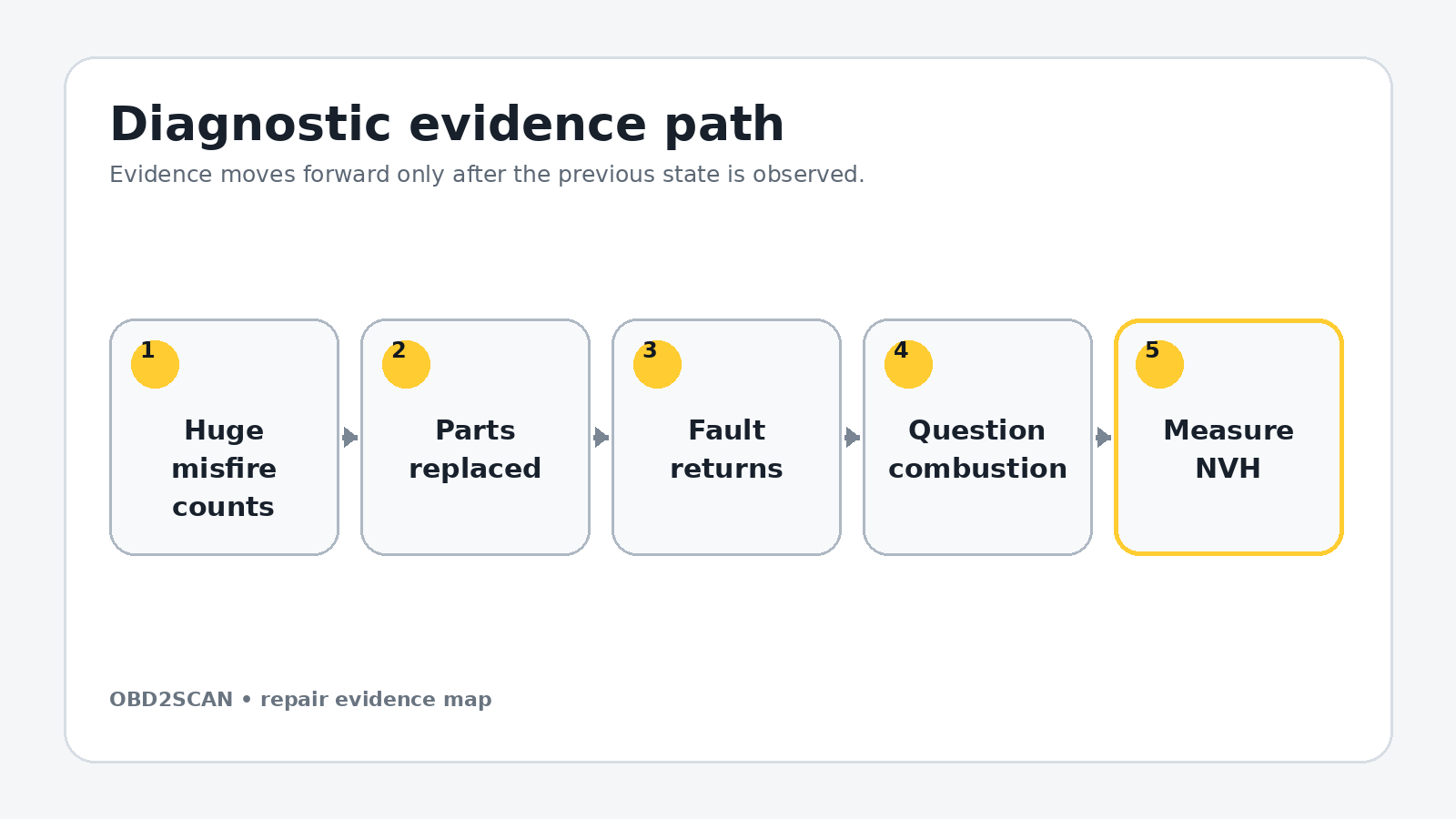
Ignition, fuel and sensor components had been replaced across repeated visits. Short test drives appeared successful, then the warning returned days or weeks later. That recurrence weakens the component hypotheses even if each new part temporarily changes adaptation or operating conditions.
Do not use another new coil to answer a contradiction between the counter and the engine. Save cylinder counts by rpm and load, compare good and bad operating zones, and ask what non-combustion event shares that speed.
Convert the vibration into frequency and order
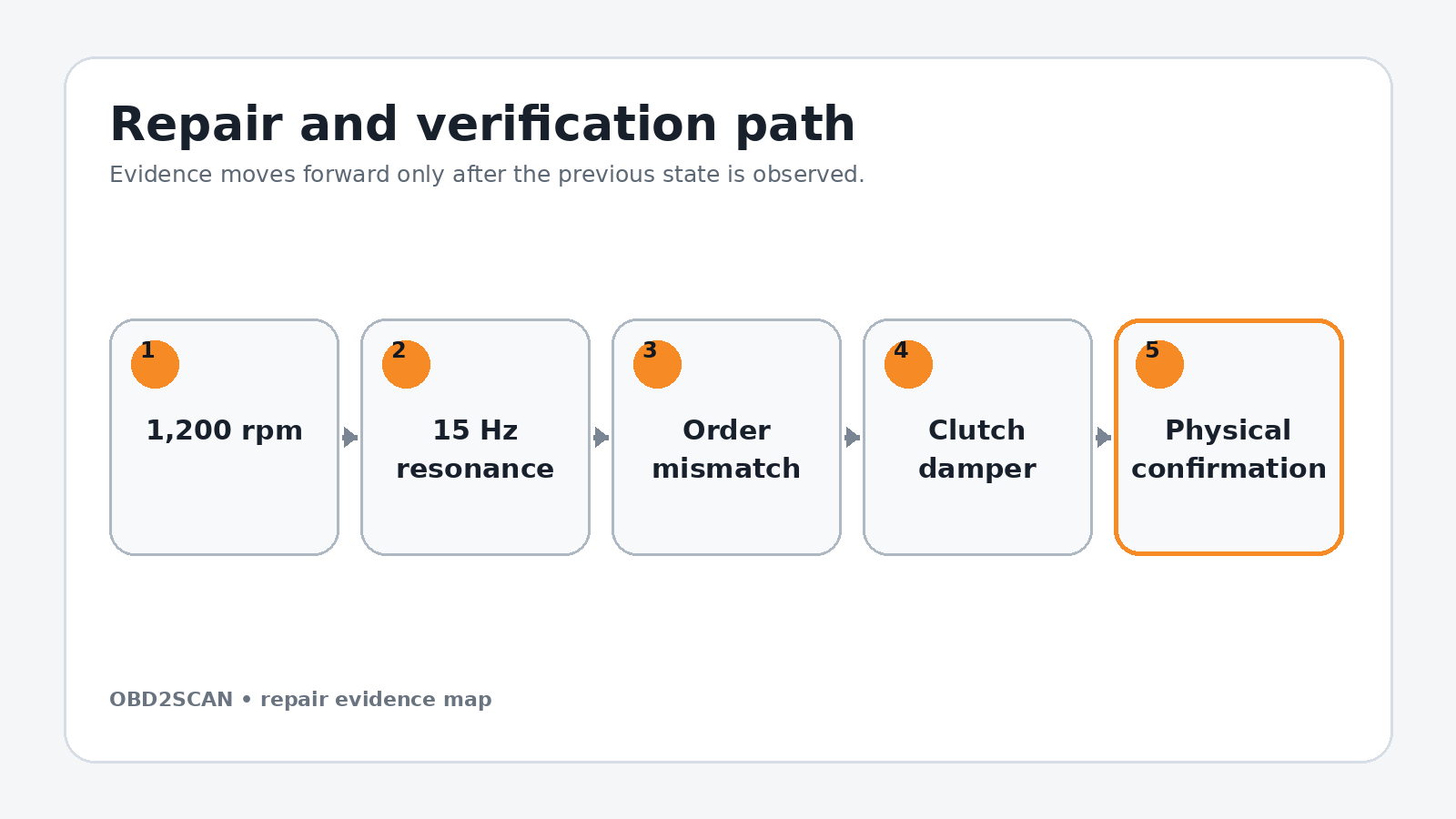
The resonance concentrated around 15 Hz near 1,200 engine rpm. Engine speed at 1,200 rpm is 20 revolutions per second, so the dominant vibration did not behave like a simple one-per-revolution engine order. It also did not align with the measured transmission-output order.
Accelerometers and an oscilloscope made the vibration measurable. Frequency alone does not name a component; it narrows the rotating systems capable of producing the event. The hybrid coupling and its damper became the plausible path only after engine and transmission-output relationships were compared.
Use the NVH result to justify high-cost disassembly
Removing a hybrid transmission or clutch assembly is a high-voltage, high-mass operation. Before authorizing it, reproduce the resonance, confirm sensor placement and sample rate, repeat the capture, and exclude mounts, exhaust contact and accessory order. Isolate the high-voltage system only with trained personnel and model-specific procedure.
The rough-running evidence map helps document the negative combustion tests. NVH evidence then supplies the positive alternative, rather than disassembly being driven only by “nothing else worked.”
Safety boundary: Use current vehicle-specific service information, approved support and the correct test load before opening a circuit or assembly.
Physical inspection must agree with the frequency diagnosis
Once exposed, the clutch-plate damper behaved like an undamped spring rather than controlling torsional energy. That physical failure matched the measured resonance and the crank-speed disturbance. The diagnosis was therefore not merely a spectrum guess.
The replacement assembly removed the resonance and ended the recurring misfire warning. Post-repair verification should repeat the same 1,200-rpm sweep, save misfire counters, check hybrid engagement and scan every involved control module.
Verification boundary: A cleared code is not a result by itself. Repeat the original operating condition and retain the measured before-and-after evidence.
When to leave the engine and enter NVH diagnosis
Stay in combustion diagnosis while measured spark, fuel, air or mechanical evidence supports it. Move to vibration analysis when the counts are implausibly large, the engine evidence remains normal, the event occupies a narrow speed band, or repairs repeatedly fail.
A fault code is the controller’s interpretation of a signal. In difficult cases, solving the car means measuring the physical event that made the interpretation believable.
Minimum record to retain
Keep the initial scan before clearing anything, the exact ambient and operating condition that reproduces the complaint, and one labeled result for every branch tested. Save photographs or waveforms at their original resolution and identify the measurement point, scale, engine state and tool setup. A future technician should be able to distinguish a direct observation from an inference without reconstructing the whole visit from invoices. Retain exact vehicle identification with every saved measurement.
- Misfire counts returned after many ignition, fuel and sensor replacements.
- A resonance around 15 Hz appeared near 1,200 rpm and did not match transmission output order.
- Frequency analysis implicated the hybrid clutch damper; teardown confirmed lost damping action.
- Hybrid clutch replacement resolved the warning and counters.
This case includes a repair result, but the same-condition retest is still the reason the result is credible. Record what changed, what did not change, and which test was repeated after the work. Also retain any programming, adaptation or calibration report and a final whole-vehicle scan. If the symptom is intermittent, define a monitoring window instead of treating one successful start or one short drive as permanent proof.




Comments 0
Questions, fixes, and real-world diagnostic notes from readers.
Be the first to share a diagnostic result or ask a follow-up question.