
2014 Transit Custom Runs Rough With Normal-Looking Injector Data: Electrical Activation Is Not Fuel Delivery

Quick answer: A normal-looking activation trace does not show the fuel spray leaving an injector. If the engine clearly runs poorly, use the data to narrow the question without allowing it to dismiss the physical complaint.
When the van plainly feels rough but the screen looks reassuring, neither observation should be discarded. The useful question is what each test actually measures. An electrical command, a fuel spray and a cylinder’s contribution are related, but they are not the same evidence.

In this guide
- Do not normalize a rough idle because the lamp is off
- What an electrical trace actually observes
- Why balanced correction numbers may not settle the complaint
- Specialist delivery testing answers a different question
- One failed injector and a four-injector quote are not the same claim
- Confirm setup and actual running together
- Ask about follow-up without inventing previous damage
Do not normalize a rough idle because the lamp is off
Describe the roughness as a real complaint: when it occurs, whether it changes with ordinary operating conditions and whether it appeared before or after other work. A warning lamp is not required for the observation to deserve attention.
If the vehicle is running severely abnormally or has other concerning symptoms, seek an assessment of safe use rather than continuing to operate it to collect more data. The repairer should decide which controlled checks are appropriate.
Do not frame the problem as a contest between the driver’s senses and the diagnostic equipment. The driver reports the result; the instruments help investigate it. A sensible plan explains why apparently normal data has not yet accounted for the poor running.
What an electrical trace actually observes
An electrical trace can show features of activation at the point being measured. It does not directly display the amount, distribution or quality of fuel leaving the injector. That is the central distinction in this case.
Ask what conclusion the trace supports and where its limits are. Similar traces may be useful when comparing electrical behavior, but they do not make every downstream physical outcome identical. The next question may concern delivery rather than another attempt to find an electrical difference.
This does not make waveform analysis unhelpful. It places the finding on the correct level of the investigation: evidence about electrical activity, to be combined with other appropriate observations when the running complaint remains unexplained.
In the Professional Motor Mechanic published case, joshua Jones reported a rough-idling Transit with no warning, balanced-looking correction data and similar injector electrical traces. Further cylinder assessment identified number two; specialist testing found poor spray characteristics. Injector replacement and coding transformed the reported running. The article supplies no complete bench report for all four injectors.

Why balanced correction numbers may not settle the complaint
A displayed correction value needs to be interpreted within the system’s method and operating conditions. Numbers that appear balanced are not, by themselves, a direct spray-quality assessment of every injector.
The same caution applies to other narrowing checks. A relative comparison is not automatically an absolute measurement, and a position report does not necessarily establish perfect sealing. Ask the technician what the test has excluded, what it has only made less likely and what remains open.
That distinction can prevent a string of apparently reassuring results from becoming a premature all-clear. If the physical complaint remains, the investigation needs a defensible next step that observes a different part of the process, rather than simply repeating that the numbers look normal.
Specialist delivery testing answers a different question
A suitable specialist delivery assessment can examine behavior that the vehicle’s electrical trace does not directly show. If an injector is removed for that purpose, ask for the component identity and the relevant findings to be linked clearly to the report.
The historical case supports that distinction, but it is not an at-home test procedure. Diesel common-rail pressure can cause serious injury. Do not loosen injector pipes, attempt improvised cut-out testing or try to watch a spray from an exposed live system.
Equipment suitability matters as well. A gasoline injector-cleaning machine is not automatically a diesel common-rail test bench. Choosing the right service capability precedes deciding whether an injector should be cleaned, repaired or replaced.

One failed injector and a four-injector quote are not the same claim
One confirmed failed component supports a conclusion about that component. It does not automatically prove that every other injector has the same defect. A recommendation involving a set needs its own rationale.
Ask whether the wider scope is based on additional test results, a vehicle-specific requirement, condition assessment or an optional preventive recommendation. Those are different reasons, and they should be distinguishable in the estimate. This is not a rule that only one injector should ever be replaced; it is a request to match the claim to its evidence.
The published account does not provide a complete bench report establishing the condition of all four. Do not turn its outcome into a universal four-injector replacement instruction.
Confirm setup and actual running together
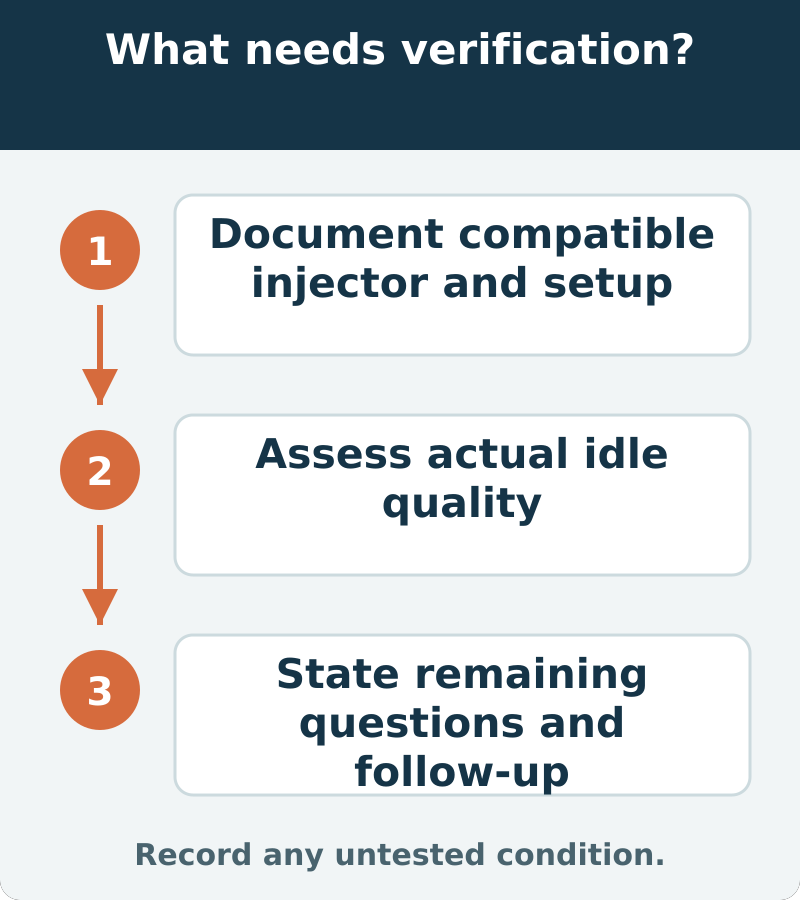
The repair is not fully described by the fitted part alone. Ask whether the correct replacement identification and any required coding or setup have been completed, then whether the engine’s actual running has been reassessed.
A setup entry and a smooth-running demonstration answer different completion questions. Neither should be inferred solely from clearing the fault memory, particularly when no warning was present at the start.
Bring the original idle complaint into the final assessment. If it occurred under a particular ordinary condition, ask whether that condition was included safely. Keep any remaining roughness visible on the job record rather than allowing a completed injector replacement to stand in for a completed complaint.
Ask about follow-up without inventing previous damage
Ask what symptoms should prompt a return visit and what remains outside the completed assessment. That helps you respond to a recurrence without assuming the replacement has necessarily failed again.
Do not add a narrative of long-term engine or exhaust damage unless the workshop has evidence for it on the vehicle. Nor should an immediate improvement be described as a durability result extending beyond the checks actually performed.
The practical lesson is an evidence ladder: electrical activation, physical delivery and combustion contribution each answer a different question. If one level looks normal while the end result does not, move to an appropriate observation of the next relationship. A reassuring signal should narrow the investigation, not erase the rough idle.










Comments 0
Questions, fixes, and real-world diagnostic notes from readers.
Be the first to share a diagnostic result or ask a follow-up question.