
2010 Kia Forte Would Not Shift Out of Park: Every Input Arrived, but the BCM Never Released It

All Inputs Present, No Park Release?
<strong>Quick answer:</strong> The shift interlock had its power supply, the BCM received the necessary inputs, and the module’s own power and grounds were sound, yet ground control never arrived. A programmed replacement BCM restored normal selector operation. This article follows one documented vehicle. It explains the evidence chain, not a universal failure rate or a direction to replace the same part on every similar car. Stop whenever the test would involve overheated brakes, high current, moving parts, refrigerant handling or an uncontrolled road condition.
At the interlock stage, a circuit analyzer can verify an identified supply, ground path and low-current actuator circuit under the wiring diagram’s limits; MRCARTOOL B550 Circuit Analyzer is appropriate for those bounded checks. It cannot determine BCM logic, replace a bidirectional Kia scan tool, program the replacement, or make power injection safe on a network or module output.
The Forte had every reason to unlock Park—key state, brake input and selector information were all reaching the body controller. The missing event was the controller’s ground command to the interlock solenoid.
Quick answer: The shift interlock had its power supply, the BCM received the necessary inputs, and the module’s own power and grounds were sound, yet ground control never arrived. A programmed replacement BCM restored normal selector operation.
In this guide
Make the vehicle safe before bypassing Park
A stuck-in-Park vehicle must be secured before any manual release or circuit test. Apply the parking brake, chock the wheels and keep clear of the vehicle path. The manual override can move the car for service; it does not diagnose the electrical interlock or make an uncontrolled bypass acceptable. Preserve the original condition before changing it. The first observation is the control sample against which every later test must be compared.
Separate mechanical lock from electrical release
First determine whether the selector is mechanically jammed or the lock pin never retracts. Listen for the solenoid and observe brake-lamp response. If the lever moves through the approved manual release, the search can focus on interlock power, control and the inputs that permit release. Use service information for the exact engine, build date and options. A correct method on the wrong terminal can create a precise but useless result.
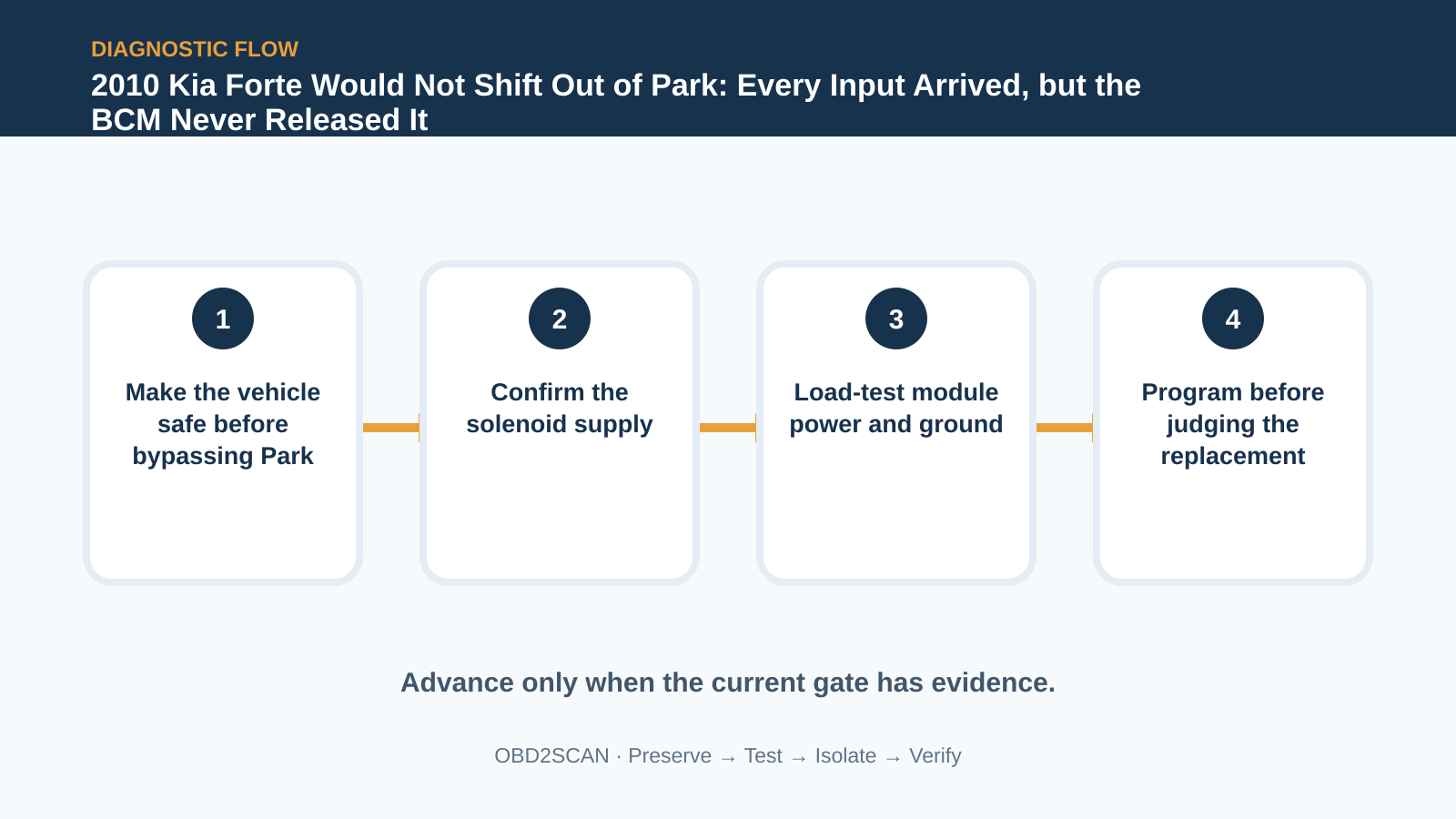
Confirm the solenoid supply
The interlock solenoid had battery voltage with the key on. This design used the BCM to complete the ground side, so supply voltage at one terminal did not prove that the coil was commanded or that it could pull under load. Test on the correct connector without forcing terminals. Treat prior work as evidence, not blame. A repair that made no change can narrow the case when its installation and test conditions are verified.
List the BCM inputs as a truth table
Lay out the required inputs as rows: ignition state, brake-switch state and selector/key information. The documented case showed those inputs arriving at the BCM. A truth table prevents a working brake switch or key input from being mentioned vaguely and then forgotten before the module decision. At this stage, separate what was observed from what is inferred. The observation should remain true even if the current theory is later rejected.
| Observation | What it supports | What it does not prove |
|---|---|---|
| Selector will not leave Park | Interlock path is blocked | BCM has failed |
| Solenoid has key-on voltage | Supply side is present | Ground command is present |
| Inputs and BCM supports pass | Prerequisites reach the module | Output circuit is intact under every condition |
| Programmed BCM restores operation | BCM was causal here | Every no-code interlock needs a module |
Load-test module power and ground
Module power and grounds were verified against the wiring diagram. Use voltage drop or an appropriate load where specified, because a high-impedance meter can display voltage through a weak connection. Also inspect connector fit and water intrusion; a good number on the wrong side of a terminal is not a passing support. This is the decision point in the documented case. Its value comes from changing one bounded condition while leaving the rest of the system intact.
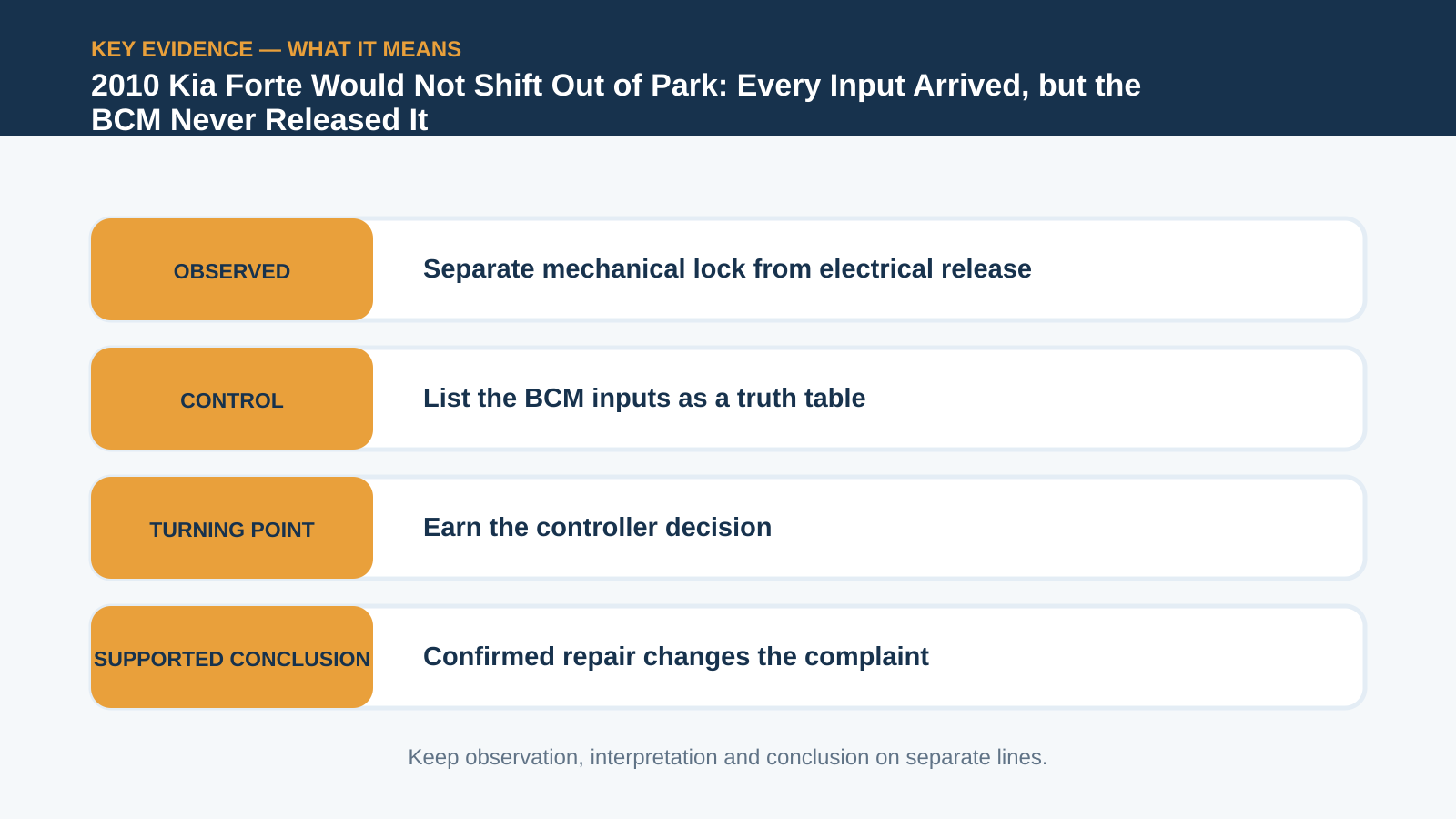
Earn the controller decision
Only after inputs, supply, grounds and the output circuit were separated did the absent BCM ground control support module replacement. Confirm service bulletins and part/configuration requirements before ordering. Controller failure is a conclusion reached by exclusions, not a default whenever no code is stored. A confirmed component still needs a repair that restores sealing, support, torque, routing or terminal fit—the physical conditions that keep the fault from returning.
Program before judging the replacement
The replacement BCM was dealer programmed. Maintain stable support voltage and follow Kia’s immobilizer/configuration process; programming failure can create a no-start or new body faults. Do not judge an unconfigured controller by the behavior of the original failed one. Reassemble protective covers and retainers before declaring success. A diagnostic shortcut must not become the next failure mechanism.
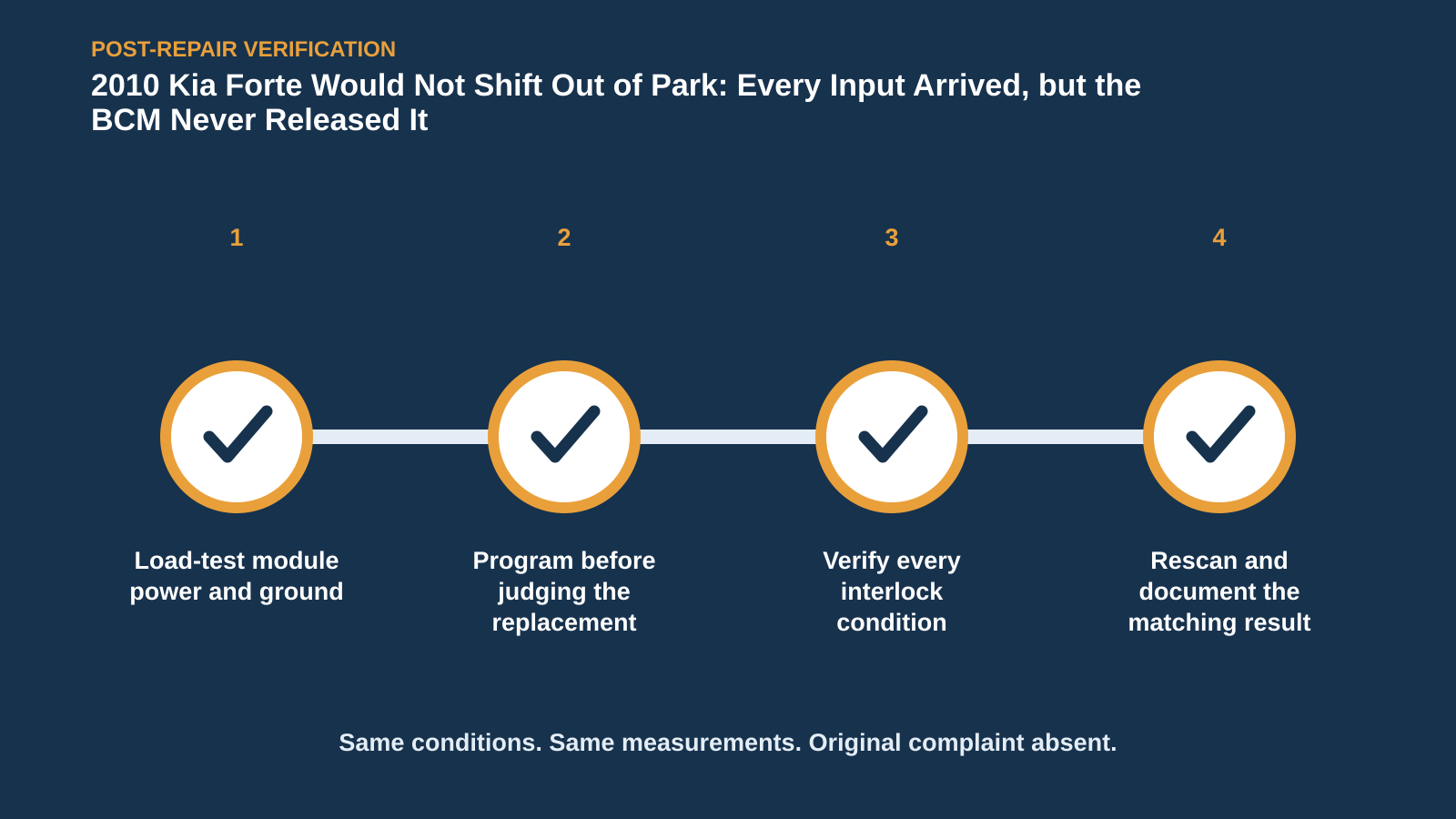
Verify every interlock condition
Verify release with the brake applied, retention with the brake released, brake-lamp timing, key interlock and every selector position. Repeat several cycles and rescan all related modules. The selector moving once proves less than the complete safety logic working in both allowed and blocked states. Use the customer’s original complaint as the final specification. A cleared code, quiet bay or one good key cycle is not equivalent to reproducing and passing that condition.
If you are bringing a similar symptom to a shop, arrive with the useful conditions rather than a requested part: whether the vehicle was cold or hot, the exact speed or switch position, which warning lamps appeared, what changed after a restart, and a chronological list of earlier repairs. A short video can preserve an intermittent sound or lamp pattern, but record it only while parked or with a passenger handling the camera. Ask the technician to retain the pre-repair scan and measurements, explain the test that separated the failed path from the alternatives, and show how the original complaint was repeated afterward.
For the owner or service adviser, a useful repair explanation has three parts: what was observed, why the decisive test narrowed the fault, and which original condition passed after the repair. It should also say what the test did not prove. That boundary prevents a memorable case from becoming an automatic parts recommendation.
The shift interlock had its power supply, the BCM received the necessary inputs, and the module’s own power and grounds were sound, yet ground control never arrived. A programmed replacement BCM restored normal selector operation. The reusable lesson is narrower and more valuable: Frame the case as a truth table: inputs present, prerequisites present, output absent—then state what still must be ruled out before the module is ordered.










Comments 0
Questions, fixes, and real-world diagnostic notes from readers.
Be the first to share a diagnostic result or ask a follow-up question.