
2009 Acura MDX Lights Failed and Wipers Moved Alone: A 7-Volt CAN-B Waveform Found the Node

Wipers Move Alone? Look At Can-B Shape
Three strange body symptoms and no stored codes can feel like an electronic fog. A waveform that climbed two volts too high gave this MDX a concrete path through that fog.
When this diagnostic path reaches a measurement question, the useful machine type is one that answers only that question. For that supporting role, the AUTOOL DM303 Circuit Tester is one practical option. A meter with a K/CAN oscilloscope mode can view a bounded signal at a verified low-voltage test point. It cannot decode every Acura message, identify a node by waveform alone, or make back-probing safe without terminal information.
<strong>Quick answer:</strong> An over-voltage network waveform led to node isolation. Removing the rear fuse-box node normalized communication, and replacement restored the body functions. This article follows one documented vehicle. It explains the evidence chain, not a universal failure rate or a direction to replace the same part on every similar car. Stop whenever the test would involve overheated brakes, high current, moving parts, refrigerant handling or an uncontrolled road condition.
Quick answer: An over-voltage network waveform led to node isolation. Removing the rear fuse-box node normalized communication, and replacement restored the body functions.
In this guide
- Three body symptoms point toward communication
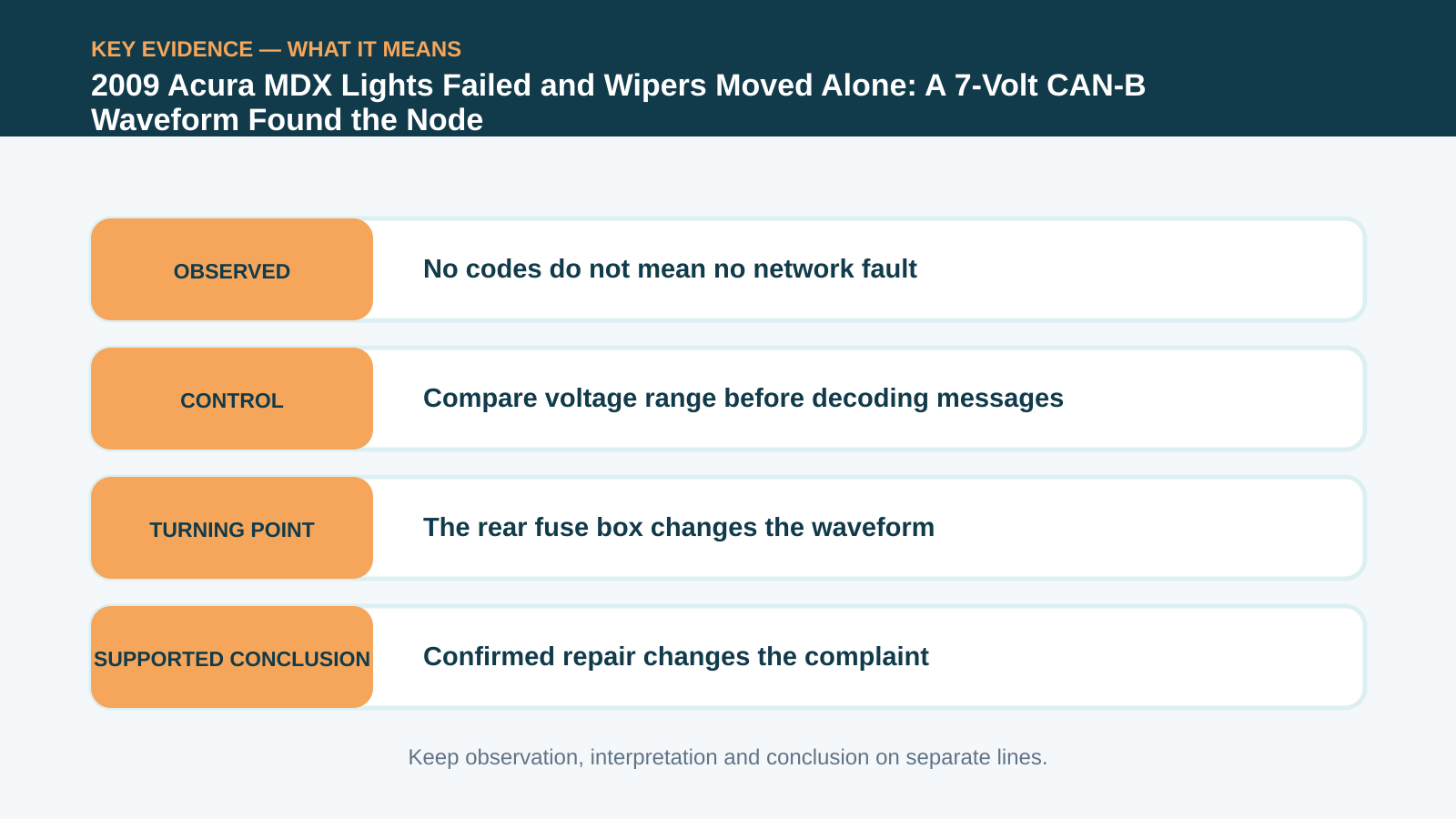
- No codes do not mean no network fault
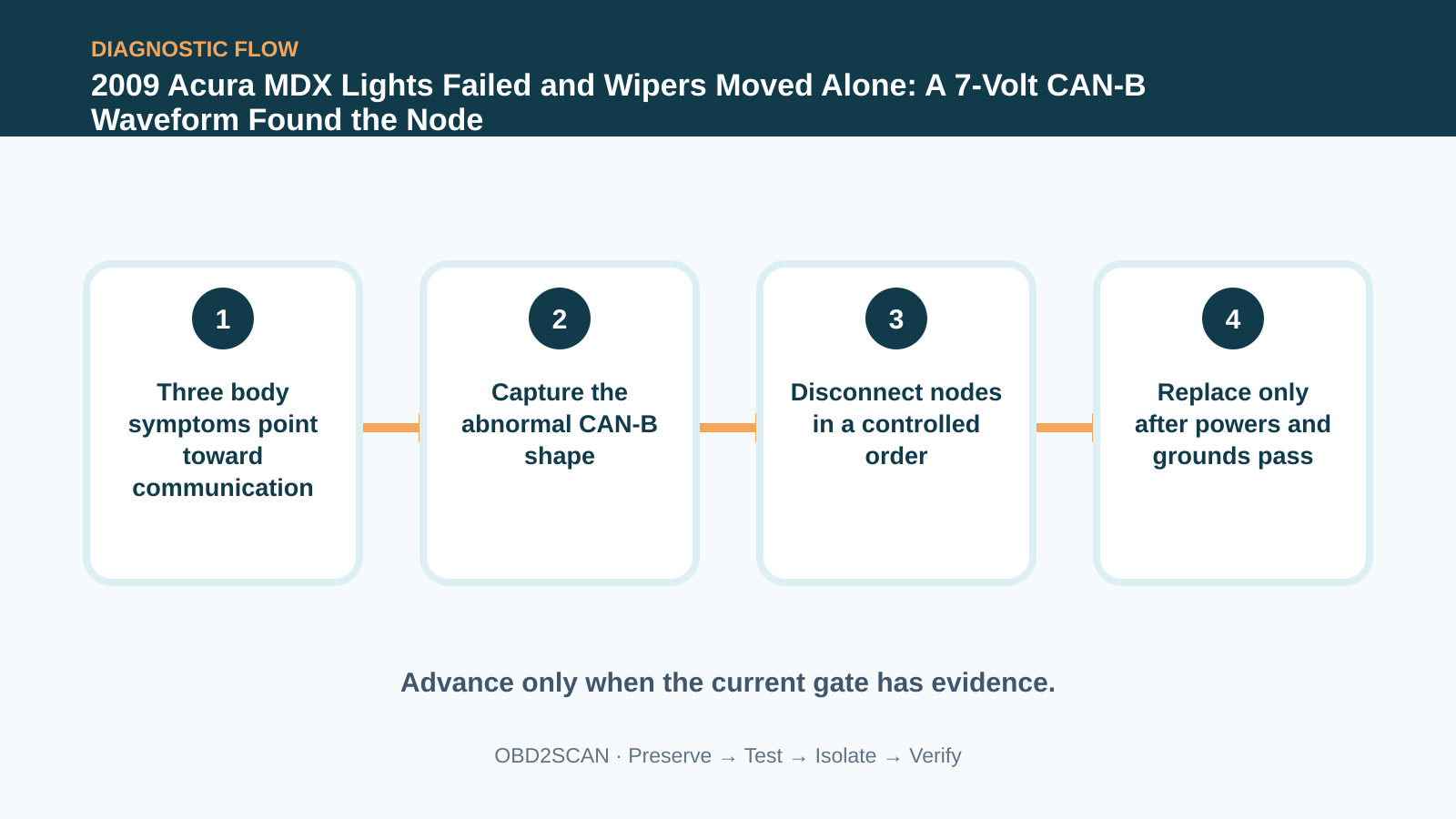
- Capture the abnormal CAN-B shape
- Compare voltage range before decoding messages
- Disconnect nodes in a controlled order
- The rear fuse box changes the waveform
- Replace only after powers and grounds pass
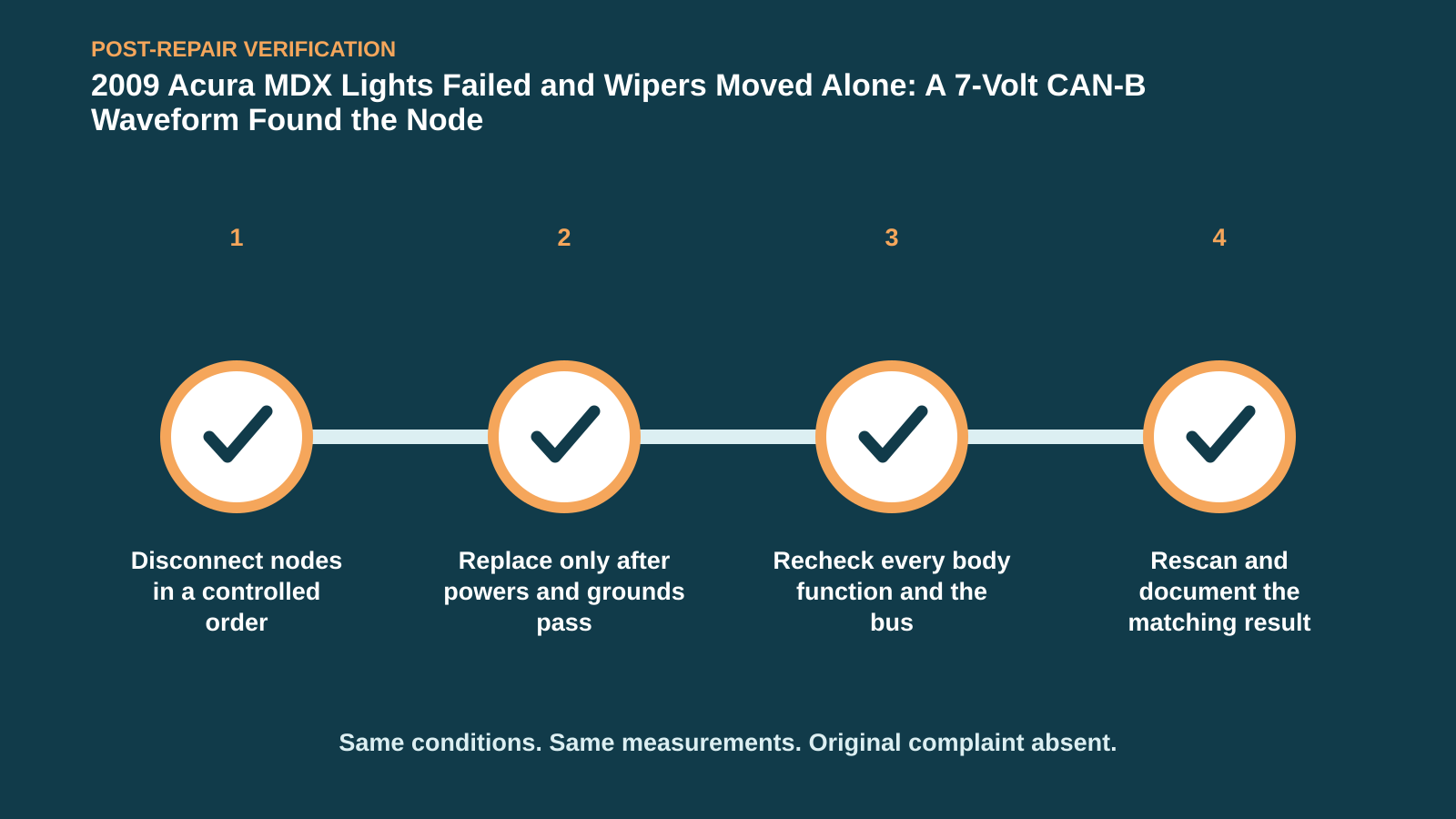
- Recheck every body function and the bus
Three body symptoms point toward communication
Exterior lights failing while wipers activate on their own and the cluster flickers suggests communication or shared-power trouble, not three unrelated switches. Record exactly which functions move together and scan every responding module before disconnecting the battery or clearing history. Preserve the original condition before changing it. The first observation is the control sample against which every later test must be compared.
No codes do not mean no network fault
No DTCs were stored, yet communication with the body controller was intermittent. Codes require a module to remain online long enough to recognize and report a fault. An unstable network can remove the witness, so “no codes” cannot overrule the physical symptom. Use service information for the exact engine, build date and options. A correct method on the wrong terminal can create a precise but useless result.
Capture the abnormal CAN-B shape
At a verified CAN-B test point, the waveform moved from about zero to seven volts instead of the expected zero-to-five range for this Acura network. Capture time base, probe reference and vehicle state. One screenshot is meaningful only when compared with the correct network specification. Treat prior work as evidence, not blame. A repair that made no change can narrow the case when its installation and test conditions are verified.
Compare voltage range before decoding messages
The voltage range showed that the bus was being pulled outside its normal state, but it did not name the guilty node. Avoid interpreting every edge as a decoded message. Check battery stability, bus grounds and connector integrity before beginning module isolation. At this stage, separate what was observed from what is inferred. The observation should remain true even if the current theory is later rejected.
| Observation | What it supports | What it does not prove |
|---|---|---|
| No stored DTCs | Reporting was intermittent | Network is healthy |
| CAN-B reaches 7 V | Bus state is abnormal | A particular node failed |
| Unplugging rear box normalizes bus | That node/connection is causal | Internal box fault is automatic |
| Replacement restores functions | Assembly was causal here | All MDX symptoms share it |
Disconnect nodes in a controlled order
Use Acura topology to disconnect one allowed node at a time with ignition state controlled, then reconnect it before moving on. Watch whether waveform and communication normalize. Randomly unplugging several modules can create new codes and make the original path impossible to reconstruct. This is the decision point in the documented case. Its value comes from changing one bounded condition while leaving the rest of the system intact.
The rear fuse box changes the waveform
When the rear cargo-area fuse box was removed from the network, the signal returned to the expected range and the body functions stabilized. Verify its powers, grounds and connectors—including moisture or terminal spread—so an external fault is not mistaken for internal failure. A confirmed component still needs a repair that restores sealing, support, torque, routing or terminal fit—the physical conditions that keep the fault from returning.
Replace only after powers and grounds pass
Replace the confirmed assembly following exact configuration requirements. Some integrated fuse or body modules may require setup depending on build. Protect cargo-area seals and harness routing, then reconnect every node and clear only the diagnostic artifacts created by controlled isolation. Reassemble protective covers and retainers before declaring success. A diagnostic shortcut must not become the next failure mechanism.
Recheck every body function and the bus
Rescan the entire vehicle and operate exterior lamps, wipers and cluster repeatedly through sleep and wake cycles. Recapture CAN-B at the same point and scale. A normal waveform plus stable communication and restored functions closes the case more convincingly than a code-free scan alone. Use the customer’s original complaint as the final specification. A cleared code, quiet bay or one good key cycle is not equivalent to reproducing and passing that condition.
If you are bringing a similar symptom to a shop, arrive with the useful conditions rather than a requested part: whether the vehicle was cold or hot, the exact speed or switch position, which warning lamps appeared, what changed after a restart, and a chronological list of earlier repairs. A short video can preserve an intermittent sound or lamp pattern, but record it only while parked or with a passenger handling the camera. Ask the technician to retain the pre-repair scan and measurements, explain the test that separated the failed path from the alternatives, and show how the original complaint was repeated afterward.
For the owner or service adviser, a useful repair explanation has three parts: what was observed, why the decisive test narrowed the fault, and which original condition passed after the repair. It should also say what the test did not prove. That boundary prevents a memorable case from becoming an automatic parts recommendation.
An over-voltage network waveform led to node isolation. Removing the rear fuse-box node normalized communication, and replacement restored the body functions. The reusable lesson is narrower and more valuable: Show the abnormal and expected waveforms before naming a module; isolation earns the conclusion.







Comments 0
Questions, fixes, and real-world diagnostic notes from readers.
Be the first to share a diagnostic result or ask a follow-up question.