
2010 VW Tiguan Misfired for Five Cold Minutes: Intake-Valve Carbon Changed the Airflow

Cold Misfire For Five Minutes? Inspect Airflow
The Tiguan misfired badly when cold, stored several faults, then smoothed out after roughly five minutes. That short window was the case. Warming the engine before testing would make the car easier to work around and the diagnosis much harder to prove.
When airflow evidence points toward the intake valves, the next useful capability is visual inspection through a safe, manufacturer-approved access route. The MRCARTOOL N180 can help document deposits in confined areas. N180 can help document intake-valve deposits through an appropriate, safely opened access path. It cannot quantify airflow restriction, prove that carbon is the only misfire cause or authorize solvent, walnut or other cleaning methods for this engine.
Cold misfire data and vacuum behavior moved the diagnosis away from a simple ignition guess. Direct inspection found substantial carbon on the intake valves. Cleaning the valves and then repeating a true cold soak restored stable operation through the original five-minute failure period.
Quick answer: Cold-only misfires, vacuum evidence and direct inspection supported heavy intake-valve deposits; cleaning restored the first five minutes of operation.

In this guide
- The first five minutes are the test window
- Save every cold-start code before clearing
- Do not let warm operation erase the pattern
- Compare crankcase and manifold vacuum
- Inspect the intake valves through a safe access route
- Choose a cleaning method approved for the engine
- Protect cylinders and reassemble carefully
- Repeat a true cold soak before closing the case
The first five minutes are the test window
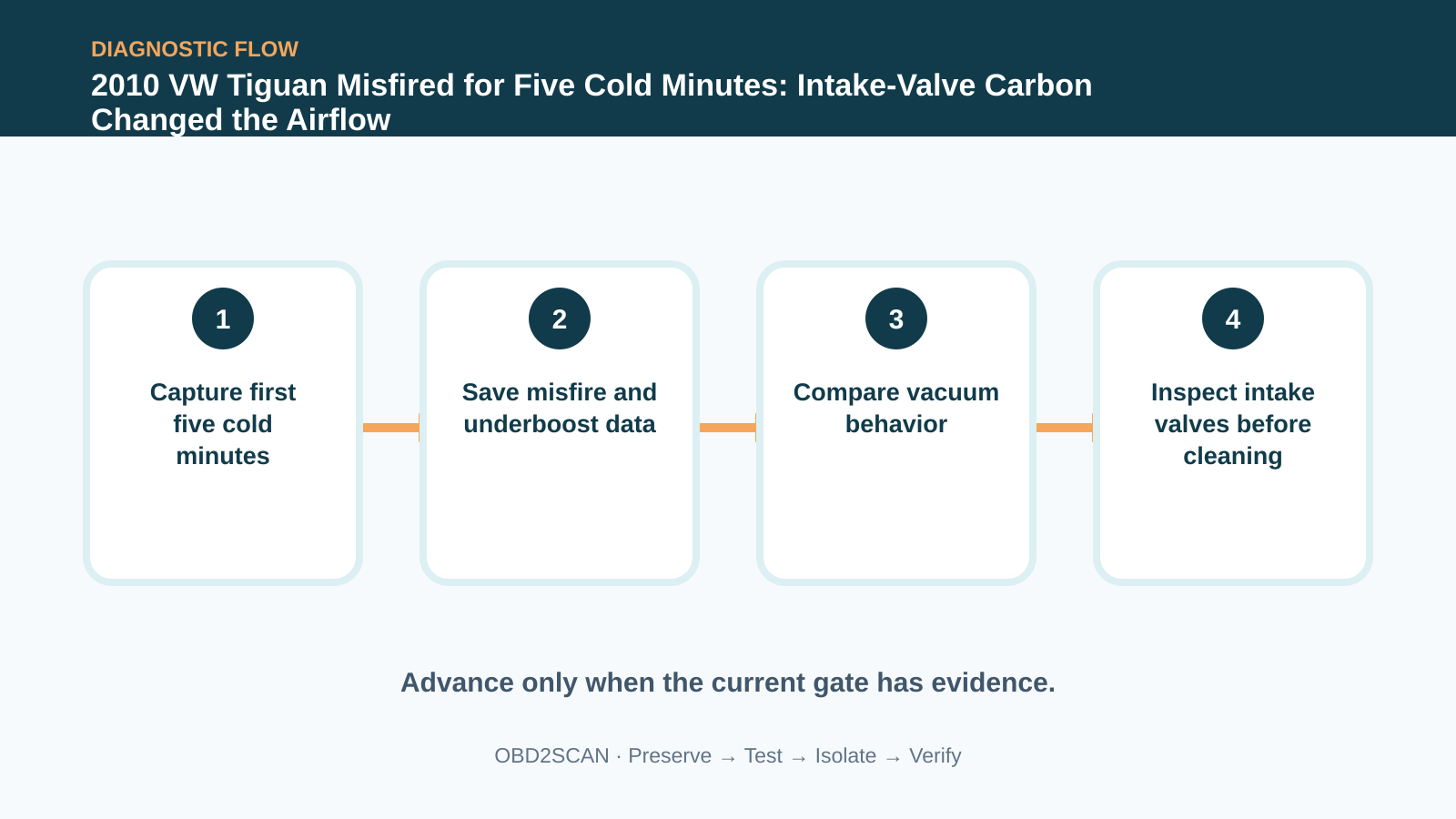
Arrange an overnight soak before touching the car. Record outside temperature, coolant and intake temperature at key-on, fuel level and how long the roughness lasts. Save all codes, freeze frames and cylinder misfire counters before clearing anything. Limit running if the MIL flashes because raw fuel can damage the catalyst. A cold-only misfire is not permission to replace coils as a set. The same plug, injector, compression and air paths still need testing, but every check must respect that the useful condition expires as the engine warms.
Save every cold-start code before clearing
Start the capture before the first crank. Watch misfire counts by cylinder, desired and actual boost or load, fuel trims and rpm for the entire five-minute transition. If a cylinder stops misfiring as metal, oil and deposits warm, note the exact temperature rather than merely “runs fine later.” Underboost codes can be consequences of unstable combustion rather than a separate turbo failure. Keep a timeline showing what changed first. The order can separate a breathing problem from a fuel correction that arrives afterward.
Do not let warm operation erase the pattern
Do not immediately warm the engine for compression or swap tests. Inspect plugs and coils after the first capture, preserving cylinder position, and compare injector command where appropriate. A coil swap that moves the misfire is strong evidence; one that does not is only a branch closed. On a direct-injection engine, fuel does not wash the back of the intake valves, so deposits are plausible, but plausibility is not diagnosis. The case needed air-movement evidence before the manifold was opened.
Compare crankcase and manifold vacuum
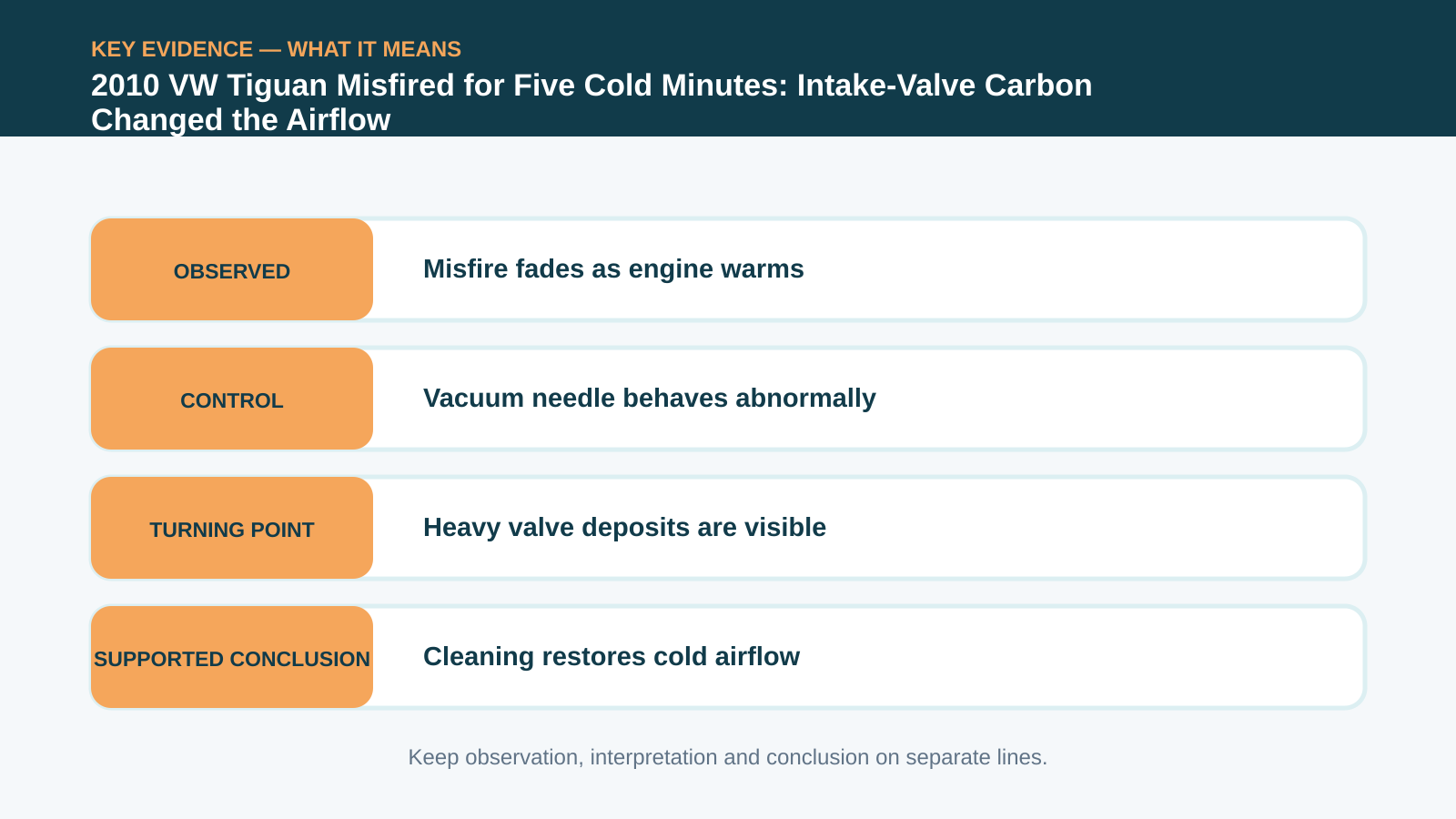
Crankcase and manifold vacuum can reveal how the engine breathes. Measure with equipment and connections appropriate for the engine, then compare the needle or pressure trace during the rough cold interval and after it smooths. A shaking vacuum signal may reflect uneven cylinder filling, valve action or combustion. It does not name carbon by itself. Check PCV behavior and obvious leaks so a failed diaphragm or unmetered-air path is not mistaken for restricted valve flow. The value is the cold-to-warm change under controlled conditions.
| Evidence | What it supports | What remains unproved |
|---|---|---|
| Misfire lasts about five cold minutes | Temperature/time controls the fault | Which component is responsible |
| Underboost appears with rough combustion | Airflow/load calculation is disturbed | Turbocharger failure |
| Vacuum is unstable during cold interval | Cylinder breathing is uneven | Carbon as the only cause |
| Heavy intake-valve deposits are visible | Deposits can obstruct cold airflow | Repair success before another cold soak |
Inspect the intake valves through a safe access route
Once the evidence points toward intake breathing, create the access route specified for the Tiguan and inspect each valve. Prevent debris from entering open ports and confirm valve position before any cleaning work. A borescope should document deposit location and relative severity, not turn color or appearance into a universal threshold. Oil residue, lighting and camera angle can exaggerate differences. Photograph all cylinders consistently. Heavy deposits matching the cold pattern strengthened this case because the electrical and vacuum branches already led there.
Choose a cleaning method approved for the engine
Choose a cleaning method approved for the engine and available shop containment. Whether the procedure uses walnut media, chemical treatment or disassembly, isolate each cylinder, protect sensors and recover debris. Do not spray an unknown solvent into a running engine as a shortcut. Replace required gaskets, inspect injector seals if disturbed and torque the manifold in sequence. The mature case reported that intake-valve cleaning corrected the condition; the important repair is controlled deposit removal without creating ingestion, sealing or fuel-system faults.
Protect cylinders and reassemble carefully
After reassembly, smoke-test the intake at safe pressure if the procedure allows, verify all connectors and start the engine. Expect short-term effects only if the approved process describes them; stop for abnormal noise or persistent misfire. Check fuel trims, boost data and cylinder counters at warm idle, but do not call the cold complaint fixed. Clear saved faults after documentation and inspect for pending codes. A smooth warm engine merely confirms that reassembly did not create an obvious new problem.
Repeat a true cold soak before closing the case
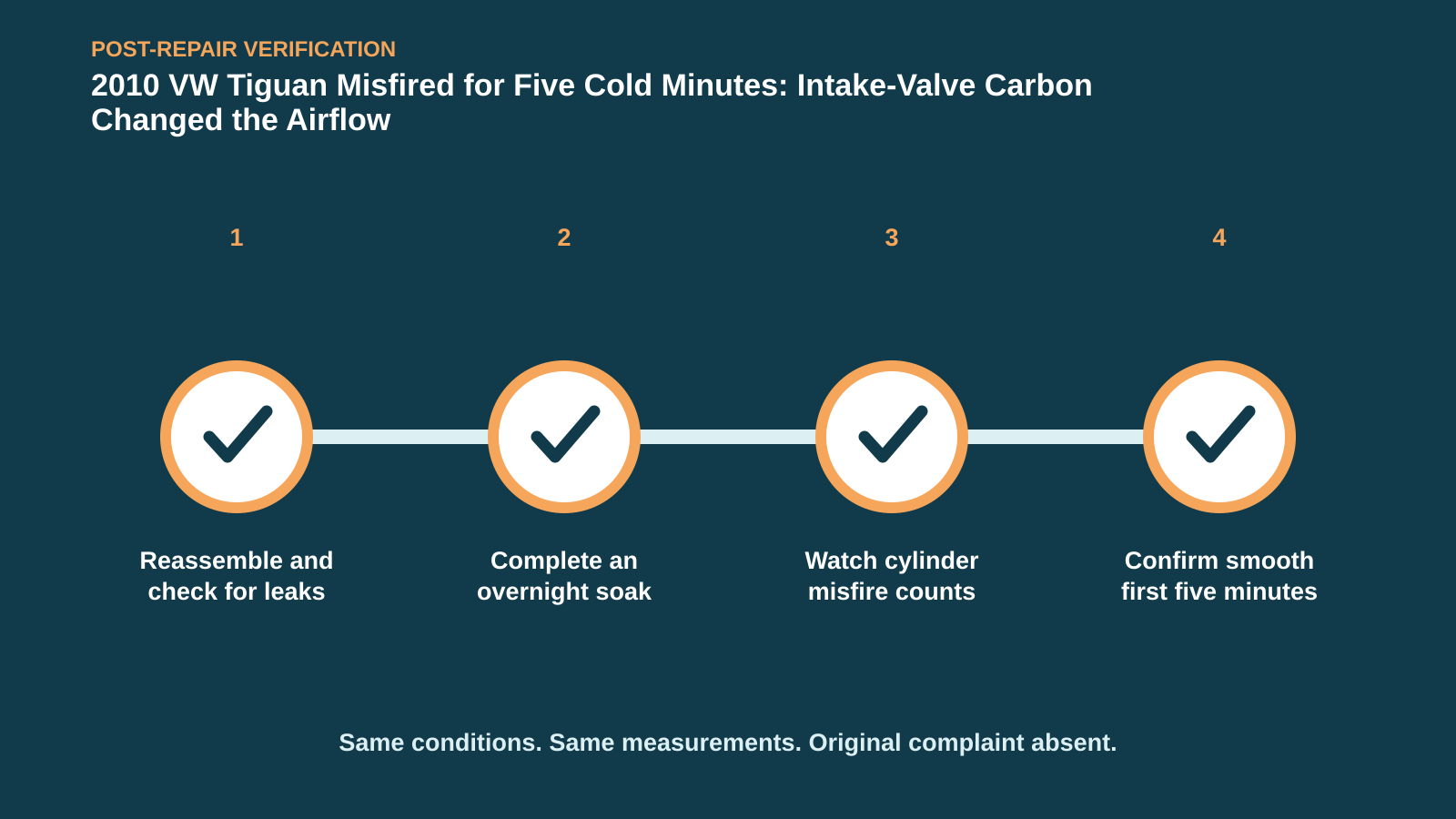
Allow the vehicle to cool completely, preferably overnight in similar ambient temperature. Capture the next first start using the same channels and duration. Misfire counters should remain controlled, vacuum behavior should be steadier and the first five minutes should feel normal. Repeat after another soak if the original complaint was intermittent. Then road-test through light and moderate load, rescan for underboost and misfire codes, and explain to the owner that one successful warm start would not have been equivalent evidence.
The deposits were visible at the end, but time found them first. Protecting the five-minute cold window made the difference between inspecting a cause and merely naming a common one.








Comments 0
Questions, fixes, and real-world diagnostic notes from readers.
Be the first to share a diagnostic result or ask a follow-up question.