
BMW X3 Front Brake Noise: Inner Pad Worn to the Backing Plate

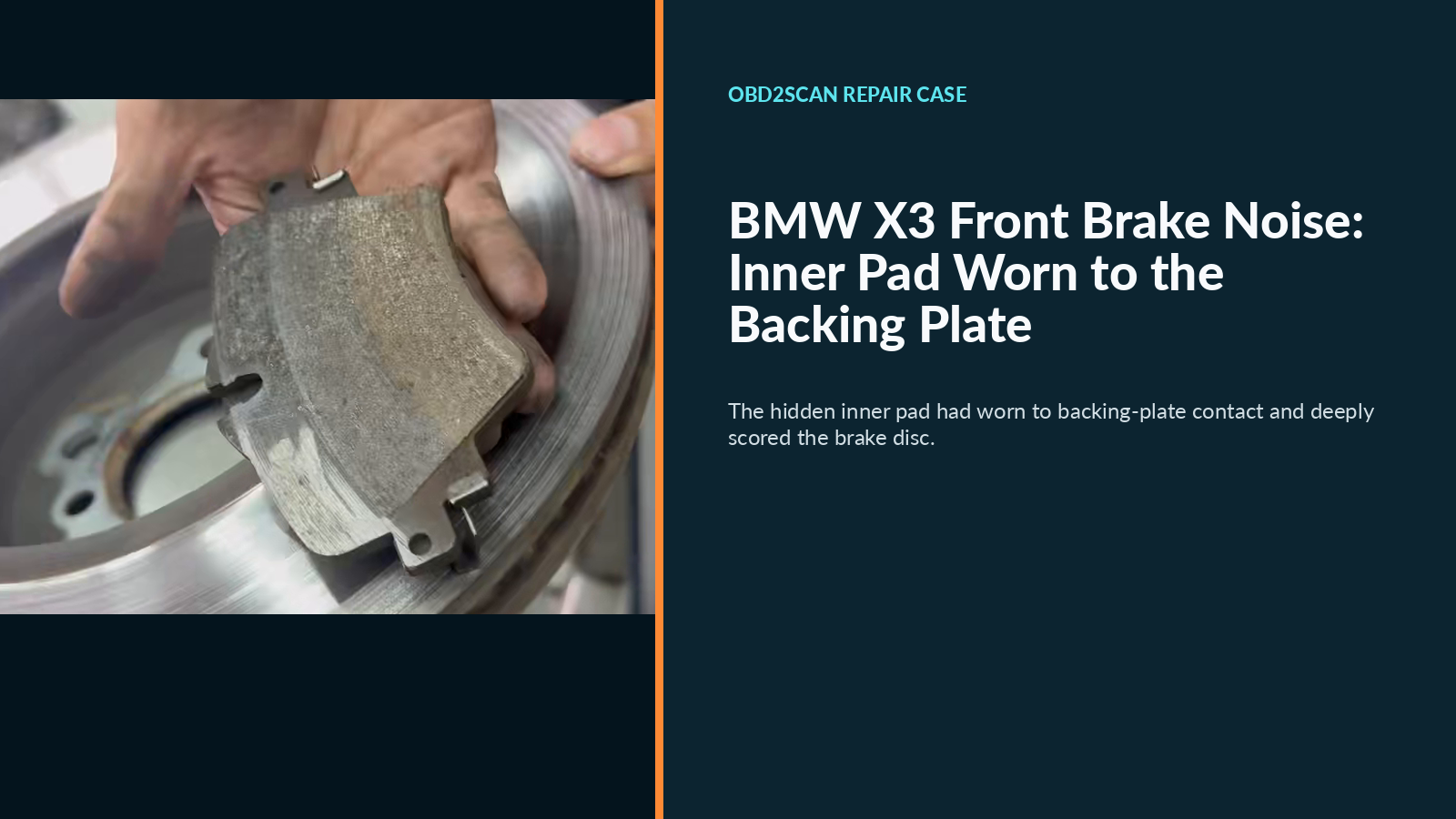
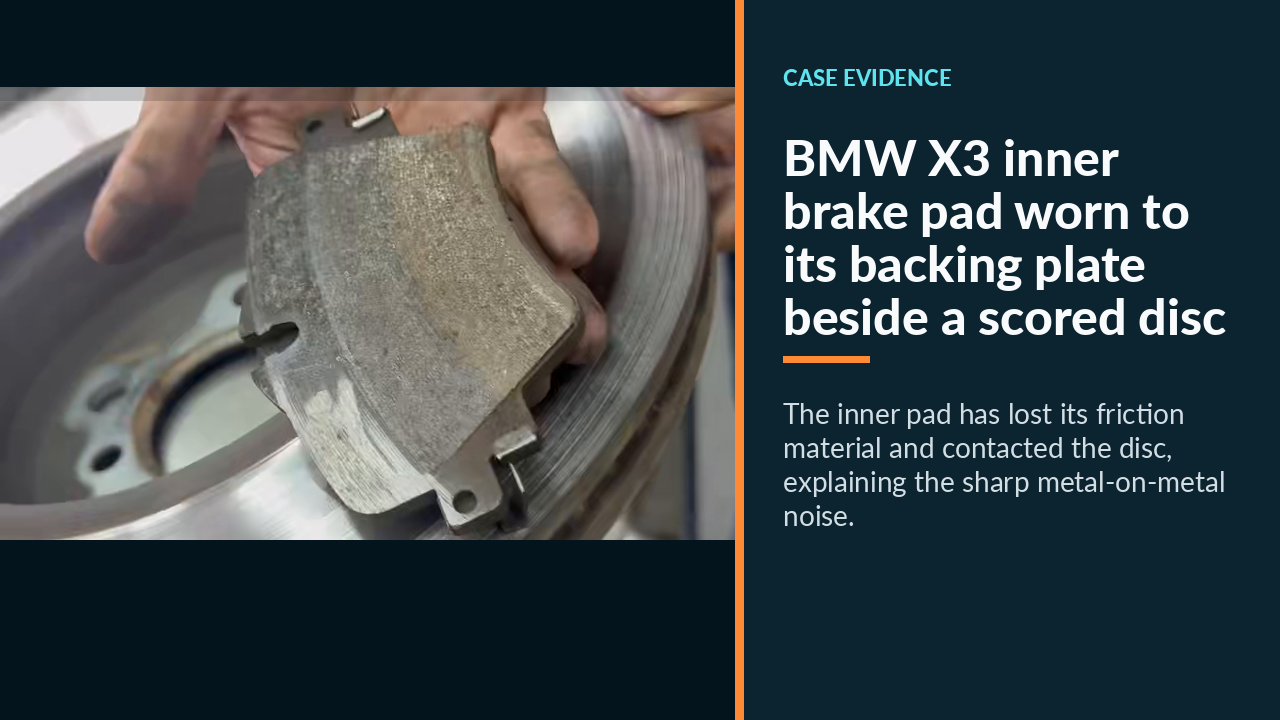
A BMW X3 identified in the case record as G08 (year, engine and mileage not reported) came in with a sharp front-brake noise. Wheel-off inspection found an inner pad worn completely to its steel backing plate, severe metal-to-metal disc scoring and a recorded disc measurement of 22.4 mm. The front discs, pads and wear sensor were replaced, CBS was reset, and a reported road test of at least 10 km ended with normal pedal travel, balanced braking and no squeal.
Case at a glance
| Item | This vehicle |
|---|---|
| Vehicle | BMW X3, case record identifies G08; other identity details not reported |
| Complaint | Sharp noise from the front brakes |
| Confirmed fault | Inner pad at backing plate with disc surface damaged by metal contact |
| Measurement | Record records 22.4 mm; applicable discard thickness was not independently established here |
| Repair | Front pads and discs, new wear sensor, mounting-face cleanup, CBS reset |
| Verification | At least 10 km reported road test; normal pedal, balanced braking, no squeal |
The outer view and warning system did not reveal the inner damage
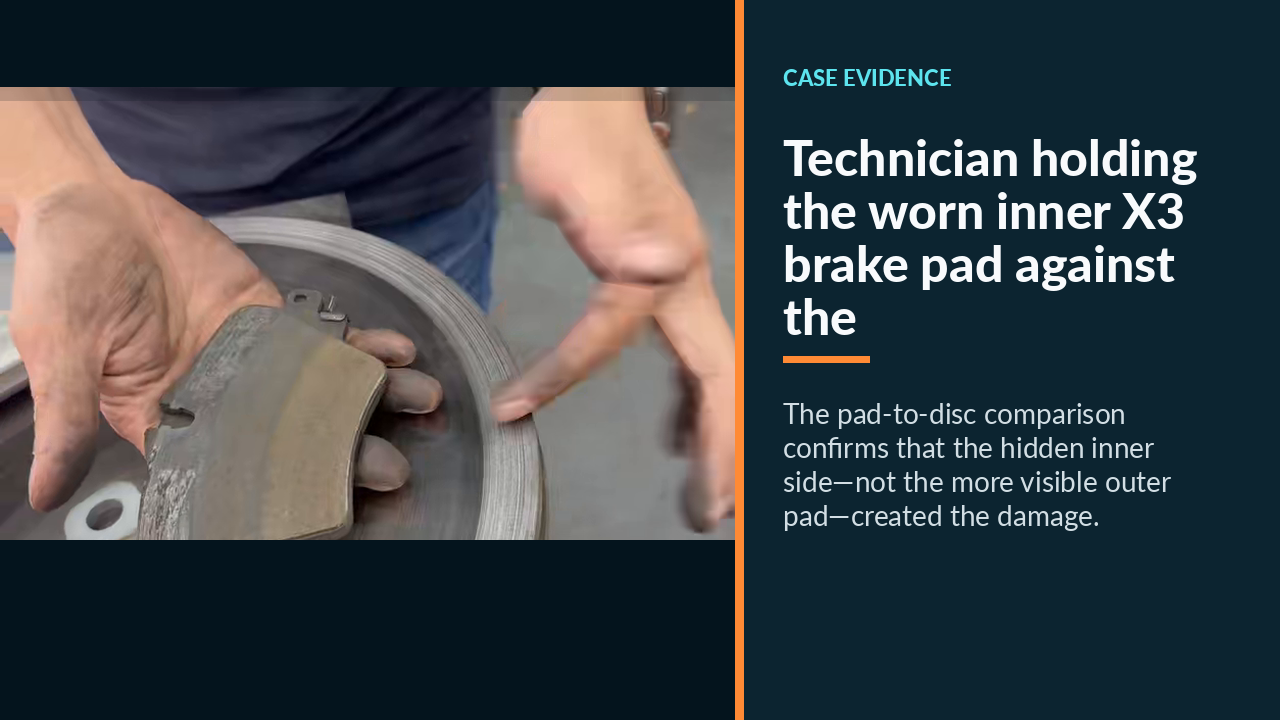
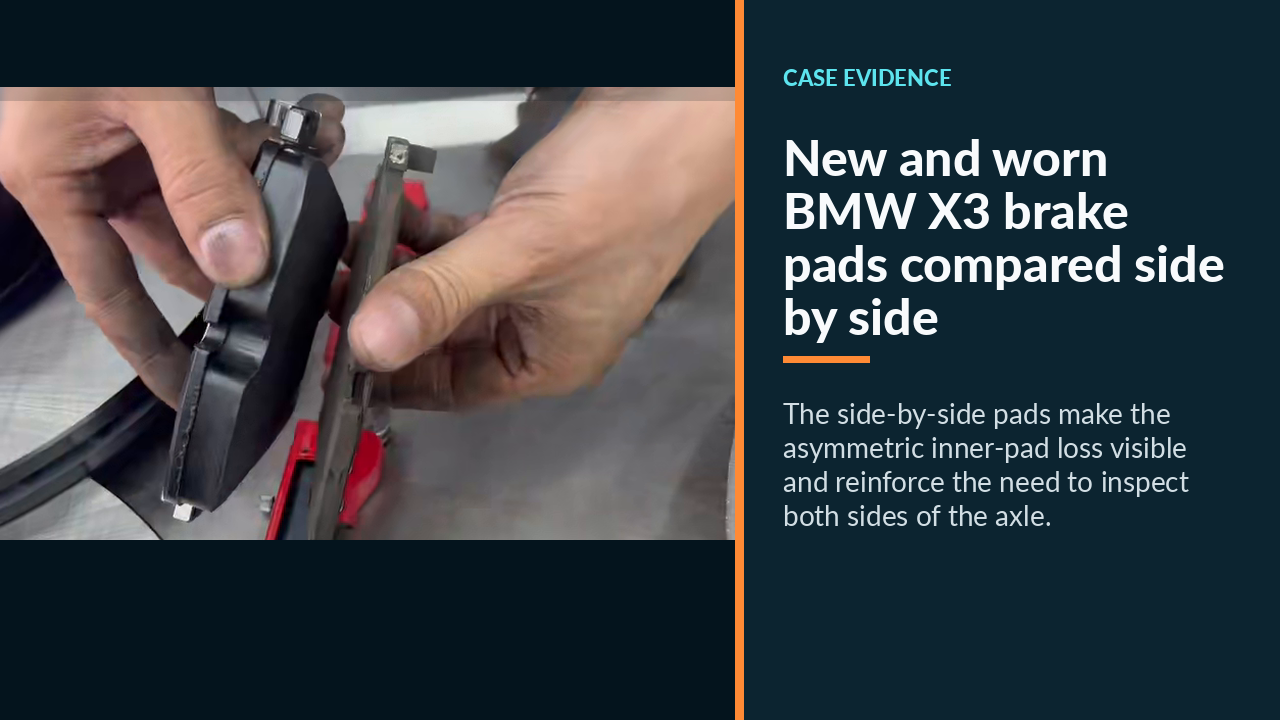
The diagnostic value of this case is asymmetrical wear. The outer pad and an untriggered wear warning can appear reassuring while the inner friction material disappears faster. After the wheel was removed, the inner pad’s backing plate was directly contacting the disc.
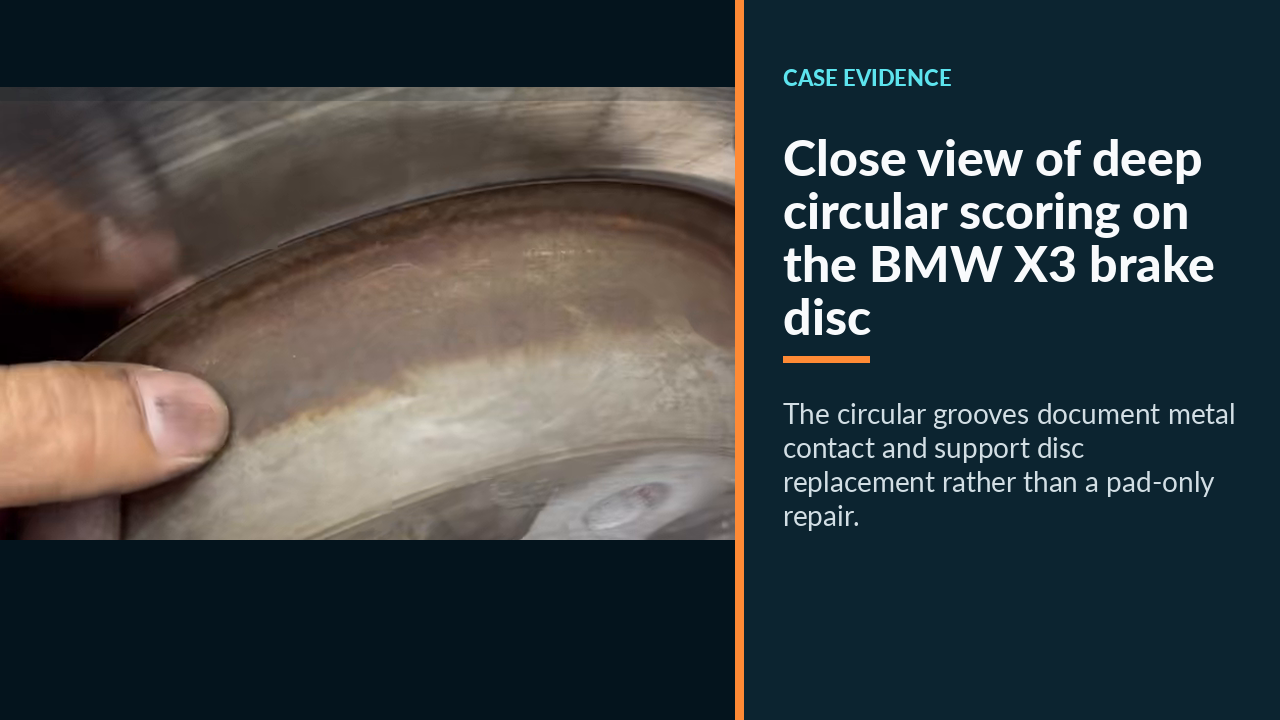
That contact explained the sharp noise and the deep circumferential scoring visible on the disc. The report suggests slow caliper-piston return or poorly lubricated guides as possible causes of the uneven wear, but it does not provide a measured guide-pin or piston test. Those remain suspected contributors, not confirmed root causes.
Measurement supported replacement, but the limit is vehicle-specific
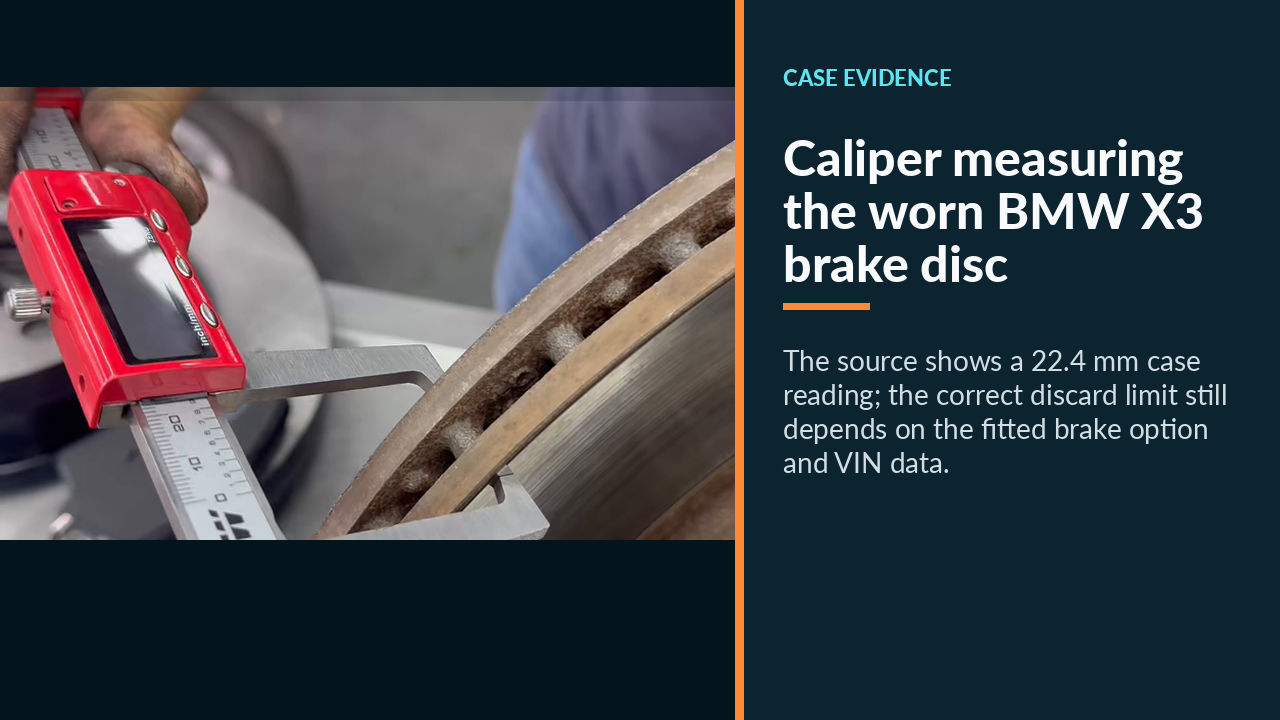
The disc was measured at multiple points with a micrometer, and the case record documents 22.4 mm. It also labels that value a legal/original discard limit. Because the exact brake option and a current BMW specification are not supplied, this article preserves 22.4 mm only as the case’s recorded reading—not a universal threshold.
The correct decision on another X3 must use the disc marking and VIN/brake-option-specific repair information, with measurements taken away from the wear lip. Here, the combination of backing-plate contact, major scoring and the recorded measurement established the replacement scope.
Brake work is safety-critical. Vehicle support, fastener replacement, tightening values, caliper support, brake-fluid control and bedding must follow the exact vehicle procedure. If those resources and equipment are unavailable, the safe action is to stop driving and arrange qualified brake service.
Contact surfaces and sliding hardware mattered during repair
The worn front discs and pads were replaced. The hub mounting faces were cleaned so corrosion or debris could not hold a disc off-axis. Appropriate brake lubricant was reportedly applied only at specified pad contact/guide areas, with anti-seize used at the wheel-to-hub interface; nothing belongs on friction surfaces.
A new wear sensor was installed and the CBS service item was reset. The case record states that bracket and wheel fasteners were tightened to manufacturer values but does not provide traceable values. None are inferred here.
Verification challenged the original noise under motion
The shop reports a dynamic test of at least 10 km after assembly. Pedal travel was described as compact/normal, braking remained balanced and the original squeal was absent. This is more meaningful than a stationary pedal press because it returns to the noise and braking behavior that the driver experienced.
The report does not document measured braking-force balance, rotor runout or a later reinspection. The supported result is therefore the reported road-test outcome, bounded to that check.
First checks when one front brake starts making metal noise
Avoid repeated braking to “see if it clears.” Inspect both inner and outer pads on both sides, look for backing-plate contact and heat discoloration, and measure each disc against the specification for the installed brake package. Then check guide movement, piston return, boot condition and hose behavior so uneven wear is not treated as a pad-only problem.
This X3 shows that a wear sensor is not a substitute for physical inspection. It does not prove that every G08 noise has the same cause; stones, shields, wheel bearings, surface rust and other brake faults can sound similar.
Both sides of the axle needed a measured inspection
The hidden inner pad was the diagnostic lesson, but the repair decision covered the axle. Once backing-plate contact had scored a disc, the workshop compared both pads and both braking surfaces rather than treating the visible outer pad as representative. The case record shows a 22.4 mm case reading; it does not provide the exact brake option or BMW discard specification, so that number is not reused as a universal limit.
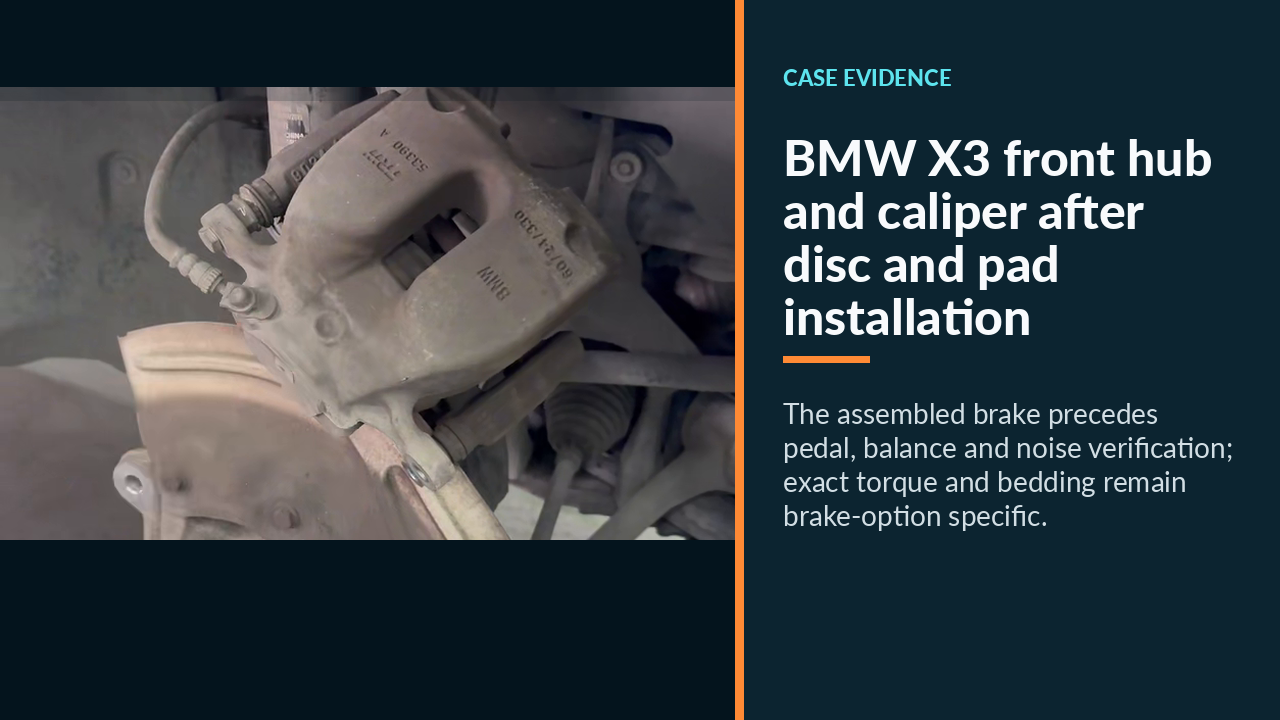
After discs, pads and the wear sensor were installed, the mounting faces were cleaned, the system was reassembled to vehicle data and the CBS service item was reset. The reported road test exceeded 10 km and checked normal pedal feel, balanced braking and absence of the original squeal. Brake bedding and fastener values still depend on the VIN and fitted brake package.
For another X3 with a sharp braking noise, do not wait for a dashboard warning to inspect it. Compare inner and outer friction material at every corner on the affected axle, look for taper or seized hardware, and measure the discs against the correct specification. Grinding or reduced braking is a stop-driving condition, not a cue to keep testing on the road.








Comments 0
Questions, fixes, and real-world diagnostic notes from readers.
Be the first to share a diagnostic result or ask a follow-up question.