
2008 Chevy Express No-Crank: A Coin in the Radio Shorted Low-Speed GMLAN

No Crank? Split The Bus Before Buying Modules
A coin inside a CD player sounds like the punch line, but it was not the diagnostic method. The Chevy Express would not crank and multiple low-speed modules disappeared. Only after the network was divided at its splice pack did the radio branch earn inspection—and the piece of spare change become evidence instead of a story.
At the first network checkpoint, technicians need safe access to the specified DLC pins without crowding the connector. The AUTOOL OBD2 Breakout Box Premium can expose those lines for a compatible meter or scope. The OBD2 breakout box can expose specified DLC power, grounds and network pins for safe observation. It cannot identify the JX200 branch, locate a short inside the radio or justify resistance testing on a powered network without GM wiring information.
Low-speed GMLAN was being held down by one branch. Disconnecting legs at JX200 restored communication when the radio circuit was removed. Opening the CD mechanism revealed a coin bridging electronics. Removal returned the bus and allowed the van to crank and start.
Quick answer: Branch isolation at JX200 exposed a radio leg shorted by a coin inside the CD player; removing it restored communication and starting.

In this guide
- No-crank plus missing communication points wider than the starter
- Identify which network is actually down
- Measure at the DLC without disturbing the bus
- Use JX200 to divide the low-speed network
- The radio branch changed everything
- Inspect the component before ordering a module
- Remove the coin and confirm the short is gone
- Verify start, accessories and every network branch
No-crank plus missing communication points wider than the starter
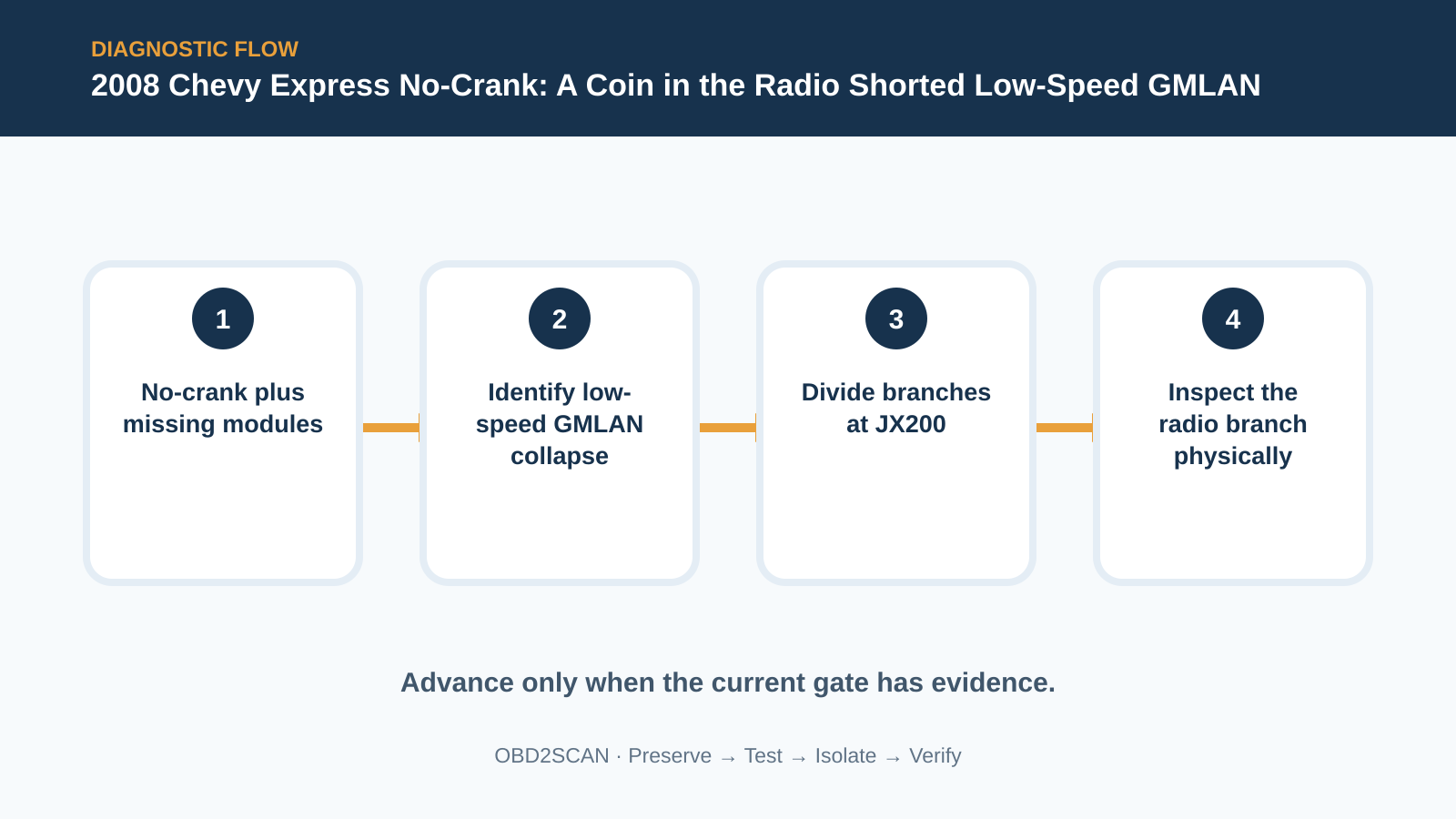
Define the no-crank precisely. Did the starter relay click, did the security indicator change, and which accessories failed at the same time? A starter motor fault cannot explain several missing body modules, while a network or shared power problem can affect start authorization and unrelated conveniences together. Verify battery condition and main connections first, then save the complete scan result. Repeatedly jumping the starter may move the vehicle but bypasses the question and can be unsafe. The combination of no-crank and lost communication is the map.
Identify which network is actually down
GM vehicles of this era may use more than one communication network. Identify which modules answer and which are silent, then consult the exact topology. If high-speed powertrain communication remains while low-speed body controllers vanish, focus on the low-speed path rather than testing every module on the van. Measure the specified bus at the DLC with ignition state controlled. A stuck voltage suggests a short or a node holding the line, but it does not tell you which branch or whether wiring and a module are equally possible.
Measure at the DLC without disturbing the bus
Connect a compatible scope or high-impedance meter through the correct DLC pin and record the bus before disturbing it. Do not use an ohmmeter on an energized network, and do not inject power into a data line. A breakout device improves physical access; the wiring diagram supplies meaning. Note whether the network changes during key movement, door activity or radio operation. If communication returns temporarily after a connector is moved, preserve that clue and reproduce it before removing trim. Intermittent recovery can be as valuable as the failure.
Use JX200 to divide the low-speed network
JX200 provided the diagnostic leverage because it joined several low-speed branches. With power managed according to GM procedure, disconnect one defined leg at a time and observe whether normal bus voltage and module communication return. Label connectors and restore each branch before moving to the next unless the topology says otherwise. Randomly unplugging every controller can create new codes and hide shared paths. The branch that restores the bus is not automatically a failed module; it contains the short that now needs local separation.
| Test state | Network result | What it narrows |
|---|---|---|
| All JX200 branches connected | Low-speed modules remain offline | Shared bus is pulled out of range |
| Non-radio branches isolated | Fault remains | Those legs are less likely |
| Radio branch removed | Bus and communication return | Short lies on radio leg or radio itself |
| Coin removed from CD unit | Network and starting remain normal | Physical short is causally supported |
The radio branch changed everything
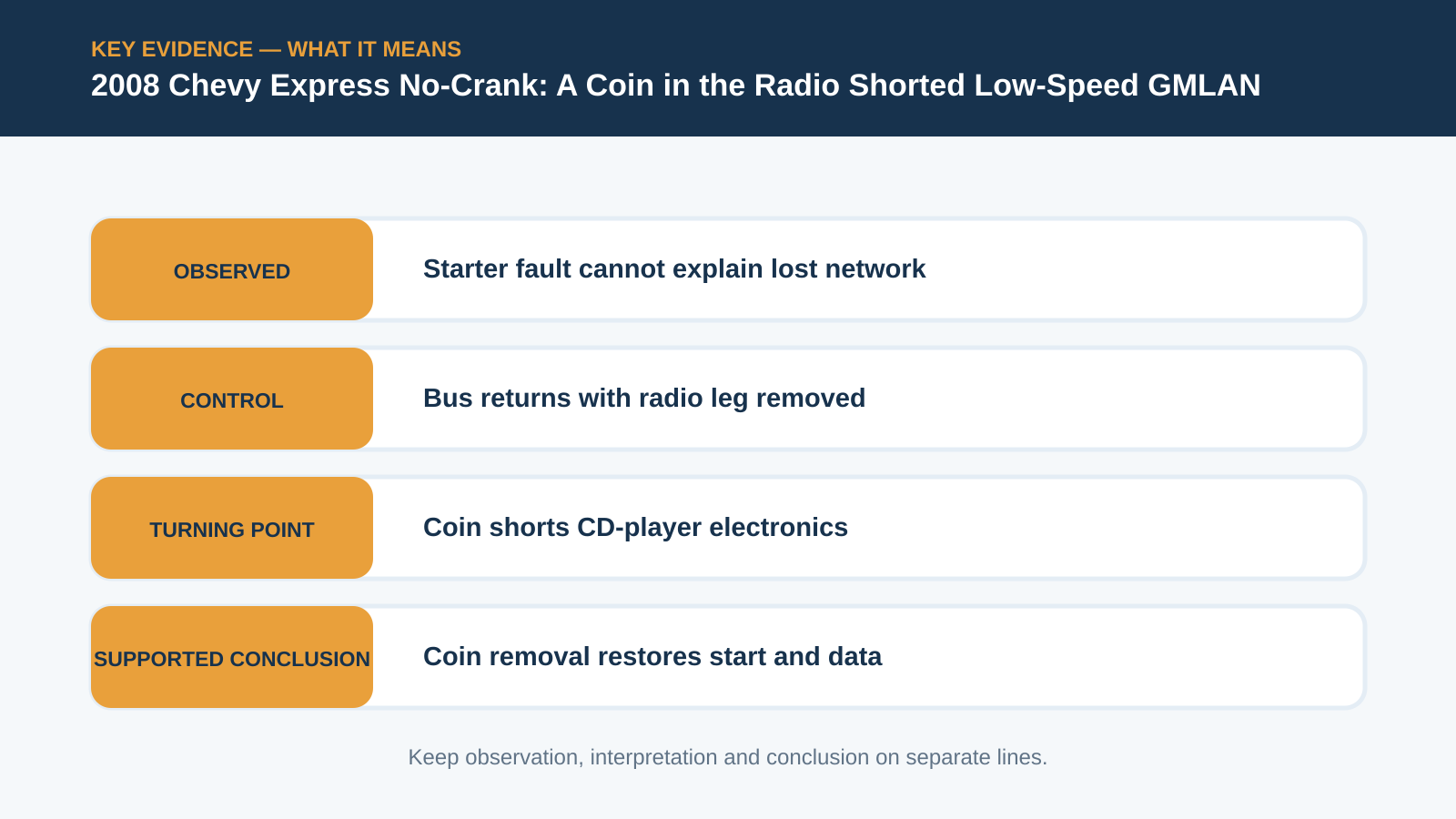
Once the radio leg was isolated, inspect its harness for pinched wires, aftermarket splices and liquid entry before condemning the head unit. The Express case contained an unusually literal cause: a coin had entered the CD mechanism and bridged the electronics. A conductive object can pull the module and shared data line into an invalid state. Do not shake powered electronics or reach inside with metal tools. Disconnect the unit safely, remove it to a bench and follow service guidance before opening any enclosure.
Inspect the component before ordering a module
Removing the coin should change a measurement, not merely improve the story. Check that the radio no longer presents the short seen on its branch, reconnect it and verify the low-speed bus remains in a valid state. If the network collapses again, the unit may have suffered internal damage and needs further repair or replacement. Inspect for additional coins and explain the slot hazard to the owner without blaming them. The supported repair is elimination of the conductive short while preserving the factory network—not permanent removal of a branch.
Remove the coin and confirm the short is gone
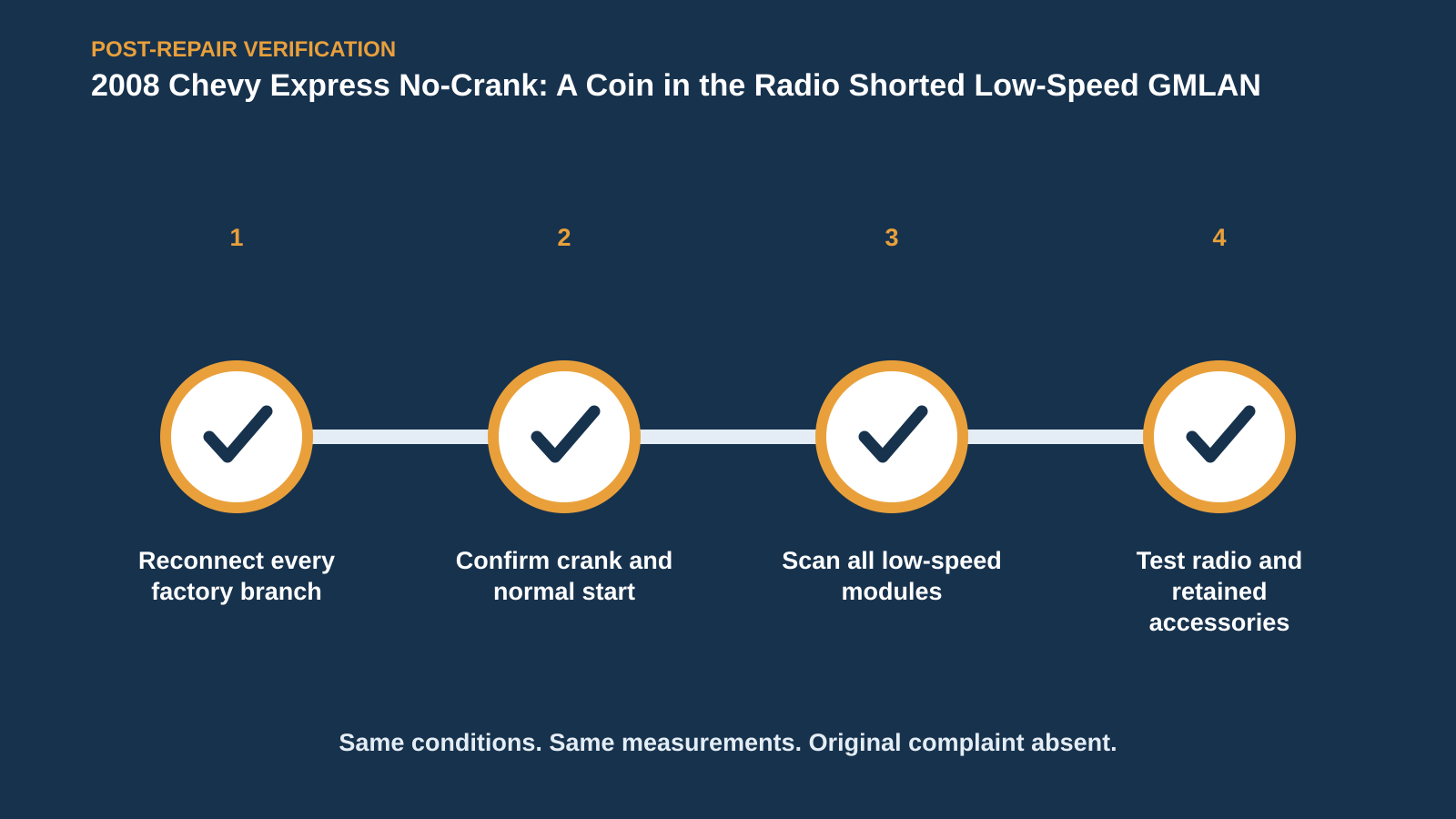
With all connectors restored, confirm that every previously silent module communicates. Clear the diagnostic record only after saving it, then cycle the key and request a normal start several times. Test the radio, cluster, door functions and any other low-speed nodes that were affected. Move the harness gently at the splice and radio while observing communication. A one-time start with the radio disconnected would be an isolation result, not closure. Normal function must remain with the vehicle returned to its intended configuration.
Verify start, accessories and every network branch
The final road check is simple but broad: start quality, cluster behavior, charging voltage, accessory operation and a clean full scan. Reinspect trim so no connector is strained or pinched during reassembly. If the battery was deeply discharged by repeated attempts, test it separately rather than letting a weak battery cloud the network repair. The memorable coin belongs at the end of the explanation; the reusable lesson is how a splice pack turned a van-wide failure into one inspectable branch.
The surprising cause did not replace method. Topology found the branch, the branch found the radio, and only then did spare change explain a no-crank van.








Comments 0
Questions, fixes, and real-world diagnostic notes from readers.
Be the first to share a diagnostic result or ask a follow-up question.