
Triumph Bonneville 1200 Stalled in Sequential Mode: Its ECU Was 360 Degrees Early

Runs In Batch, Stalls In Sequential
The custom Bonneville could start in batch-fire mode, but as soon as the programmable ECU changed to sequential operation, the engine stopped. That behavior was almost a calendar clue: the hardware could produce compression, spark and fuel, yet one event landed in the wrong revolution of the four-stroke cycle.
On an otherwise stock, explicitly supported motorcycle, a dedicated scanner such as the FXTUL M7 can collect codes, live data and service information before custom work begins. M7 can read codes, data and supported service functions on listed stock motorcycle systems. It does not replace the programmable ECU’s own calibration software, prove a custom harness pinout or authorize changes to a bespoke engine map.
The 270-degree parallel twin used intake pressure rather than a conventional cam sensor to establish phase. Synchronized captures showed the sequential injector firing during the power stroke—roughly 360 crank degrees early. Changing the custom ECU’s coupling angle from 285 to 645 degrees moved injection into the intake stroke, after which the motorcycle started, idled and accelerated cleanly.
Quick answer: The custom ECU fired injection one crank revolution early in sequential mode; a 360-degree coupling-angle correction restored operation.
In this guide
- The fault began where batch fire ended
- Draw the 270-degree crank before testing
- Prove the engine is mechanically credible
- Use MAP as the custom ECU’s phase clue
- Place spark and fuel on a 720-degree cycle
- The injector event was one revolution early
- Correct the coupling angle with calibration control
- Verify start, idle, transition and acceleration
The fault began where batch fire ended
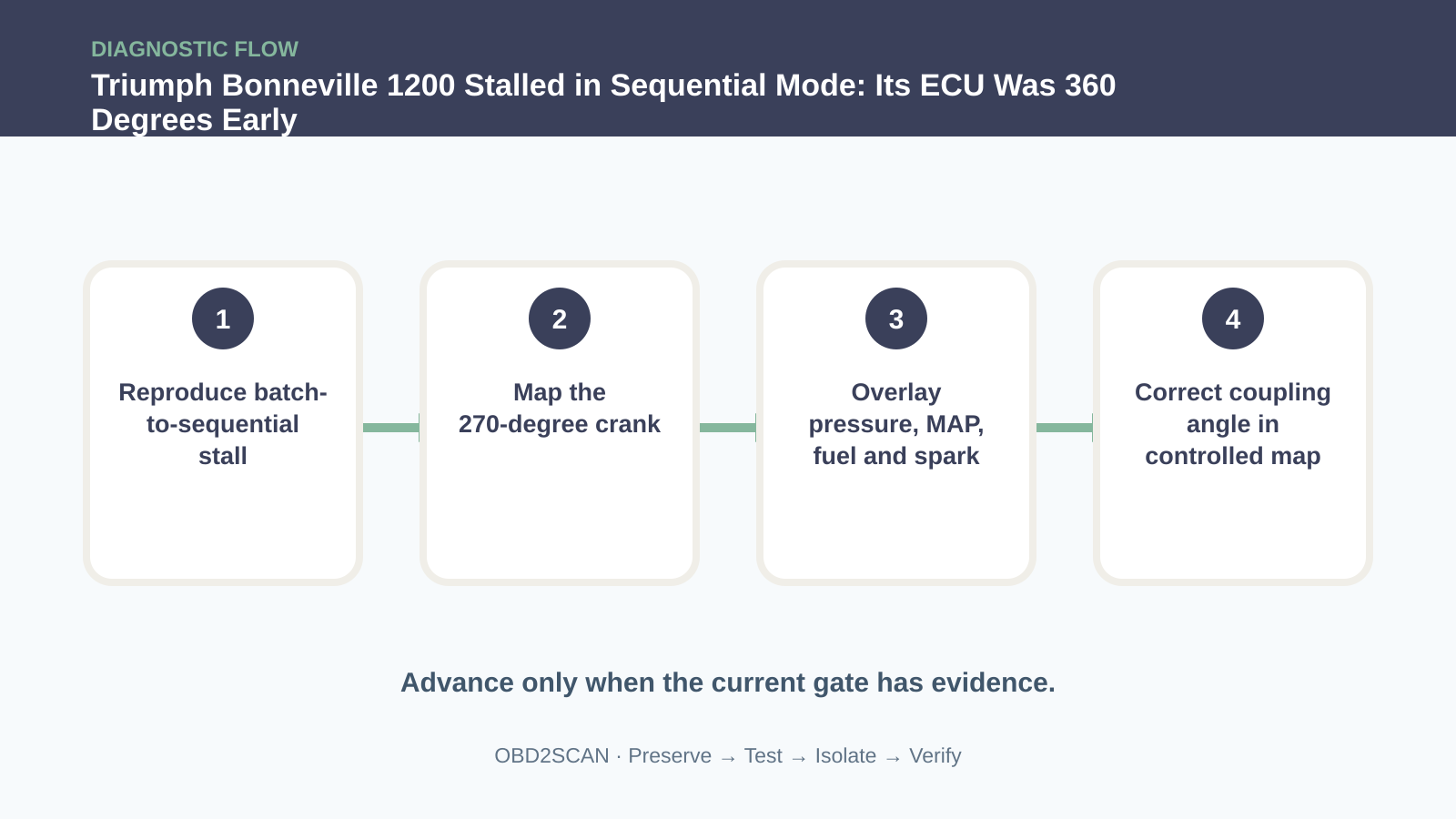
Start by separating the two operating modes. During cranking and early start, this ECU batch-fired ignition and injection every 360 degrees, giving the engine more than one opportunity to catch. After MAP and speed thresholds were met, it switched to one event per 720-degree four-stroke cycle. The motorcycle ran in the forgiving mode and died in the precise one. Preserve the exact calibration revision, battery voltage, thresholds and trigger pattern before changing anything. Secure the motorcycle on an appropriate stand and keep people, cables and clothing clear of wheels, chain and hot exhaust.
Draw the 270-degree crank before testing
A 270-degree parallel twin does not place compression events at equal 360-degree intervals. One cylinder fires, the second follows 270 degrees later, then the crank travels 450 degrees before the first fires again. Draw that sequence before interpreting starter-current peaks; the long gap can look like missing compression to someone expecting a conventional pattern. In-cylinder pressure on both cylinders showed the mechanical events occurring where this engine design required. The odd rhythm was architecture, not a failed cylinder. Understanding the crank arrangement removed an attractive but false mechanical fault.
Prove the engine is mechanically credible
Paired pressure traces, a crank reference and ignition sync established cylinder identity and credible compression. That step mattered because software cannot calibrate around a mechanically unhealthy engine. It also showed why one measurement rarely settles a custom build: relative current explained rotational effort, pressure described valve and compression events, and the crank signal provided angle. The result was a trustworthy 720-degree map. Do not copy the numerical setup to another Bonneville; custom trigger wheels, sensor polarity, wiring and ECU firmware can change the relationship.
Use MAP as the custom ECU’s phase clue
This build had no conventional cam-position input. Instead, the programmable controller watched manifold pressure near its primary cylinder to decide which crank revolution represented intake. A MAP pulse is therefore not merely load data—it is a phase landmark. Confirm sensor supply, ground, hose routing and signal direction before trusting it. A scanner may show a plausible average while hiding the pulse shape the custom controller uses. The question was not whether MAP voltage changed, but whether its change aligned with the correct cylinder and crank angle.
| Operating state | Injection pattern | What the engine did |
|---|---|---|
| Cranking/batch | Extra event every 360° | Started and ran |
| Sequential with 285° coupling | One event landed on power stroke | Stalled after transition |
| Sequential with 645° coupling | Event moved to intake stroke | Idled and accelerated |
| Final synchronized capture | Fuel, spark, MAP and crank agree | Calibration direction confirmed |
Place spark and fuel on a 720-degree cycle
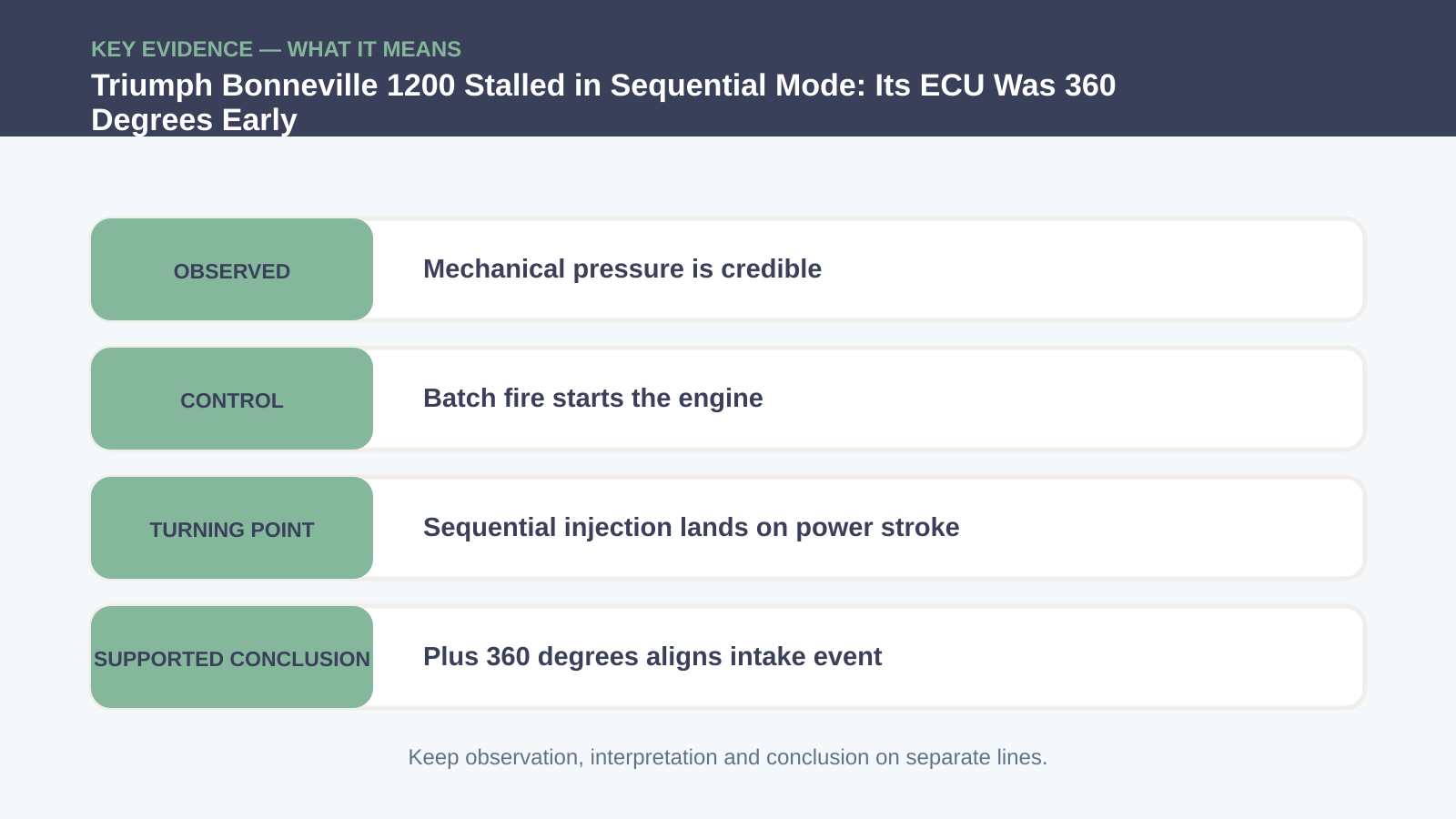
With pressure and crank rulers in place, ignition sat near the expected compression TDC. In batch mode, the extra fuel and spark events were visible but the engine tolerated them long enough to start. After the strategy switched, the single injector event occurred on the power stroke. Fuel arriving there could not prepare the next intended combustion event. The repeated offset was nearly 360 degrees—one complete crank revolution, or exactly the kind of error that makes crank position look right while four-stroke phase is wrong.
The injector event was one revolution early
The coupling angle told the ECU how to relate its crank trigger to the engine’s 720-degree cycle. Moving the value from 285 to 645 degrees added the missing revolution. After the controlled edit, the injector pulse fell during the intake stroke and ignition followed at the relevant compression event. Calibration changes require the custom ECU software, a saved rollback file and a tuner who understands the build. A production motorcycle scan tool cannot safely rewrite this relationship, and a successful number from one custom machine is not a universal Triumph setting.
Correct the coupling angle with calibration control
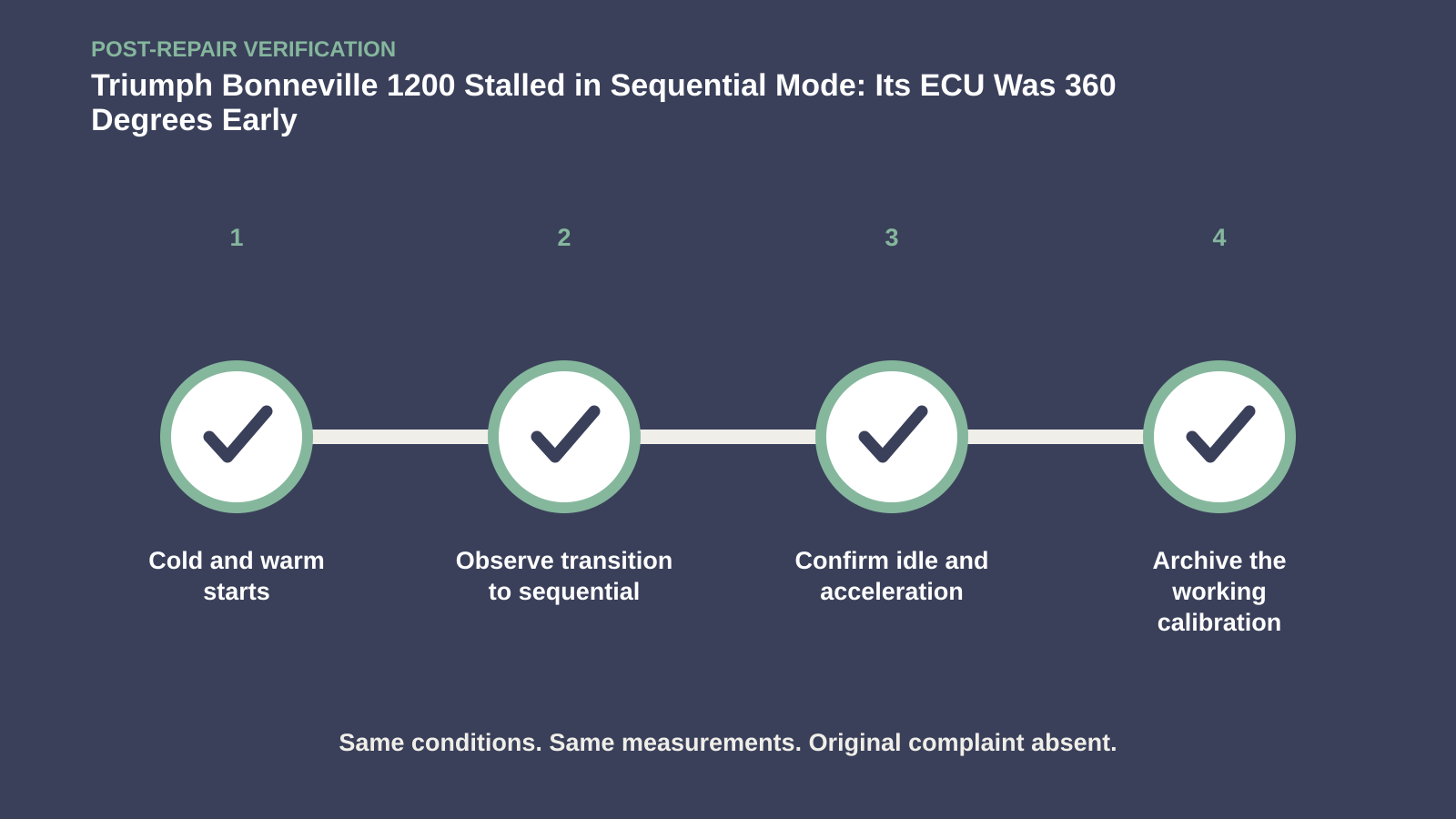
The post-change capture looked logically better, but the rider needs a machine that behaves beyond one workshop moment. Repeat cold and warm starts, observe the exact batch-to-sequential transition, and hold several stable idle conditions. Then increase rpm under controlled conditions, checking fuel pressure, mixture, knock protection and charging voltage as the ECU map requires. The mature case reported that the motorcycle started, idled and accelerated after minor timing and fueling adjustments, providing the functional close that the original stalling transition lacked.
Verify start, idle, transition and acceleration
Archive the working map, software version, coupling-angle definition and annotated waveform together. Future edits should change one variable at a time and retain a rollback. Verify that throttle return, kill switch, cooling and other safety functions remain normal before road use. The durable lesson is not “add 360” whenever a custom twin stalls. It is to place every fuel and spark event on a mechanical cycle, then correct the definition that is demonstrably one revolution out.
Once the engine was drawn as a 720-degree calendar, the fault became readable: sequential control was punctual on the wrong day. The waveform did not tune the motorcycle by itself; it made the calibration error visible enough to change responsibly.









Comments 0
Questions, fixes, and real-world diagnostic notes from readers.
Be the first to share a diagnostic result or ask a follow-up question.