
Peugeot Partner ABS Light Returned After Clearing: P1536 Led to the Brake Pedal Switch

Abs Light Returns? Follow The Code That Returns
The Peugeot Partner drove normally, but its ABS and brake warning stayed on. The first scan contained P1536, P2562 and P1497—enough codes to invite three separate repairs. A disciplined clear and retest did something more useful: only P1536 returned with the warning, allowing the workshop to follow the fault that was happening now while preserving the other two as history.
When Peugeot wiring identifies the brake-switch pins, backprobe leads can let a compatible meter observe the circuit without piercing insulation. The AUTOOL 92-Piece Circuit Test Lead Kit is one option for that connection layer. The 92-piece lead kit can help a compatible meter backprobe an identified switch circuit without cutting insulation. It does not read P1536, supply Peugeot wiring data or prove switch plausibility without scan data and the correct test procedure.
P1536 returned after the initial code clear and was described in the case as a brake-pedal travel or coherence fault. The related wiring passed its checks, and service information directed attention to the pedal switch. Replacement kept the warning off during road test and left the rescan clean. The two engine-related codes did not return and were reported as advisory items rather than repaired by guesswork.
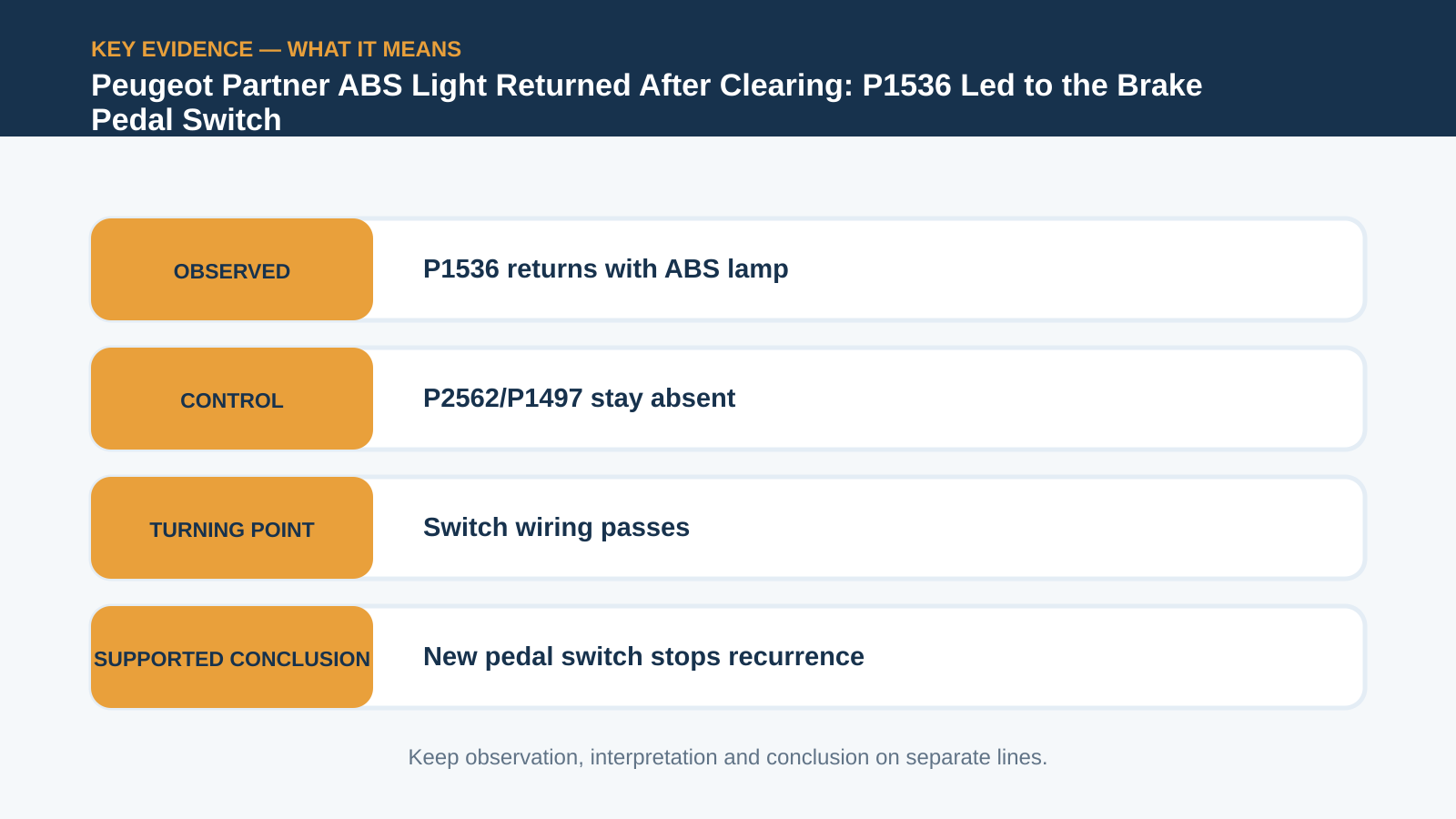
Quick answer: Only P1536 returned after a controlled clear. Switch wiring passed, a new brake-pedal switch kept the ABS lamp off, and two history codes stayed absent.
In this guide
- Record all three codes before the first clear
- Let one controlled clear separate now from before
- Translate P1536 with Peugeot information
- Compare pedal movement with switch state
- Test the wiring without damaging it
- Replace the switch after the circuit passes
- Road-test the warning under real pedal use
- Report the two codes that did not return
Record all three codes before the first clear
Photograph the warning state and save every code with module, status and description before clearing. Ask when the lamp became permanent and whether brake lamps, cruise control or engine response changed. Confirm brake-fluid level and basic brake operation; an ABS lamp should not postpone a physical safety inspection. P1536 wording varies by tool and vehicle configuration, so preserve the numeric code and originating module rather than trusting a generic sentence detached from Peugeot information.
Let one controlled clear separate now from before
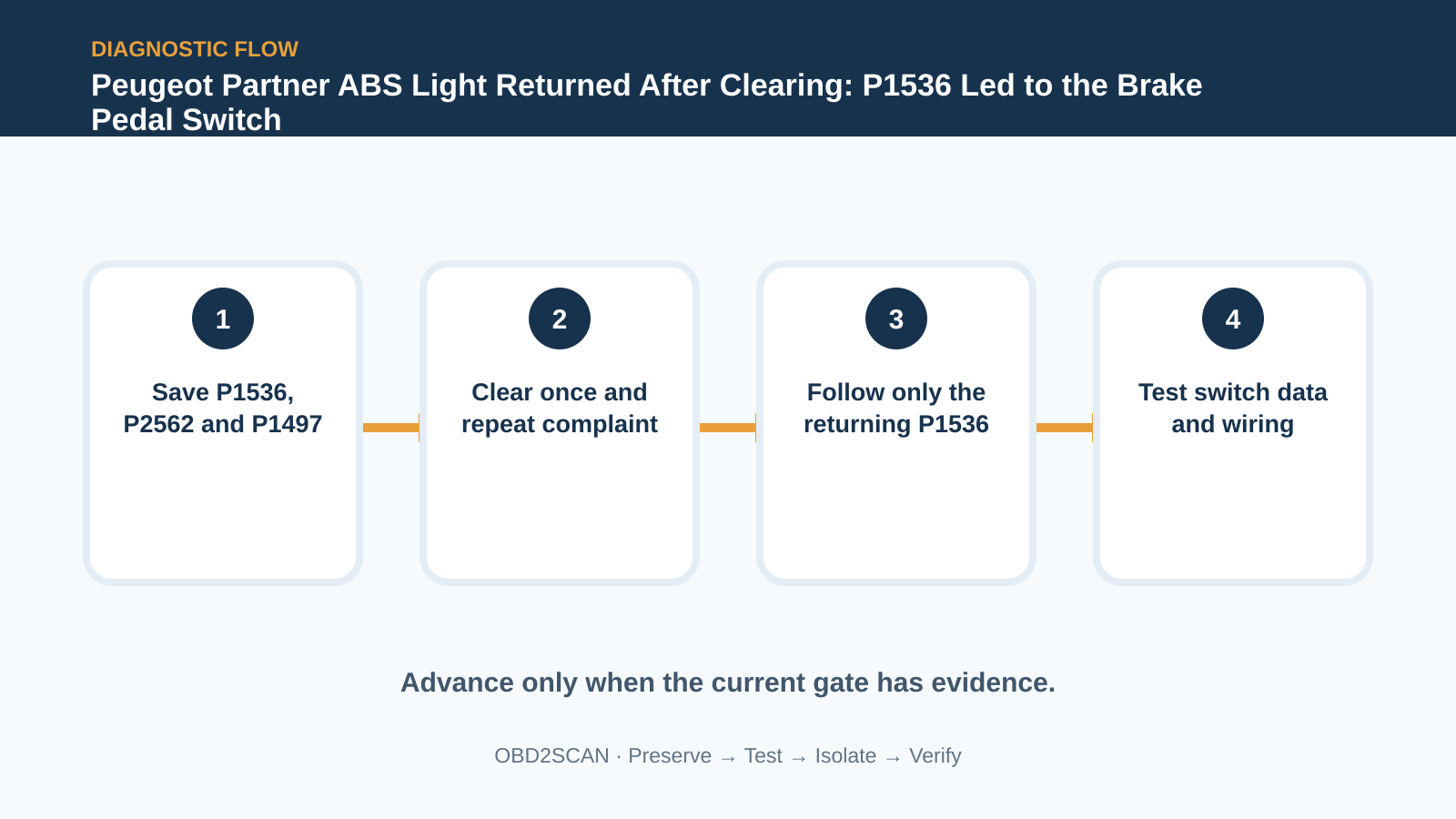
One controlled clear is useful only after the evidence is saved. Cycle the ignition, operate the pedal and perform a short safe drive while watching which fault returns. Here, P1536 came back and the ABS warning reappeared, while P2562 and P1497 did not. That separates a current reproducible concern from stored events. It does not prove the other systems are perfect, but it prevents non-returning history from expanding the present job without customer authorization.
Translate P1536 with Peugeot information
Use the exact model, year, engine and ABS configuration to interpret P1536. The case’s information linked it to brake-pedal travel or signal coherence and directed the technician toward the switch. Check whether the vehicle uses one contact, redundant contacts or a learned pedal state. Compare live data with the physical brake lamps and pedal movement. A value that changes can still switch at the wrong point or disagree with its companion channel.
Compare pedal movement with switch state
Operate the pedal slowly while graphing both switch states if the scan platform supports it. Look for simultaneous transitions where the specification requires staggering, chatter near the rest position or a state that lags release. Confirm switch adjustment and pedal return before condemning the electrical part. Floor mats, pedal-box damage or a binding linkage can create a real coherence issue with a healthy switch. Record the failure several times instead of judging one press.
Test the wiring without damaging it
Test supply, ground and signal at the switch using the Peugeot diagram. Backprobe with the connector assembled where possible; piercing insulation can introduce future corrosion. Check voltage drop and continuity through the full pedal range, and gently move the harness. If the wiring is stable from switch to controller and live data still becomes incoherent, the switch or its adjustment is supported. A test-lead kit improves access, but the wiring diagram and expected states give the readings meaning.
| Code or test | After controlled retest | Action |
|---|---|---|
| P1536 | Returns with ABS warning | Continue brake-switch/coherence diagnosis |
| P2562 | Does not return | Preserve as history; advise if appropriate |
| P1497 | Does not return | Preserve as history; do not invent a repair |
| Switch wiring | Passes checks | Switch/adjustment becomes the supported branch |
Replace the switch after the circuit passes
Fit the correct switch and follow any self-adjusting installation sequence. Some brake switches can be damaged or mis-set if the plunger is handled incorrectly. Confirm the pedal rests fully, lamps extinguish promptly and both data states agree before driving. Do not use an ABS warning as the only indication that the new switch was installed correctly; the brake lamps are a direct safety function and must be checked independently.
Road-test the warning under real pedal use
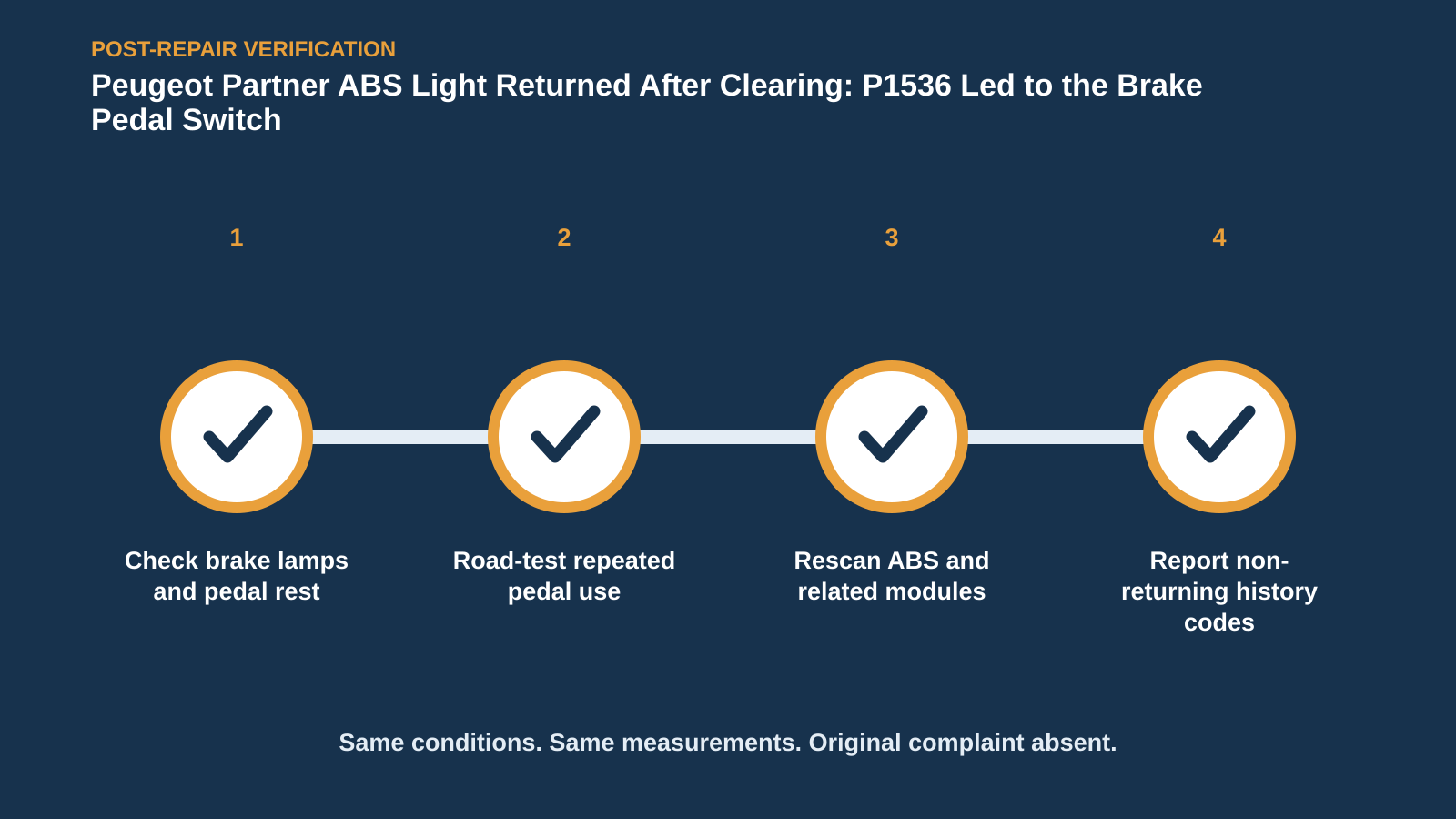
Road-test over a route that includes repeated light and firm pedal applications and, where safe, the conditions that previously returned the lamp. The warning remained off in the documented case. Rescan the ABS and related modules, looking for current or pending P1536. Verify cruise control or start interlocks if they share the signal. A lamp that stays off in the bay is weaker evidence than consistent pedal data through an actual drive.
Report the two codes that did not return
Tell the owner that P2562 and P1497 were present initially but did not return during this visit. Preserve the original report and explain what symptom would justify reopening those branches. This is not ignoring codes; it is respecting their status. The completed repair addressed the current ABS complaint, proved the switch result and avoided billing the driver for turbo or emissions work that the vehicle did not presently support.
The useful skill was not clearing codes; it was knowing what to do with their return status. Following P1536 while documenting the two non-returning records kept the repair small, verifiable and fair to the owner.




Comments 0
Questions, fixes, and real-world diagnostic notes from readers.
Be the first to share a diagnostic result or ask a follow-up question.