
CAT 308E Misfire Looked Like an Injector: A Broken Intake Rocker Changed the Case

Even Compression, Broken Rocker
The owner of a CAT 308E was told it needed all four injectors. A second opinion used relative compression, rail pressure and exhaust pulse—and still started leaning toward an injector on cylinder one. Then repair access revealed a broken intake rocker. The valuable part of this case is not that a technician was wrong; it is why reasonable-looking data failed to expose a one-of-two-valve problem.
Once the evidence justifies safe mechanical access, an articulating inspection camera can document restricted valvetrain areas. The MRCARTOOL N180 is one such visual aid. N180 can document accessible valvetrain or cylinder areas only after safe access and cooldown. It cannot see through a closed rocker cover, measure airflow pulses or prove a running misfire from an image alone.
Cranking peaks looked even at about 172 rpm, while running exhaust pulses and small rail-pressure changes implicated cylinder one. This Kubota engine uses two intake valves per cylinder. One working valve admitted enough air at cranking speed to keep current peaks uniform, but not enough for clean combustion under running conditions. The broken rocker was physically confirmed; the mature source did not publish the completed repair or a post-repair trace.
Quick answer: Even relative compression did not clear the valvetrain: one of two intake valves still opened. A broken cylinder-one rocker explained the misfire and black smoke.
In this guide
- A second opinion should restart the diagnosis
- Read relative compression with engine design in mind
- Add intake or exhaust movement to the crank test
- Use cylinder identity before ordering a part
- Why the rail trace pointed the wrong way
- The broken rocker explains the contradiction
- Define the repair inspection before assembly
- Leave the case open until the same tests pass
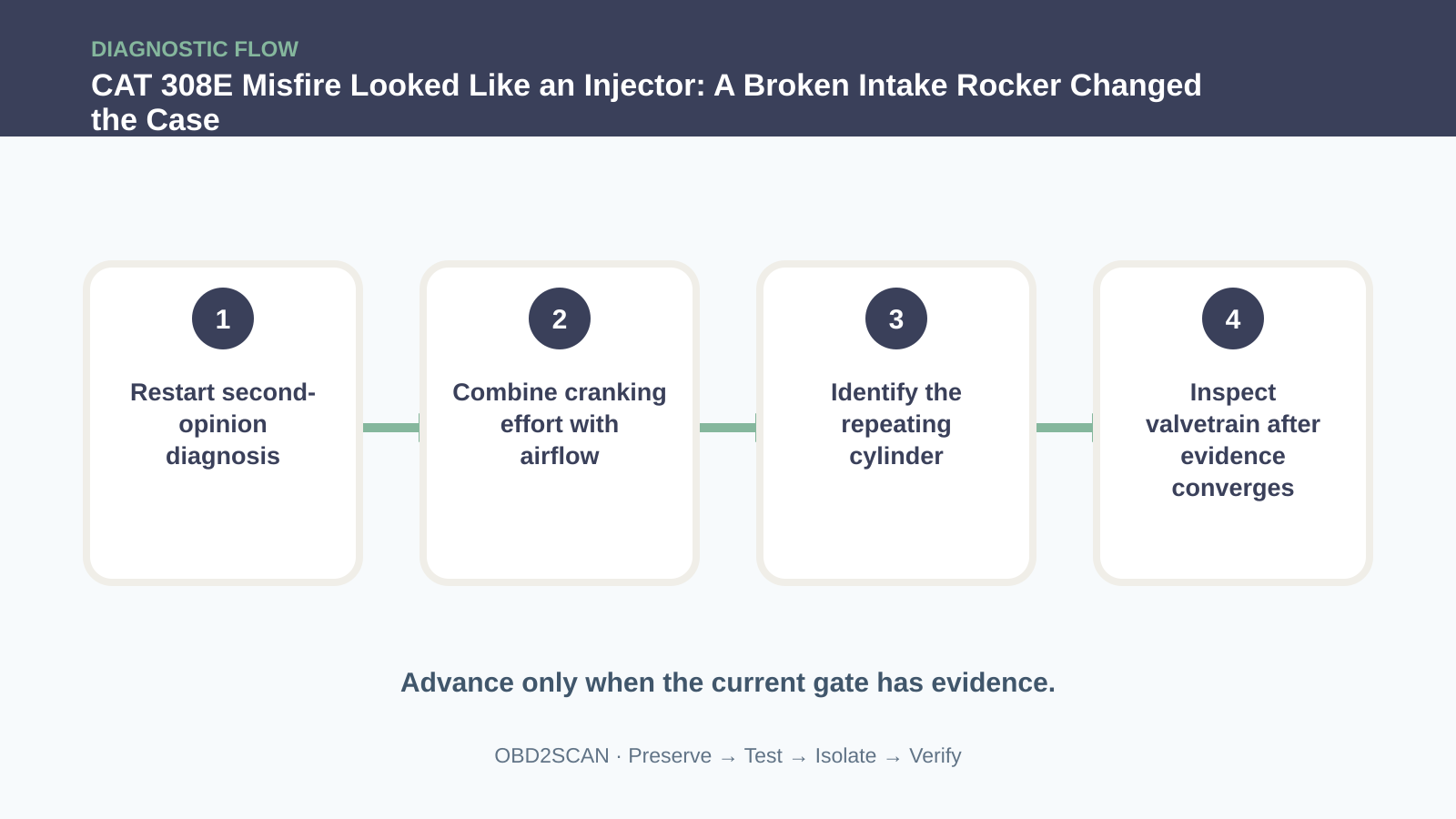
A second opinion should restart the diagnosis
A second opinion should begin before the first diagnosis, not after it. Record the black-smoke and misfire conditions, engine temperature, load and previous recommendation, then ask what observation originally supported four injectors. Do not treat the quoted repair cost as technical evidence. Check fluid levels and listen for valvetrain noise without prolonged loaded operation. Because the machine must be secured before covers are removed, plan non-intrusive tests first and preserve the owner’s need for a useful decision: which system is failing, and how certain is the part call?
Read relative compression with engine design in mind
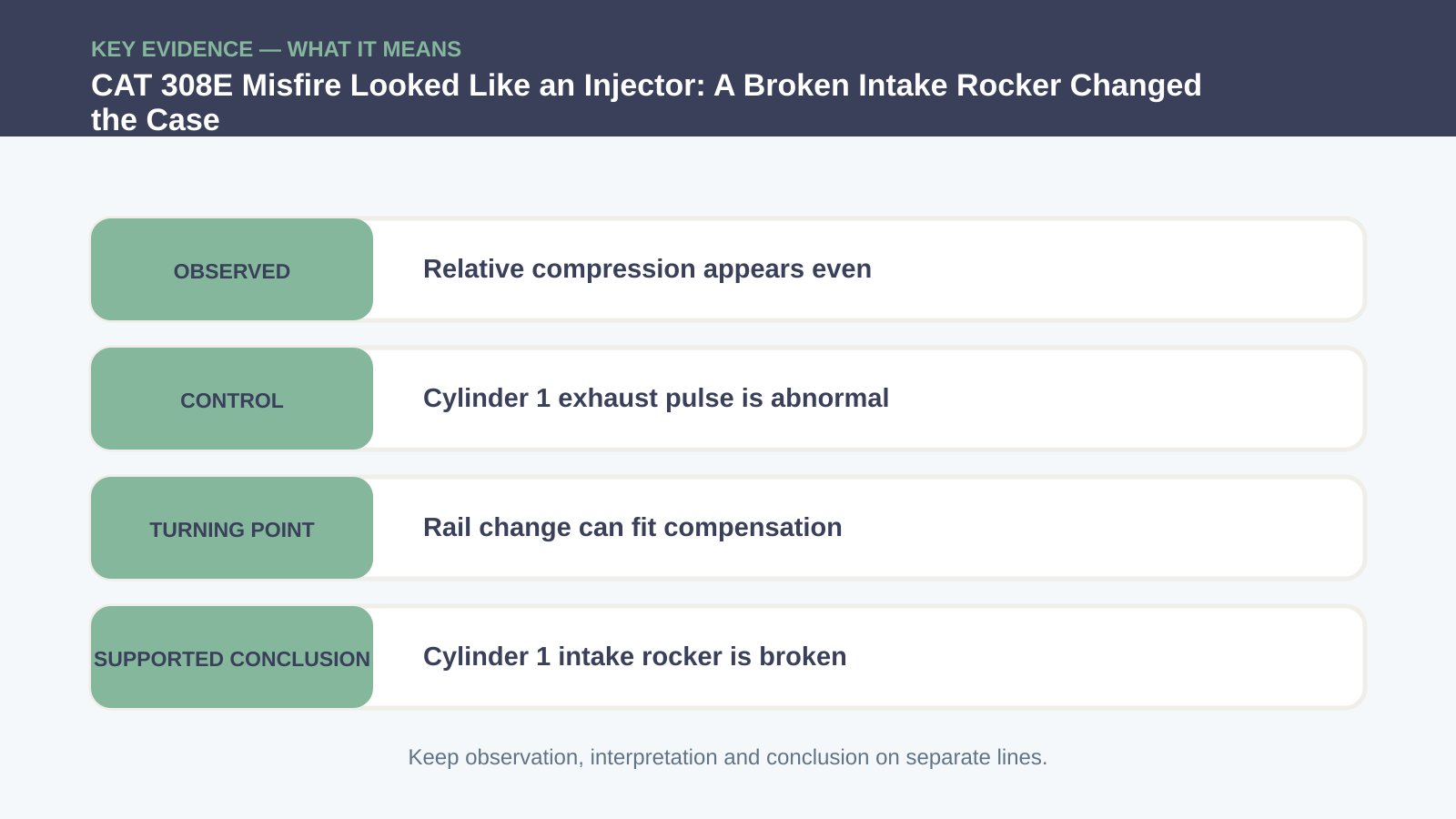
Relative compression showed even starter-current peaks. Cranking speed was about 172 rpm and peak draw around 700 amps in cold December conditions. Uniform peaks mean the cylinders required broadly similar cranking effort; they do not guarantee normal breathing through every valve. Compare the waveform with temperature and battery condition, and avoid using a cold high-current value as a starter verdict without a warm control. Most importantly, identify the engine’s valve arrangement before deciding what one balanced crank trace can exclude.
Add intake or exhaust movement to the crank test
The stronger opening test would have combined relative compression with intake or exhaust pulsation and cylinder identity. An engine is an air pump while cranking. If one of two intake valves stays closed, peak compression may remain similar while the volume and timing of airflow change. A multi-channel test can therefore expose the disagreement earlier: balanced effort but abnormal gas movement. This is a principle, not a promise that every broken rocker creates the same pulse shape; transducer placement and engine geometry matter.
Use cylinder identity before ordering a part
At idle, the exhaust trace repeated an abnormal event aligned with cylinder one. A small rail-pressure drop also differed around cylinders one and four, which made fuel delivery seem plausible. Cylinder identification should come from a trusted cam, injector-current or other reference plus the verified firing order. Do not number the cylinder from screen position alone. Once the same event is tied to one cylinder, compare fuel command, pressure effect and airflow before ordering an injector.
Why the rail trace pointed the wrong way
Rail-pressure derivative data can reveal small injection events, but it does not directly measure fuel leaving each nozzle. A weak pressure change may reflect command, leakage, compensation or a cylinder that cannot use the delivered fuel normally. Here, the trace fit the earlier injector narrative well enough that one injector was ordered. That is exactly why independent evidence matters. When a result can be both cause and response, make another physical system answer before committing to an expensive part.
| Evidence | Initial reading | Better interpretation after inspection |
|---|---|---|
| Even relative compression | Mechanical condition seems uniform | One remaining intake valve can mask lost lift at cranking speed |
| Uneven exhaust pulse | Cylinder contribution is abnormal | Airflow as well as fuel can create it |
| Small rail-pressure deviation | Injector fault is possible | Compensation can follow poor combustion |
| Broken cylinder-one rocker | Physical intake-lift failure | Explains black smoke and running misfire |
The broken rocker explains the contradiction
The broken intake rocker reconciled the contradiction. This four-valve-per-cylinder design still opened the second intake valve, admitting enough air for comparable cranking resistance. At running speed, however, the restricted intake flow left cylinder one short of oxygen, producing incomplete combustion, black smoke and a repeating exhaust disturbance. The lesson is model-specific in mechanism but broadly useful in method: a normal aggregate test may miss a partial failure inside a duplicated path.
Define the repair inspection before assembly
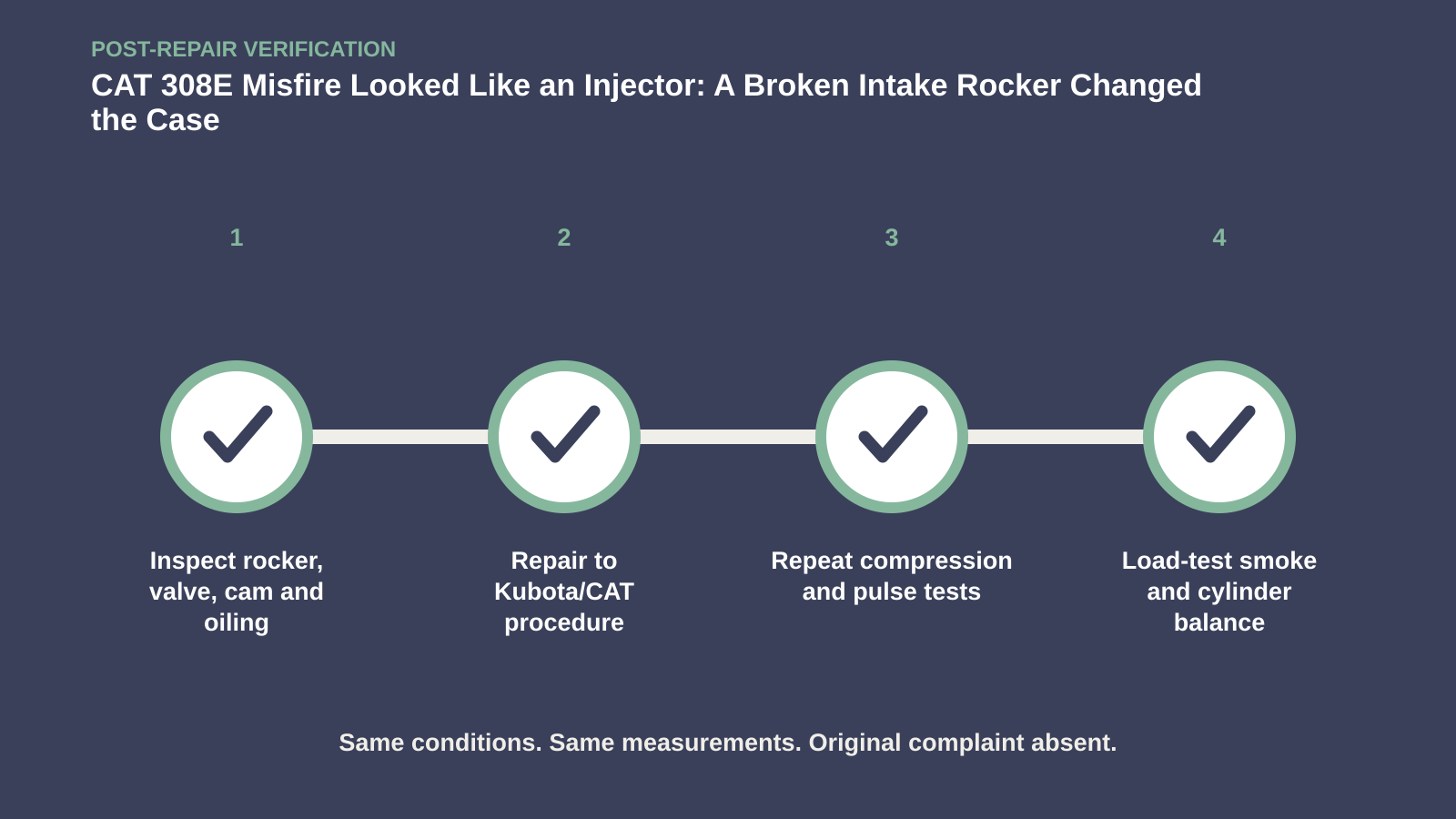
A responsible repair plan would inspect the broken rocker, shaft or pivot, cam lobe, valve tip, lash components and oil supply before fitting a replacement. Determine why it fractured and confirm the valve moves freely. Follow CAT/Kubota torque and clearance data, replace contaminated oil or damaged related parts as required, and turn the engine by hand under the official procedure before starting. An inspection camera can document inaccessible surfaces, but it cannot substitute for measured lift and clearance.
Leave the case open until the same tests pass
The published account ends at discovery, so the article must not claim the excavator returned to service. Closure would require repeating relative compression plus intake/exhaust pulse, checking cylinder balance and smoke at idle and under an approved load, and confirming valve clearance after the specified run-in. If the rail-pressure anomaly remained, the injector branch would reopen. The honest endpoint is a confirmed broken rocker and a defined verification plan—not a fictional successful repair.
The even compression trace was not useless; it answered a narrower question than everyone first assumed. Adding engine architecture and airflow evidence explains the miss—and keeps a valuable diagnostic correction from becoming another oversimplified rule.






Comments 0
Questions, fixes, and real-world diagnostic notes from readers.
Be the first to share a diagnostic result or ask a follow-up question.