
Porsche Cayenne Hybrid Felt Like a Misfire at 1,200 RPM: The Clutch Damper Was Shaking

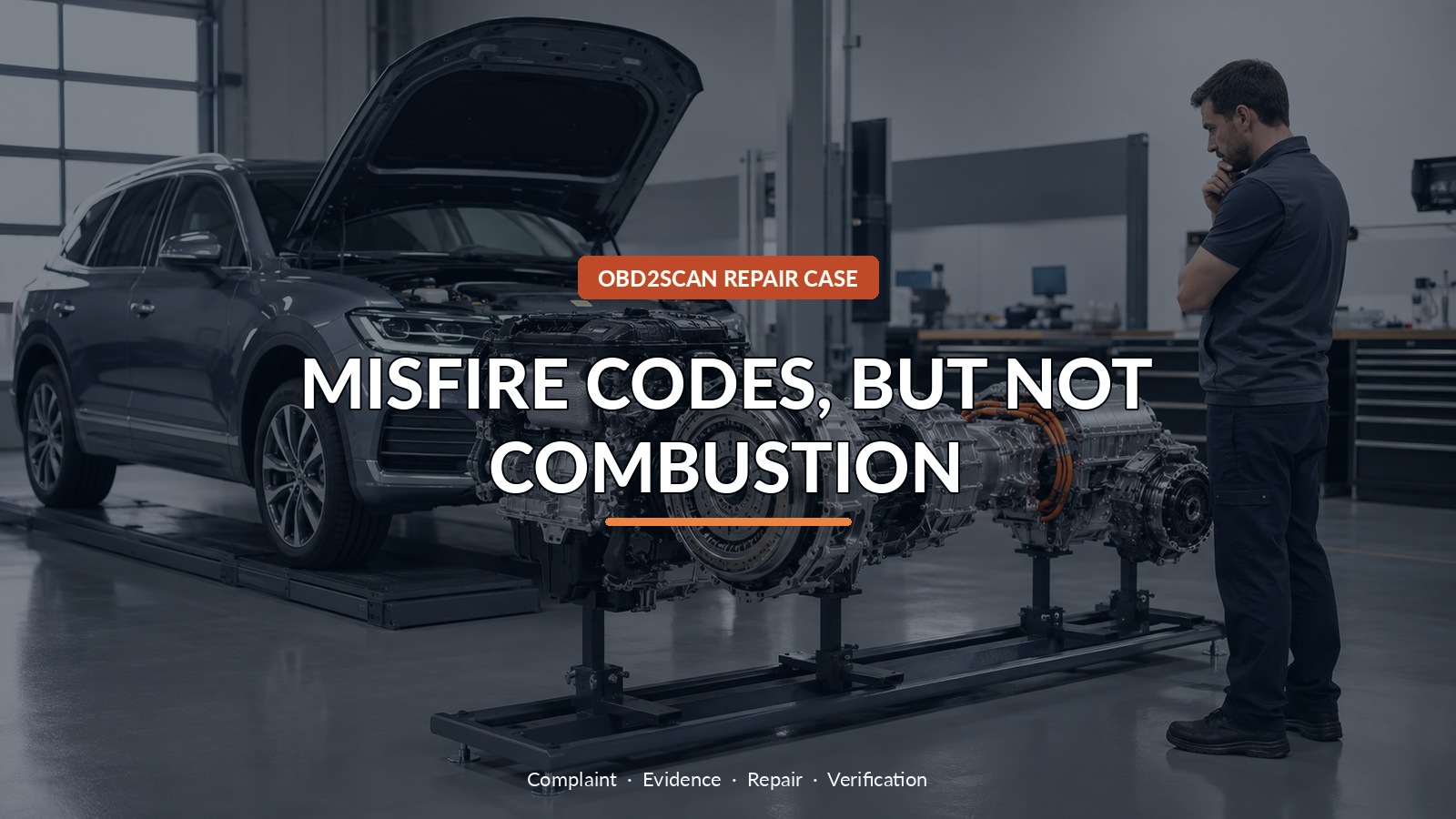
Misfire Codes, But Not Combustion
A Porsche Cayenne V6 hybrid developed an intermittent rumble-strip sensation around 1,200 rpm. Its warning history included random and all-cylinder misfire DTCs, so a combustion repair would have sounded reasonable. Yet the event arrived near zero torque, felt mechanical and did not behave like six cylinders failing independently. The decisive question became: where in the rotating system did speed first become uneven?
An automotive meter/scope is useful here only for a bounded first look at an approved, accessible low-voltage speed or position signal. The AUTOOL DM303 is one such route for checking signal presence and basic shape before specialist testing. DM303 can support an accessible low-voltage speed or position signal check only at Porsche-approved points and within its channel limits; it cannot make the high-voltage hybrid system safe, perform the multi-signal phase analysis used here, condemn a hybrid clutch or replace Porsche workshop procedures.
This was a localization case, not a code-clearing exercise. The engine controller called the rotational disturbance a misfire because that is what its speed analysis could see. Synchronized measurements across the engine, electric machine and transmission showed the disturbance crossing the hybrid-clutch interface. The failed part was the clutch damping plate, not six ignition or fueling components.
Quick answer: All-cylinder misfire codes described rotational disturbance, not combustion failure. Phase evidence localized the rumble to a failed hybrid-clutch damping plate.
In this guide
- Reproduce the narrow 1,200-rpm window
- Ask whether torque changes the vibration
- Do not let all-cylinder codes condemn six cylinders
- Map every rotating speed signal in order
- Find where phase disturbance first appears
- Stop at the hybrid high-voltage boundary
- Inspect and replace the failed damping assembly
- Repeat the same low-torque transition after repair
Reproduce the narrow 1,200-rpm window
A useful road test must hold the complaint still. Record engine speed, vehicle speed, accelerator position, requested and actual torque, gear, engine-on state and battery state. In this case the narrow window near 1,200 rpm mattered more than a generic description such as ‘vibrates while driving.’ Have a second qualified person operate the recording equipment; the driver should not watch graphs. If the vibration becomes severe, any drivetrain warning turns red or the vehicle loses predictable propulsion, stop the test and arrange professional recovery.
Ask whether torque changes the vibration
Load direction separates many look-alike vibrations. Does the rumble appear while the engine drives the wheels, while the electric machine changes state, during regenerative torque, or as torque crosses zero? A combustion misfire commonly reacts to cylinder load, while a coupling or damper may reveal itself during a narrow transition. Repeat only the minimum safe combinations needed. The aim is not to provoke damage; it is to identify the state that switches the event on and off. That state becomes the reference for every later capture.
Do not let all-cylinder codes condemn six cylinders
A misfire monitor infers combustion quality from crankshaft acceleration. Anything that perturbs rotational speed can influence that judgment. All-cylinder or random codes therefore deserve a basic combustion screen—fuel quality, obvious intake faults, ignition where applicable and cylinder balance—but they do not authorize six coils, injectors or mechanical repairs. When the driver feels a coherent rumble and the counters rise together, ask whether the monitor is observing motion transmitted from another component. The code describes a detected effect; it does not locate the source.
Map every rotating speed signal in order
Map the rotating chain in physical order: combustion crankshaft, hybrid separation clutch, electric machine and transmission input/output. The mature diagnostic route observed several speed signals at the same instant so phase and disturbance could be compared. A single trace can show that a signal exists; it cannot reveal where a disturbance starts across three assemblies. This is also a strict high-voltage boundary. Removing covers, disabling interlocks or probing orange-cable areas requires trained personnel, current Porsche information and approved safety equipment.
| Observation | Most useful interpretation | Premature conclusion to avoid |
|---|---|---|
| Rumble near 1,200 rpm | Preserve a narrow reproduction window | Engine mounts are definitely bad |
| Misfire counts on many cylinders | Crank speed is fluctuating | Six combustion faults occurred together |
| Event near zero torque | Inspect transition and damping behavior | No load means no mechanical stress |
| Disturbance changes across clutch interface | Localizes the source/path | Any one speed signal condemns the clutch |
Find where phase disturbance first appears
With the captures aligned, compare not only amplitude but when each speed trace changes. If the engine signal is relatively orderly before a coupling and the downstream relationship becomes irregular at that interface—or the pattern reverses with torque direction—the coupling deserves priority. Specialists may combine frequency, phase and rotational-order analysis to avoid mistaking a response point for a source. A handheld scope is not an equivalent substitute. The value of this step is its ability to justify major disassembly with evidence instead of with the location where the driver feels the shake.
Stop at the hybrid high-voltage boundary
Hybrid drivetrain work contains stored energy, heavy components and precise alignment requirements. Once the measurements localized the fault, the safe next step was workshop disassembly under Porsche procedure. Inspection confirmed damage in the clutch damping plate. That physical finding connected the measured rotational behavior to a component capable of producing it. Wear elsewhere should be documented, but the repair scope should not expand merely because the drivetrain is open. Replace the confirmed assembly and all one-time-use hardware specified by the manufacturer.
Inspect and replace the failed damping assembly
Installation is not the end of the diagnostic argument. Complete required adaptations or commissioning, restore all high-voltage safety systems and check for leaks or abnormal noises before a road test. A repair that removes a vibration but creates a hybrid isolation, cooling or calibration fault has not passed. Preserve the pre-repair capture and use the same channels, sample rate and trigger for the after-capture where possible. Without matched conditions, a smoother drive remains encouraging but not comparable evidence.
Repeat the same low-torque transition after repair
To verify the repair, return to the original low-torque, 1,200-rpm transition and repeat it in both torque directions. Confirm the rumble-strip sensation is absent, the rotational relationship remains stable and misfire counters no longer climb. Then check ordinary combustion quality so the mechanical diagnosis does not conceal a real cylinder issue. Scan every relevant control unit rather than only the engine ECU. A clean drive, clean hybrid transition and clean rescan together are stronger than any one result.
The Cayenne did not have imaginary data; it had data interpreted too narrowly. Misfire logic saw uneven rotation. Phase and frequency work located the reason—a failed clutch damper outside the combustion chambers.







Comments 0
Questions, fixes, and real-world diagnostic notes from readers.
Be the first to share a diagnostic result or ask a follow-up question.