
Tesla Roadster ABS and TC Lights: One Rear Hub Disabled More Than ABS

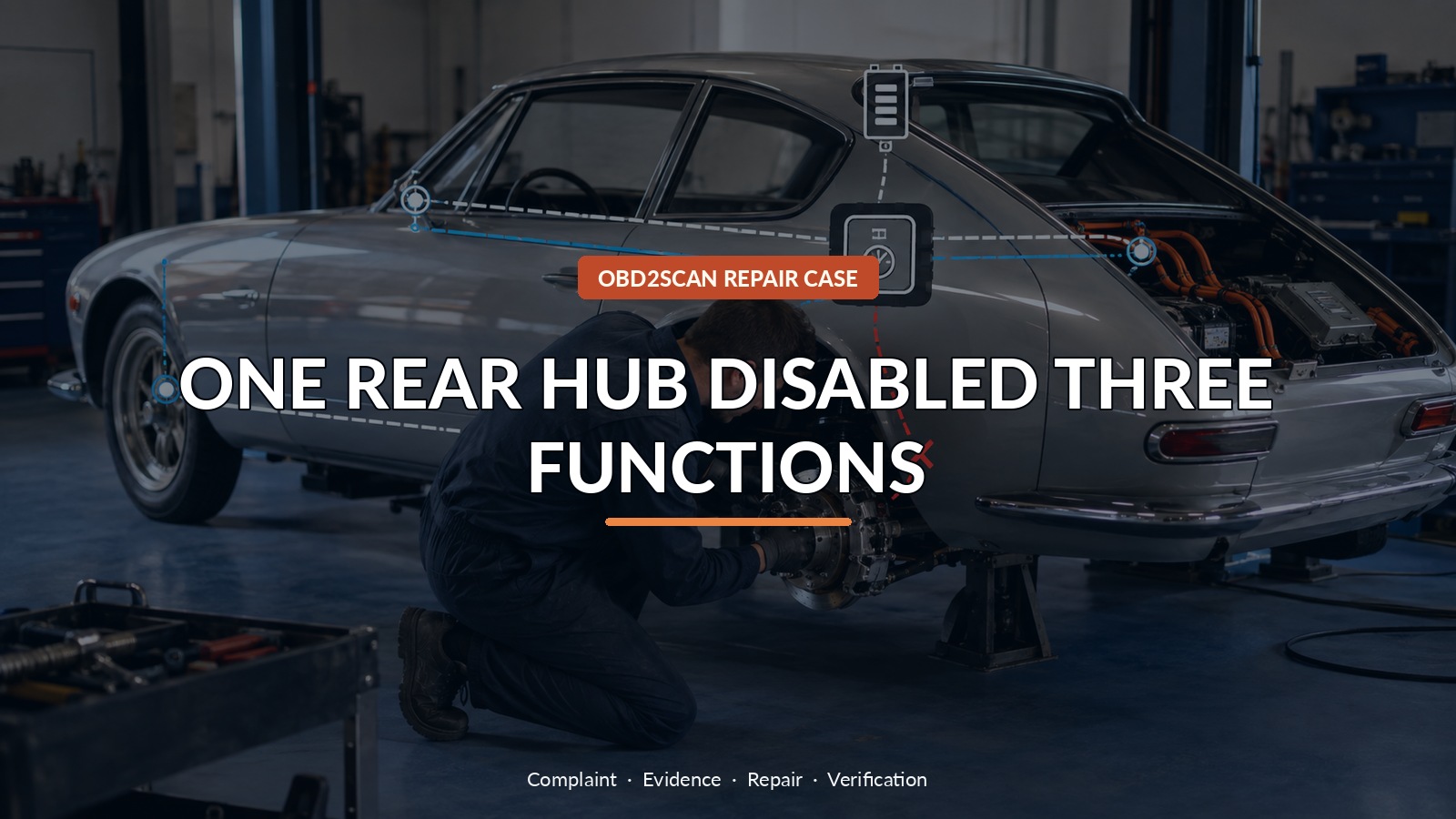
One Rear Hub Disabled Three Functions
On this early Tesla Roadster, one rear wheel-speed failure did more than illuminate ABS and traction-control lamps. It also removed regenerative braking because several systems no longer trusted vehicle-speed information. Comparing the right-rear input with the other three wheels led to the pickup integrated in the hub, and hub replacement restored all three functions.
For accessible low-voltage sensor wiring, a MRCARTOOL B550 can help a qualified technician check the identified feed, ground, or signal path after the Roadster diagram is in hand. B550 can support accessible low-voltage power, ground and sensor-circuit checks after Roadster service data identifies the pins; it cannot make the high-voltage system safe, interpret every wheel-speed architecture or prove an integrated magnetic pickup is defective from resistance alone.
This is a systems-dependency story for an older EV, not a generic instruction to replace a hub whenever regeneration disappears. Until diagnosis is complete, drive as if ABS, traction control, and regenerative deceleration are unavailable; the friction brakes may have to do more work than the driver expects.
Quick answer: One missing right-rear wheel-speed input disabled ABS-related functions, traction control, and regeneration. The integrated hub pickup was confirmed and hub replacement restored all three.
In this guide
- Drive as though ABS, TC and regeneration are unavailable
- Map the three lost functions to shared speed data
- Save all four wheel-speed states
- Challenge the right-rear input safely
- Separate wiring from the integrated pickup
- Replace the hub only after the signal path fails
- Restore the system state without touching high voltage
- Road-test braking, traction control and regeneration together
Drive as though ABS, TC and regeneration are unavailable
If the warnings appear on every drive, photograph them once while stationary and note exactly when they set. Confirm whether the brake pedal feels normal, whether regenerative deceleration disappears, and whether traction control is unavailable. Increase following distance, avoid slippery roads and aggressive acceleration, and arrange transport if braking feels abnormal. The car’s high-voltage propulsion system and low-voltage chassis electronics interact, but only trained EV personnel should isolate or access high-voltage areas. Wheel-speed diagnosis should not require casual contact with orange cables.
Map the three lost functions to shared speed data
ABS uses wheel-speed differences to control lockup; traction control uses them to recognize slip; regenerative braking needs credible speed and stability context before applying motor braking. That explains why three driver-visible functions can fall together without three independent failures. Save a complete scan, not only the ABS code. Check 12-volt system condition and network health, because several missing modules or implausible speeds may point to a shared power or communication problem rather than one wheel.
Save all four wheel-speed states
View all four wheel speeds on a lift or during a controlled low-speed test as the service procedure permits. Look for a channel that stays at zero, drops out, reads a different direction, or becomes noisy at a repeatable speed. Compare raw signal where accessible rather than relying only on a processed scan value. In this case the right rear failed to create the same system response as the other wheels. Three matching channels form a useful control group, but tire-size mismatch and wheel movement must still be excluded.
| Driver notices | Shared information to verify |
|---|---|
| ABS warning | Reliable individual wheel speeds |
| Traction control unavailable | Wheel-speed agreement and vehicle motion |
| Regenerative braking reduced or absent | Credible speed/stability state before motor braking |
| Several wheel channels fail | Shared power, network, or controller before four hubs |
Challenge the right-rear input safely
Challenge the suspected corner without swapping random parts. Inspect the sensor connector, routing, chafe points, terminal condition, bearing play, debris, and damage from prior hub or suspension work. Rotate the wheel at a consistent speed and compare signal amplitude and pattern. An active sensor may need power and ground; a passive design behaves differently. Use the exact architecture before applying a resistance test. A resistance value that looks plausible cannot clear a damaged magnetic encoder or an intermittent connection under movement.
Separate wiring from the integrated pickup
Divide the path at the most accessible connector. If a correct signal exists at the hub but disappears at the controller, test the harness under movement and load. If supply and ground reach an active sensor yet no corresponding output leaves the hub, the pickup side becomes credible. The Roadster’s pickup was integrated into the hub assembly, so it was not a separate bolt-on sensor decision. Confirm that architecture by VIN and parts data; later Tesla models and other vehicles may package wheel-speed components differently.
Replace the hub only after the signal path fails
Replace the right-rear hub using the correct lifting, axle, bearing, fastener, and torque procedure. Inspect the tone or magnetic surface and keep contamination away from the new pickup. Route the harness with full suspension travel in mind. This repair should be performed without opening high-voltage components, but the vehicle’s EV workshop rules still apply. Before lowering, rotate the wheel and confirm a stable signal comparable with the other side. If the signal remains absent, stop and return to the harness and controller branch.
Restore the system state without touching high voltage
Clear saved faults only after the new signal has been seen. Cycle the car through its normal wake and drive states, then recheck all related modules. Some warnings may require wheel movement before self-testing completes. Do not infer that regeneration is safe to test simply because the lamps go out in the bay. Confirm brake-fluid and friction-brake condition if the car has been driven for an extended period without regenerative assistance, since the conventional brakes have carried the full deceleration load.
Road-test braking, traction control and regeneration together
Road-test in a controlled environment. Confirm all four wheel speeds rise and fall together, the ABS and TC lamps remain off, traction intervention is available under an approved low-risk test, and regenerative braking returns predictably. Repeat an ignition cycle and another drive because the original warning appeared on every outing. The documented Roadster passed those checks after hub replacement. The repair closes when the shared input and all affected functions work—not when a single DTC can be erased.
One missing wheel-speed input created a much larger experience than a conventional ABS lamp. Explaining that dependency helps the driver understand why regeneration changed and why the hub was not chosen from the warning alone. The durable workflow is to compare all four corners, separate wiring from the integrated pickup, replace only the failed architecture, and verify braking, traction, and regeneration as one connected system.


Comments 0
Questions, fixes, and real-world diagnostic notes from readers.
Be the first to share a diagnostic result or ask a follow-up question.