
VW Polo P0106 and P0172: The Timing-Chain Fault the Scan Tool Didn’t Name

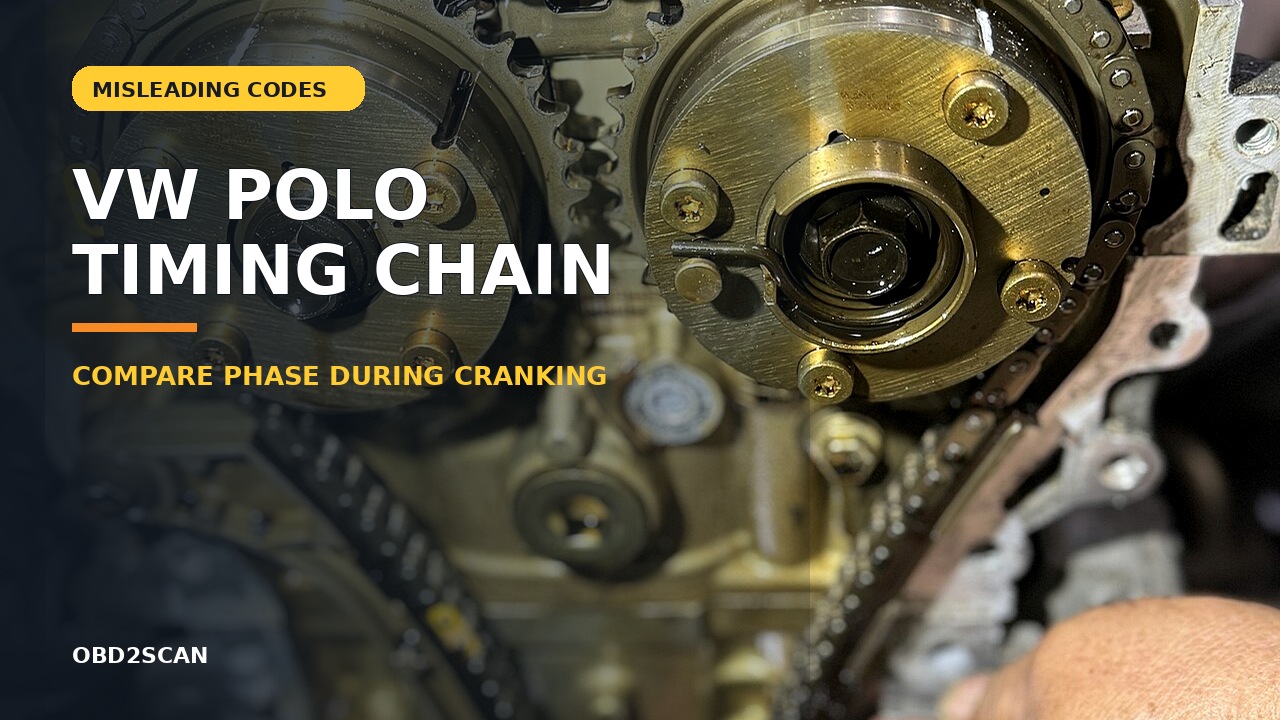
Bottom line: A three-cylinder Polo case where MAP contamination was real but dynamic cam/crank phase movement proved the remaining timing-chain fault.
In this case
- Case at a glance
- The answer: the chain moved dynamically even without a correlation code
- Treat P0106 and P0172 as measured effects
- Clean the contaminated MAP, then rerun the complaint
- Compare cam and crank under the condition that stresses the chain
- Use in-cylinder pressure before removing a head on conflicting compression
- Replace the worn set and verify the relationships
- The reusable lesson from misleading codes
- Minimum record to retain
Case at a glance
| Field | Case detail |
|---|---|
| Vehicle | Volkswagen Polo 1.2 three-cylinder |
| Complaint | Poor power, intermittent cutout and later long/lumpy cranking |
| Codes | P0106 MAP performance and P0172 rich |
| First real defect | MAP sensor tip contaminated; cleaning improved signal but not power |
| Decisive test | Cam/crank phase shifted about 3° running and moved about 9° during cranking |
| Repair | Timing-chain set replaced |
| Verification | Power restored and DTCs did not return |
The answer: the chain moved dynamically even without a correlation code
The contaminated MAP sensor was a genuine defect, but cleaning it did not restore power. The remaining fault was timing-chain wear and uncontrolled movement. Cam/crank comparison showed about a three-degree phase displacement while running and roughly nine degrees of movement during cranking. The ECU never named that mechanical instability with a dedicated correlation DTC.
Replacing the timing-chain set restored power and stopped P0106 and P0172 from returning. The case demonstrates why a corrected sensor can be a completed sub-repair and still not be the root cause of the customer complaint.
Evidence boundary: The numeric values in this article belong to the documented vehicle unless an official applicability statement says otherwise.
Treat P0106 and P0172 as measured effects
P0106 says manifold pressure behavior is implausible; P0172 says fuel control is removing fuel. Neither code promises the MAP sensor is the only fault. Incorrect valve timing changes cylinder filling, manifold pressure and oxygen feedback, so a mechanical fault can generate both system-level codes.
The code-to-system diagnostic workflow starts with freeze frame and live relationships. It does not turn a component name inside a code description into a purchase order.
Clean the contaminated MAP, then rerun the complaint
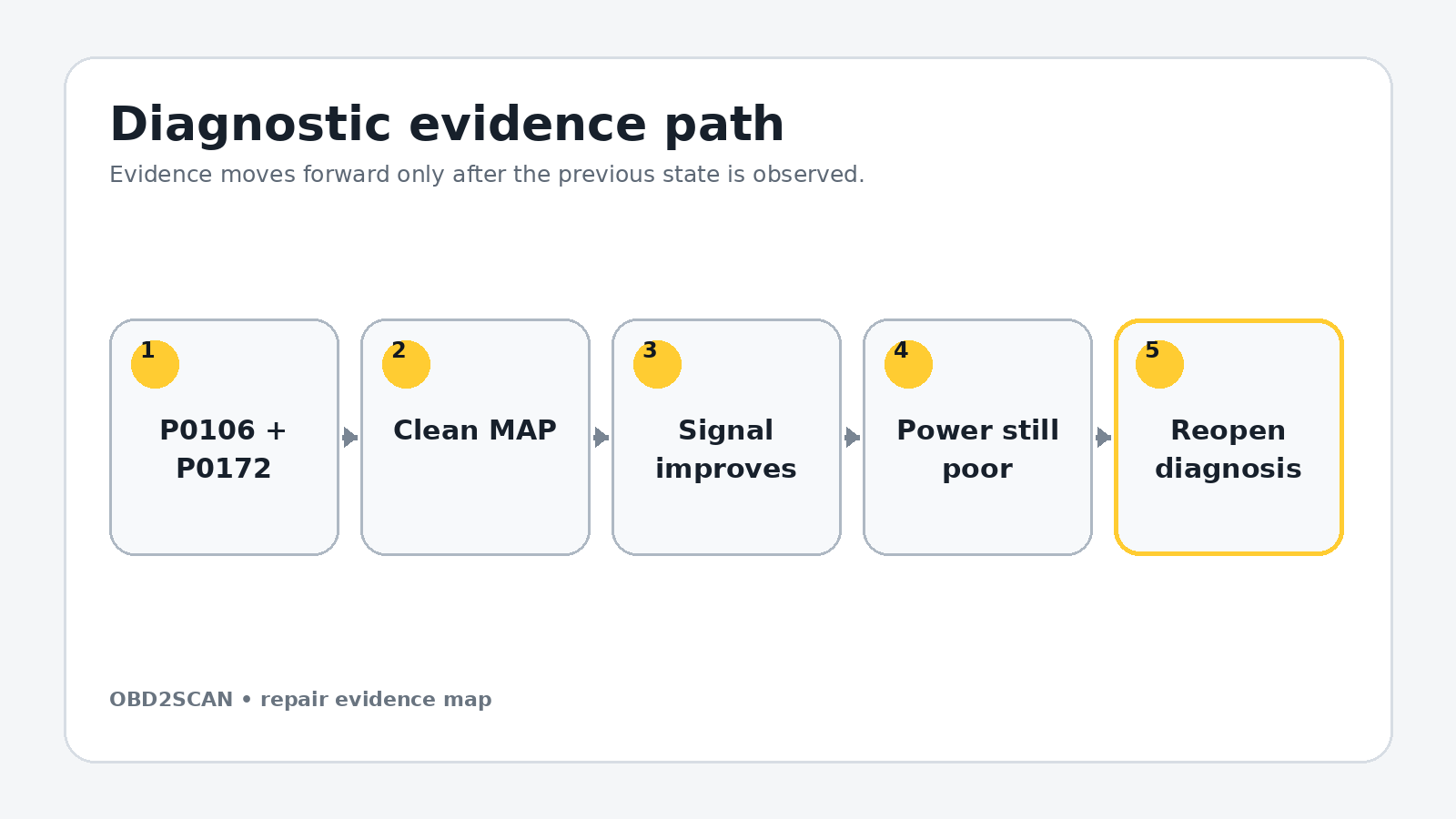
The MAP tip was visibly contaminated and its response improved after careful cleaning. That made cleaning worthwhile. The vehicle still lacked power, so the test outcome was “sensor condition improved; customer complaint remains.”
Every intermediate repair needs its own acceptance test. If power, cranking quality or trims do not normalize, preserve the new baseline and continue. Do not undo a valid correction just because it was not the only correction.
Compare cam and crank under the condition that stresses the chain
A static timing check can show that the chain has not skipped a whole tooth while missing backlash, tensioner delay and whip. Simultaneous cam and crank signals revealed a displaced running relationship and much larger phase motion during cranking, when speed was low and chain control weakest.
Overlay the suspect capture with a known-good waveform from the same engine and acquisition setup. Marker choice, polarity and scaling must match. A few degrees quoted from another engine are not a universal reject limit; the abnormal movement and comparison are the evidence.
Safety boundary: Use current vehicle-specific service information, approved support and the correct test load before opening a circuit or assembly.
Use in-cylinder pressure before removing a head on conflicting compression
Diagnostic handling allowed hydraulic lifters to lose and regain their working state, producing compression readings that could have pushed the repair toward an unnecessary cylinder-head removal. In-cylinder pressure analysis showed how valve events and trapped pressure were changing.
The mechanical branch in the mechanical-integrity misfire workflow uses compression as a beginning. Leakage location, valve-event timing and repeatability decide whether the head truly needs to come off.
Replace the worn set and verify the relationships
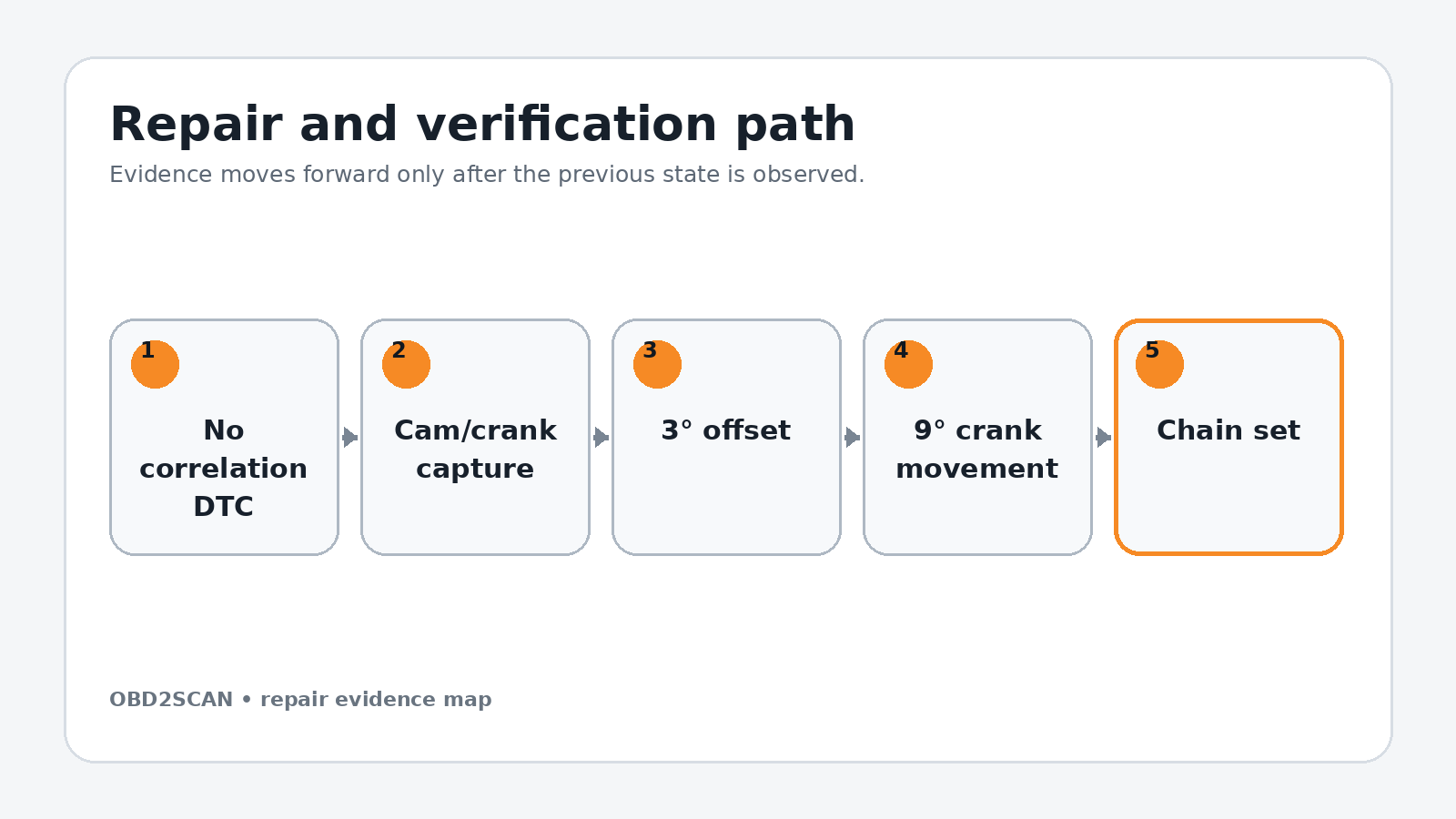
Chain service includes the exact chain, guides, tensioner and one-time-use hardware specified for the engine code. Lock timing with the approved tools and follow torque-angle procedures. Rotate by hand, verify timing references and establish oil pressure before relying on the starter.
After repair, repeat the cam/crank capture during cranking and running, clear adaptations only where instructed, road test under the original load, and confirm power and trims. The absence of returning P0106/P0172 supports the repair only because the symptom and timing evidence also normalized.
Verification boundary: A cleared code is not a result by itself. Repeat the original operating condition and retain the measured before-and-after evidence.
The reusable lesson from misleading codes
Correct the defect you can prove, then ask whether the complaint changed. When it does not, move from sensor output to the physical process creating that output. On an engine with poor power and changing crank quality, dynamic valve timing belongs near the front of the plan.
A scan tool can report that two signals disagree without knowing whether the chain moves only during the milliseconds the starter is turning. Capturing those milliseconds is what solved this Polo.
Minimum record to retain
Keep the initial scan before clearing anything, the exact ambient and operating condition that reproduces the complaint, and one labeled result for every branch tested. Save photographs or waveforms at their original resolution and identify the measurement point, scale, engine state and tool setup. A future technician should be able to distinguish a direct observation from an inference without reconstructing the whole visit from invoices. Retain exact vehicle identification with every saved measurement.
- MAP contamination was real; cleaning improved the sensor but not the power loss.
- Running correlation was displaced by about 3° and moved about 9° during cranking.
- Dynamic movement indicated chain whip/backlash despite no correlation DTC.
- In-cylinder pressure avoided unnecessary head removal when hydraulic-lifter state distorted compression.
This case includes a repair result, but the same-condition retest is still the reason the result is credible. Record what changed, what did not change, and which test was repeated after the work. Also retain any programming, adaptation or calibration report and a final whole-vehicle scan. If the symptom is intermittent, define a monitoring window instead of treating one successful start or one short drive as permanent proof.




Comments 0
Questions, fixes, and real-world diagnostic notes from readers.
Be the first to share a diagnostic result or ask a follow-up question.