
Mercedes A200 P033815 and Hard Starting: Failed Dual-Mass Flywheel Confirmed

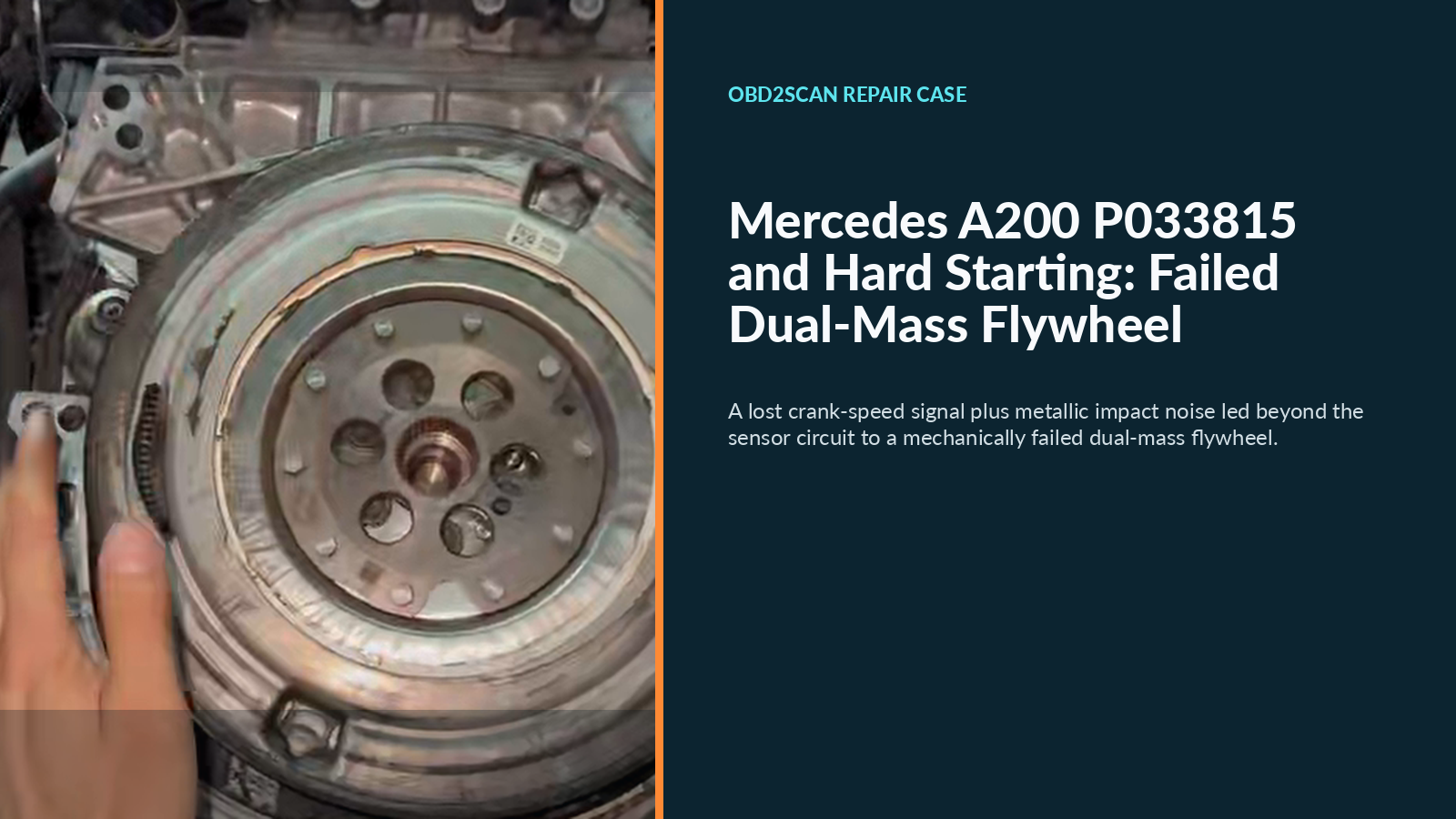
This 2021 Mercedes-Benz A200 (W177/M282) had covered 49,000 km when it developed difficult hot and cold starts, severe idle shaking, and a metallic impact noise. The engine controller stored P033815 for the crankshaft-position sensor 1 circuit, but the noise and missing stable crank-speed signal kept the diagnosis from ending at the sensor. Transmission removal exposed a mechanically broken dual-mass flywheel that had disturbed and damaged the signal area; replacing the flywheel and sensor, cleaning debris, clearing faults, and adapting the clutch restored stable starting signal and idle.
Case at a glance
| Element | This vehicle |
|---|---|
| Vehicle | 2021 Mercedes-Benz A200, W177 chassis, M282 engine, 49,000 km |
| Complaint | Hard starting hot or cold, severe idle shake, metallic impact noise |
| Initial evidence | P033815 and unstable crankshaft-speed signal during starting |
| Confirmed fault | Internally failed dual-mass flywheel with abnormal target/sensor contact |
| Repair | Flywheel and damaged crankshaft-position sensor replaced; debris cleaned |
| Verification | Repeated starts produced stable crank signal and normal reported idle balance |
Why P033815 was a clue rather than the conclusion
P033815 was described as a short-to-positive or open-circuit record for crankshaft-position sensor 1. During starting, the diagnostic system could not capture a stable crankshaft-speed signal. Either observation could support checking the sensor circuit, its supply, connector, wiring, sensor, or target.
The mechanical sound changed the decision. A sensor circuit problem does not normally explain a strong metallic impact occurring with severe shaking. Treating the code and sound as one evidence set raised a different possibility: the sensor might be reporting, or even suffering from, abnormal mechanical movement in the signal-producing assembly.
The source does not publish freeze-frame data, status bytes, voltage checks, continuity results, or a waveform. It therefore does not prove that every electrical possibility was eliminated before teardown. What it does document is the combination that led the workshop to inspect mechanical synchronization rather than simply fitting a sensor.
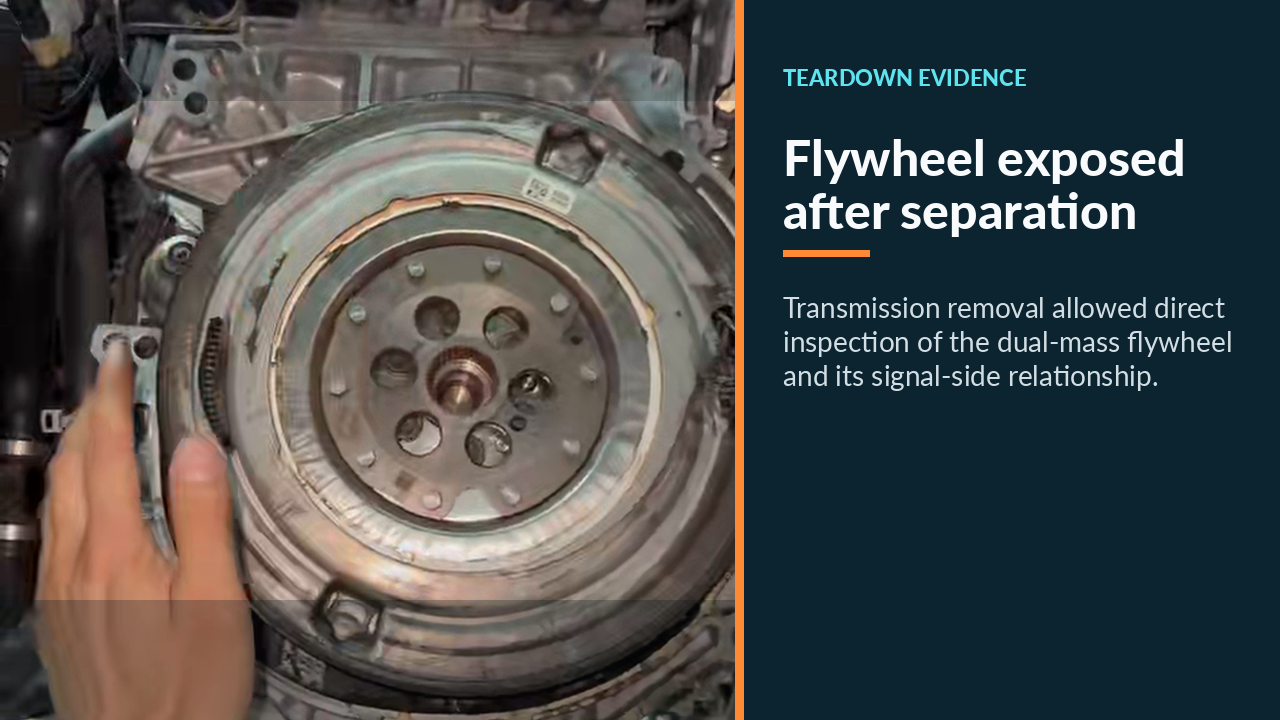
Transmission removal revealed the failed mechanism
Separating the transmission from the engine exposed the dual-mass flywheel. The internal damping structure had physically broken apart, and the flywheel showed excessive free movement. The source reports that this abnormal movement caused contact between the signal target area and the crankshaft-position sensor.
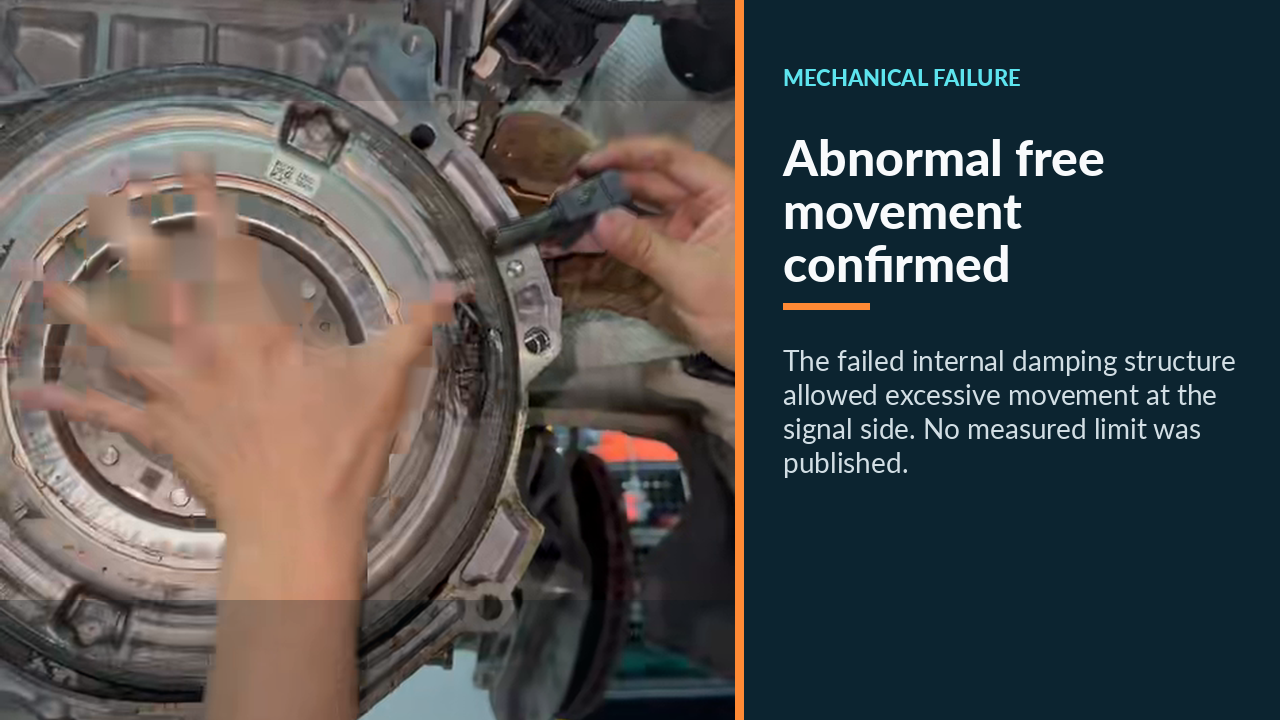
This finding connected both sides of the case. The broken flywheel explained the metallic noise and shaking, while abnormal target movement and physical contact explained why the crankshaft signal path was affected. That chain is more specific than saying P033815 “means flywheel,” which it does not.
No measured free-play value or allowable limit is published. The visual movement and teardown finding support this vehicle’s diagnosis, but specifications for another flywheel must come from exact service information.
Repair covered the mechanical and signal damage
The workshop replaced the failed dual-mass flywheel with an original-specification unit and restored its positioning. It also replaced the crankshaft-position sensor that had been physically damaged and cleaned metal debris from the signal opening.
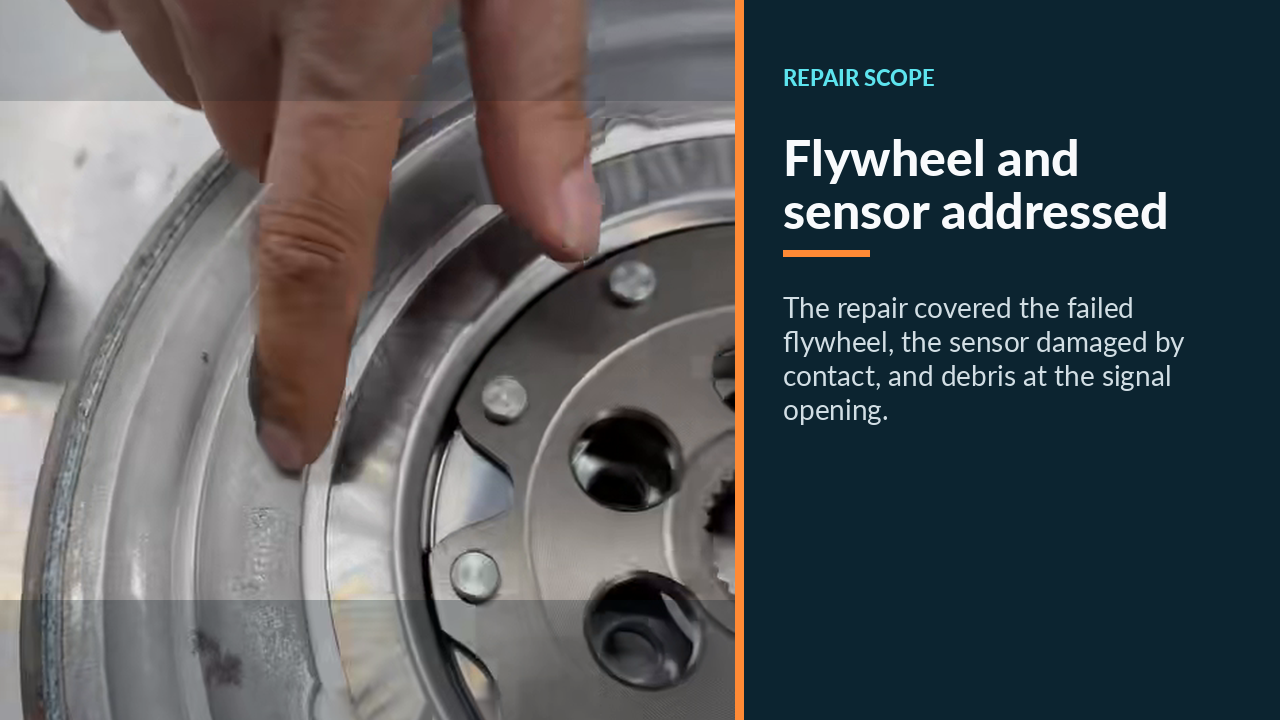
These were two linked repair items, not two independent guesses. Replacing only the sensor would have left the mechanically unstable flywheel in place. Replacing only the flywheel while ignoring physical sensor damage and debris would have left the signal path incompletely restored.
Transmission separation and flywheel replacement are specialist work. The source does not provide fastener torque, positioning tolerance, clutch handling, sensor clearance, or part-number compatibility. Those details should not be reconstructed from a short video.
Adaptation and repeated starts closed the first check
After reassembly, the workshop cleared chain-reaction DTCs and performed the transmission clutch engagement-point adaptation. Those restoration actions followed the mechanical repair; they were not evidence used to condemn the flywheel.
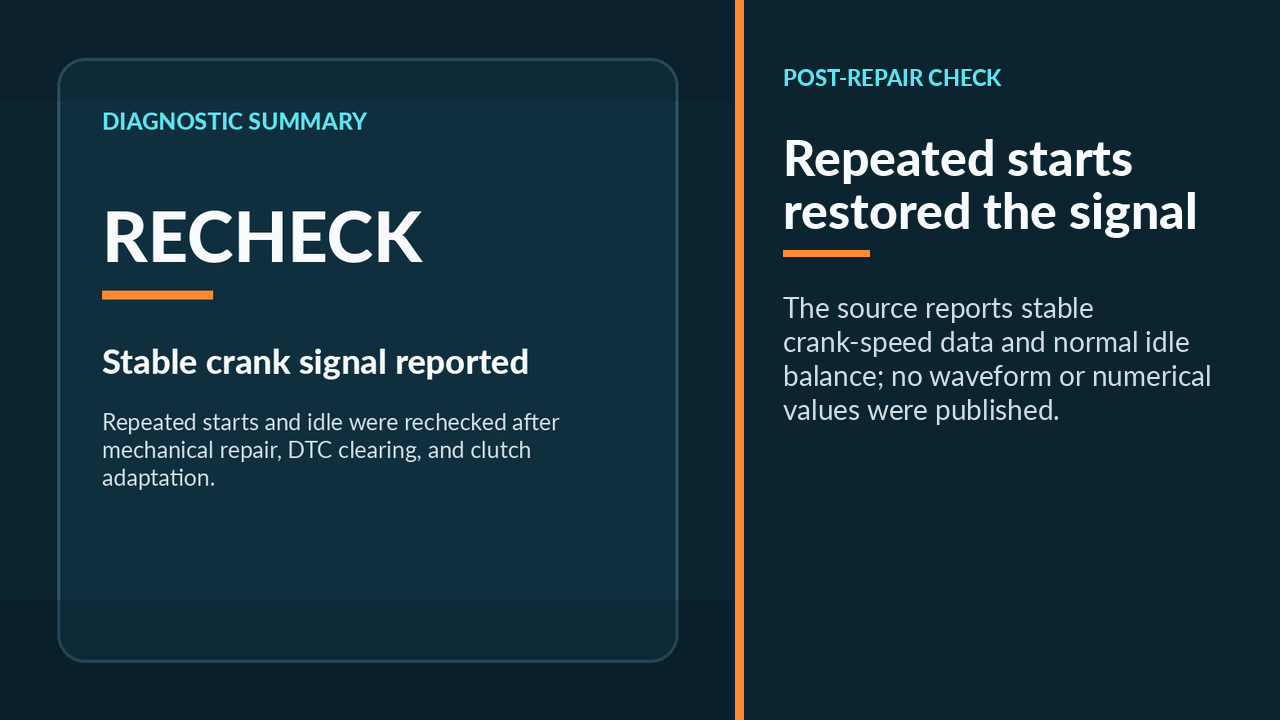
The source reports that repeated start-stop operation produced a stable crankshaft signal and that idle balance returned to the normal range. This returns directly to the two measurable consequences of the original failure: unreliable starting signal and unstable idle. A waveform image, numerical idle values, road-test distance, and later follow-up are not published, so the supported result is a successful first repeated-start and idle recheck.
What transfers to another P033815 case
Start with the exact code status and circuit checks, but keep other symptoms in the diagnosis. If P033815 appears without mechanical noise, the appropriate path may remain electrical. If hard starting and signal loss occur with impact noise or abnormal drivetrain movement, a qualified inspection of the signal target and connected mechanical assembly becomes relevant.
This A200’s answer was a broken dual-mass flywheel that damaged the crankshaft signal area. Another vehicle may have a sensor, connector, harness, power, ground, target, controller, or unrelated starting fault. The transferable lesson is to make the code explain the whole symptom set—or continue testing until the mechanical and electrical evidence agree.


Comments 0
Questions, fixes, and real-world diagnostic notes from readers.
Be the first to share a diagnostic result or ask a follow-up question.