
2016 VW Passat Idle Surged Intermittently: A Sticking VVT Adjuster Needed a Cold Recheck

Idle Surges Sometimes? Preserve The Cold Failure
The Passat’s idle surge had an inconvenient habit: it was gone when testing began. The first smoke and purge checks were useful even though they found nothing, because they prevented an intake leak from being carried forward as an assumption. The case only moved when the fault returned under its own temperature and time conditions.
A low-pressure smoke machine is useful when the opening question is whether unmetered air or a leaking purge path can explain the surge. The AUTOOL SDT106 can serve that bounded check when connected by the vehicle procedure. SDT106 can support a low-pressure smoke check of an identified intake or vacuum path using the vehicle procedure. It cannot test VVT pin movement, judge cam timing or turn a no-smoke result into proof that the engine has no air-management fault.
After the idle fluctuation returned, a controlled tap at the VVT adjuster changed the behavior, pointing to a sticking internal locking mechanism. Replacement, followed by cold-start, warm-idle and drive checks, removed the recurrence. The negative smoke test remained part of the proof, not a failed detour.
Quick answer: A negative first smoke test did not close the case; when the surge returned, a controlled VVT-adjuster response led to replacement and repeated verification.
In this guide
- An intermittent surge must be present to be diagnosed
- Record temperature and time since start
- Clear purge and intake leaks without overclaiming
- Wait for the idle to move again
- Use the VVT adjuster response as an A/B clue
- Replace the confirmed sticking adjuster
- Repeat cold start and warm idle
- Keep the case closed only if the delay no longer matters
An intermittent surge must be present to be diagnosed
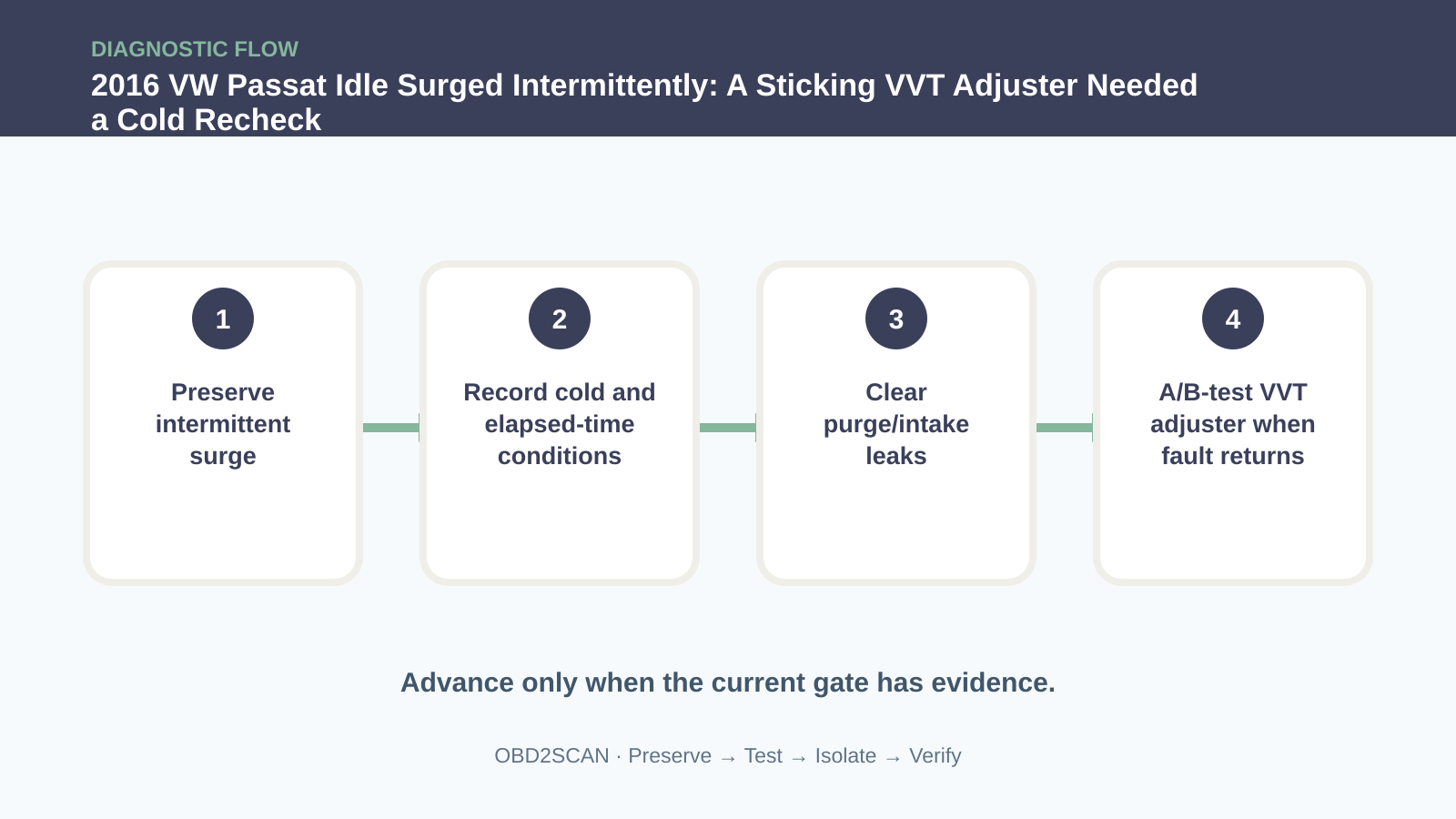
An intermittent complaint needs a reproduction contract. Ask whether the engine was cold, how many minutes it had run, whether the fuel tank was just filled, what electrical loads were on and how long the surge lasted. Record rpm rather than relying only on “rough.” Do not clear adaptations or warm the car repeatedly before the first observation. Each action can erase the state. If the vehicle is stable, that is not permission to replace a purge valve, throttle body or cam adjuster by reputation. It is a reason to preserve conditions and wait.
Record temperature and time since start
Build a simple timeline from overnight soak through warm idle. Capture coolant temperature, intake temperature, desired and actual idle, purge command, short-term fuel trim and desired/actual cam position if supported. A fault that begins only after oil pressure changes or a locking pin is expected to release has a different timing signature from an immediate vacuum leak. The Passat case required delayed recurrence, so elapsed time was a diagnostic channel. A cold vehicle delivered later in the day may no longer be the same test object.
Clear purge and intake leaks without overclaiming
Purge flow and unmetered air were sensible first branches. Inspect obvious hoses, isolate the purge path according to Volkswagen information, and smoke-test only at safe low pressure with the system configured correctly. Watch for smoke at boots, manifold joints and PCV connections. A no-smoke result is bounded: it means this test did not reveal a leak under these conditions. It does not prove every diaphragm, dynamic valve or cam event is healthy. Keep the negative result because it frees attention for what changes when the surge is actually present.
Wait for the idle to move again
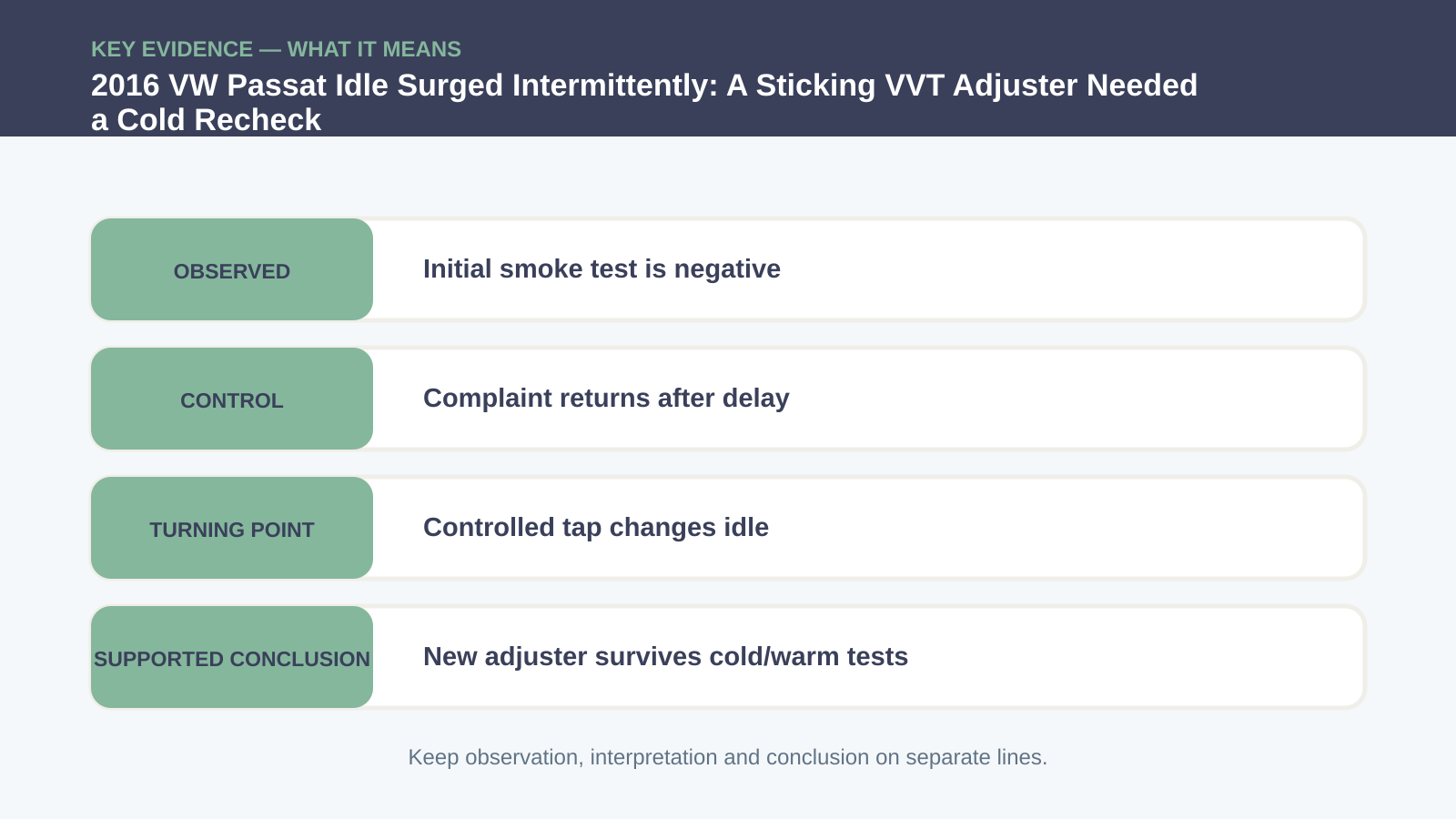
When the idle began fluctuating, record data before touching anything. Compare desired and actual cam position and listen for a change in the timing area. The mature case used a controlled tap at the VVT adjuster; the idle behavior changed, suggesting a sticking internal pin. This is an A/B clue, not a universal hammer test. Contact only the safe, documented location with the engine protected from tools, clothing and moving parts. If the reaction cannot be repeated, do not let one coincidence order a component.
| Moment | Observation | Diagnostic value |
|---|---|---|
| Initial warm inspection | Idle is stable | Complaint is not currently available |
| Purge/intake smoke check | No leak is revealed | Major static air leak moves down the list |
| Fault returns cold/delayed | Idle and cam behavior fluctuate | VVT branch becomes testable |
| Controlled adjuster tap | Behavior changes immediately | Sticking mechanism gains causal support |
Use the VVT adjuster response as an A/B clue
The reaction fit a VVT adjuster that was not consistently locking or moving as intended. Before replacement, verify oil level, grade, pressure concerns and control-solenoid wiring because an adjuster depends on clean oil and a valid command. Check relevant faults and adaptation data. A tap cannot separate worn internal parts from contamination or incorrect oil. The repair decision becomes credible when the physical response, cam data, recurrence timing and cleared air-leak branch all point in the same direction.
Replace the confirmed sticking adjuster
Follow Volkswagen timing and locking procedures during adjuster replacement. Protect the engine from losing mechanical time, use required one-time fasteners and confirm chain or belt condition while access is open. Do not rotate components independently where valve contact is possible. After assembly, set oil level and perform adaptations or basic settings specified for the engine. The goal is to restore designed movement and locking, not merely silence an idle event for one warm start.
Repeat cold start and warm idle
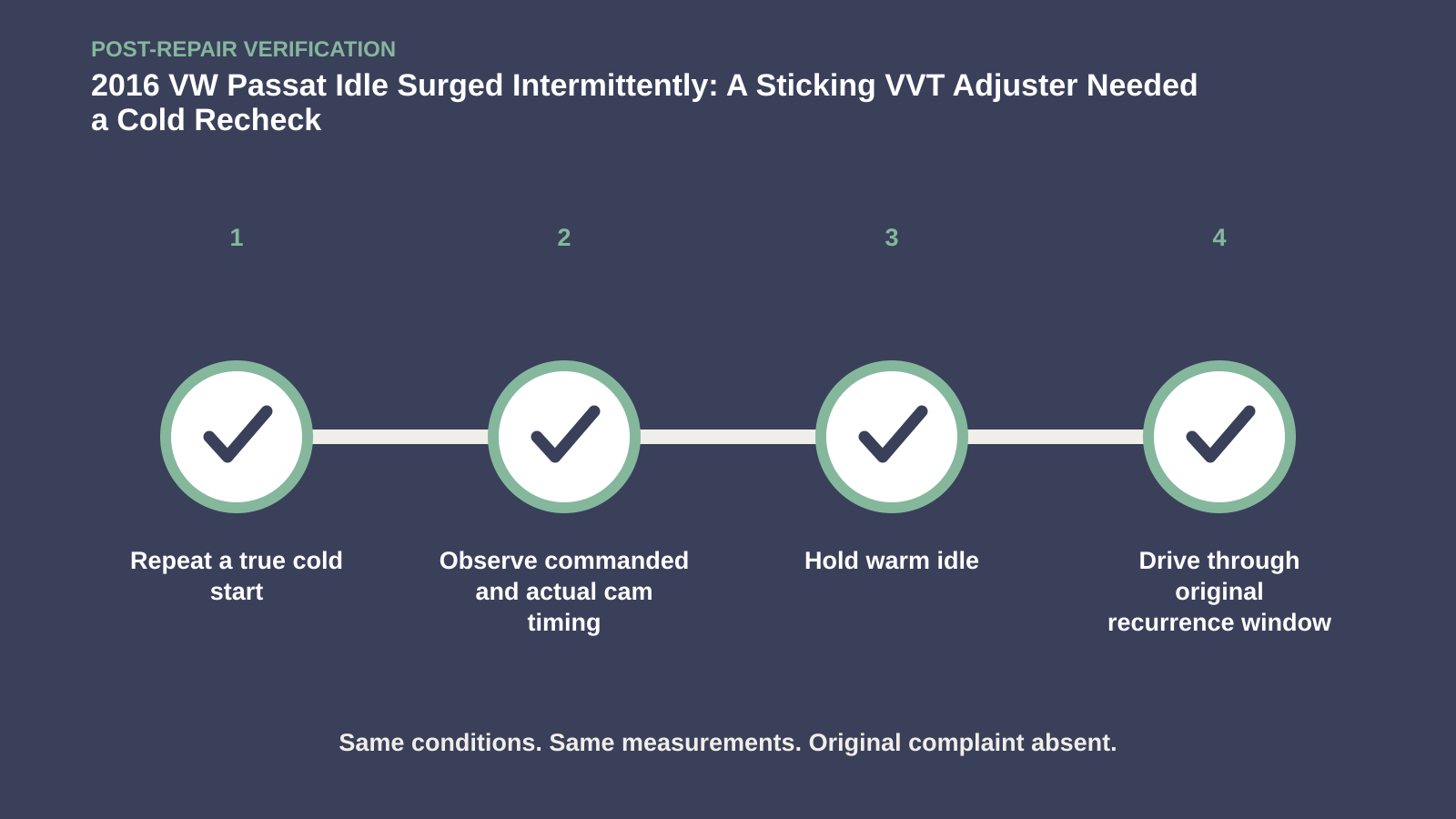
The first verification is another true cold start. Watch the same variables from start through the original recurrence time, then hold a fully warm idle with loads on and off. Compare desired and actual cam position and confirm fuel trim remains reasonable. A clean smoke test after reassembly checks that the repair did not create a hose or seal leak. Clear saved faults, cycle the ignition and rescan. One smooth minute after repair is weaker than the delayed failure the vehicle originally required.
Keep the case closed only if the delay no longer matters
Finish with the customer’s drive pattern and enough time for the old fluctuation to appear. Record ambient temperature and soak duration so a future recurrence can be compared honestly. If the symptom returns, preserve it and reopen the evidence rather than assuming the new part is bad. In the documented case, repeated cold and driving checks stayed stable after the adjuster was replaced. That multi-condition close is what turns the tactile clue into a repair, rather than a lucky moment in the bay.
The case advanced because the shop waited for the engine to tell the same story twice. Negative leak testing narrowed it; recurrence and an immediate adjuster response gave it direction.










Comments 0
Questions, fixes, and real-world diagnostic notes from readers.
Be the first to share a diagnostic result or ask a follow-up question.