
2000 Toyota Tundra Shuddered at Low Speed After Brake Work: All Four ABS Signals Were Dirty

False Abs After Brake Work? Compare All Four
Quick answer: This was not trapped air or one new bad sensor. All four wheel-speed signals were erratic, and accumulated debris at the sensors and tone rings distorted the low-speed information; careful cleaning followed by the same stop test restored normal ABS behavior. This article follows one documented vehicle. It explains the evidence chain, not a universal failure rate or a direction to replace the same part on every similar car. Stop whenever the test would involve overheated brakes, high current, moving parts, refrigerant handling or an uncontrolled road condition.
Where the tone ring cannot be seen directly, a steerable inspection camera can document accessible tooth condition, debris and sensor-area damage before removal; AUTOOL SVB308 Articulating Borescope can support that visual step with the truck safely lifted. It cannot measure wheel-speed signal quality, prove air gap, support the vehicle, or replace live-data comparison and electrical testing.
The Tundra’s ABS complaint started after brake work and appeared near walking speed. Four wheel signals had to be compared as a set before dirt at every sensor and tone ring could explain the false intervention.
Quick answer: This was not trapped air or one new bad sensor. All four wheel-speed signals were erratic, and accumulated debris at the sensors and tone rings distorted the low-speed information; careful cleaning followed by the same stop test restored normal ABS behavior.
In this guide
Describe the exact low-speed shudder
Unwanted ABS operation is a brake-safety complaint. Reproduce it on a controlled low-speed route with a second qualified person watching data; do not focus on the scan tool while driving. Note speed, steering angle, pedal feel and whether the warning lamp appears before or after the shudder. Preserve the original condition before changing it. The first observation is the control sample against which every later test must be compared.
Clear tire circumference first
Confirm all tires match in size, pressure and meaningful tread circumference. A wheel that decelerates at a different calculated rate can look like slip even when the road is dry. In this Tundra those basics matched, so tire variation was not the useful explanation. Use service information for the exact engine, build date and options. A correct method on the wrong terminal can create a precise but useless result.
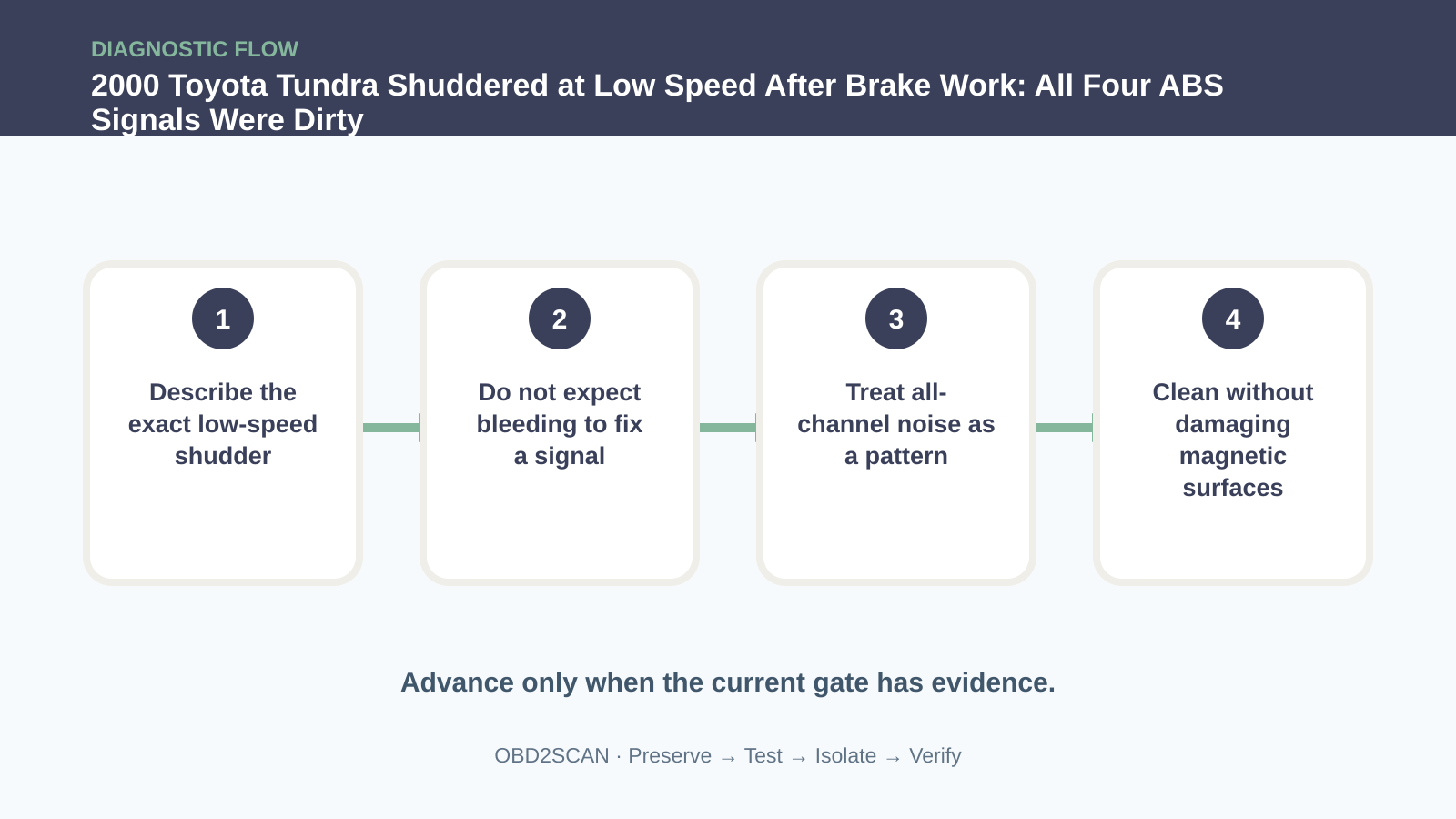
Do not expect bleeding to fix a signal
Bleeding the hydraulic system did not change the symptom. A low or spongy pedal can require base-brake work, but air does not create an erratic electrical speed signal. Keep hydraulic feel and electronic intervention as parallel checks rather than assuming one service fixes both. Treat prior work as evidence, not blame. A repair that made no change can narrow the case when its installation and test conditions are verified.
Graph four wheel speeds together
Graph all four wheel-speed PIDs on the same time scale during the low-speed event. One dropout usually points to one corner; all four noisy or implausible channels suggest a shared condition, setup issue or widespread contamination. The documented drive showed erratic signals at every wheel. At this stage, separate what was observed from what is inferred. The observation should remain true even if the current theory is later rejected.
| Observation | What it supports | What it does not prove |
|---|---|---|
| ABS shudders at low speed | Wheel-speed plausibility matters | Hydraulic air is the cause |
| All tires match | Circumference branch is lower | Every sensor is good |
| All four speed signals are erratic | Common/widespread condition deserves priority | All four sensors need replacement |
| Cleaning restores normal stops | Contamination was causal here | Cleaning fixes every ABS fault |
Treat all-channel noise as a pattern
Remove sensors only by the Toyota procedure and support the truck correctly. Inspect tips, mounting faces, air gaps, wiring and tone-ring teeth. Dirt at the mounting surface can change gap, while metallic debris on a magnetic sensor can distort low-amplitude signals most noticeably near a stop. This is the decision point in the documented case. Its value comes from changing one bounded condition while leaving the rest of the system intact.
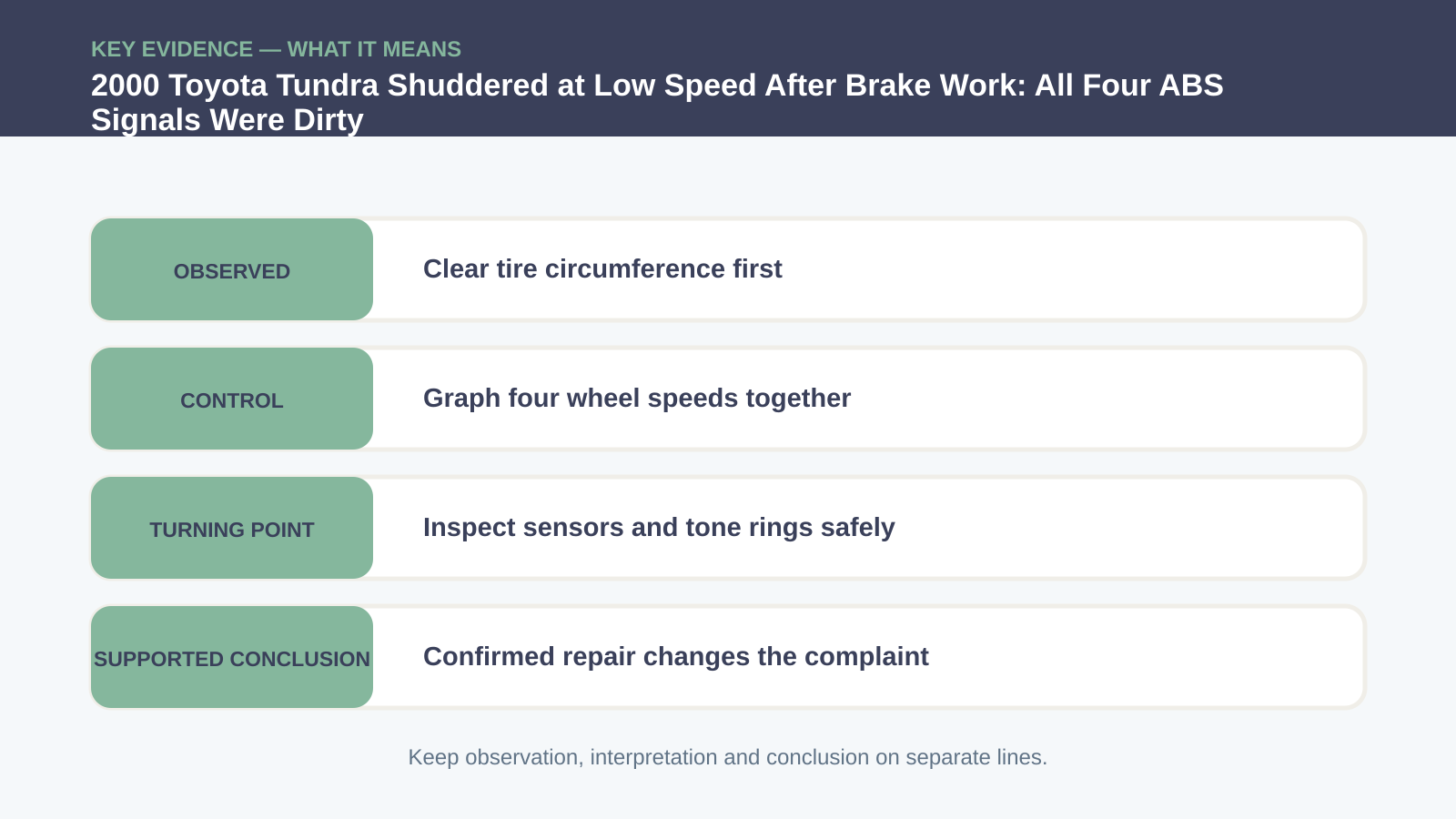
Inspect sensors and tone rings safely
Clean components with methods safe for the sensor and tone-ring material. Do not pry against teeth, sand a magnetic encoder or blast debris into a bearing seal. Replace a part only if physical or electrical testing proves damage that cleaning cannot correct. A confirmed component still needs a repair that restores sealing, support, torque, routing or terminal fit—the physical conditions that keep the fault from returning.
Clean without damaging magnetic surfaces
After reassembly, verify the harness is clipped away from moving parts and the sensor seats fully. Clear relevant codes, then repeat the same speed-bump and stop conditions while all four signals are graphed. The traces should decay together without a false low-speed divergence. Reassemble protective covers and retainers before declaring success. A diagnostic shortcut must not become the next failure mechanism.
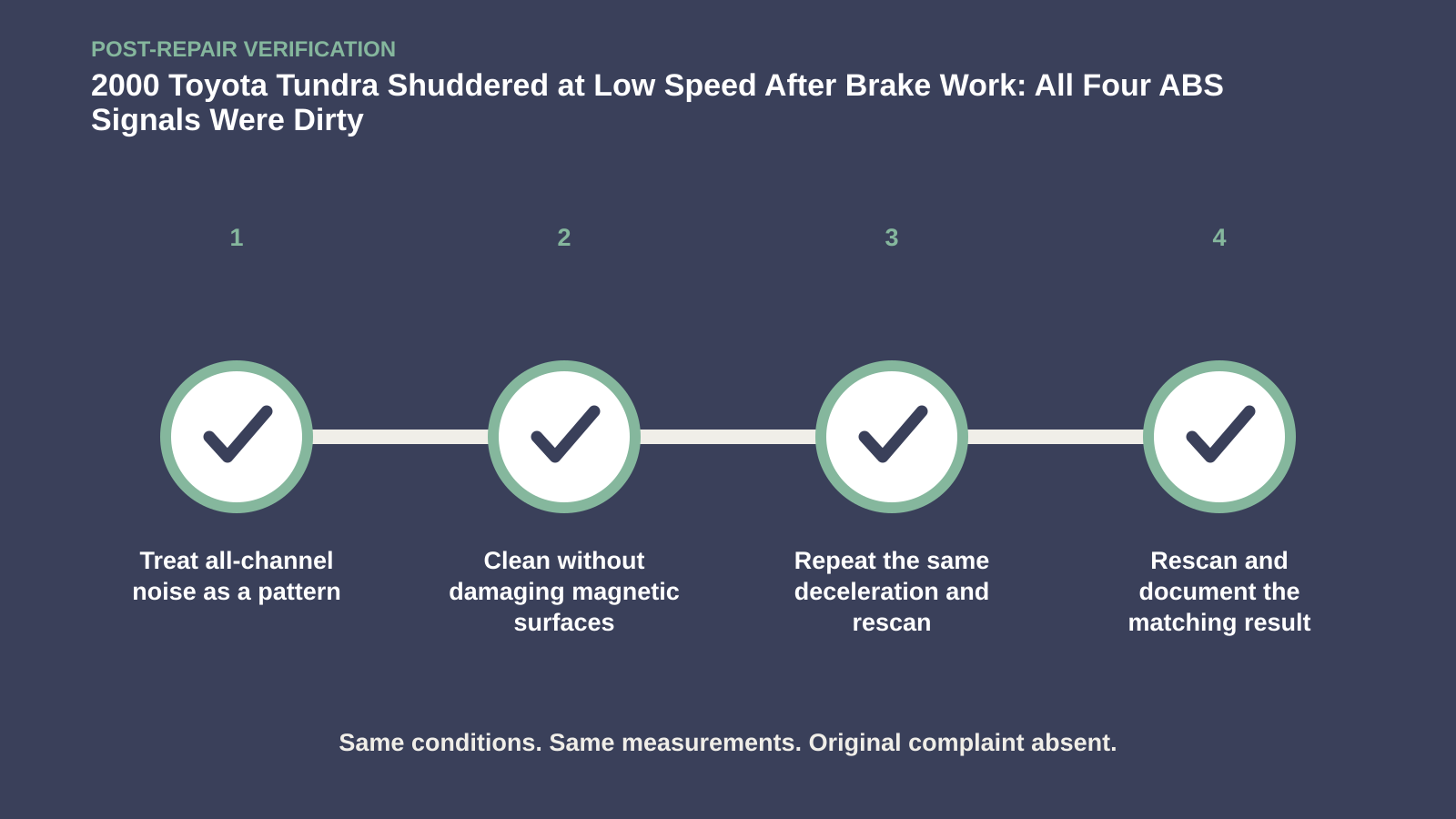
Repeat the same deceleration and rescan
Finish with a base-brake inspection and a controlled stop confirming normal pedal feel and ABS operation. The lesson is not ‘clean every sensor’ for every shudder; it is that a four-corner data pattern should guide a four-corner physical inspection before more parts are ordered. Use the customer’s original complaint as the final specification. A cleared code, quiet bay or one good key cycle is not equivalent to reproducing and passing that condition.
If you are bringing a similar symptom to a shop, arrive with the useful conditions rather than a requested part: whether the vehicle was cold or hot, the exact speed or switch position, which warning lamps appeared, what changed after a restart, and a chronological list of earlier repairs. A short video can preserve an intermittent sound or lamp pattern, but record it only while parked or with a passenger handling the camera. Ask the technician to retain the pre-repair scan and measurements, explain the test that separated the failed path from the alternatives, and show how the original complaint was repeated afterward.
For the owner or service adviser, a useful repair explanation has three parts: what was observed, why the decisive test narrowed the fault, and which original condition passed after the repair. It should also say what the test did not prove. That boundary prevents a memorable case from becoming an automatic parts recommendation.
This was not trapped air or one new bad sensor. All four wheel-speed signals were erratic, and accumulated debris at the sensors and tone rings distorted the low-speed information; careful cleaning followed by the same stop test restored normal ABS behavior. The reusable lesson is narrower and more valuable: Turn the case into a four-channel comparison: the phrase ‘all four’ changes the diagnosis from isolated sensor failure to a common maintenance condition.




Comments 0
Questions, fixes, and real-world diagnostic notes from readers.
Be the first to share a diagnostic result or ask a follow-up question.